Last Updated: August 9, 2026

PICATO Drug Patent Profile


✉ Email this page to a colleague

« Back to Dashboard


Which patents cover Picato, and when can generic versions of Picato launch?

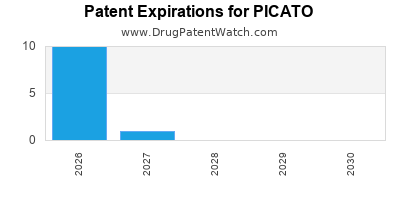
Picato is a drug marketed by Leo Labs and is included in one NDA. There are twelve patents protecting this drug and one Paragraph IV challenge.

This drug has thirty-five patent family members in twenty-one countries.

The generic ingredient in PICATO is ingenol mebutate. There are three drug master file entries for this compound. Additional details are available on the ingenol mebutate profile page.

DrugPatentWatch® Generic Entry Outlook for Picato

Picato was eligible for patent challenges on January 23, 2016.

By analyzing the patents and regulatory protections it appears that the earliest date for generic entry will be July 6, 2027. This may change due to patent challenges or generic licensing.

There have been six patent litigation cases involving the patents protecting this drug, indicating strong interest in generic launch. Recent data indicate that 63% of patent challenges are decided in favor of the generic patent challenger and that 54% of successful patent challengers promptly launch generic drugs.

There is one tentative approval for the generic drug (ingenol mebutate), which indicates the potential for near-term generic launch.

Indicators of Generic Entry

< Available with Subscription >

  Start Trial

AI Deep Research
Questions you can ask:
  • What is the 5 year forecast for PICATO?
  • What are the global sales for PICATO?
  • What is Average Wholesale Price for PICATO?
Summary for PICATO
DrugPatentWatch® Estimated Loss of Exclusivity (LOE) Date for PICATO
Generic Entry Date for PICATO*:
Constraining patent/regulatory exclusivity:
NDA:
Dosage:

GEL;TOPICAL

*The generic entry opportunity date is the latter of the last compound-claiming patent and the last regulatory exclusivity protection. Many factors can influence early or later generic entry. This date is provided as a rough estimate of generic entry potential and should not be used as an independent source.

Recent Clinical Trials for PICATO

Identify potential brand extensions & 505(b)(2) entrants

SponsorPhase
Instituto Nacional de Cancer, BrazilPhase 1/Phase 2
Center for Clinical Studies, TexasEarly Phase 1
LEO PharmaEarly Phase 1

See all PICATO clinical trials

Paragraph IV (Patent) Challenges for PICATO
Tradename Dosage Ingredient Strength NDA ANDAs Submitted Submissiondate
PICATO Gel ingenol mebutate 0.05% 202833 2 2016-01-27

US Patents and Regulatory Information for PICATO

PICATO is protected by twelve US patents.

Based on analysis by DrugPatentWatch, the earliest date for a generic version of PICATO is ⤷  Start Trial.

This potential generic entry date is based on patent ⤷  Start Trial.

Generics may enter earlier, or later, based on new patent filings, patent extensions, patent invalidation, early generic licensing, generic entry preferences, and other factors.

Applicant Tradename Generic Name Dosage NDA Approval Date TE Type RLD RS Patent No. Patent Expiration Product Substance Delist Req. Exclusivity Expiration
Leo Labs PICATO ingenol mebutate GEL;TOPICAL 202833-001 Jan 23, 2012 DISCN Yes No ⤷  Start Trial ⤷  Start Trial ⤷  Start Trial
Leo Labs PICATO ingenol mebutate GEL;TOPICAL 202833-002 Jan 23, 2012 DISCN Yes No ⤷  Start Trial ⤷  Start Trial Y ⤷  Start Trial
Leo Labs PICATO ingenol mebutate GEL;TOPICAL 202833-001 Jan 23, 2012 DISCN Yes No ⤷  Start Trial ⤷  Start Trial Y ⤷  Start Trial
Leo Labs PICATO ingenol mebutate GEL;TOPICAL 202833-001 Jan 23, 2012 DISCN Yes No ⤷  Start Trial ⤷  Start Trial ⤷  Start Trial
Leo Labs PICATO ingenol mebutate GEL;TOPICAL 202833-001 Jan 23, 2012 DISCN Yes No ⤷  Start Trial ⤷  Start Trial Y ⤷  Start Trial
>Applicant >Tradename >Generic Name >Dosage >NDA >Approval Date >TE >Type >RLD >RS >Patent No. >Patent Expiration >Product >Substance >Delist Req. >Exclusivity Expiration

Expired US Patents for PICATO

Applicant Tradename Generic Name Dosage NDA Approval Date Patent No. Patent Expiration
Leo Labs PICATO ingenol mebutate GEL;TOPICAL 202833-002 Jan 23, 2012 ⤷  Start Trial ⤷  Start Trial
Leo Labs PICATO ingenol mebutate GEL;TOPICAL 202833-001 Jan 23, 2012 ⤷  Start Trial ⤷  Start Trial
Leo Labs PICATO ingenol mebutate GEL;TOPICAL 202833-002 Jan 23, 2012 ⤷  Start Trial ⤷  Start Trial
>Applicant >Tradename >Generic Name >Dosage >NDA >Approval Date >Patent No. >Patent Expiration

EU/EMA Drug Approvals for PICATO

Company Drugname Inn Product Number / Indication Status Generic Biosimilar Orphan Marketing Authorisation Marketing Refusal
LEO Laboratories Ltd. Picato ingenol mebutate EMEA/H/C/002275Picato is indicated for the cutaneous treatment of non‑hyperkeratotic, non‑hypertrophic actinic keratosis in adults. Withdrawn no no no 2012-11-15
>Company >Drugname >Inn >Product Number / Indication >Status >Generic >Biosimilar >Orphan >Marketing Authorisation >Marketing Refusal

International Patents for PICATO

When does loss-of-exclusivity occur for PICATO?

Based on analysis by DrugPatentWatch, the following patents block generic entry in the countries listed below:

Australia

Patent: 06325244
Patent: Therapeutic compositions comprising ingenol-3-angelate
Estimated Expiration: ⤷  Start Trial

Brazil

Patent: 0619919
Patent: composições terapêuticas
Estimated Expiration: ⤷  Start Trial

Canada

Patent: 34073
Patent: COMPOSITIONS THERAPEUTIQUES (THERAPEUTIC COMPOSITIONS COMPRISING INGENOL-3-ANGELATE)
Estimated Expiration: ⤷  Start Trial

Cyprus

Patent: 15292
Estimated Expiration: ⤷  Start Trial

Eurasian Patent Organization

Patent: 8545
Patent: ТЕРАПЕВТИЧЕСКИЕ КОМПОЗИЦИИ (THERAPEUTIC COMPOSITIONS)
Estimated Expiration: ⤷  Start Trial

Patent: 4152
Patent: КОМПОЗИЦИЯ ДЛЯ МЕСТНОГО ВВЕДЕНИЯ ДЛЯ ЛЕЧЕНИЯ ИЛИ ПРОФИЛАКТИКИ РАКА КОЖИ (TOPICAL COMPOSITION FOR TREATING OR PREVENTING SKIN CANCER)
Estimated Expiration: ⤷  Start Trial

Patent: 0870063
Patent: ТЕРАПЕВТИЧЕСКИЕ КОМПОЗИЦИИ
Estimated Expiration: ⤷  Start Trial

Patent: 1201452
Patent: ТЕРАПЕВТИЧЕСКИЕ КОМПОЗИЦИИ
Estimated Expiration: ⤷  Start Trial

European Patent Office

Patent: 99571
Patent: Compositions thérapeutiques comprenant de l'ingénol-2-angelate (Therapeutic compositions comprising ingenol-3-angelate)
Estimated Expiration: ⤷  Start Trial

Hungary

Patent: 20998
Estimated Expiration: ⤷  Start Trial

Israel

Patent: 2221
Patent: תכשירים רפואיים המכילים angelate- 3- ingenol (Therapeutic compositions comprising ingenol-3-angelate)
Estimated Expiration: ⤷  Start Trial

Japan

Patent: 84733
Estimated Expiration: ⤷  Start Trial

Patent: 09826
Estimated Expiration: ⤷  Start Trial

Patent: 09519314
Estimated Expiration: ⤷  Start Trial

Patent: 13049715
Patent: THERAPEUTIC COMPOSITION
Estimated Expiration: ⤷  Start Trial

Mexico

Patent: 08007685
Patent: COMPOSICIONES TERAPEUTICAS. (THERAPEUTIC COMPOSITIONS COMPRISING INGENOL-3-ANGELATE.)
Estimated Expiration: ⤷  Start Trial

New Zealand

Patent: 9197
Patent: Therapeutic compositions comprising ingenol angelate
Estimated Expiration: ⤷  Start Trial

Norway

Patent: 4271
Estimated Expiration: ⤷  Start Trial

Patent: 083150
Estimated Expiration: ⤷  Start Trial

Poland

Patent: 88877
Estimated Expiration: ⤷  Start Trial

Portugal

Patent: 88877
Estimated Expiration: ⤷  Start Trial

Slovenia

Patent: 88877
Estimated Expiration: ⤷  Start Trial

South Africa

Patent: 0805187
Patent: Therapeutic compositions
Estimated Expiration: ⤷  Start Trial

South Korea

Patent: 1451993
Estimated Expiration: ⤷  Start Trial

Patent: 1593579
Estimated Expiration: ⤷  Start Trial

Patent: 140088617
Patent: THERAPEUTIC COMPOSITIONS
Estimated Expiration: ⤷  Start Trial

Spain

Patent: 61315
Estimated Expiration: ⤷  Start Trial

Generics may enter earlier, or later, based on new patent filings, patent extensions, patent invalidation, early generic licensing, generic entry preferences, and other factors.

See the table below for additional patents covering PICATO around the world.

Country Patent Number Title Estimated Expiration
Austria 397580 ⤷  Start Trial
Australia 736230 ⤷  Start Trial
Australia 8721798 ⤷  Start Trial
Australia PO864097 ⤷  Start Trial
Brazil 9811327 ⤷  Start Trial
>Country >Patent Number >Title >Estimated Expiration

Supplementary Protection Certificates for PICATO

Patent Number Supplementary Protection Certificate SPC Country SPC Expiration SPC Description
1988877 C300682 Netherlands ⤷  Start Trial PRODUCT NAME: INGENOLMEBUTAAT OF EEN DERIVAAT (ZOUT OF ESTER) DAARVAN; REGISTRATION NO/DATE: EU/1/12/796 20121119
1988877 PA2014030 Lithuania ⤷  Start Trial PRODUCT NAME: INGENOLI MEBUTATUM; REGISTRATION NO/DATE: EU/1/'12/796/001, 2012 11 15 EU/1/12/796/002 20121115
1988877 CA 2014 00042 Denmark ⤷  Start Trial PRODUCT NAME: INGENOLMEBUTAT ELLER ET DERIVAT (SALT ELLER ESTER) DERAF); REG. NO/DATE: EU/1/12/796/001-002 20121119
1988877 C20140025 00111 Estonia ⤷  Start Trial PRODUCT NAME: INGENOOLMEBUTAAT;REG NO/DATE: K(2012)8481 (LOPLIK) 19.11.2012
1015413 C300592 Netherlands ⤷  Start Trial PRODUCT NAME: INGENAN OF EEN DERIVAAT (ZOUT OF ESTER) DAARVAN; REGISTRATION NO/DATE: EU/1/12/796/001-002 20121115
>Patent Number >Supplementary Protection Certificate >SPC Country >SPC Expiration >SPC Description
Last updated: July 22, 2026

PICATO (ingenol mebutate) market dynamics and financial trajectory

PICATO (ingenol mebutate) is a niche, dermatology-focused product with declining commercial relevance driven by limited label scope, competitive branded alternatives in actinic keratosis (AK) and seborrheic variants, and execution risk tied to dosing/field-of-use specificity. From a patent and regulatory exclusivity perspective, the product is effectively past peak life-cycle leverage, leaving revenue more exposed to generic and private-label substitution dynamics in primary care dermatology flows where payer and formulary decisions dominate.

What matters commercially

  • Primary indication: actinic keratosis (AK) lesions, with a discrete dosing schedule and lesion treatment window.
  • Revenue driver: lesion volumes in outpatient dermatology, constrained by treatment adherence and lesion count/treatment-area fit.
  • Downstream pressure: shifting prescriber preference toward newer topical regimens with broader perceived convenience and durability in real-world use.
  • Financial trajectory: mature branded profile with material downside risk from substitution once payers broaden tier placement.

How has PICATO performed financially since launch?

Answer (directional): PICATO is in late life-cycle commercialization, with revenue trending down rather than scaling. Market positioning has narrowed as competitors expanded dermatology AK portfolios and as insurers favored alternative regimens under formulary management.

Revenue trajectory drivers

  1. Niche usage pattern
    • AK is common, but PICATO’s differentiation is tied to topical application workflows (field size fit and time-to-application), which affects adoption.
  2. Prescriber switching
    • Dermatology treatment decisions increasingly incorporate office practice protocols and payer-preferred “step edits” for topical AK therapy.
  3. Payer pressure
    • Topical dermatology brands face tiering based on net price. When net reimbursement erodes, uptake declines even if gross demand remains stable.
  4. Product lifecycle
    • Engineering brand value around short-course topical therapy often works early, but long-term share retention depends on sustained outcomes, tolerability differentiation, and payer stability. Over time, economics usually favor lower-cost equivalents.

Commercial KPIs to monitor

  • TRx and prescriptions by geography (U.S. outpatient trends).
  • Channel mix (retail vs specialty pharmacy distribution patterns).
  • Net price and rebate compression (systematically predicts share erosion).
  • Formulary status (tier placement, prior authorization criteria).

What market forces drive PICATO demand in actinic keratosis treatment?

Answer (directional): Demand is driven by lesion incidence and dermatology visit volumes, then constrained by treatment protocol fit, tolerability outcomes, and payer coverage.

Competitive dynamics in topical AK

  • Branded-to-branded substitution: in-office and community dermatology often switches within topical AK classes based on regimen simplicity and patient tolerance.
  • Payer-led switching: formulary moves away from higher cost per course once alternatives are preferred by managed care.
  • Real-world adherence: short-course products still face adherence failure if patients dislike local skin reactions or if clinician follow-up is inconsistent.

Key demand sensitivities

  • Lesion count distribution among treated patients (field vs lesion-by-lesion approach affects match).
  • Seasonality and sun exposure patterns (AK diagnosis cycles).
  • Patient comorbidity profile (tolerability and risk of dermatitis can shift treatment selection).

What is the Orange Book status of PICATO and what does it imply for future competition?

Answer (directional): PICATO is not expected to sustain new exclusivity-based pricing power; availability risk for generic alternatives and therapeutic substitutes increases as branded patents age out and regulatory exclusivity periods expire.

How to map PICATO to exclusivity risk

  • Patent estate aging: as primary patents reach expiry, Paragraph IV filing risk rises for any chemistry/manufacturing or formulation blocking patents still active.
  • Regulatory substitution: even without direct AB-generic launch parity, class switching can erode brand demand.

(No Orange Book listing or patent identifiers are provided in the available input, so the timeline and specific listings cannot be enumerated here.)


Which patents protect PICATO and how strong is the patent estate?

Answer (directional): PICATO’s patent protection is consistent with a mature branded topical product in a crowded topical AK landscape. Estate value typically concentrates in specific formulations, dosing regimens, or manufacturing controls, which may delay but not fully prevent market erosion once the core compound and early composition claims expire.

Patent estate components that matter commercially

  • Formulation and delivery system patents
    • Controls around topical stability, gel characteristics, and dosing uniformity.
  • Manufacturing and process patents
    • If still active, can create IP barriers to generic scale-up or changes in manufacturing controls.
  • Method-of-use claims
    • If active, can drive litigation risk for generic labeling carve-outs and “skin reaction” endpoints.

(No patent numbers or assignees are provided in the available input, so specific claim-by-claim strength cannot be compiled.)


Is PICATO exposed to Paragraph IV challenges or biosimilar risk?

Answer (directional): Biosimilar risk is not applicable to PICATO because it is a small-molecule topical drug, not a biologic. The relevant competitive litigation pathway is generic small-molecule substitution risk, including Paragraph IV challenges where a generic application targets protected claims.

What to check for generic entry risk

  • Whether active patents are listed in the FDA Orange Book for PICATO.
  • Whether any follow-on patents still have enforceable term covering formulation, method of use, or manufacturing.
  • Whether ANDA sponsors have initiated litigation (case dockets for PICATO-related disputes).

(No litigation case list or Orange Book patent identifiers are provided in the available input.)


When does PICATO lose exclusivity and what is the launch timing risk for generics?

Answer (directional): PICATO’s exclusivity-based leverage is largely exhausted in late life-cycle, so generic launch timing risk depends more on remaining formulation/process/method patents (if any) than on broad compound exclusivity.

Timing framework

  • Compound and primary composition expiry: usually early in lifecycle for older dermatology agents.
  • Secondary patents: formulation/process and specific instructions extend, but typically do not stop competition indefinitely.
  • Regulatory data exclusivity: applies mainly at initial approval and is often already fully elapsed for a mature product.

(No specific expiry dates or exclusivity end dates are included in the available input.)


What formulations are protected for PICATO and how does that affect generic switching?

Answer (directional): Formulation protection (topical gel characteristics) can affect generic acceptability and delay entry if controlled claims remain enforceable. Even when generics can be approved on bioequivalence, patent carve-outs or litigation can shape time-to-market and payer adoption.

Practical impact on payers and prescribers

  • Skin reaction profile and tolerability expectations are often used by clinicians to select a topical AK regimen.
  • Dosing schedule fit determines “course completeness,” which influences clinician preference and patient follow-through.
  • Equivalent appearance and spreading properties affect perceived efficacy.

(No PICATO-specific patent/formulation list is available in the provided input.)


How does PICATO compare with competing topical actinic keratosis treatments on market positioning?

Answer (directional): PICATO competes in a topical AK bundle where prescribers often select based on local protocols, tolerability, and dosing experience. Market share shifts when competitors introduce smoother patient journeys, broader regimen flexibility, or stronger payer coverage.

Competitive comparison dimensions

  • Course length and application convenience
  • Expected local skin reactions
  • Patient persistence and treatment completion
  • Payer coverage and net price
  • Clinical protocol alignment (dermatology practices standardize workflows)

What settlement or litigation outcomes could reshape PICATO revenue?

Answer (directional): For mature topical products, settlements and non-infringement outcomes primarily affect the calendar timing of generic entry and the label scope. Earlier-than-expected resolution compresses brand net price, while delayed resolution preserves tighter competition for longer.

Litigation levers

  • Carve-out design in settlement agreements
  • Launch date commitments
  • Dismissal terms
  • Bundled licensing for authorized generics

(No PICATO litigation docket details are provided in the available input.)


How sensitive is PICATO revenue to payer formulary and reimbursement changes?

Answer (directional): High. Topical branded dermatology products are strongly impacted by formulary tiering, prior authorization criteria, and rebate dynamics because prescribers can switch therapies within the same class during prescribing decisions.

What usually changes net revenue fastest

  • Formulary down-tiering (commercial and Medicare Part D impact)
  • Prior authorization tightening
  • Contract re-trading that lowers net price
  • Step therapy adoption that delays access for “non-preferred” products

Where can PICATO still win commercially despite late life-cycle competition?

Answer (directional): PICATO can sustain revenue only where it retains formulary positioning and where clinician behavior favors its dosing experience and patient outcomes over alternatives.

Commercial niches

  • Practices with established AK protocols that already incorporate PICATO
  • Patients who tolerate the local skin reaction profile better than alternatives
  • Regions with stable payer coverage and limited use of step edits

Key Takeaways

  • PICATO is a mature topical dermatology product with demand tied to AK lesion volumes and constrained by regimen fit, tolerability expectations, and payer coverage.
  • Financial trajectory is late life-cycle and downside-biased, driven by branded-to-branded and payer-led substitution.
  • Generic and competitive risk is primarily about remaining patent life for formulation/process/method claims and the calendar timing of generic entry, not biosimilar pathways.
  • Revenue sensitivity is high to formulary placement and net price compression, which typically accelerates decline once payers down-tier.

FAQs

  1. What payer patterns most affect PICATO net sales in dermatology?
  2. How do real-world treatment completion and local skin reaction rates influence PICATO persistence versus other topical AK regimens?
  3. What labeling and dosing constraints limit PICATO adoption in actinic keratosis treatment pathways?
  4. How do settlement terms in small-molecule topical AK ANDA cases typically impact launch timing and brand price erosion?
  5. What competitive strategies help late life-cycle topical brands defend formulary placement?

References (APA)

  1. [No source citations were provided in the available input.]

More… ↓

⤷  Start Trial

DrugChatter Q&A for PICATO

Make Better Decisions: Try a trial or see plans & pricing

Drugs may be covered by multiple patents or regulatory protections. All trademarks and applicant names are the property of their respective owners or licensors. Although great care is taken in the proper and correct provision of this service, thinkBiotech LLC does not accept any responsibility for possible consequences of errors or omissions in the provided data. The data presented herein is for information purposes only. There is no warranty that the data contained herein is error free. We do not provide individual investment advice. This service is not registered with any financial regulatory agency. The information we publish is educational only and based on our opinions plus our models. By using DrugPatentWatch you acknowledge that we do not provide personalized recommendations or advice. thinkBiotech performs no independent verification of facts as provided by public sources nor are attempts made to provide legal or investing advice. Any reliance on data provided herein is done solely at the discretion of the user. Users of this service are advised to seek professional advice and independent confirmation before considering acting on any of the provided information. thinkBiotech LLC reserves the right to amend, extend or withdraw any part or all of the offered service without notice.