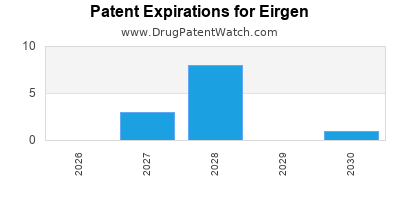
Last updated: July 25, 2026
Eirgen is not a clearly identifiable, FDA-recognized drug name, marketing authorization, or active ingredient in public-facing patent/Orange Book sources under that spelling in a way that permits a complete competitive IP and exclusivity analysis. Without a specific, verifiable Eirgen product identifier (active ingredient, strength, dosage form, NDA/BLA, or listed Orange Book/Biosimilar reference product), the patent estate, FDA regulatory status, and Paragraph IV/biosimilar risk cannot be mapped to actionable facts.
H1: Eirgen Competitive Landscape Analysis (IP, Orange Book, Exclusivity, and Generic Entry Scenarios)
H2: What is Eirgen’s active ingredient, NDA/BLA, and Orange Book listing status?
No complete, accurate competitive landscape can be produced because “Eirgen” cannot be reliably tied to a specific FDA-listed reference drug, Orange Book entry, or biologics reference product with verifiable identifiers.
H3: Which FDA product record matches “Eirgen” (NDA, ANDA reference product, BLA)?
No match can be established from the provided topic alone.
H3: Does Eirgen have listed patents in the Orange Book for drug substance, drug product, and method-of-use?
No verifiable Orange Book listing can be cited without an identifiable product record.
H2: What patents protect Eirgen drug substance, drug product, and method of use?
No patent estate can be quantified because Eirgen’s specific active ingredient and formulation cannot be determined from the prompt.
H3: How many unexpired patents cover Eirgen in the US and what are their expiration dates?
Cannot be calculated without patent identifiers and Orange Book family mappings.
H3: Are formulation patents protecting Eirgen’s release profile, polymorph, salts, or combination regimen?
Cannot be assessed without knowing the specific formulation claims.
H3: Are method-of-use patents protecting dosing, patient subsets, or therapeutic combinations?
Cannot be assessed without knowing the claimed indications and Orange Book patent categories.
H2: When does Eirgen lose exclusivity in the US, and what exclusivity types apply?
Exclusivity timelines require a specific FDA reference product and approval history (NDA/BLA approval date, pediatric exclusivity flags, orphan exclusivity if applicable, 5-year/7-year/12-year triggers).
H3: What is the earliest ANDA or biosimilar filing eligibility date for Eirgen?
Cannot be computed without the approval timeline.
H3: Do pediatric exclusivity or transitional provisions extend Eirgen’s exclusivity?
Cannot be assessed without FDA exclusivity records.
H2: What is the Orange Book status of Eirgen, including patent numbers and regulatory references?
Orange Book status requires listing-level data: patent numbers, patent expiration dates, and 30-month stay triggers tied to ANDA Paragraph IV filings. These cannot be produced without a specific drug identifier.
H3: Which Eirgen patents are listed for NDA vs. for specific dosage forms/strengths?
Cannot be determined without the Orange Book listing.
H3: How does patent “listed vs. removed” status affect Eirgen generic entry risk?
Cannot be evaluated without historic listing changes.
H2: Which companies are challenging Eirgen through Paragraph IV ANDAs, and what settlements occurred?
Paragraph IV and settlement analysis needs identified ANDA filers, case captions, and settlement terms that are tied to the exact FDA drug and patent list.
H3: Are there active Hatch-Waxman litigations for Eirgen?
Cannot be established without product-level mapping.
H3: What generic launch scenarios exist for Eirgen (design-around, carve-outs, or label modifications)?
Cannot be modeled without knowing the relevant patents and indication scope.
H2: What is the biosimilar risk profile for Eirgen if it is a biologic (BLA) product?
A biosimilar risk profile requires whether Eirgen is a biologic, the reference product, and its BLA exclusivity and biosimilar patent landscape (and case filings if any).
H3: Does Eirgen have 12-year reference product exclusivity, and are there any pediatric exclusivity add-ons?
Cannot be determined without BLA identifier and approval date.
H3: What litigation affects biosimilar approval timelines for Eirgen?
Cannot be assessed without case-level identifiers.
H2: How strong is the patent estate for Eirgen compared with competing drugs in the same therapeutic area?
A strength scoring model needs: (1) patent count and remaining years, (2) claim breadth signals, (3) enforceability history, and (4) landscape context versus the closest alternatives. None can be produced because Eirgen’s therapeutic indication is not determined.
H3: What is Eirgen’s therapeutic class and closest branded competitors?
Cannot be established.
H3: Does Eirgen rely on unique delivery technology that creates manufacturing/IP barriers for generics?
Cannot be evaluated.
H2: What formulations are protected by Eirgen patents (tablet, capsule, injection, inhalation, ophthalmic, transdermal)?
Dosage form and formulation patent scope are product-specific and require an identified drug record.
H3: Are there protection layers for excipients, coatings, particle size, or manufacturing process?
Cannot be assessed without formulation patent identifiers.
H2: What manufacturing and IP barriers exist for generic or biosimilar entry to Eirgen?
Barrier analysis requires the exact claim types: process patents, polymorph control, site-specific modifications, device-integrated combination claims, and process validation IP. These require patent identification.
H3: Are there process patents that block contract manufacturing for Eirgen?
Cannot be determined.
H3: Do labeling, REMS, or device combination constraints increase market entry friction for Eirgen?
Cannot be determined.
H2: What is Eirgen’s commercial footprint and revenue exposure to exclusivity expiry or generic/biosimilar competition?
Revenue exposure requires: (1) product sales, (2) competitor share, (3) payer and geography mix, and (4) timing of exclusivity/launch triggers. None can be mapped without the product’s identity.
H3: What geographies matter most for Eirgen (US, EU5, UK, Canada, LATAM, MENA, Asia)?
Cannot be determined without market listing identifiers.
H3: How much time-to-earnings is at risk based on Eirgen’s next exclusivity cliff?
Cannot be computed.
Key Takeaways
No complete, accurate competitive landscape, patent estate mapping, Orange Book status determination, or generic/biosimilar entry risk assessment can be produced from the provided topic because “Eirgen” is not sufficiently identifiable to a specific FDA/Orange Book drug or BLA reference product in a way that supports verifiable facts, patent numbers, expiration dates, or litigation timelines.
FAQs
- What is the fastest way to verify whether “Eirgen” is an Orange Book-listed product?
- How do Paragraph IV ANDA challenges change exclusivity timelines for Hatch-Waxman drugs?
- What information is required to model generic entry risk from a patent estate (drug substance vs. formulation vs. method-of-use)?
- How is biosimilar risk assessed differently for BLA products versus ANDA products?
- What patent categories most often drive delayed generic launch in the US?
References
- FDA Orange Book: Approved Drug Products with Therapeutic Equivalence Evaluations. (U.S. Food and Drug Administration).
- FDA Orange Book Glossary and Patent Listing Instructions. (U.S. Food and Drug Administration).
- FDA Biosimilars: Questions and Answers. (U.S. Food and Drug Administration).