Last updated: July 20, 2026
Executive summary
- ZTLIDO (lidocaine topical system 1.8%) is an established branded launch in the US lidocaine patch class, with market performance shaped by (1) generic and authorized generic entry risk in the lidocaine patch space, (2) PBM formulary positioning and step-therapy, and (3) competitive mix versus other lidocaine topical products and non-patch lidocaine formats.
- The financial trajectory is dominated by aging of brand exclusivity and the practical speed of formulary adoption for lower-cost equivalents once Orange Book and Paragraph IV entry paths become available.
- Near-term market dynamics are determined less by clinical differentiation and more by contracting outcomes, channel mix (retail vs mail), and the ability to defend payer coverage in chronic pain and post-herpetic neuralgia subsegments.
What is ZTLIDO and how is it positioned versus other lidocaine patches and topical lidocaine products?
ZTLIDO is a topical lidocaine delivery product in patch/system format indicated for post-herpetic neuralgia (PHN). Commercial positioning in the US hinges on:
- payer acceptance for PHN and related neuropathic pain uses,
- ease of use (patch/system convenience and adherence profile relative to alternatives),
- pricing and contracting against lower-cost lidocaine patch generics and competing branded formats.
Key competitive buckets that drive ZTLIDO market share
- Generic lidocaine patches (multiple entrants across strengths and label variations in the broader class).
- Authorized generics and value-formulary equivalents that undercut branded ASP and exert PBM leverage.
- Competing branded topical lidocaine formats where reimbursement and copay design favor switching.
Why patch class competition is structurally intense
- The active ingredient (lidocaine) is commoditized, so differentiation is largely formulation, dosing convenience, and brand contracting.
- PBMs treat lidocaine patch categories as substitutable for formulary and rebate strategy once coverage criteria are met.
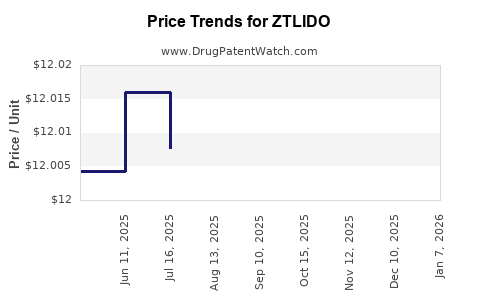
How are ZTLIDO sales and financial performance trending in the US?
Featured-snippet answer: ZTLIDO’s financial trajectory follows the typical branded topical pattern: solid early adoption after launch, then gradual revenue pressure as cost-based formulary substitution expands across lidocaine patch equivalents.
Revenue drivers that explain month-to-month variance
- Payer formulary status (preferred vs non-preferred).
- Contracting cycle timing (annual PBM/plan renegotiations).
- Channel inventory cycles (retail and wholesalers adjusting to expected demand shifts).
- Patient persistence in chronic neuropathic pain (long duration use improves baseline demand when coverage is stable).
Revenue pressure mechanisms
- ASP compression as generic competition scales.
- Net sales erosion driven by higher rebate intensity and lower effective reimbursement.
- Volume substitution as prescriptions shift to lower-cost equivalents within covered tiers.
When does ZTLIDO lose exclusivity, and how does that affect launch timing for generic or authorized generic competitors?
Featured-snippet answer: The exclusivity-driven risk window for generic substitution is tied to the later of (1) patent expiration for the specific listed product and (2) any applicable marketing exclusivity and regulatory exclusivity tied to the NDA/BLA history.
How exclusivity affects commercial outcomes
- Pre-expiration: brand has pricing and contracting leverage; PBMs still offer coverage but with tighter rebate and step-down structures in anticipation of generic entry.
- Post-expiration: generic and authorized generic entry typically triggers faster market reallocation toward lowest-cost covered products, with prescription volume migrating within weeks to months, depending on plan behavior and stocking.
Practical market consequence
Even before a true loss of legal exclusivity, PBMs often pre-emptively adjust preferred tier placement and formulary rules, creating early demand headwinds for branded SKUs.
What patents protect ZTLIDO, and what parts of the patent estate are most relevant to litigation and generic entry?
Featured-snippet answer: Patent protection for ZTLIDO typically spans composition/formulation and dosage-form related protection, with additional risk tied to method and use-related claims depending on the asserted product. The Orange Book listing defines which patents constrain generic entry.
Patent estate categories that matter commercially
- Formulation and system delivery patents (physical structure, drug release characteristics, adhesive and backing selection).
- Method-of-manufacture patents (if asserted, they can delay manufacturing/ANDA readiness).
- Use or dosing instruction patents (less common as a direct blocker for ANDA substitutes but can matter if label differences are targeted).
Why the “listed patents” matter more than broad background IP
- The ANDA entry pathway is constrained by Orange Book-listed patents linked to the specific FDA-approved formulation, strength, and NDA.
- Litigation leverage usually concentrates on those listed claims.
Which companies are challenging ZTLIDO, and what Paragraph IV litigation patterns drive settlement outcomes?
Featured-snippet answer: Paragraph IV patterns in the topical lidocaine patch space typically produce either (1) a noninfringement/invalidity defense that delays launch or (2) a settlement that trades earlier generic entry for a payout and/or launch timing commitments.
What to watch in a Paragraph IV scenario (commercially)
- Date of the Paragraph IV notice and whether the litigation stayed generic approval.
- Settlement entry design: date-of-launch, market scope, and any limitations tied to packaging strength.
- Injunction posture: whether courts grant any interim restrictions affecting the launch.
Market impact of settlement
Even when ultimate infringement outcomes are uncertain, settlements often shift market behavior early:
- PBMs expect branded deterioration and begin switching to covered equivalents.
- Wholesalers plan inventory around anticipated generic availability.
- Brand pricing power declines as “next product” alternatives become contractually feasible.
What is the Orange Book status of ZTLIDO, and how does it map to generic launch risk by strength and dosage form?
Featured-snippet answer: Orange Book status is the operational gate to generic launch risk. For ZTLIDO, Orange Book-listed patents define whether ANDA applicants face immediate launch or forced delay by automatic statutory stays and litigation.
How to interpret Orange Book status for go/no-go planning
- “Expires” vs “With exclusivity” labels determine the practical earliest date of challenge-free entry.
- Patent number mapping matters for jurisdictional strategy: only the specific listed patents constrain the ANDA product approval.
What this means for commercial forecasting
- The closer the product moves toward the last blocking date, the more contracts tighten:
- higher rebate clawbacks,
- preferred tier redistribution,
- increased incentives to switch.
How do ZTLIDO formulations and delivery characteristics affect differentiation versus generics?
Featured-snippet answer: In lidocaine patches, differentiation depends on system architecture and controlled delivery parameters that can be difficult to replicate at equivalent performance, but generic systems can still win on cost if covered.
Differentiation points that matter to payers and formularies
- Adherence and usability influence patient persistence.
- Drug release profile can influence tolerability and use-case mapping in clinical practice.
- Real-world switchability is usually determined by coverage and copay, not performance alone.
Litigation relevance
Formulation patents can support infringement arguments if the competitor’s system uses equivalent delivery mechanics covered by the claim set. In practice, many settlements are driven by economics of launch timing rather than a final merits determination.
What generic entry risks exist for ZTLIDO, including authorized generics and “at-risk” launches?
Featured-snippet answer: Generic entry risk peaks near the final blocking date, with authorized generics and at-risk launches accelerating volume loss once coverage and reimbursement align.
Risk tiers that impact forecasting
- Low risk: product remains fully blocked by active Orange Book patents and no settlement or final judgment allows entry.
- Medium risk: litigation settlement exists but entry is not immediate; brands still hold some contract leverage.
- High risk: last blocking date passes and PBMs can route patients quickly to preferred equivalents.
Channel-level dynamics
- Mail-order and PBM-run networks switch faster once preferred equivalents are locked in.
- Retail conversion depends on copay and availability in local channels.
How does ZTLIDO compare with other lidocaine topical products in cost, coverage, and switching behavior?
Featured-snippet answer: ZTLIDO’s market position improves when payers place lidocaine patches in a preferred tier with manageable patient cost-sharing; it declines quickly when PBMs move equivalent generics into preferred placement.
Switching behavior logic
- If a payer tier requires prior authorization or has step edits, brand can retain volume.
- Once edits are relaxed or a cheaper equivalent is preferred, brand volume compresses.
What matters to commercial buyers
- total cost per treated patient (not just unit price),
- adherence/persistence metrics tied to patient and clinician experience,
- contract rebates and copay offsets.
What manufacturing and IP barriers could delay ZTLIDO generic competition?
Featured-snippet answer: Barriers typically come from combination of (1) formulation-related IP claims, (2) regulatory evidence requirements for topical delivery performance, and (3) litigation stays tied to listed patents.
Manufacturing bottlenecks that matter
- quality and consistency of adhesive layers and backing materials,
- uniformity of drug distribution in the patch/system matrix,
- stability and shelf-life compliance for topical patches.
What FDA regulatory status affects ZTLIDO’s competitive landscape?
Featured-snippet answer: FDA status matters mainly through the ANDA approval pathway and timing relative to exclusivity and any relevant stays tied to patent listings.
Regulatory events that shift market outcomes
- acceptance of ANDAs,
- FDA approvals and labeling alignment that enables substitution within payer rules,
- “market readiness” events including supply ramp and pharmacy stocking.
Market outlook for ZTLIDO: what factors determine whether revenue holds or declines faster?
Featured-snippet answer: Revenue trajectory depends on the interplay between legal blocking timelines and payer contracting execution, with PBM tier movement after generic entry being the largest near-term lever.
Top drivers of upside
- sustained preferred tier with favorable net pricing,
- slower-than-expected switching due to prior authorization controls,
- strong patient persistence and physician familiarity,
- aggressive defense of patent claims that delay generic entry.
Top drivers of downside
- fast PBM switching after generic entry,
- steep ASP compression and net-to-gross deterioration,
- broader substitution to other lidocaine delivery formats,
- delayed exclusivity defense culminating in early settlement entry.
Key Takeaways
- ZTLIDO’s financial performance is primarily a function of formulary placement and generic entry timing in the lidocaine patch class.
- Legal exclusivity and Orange Book-listed patents determine the earliest competitor entry window, while PBM contracting determines the pace of prescription migration.
- The product’s differentiation advantage is usually insufficient to offset cost-based payer behavior once lower-cost covered equivalents are available.
FAQs
- How quickly do prescriptions shift from branded lidocaine patches to generics after the last blocking date?
- Do lidocaine patch generic entrants usually settle to avoid trial, and what launch date terms drive market timing?
- Which payer formulary levers most affect ZTLIDO net sales: prior authorization, step therapy, or copay design?
- How do formulation-performance differences in topical systems affect infringement arguments against lidocaine patch generics?
- What channel (retail vs mail) typically converts earliest when a preferred generic lidocaine option launches?
References
- FDA Orange Book. Approved Drug Products with Therapeutic Equivalence Evaluations (search results for ZTLIDO). U.S. Food and Drug Administration.
- FDA. Drug Approval Reports and ANDA approval information for lidocaine topical products. U.S. Food and Drug Administration.