Last updated: September 12, 2026
Zofran, the brand name for ondansetron, moved from a high-value branded antiemetic into a mature, low-cost generic market. GlaxoSmithKline's original product generated more than $1 billion in annual sales at its peak, supported by use in chemotherapy-induced nausea and vomiting, postoperative nausea and vomiting, and radiation-induced nausea. U.S. market exclusivity ended in the mid-2000s, and generic ondansetron rapidly replaced branded Zofran in routine prescribing.
The commercial franchise remains relevant because ondansetron is inexpensive, widely prescribed, available in multiple dosage forms, and included in standard antiemetic protocols. Its financial profile has shifted from branded product economics to high-volume, low-margin generic competition. The principal risks are price erosion, manufacturing competition, regulatory scrutiny over QT prolongation, and limited differentiation among suppliers.
What is Zofran and how is ondansetron used?
Zofran contains ondansetron, a selective 5-HT3 receptor antagonist. The drug blocks serotonin-mediated nausea and vomiting pathways.
| Attribute |
Zofran and ondansetron |
| Active ingredient |
Ondansetron hydrochloride |
| Originator |
Glaxo Inc., later GlaxoSmithKline |
| Primary mechanism |
Selective 5-HT3 receptor antagonism |
| Initial FDA approval |
1991, injectable formulation |
| Major indications |
Chemotherapy-induced nausea and vomiting, radiation-induced nausea and vomiting, postoperative nausea and vomiting |
| Main dosage forms |
Injection, oral tablet, orally disintegrating tablet, oral solution |
| Current market structure |
Predominantly generic |
| U.S. regulatory status |
Generic ondansetron products approved under ANDA pathways |
| Key safety issue |
Dose-dependent QT interval prolongation |
| Commercial status |
Mature, commoditized product |
FDA labeling supports ondansetron for prevention of nausea and vomiting associated with emetogenic cancer chemotherapy, radiotherapy, and surgery. Use in pregnancy-related nausea, including hyperemesis gravidarum, is widespread but has involved regulatory and litigation scrutiny because some uses are outside the original FDA-approved indications. The FDA label does not establish Zofran as a specifically approved treatment for morning sickness.[1]
When did Zofran lose exclusivity?
Zofran lost meaningful U.S. exclusivity in the mid-2000s. Generic competition followed the expiration of the core patent and related regulatory protections.
The principal commercial sequence was:
| Event |
Approximate timing |
Commercial effect |
| Injectable Zofran approved |
1991 |
Originator launch |
| Oral Zofran approved |
1992 |
Expanded outpatient market |
| Orally disintegrating formulation introduced |
Late 1990s |
Improved administration convenience |
| Core U.S. patent protection ended |
2005, with subsequent pediatric protection extending practical exclusivity |
Generic entry delayed until approximately 2006 |
| Generic ondansetron launches |
2006-2007 |
Rapid price and share erosion |
| Brand franchise matures |
2007 onward |
Volume persists, branded economics decline |
The widely cited market transition occurred in December 2006, when generic ondansetron became available after the expiration of the relevant patent and pediatric exclusivity period. Exact entry timing varied by dosage form and ANDA approval.
What patents protected Zofran?
The original ondansetron patent estate was built around the active compound and pharmaceutical use. Important U.S. patent records associated with ondansetron include:
| Patent or protection category |
Subject matter |
Commercial significance |
| U.S. Patent No. 4,695,578 |
Ondansetron compound and related chemical claims |
Core composition-of-matter protection |
| Subsequent formulation and dosage-form rights |
Tablets, orally disintegrating products, and related delivery formats |
Potentially delayed or segmented generic entry |
| Pediatric exclusivity |
Regulatory exclusivity tied to pediatric studies |
Extended practical market protection after patent expiry |
U.S. Patent No. 4,695,578 was assigned to the originator organization associated with Glaxo. Public patent databases and FDA materials should be used to distinguish the original compound patent from later formulation or method claims because the relevant expiration dates were not identical.[2]
The core patent, rather than a durable formulation platform, drove the economic value of the product. Once generic manufacturers could market standard oral and injectable ondansetron, the originator had limited ability to preserve premium pricing.
How did Zofran’s sales change over time?
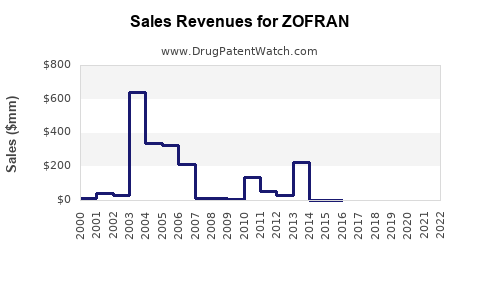
Zofran generated peak annual sales above $1 billion before generic entry. GlaxoSmithKline reported Zofran sales in the high hundreds of millions to more than $1 billion during the product's strongest commercial years, depending on the reporting period and exchange-rate effects.[3]
A simplified financial trajectory is:
| Period |
Financial position |
Main driver |
| 1991-1995 |
Rapid growth |
Launch into oncology and hospital settings |
| Late 1990s |
Expansion |
Oral and orally disintegrating dosage forms |
| 2000-2004 |
Peak branded value |
Broad institutional and outpatient adoption |
| 2005-2006 |
Pre-generic maturity |
High sales but rising exclusivity risk |
| 2007-2010 |
Sharp decline |
Generic substitution and price compression |
| 2010 onward |
Low-value mature market |
High unit demand with thin supplier margins |
The brand's peak value came from oncology protocols, where antiemetic use was often embedded in treatment pathways and hospital formularies. Zofran also benefited from administration convenience, physician familiarity, and a strong safety and efficacy record relative to older antiemetics.
After generic entry, revenue fell for two reasons. First, payers substituted generic ondansetron for branded Zofran. Second, multiple suppliers competed for the same active ingredient and dosage-form demand, lowering average selling prices.
GlaxoSmithKline later reported pharmaceutical sales by broader product categories and geographic markets rather than maintaining a detailed, standalone Zofran revenue line. The company therefore does not provide a current public revenue series that isolates every ondansetron product and market.[3]
What is the current market structure for ondansetron?
Ondansetron is a mature generic pharmaceutical with broad supplier participation. Competition is strongest in standard tablets, orally disintegrating tablets, oral solution, and injection.
Major generic companies that have marketed or obtained U.S. approvals for ondansetron products include:
- Teva Pharmaceuticals
- Sandoz
- Hikma Pharmaceuticals
- Dr. Reddy's Laboratories
- Aurobindo Pharma
- Rising Pharmaceuticals
- Amneal Pharmaceuticals
- Apotex
- West-Ward, later associated with Hikma
- Other FDA-approved ANDA holders and contract manufacturers
Market share varies by dosage form, hospital contract, wholesaler relationship, shortage conditions, and reimbursement channel. No single generic supplier controls the entire U.S. market.
How does Zofran compare with competing antiemetics?
Ondansetron competes with both branded and generic antiemetics.
| Product or class |
Principal role |
Competitive position versus ondansetron |
| Granisetron |
5-HT3 antagonist |
Similar mechanism; competes in chemotherapy and perioperative use |
| Palonosetron |
Long-acting 5-HT3 antagonist |
Differentiated by longer duration and use in chemotherapy protocols |
| Dolasetron |
5-HT3 antagonist |
Commercial relevance declined because of cardiac safety concerns |
| Aprepitant and fosaprepitant |
NK1 antagonists |
Used in combination for highly emetogenic chemotherapy |
| Netupitant/palonosetron |
Fixed combination |
Higher-value branded or specialty positioning |
| Metoclopramide |
Dopamine antagonist and prokinetic |
Low-cost alternative in selected settings |
| Promethazine |
Antihistamine and dopamine activity |
Common low-cost antiemetic, with different adverse-effect profile |
| Olanzapine |
Antipsychotic used in antiemetic regimens |
Increasingly used in selected oncology protocols |
Ondansetron's competitive advantage is price, familiarity, availability, and flexible administration. Its limitations include QT prolongation risk, constipation, and weaker performance than multidrug regimens for highly emetogenic chemotherapy.
What is the FDA regulatory status of Zofran?
The original Zofran product was approved through an NDA. Generic ondansetron products are generally approved through abbreviated new drug applications that demonstrate pharmaceutical equivalence and bioequivalence rather than repeating the full originator clinical program.[1]
FDA-approved dosage forms include:
- 4 mg and 8 mg tablets
- 4 mg and 8 mg orally disintegrating tablets
- Oral solution
- Injectable products in multiple concentrations
The FDA has warned that ondansetron can prolong the QT interval, particularly at higher intravenous doses. The agency removed the 32 mg single intravenous dose from recommended use and identified risk in patients with congenital long QT syndrome, electrolyte abnormalities, congestive heart failure, bradyarrhythmias, or concurrent QT-prolonging medicines.[4]
This safety issue affects hospital protocols and labeling but has not eliminated ondansetron's broad use. The main commercial consequence is selective restriction of high-dose intravenous administration rather than displacement of the standard oral and lower-dose injectable market.
What is the Orange Book status of Zofran?
The Orange Book historically listed Zofran and related ondansetron products under the originator NDA, together with patent and exclusivity information applicable at the time. The commercial importance of those listings declined after core patent expiry and the approval of multiple ANDA products.
Current Orange Book analysis must distinguish:
- The original Zofran NDA.
- The specific dosage form and strength.
- Listed patents that were active at the relevant reference date.
- Whether the originator product remains actively marketed.
- ANDA approvals and any Paragraph IV certifications.
Because Zofran is a mature product, Orange Book protection is no longer the principal barrier to U.S. market entry. The relevant commercial question is usually whether a generic manufacturer can secure FDA approval, maintain compliant manufacturing, and win distribution or hospital contracts.
Which companies challenged Zofran patents?
Generic companies challenged or sought to enter the ondansetron market as the core patent and regulatory protections approached expiration. The most important commercial outcome was not a prolonged period of branded exclusivity but the broad approval and launch of generic ondansetron products around 2006-2007.
Publicly available records identify generic competition involving companies such as Teva and other ANDA sponsors. The underlying disputes covered patent validity, infringement, and timing of entry. The economic result was generic availability across multiple dosage forms rather than a sustained originator-controlled market.
No current, material U.S. Paragraph IV dispute is central to the commercial outlook for standard ondansetron. The product's key intellectual-property disputes are historical.
What formulation patents protect ondansetron products?
Formulation protection has been less commercially durable than the compound patent. The orally disintegrating tablet provided a product-life-cycle extension based on convenience and administration without water, but generic manufacturers were able to commercialize equivalent dosage forms after the relevant barriers expired.
The main formulation categories are:
Orally disintegrating tablets
ODT products target patients who cannot swallow conventional tablets or need rapid administration. Their commercial value was strongest before generic ODT competition expanded.
Injectable ondansetron
Injection remains important in hospitals, ambulatory surgery centers, emergency departments, and oncology clinics. The product is subject to sterile manufacturing requirements, which can limit the number of reliable suppliers even when patent barriers are absent.
Oral solution
Oral solution serves pediatric and selected adult patients. It has a smaller commercial base than tablets but can generate supply constraints when few manufacturers maintain the dosage form.
Combination and delivery opportunities
Ondansetron has appeared in compounded and combination-use settings, but these do not create the same branded market opportunity as a new chemical entity. The principal barriers are regulatory compliance, manufacturing quality, and reimbursement rather than strong enforceable patent exclusivity.
What generic entry risks exist for Zofran?
Generic launch risk is already realized in the standard U.S. market. The remaining risk is commercial erosion among generic suppliers rather than a future originator cliff.
Key market risks include:
| Risk |
Effect |
| Multiple ANDA suppliers |
Lower prices and reduced gross margins |
| Hospital tendering |
Concentrates volume with the lowest-cost qualified suppliers |
| Wholesaler substitution |
Weakens brand loyalty |
| FDA manufacturing actions |
Can remove suppliers and create temporary shortages |
| API concentration |
Raises supply-chain vulnerability |
| QT-prolongation warnings |
Limits selected high-dose intravenous use |
| Competing antiemetic regimens |
Reduces use in some oncology protocols |
| Reimbursement controls |
Pushes utilization toward the lowest-cost product |
For a generic manufacturer, the main hurdle is not patent freedom to operate. It is securing consistent API supply, sterile manufacturing capacity, FDA compliance, and commercial distribution.
How strong is the patent estate for Zofran?
The Zofran patent estate is weak as a current commercial moat.
| Factor |
Assessment |
| Composition-of-matter protection |
Expired |
| Core U.S. exclusivity |
Expired |
| Formulation protection |
Expired or no longer commercially decisive |
| Method-of-use protection |
Limited current value for standard indications |
| Generic substitution risk |
High |
| Manufacturing barrier |
Moderate for sterile injection, low for tablets |
| Brand pricing power |
Minimal |
| Litigation leverage |
Low for standard products |
The product retains clinical utility but not meaningful originator exclusivity. Any residual value lies in manufacturing reliability, institutional contracts, international registrations, or differentiated delivery systems rather than in the historical Zofran patent estate.
What licensing deals affect Zofran?
The principal commercial value came through Glaxo's internal development and commercialization of ondansetron rather than a major current licensing platform. Following the product's maturity, generic manufacturers generally relied on ANDA approvals, supply agreements, distribution arrangements, and contract manufacturing.
No current licensing transaction materially changes the economics of standard generic ondansetron. Any deal value is likely to be associated with regional commercialization, hospital supply, or manufacturing capacity rather than exclusive rights to the active ingredient.
What litigation affects Zofran?
Historical Zofran litigation has included generic patent challenges and product-liability claims relating to alleged birth defects after maternal use during pregnancy. The product-liability cases created legal exposure for GlaxoSmithKline, although courts and juries reached differing outcomes over time.
The FDA has not approved ondansetron specifically for morning sickness. That distinction is important in evaluating litigation and regulatory risk. Use in pregnancy can occur under physician judgment, but the commercial product's core approved markets remain oncology, radiation, and postoperative nausea and vomiting.[1]
As of the mature generic-market period, patent litigation is no longer the main determinant of value. Product liability, label interpretation, and manufacturing compliance are more relevant legal considerations.
What is the outlook for Zofran and ondansetron revenue?
Revenue will remain durable in volume terms but limited in value terms.
The U.S. market should continue to support ondansetron because:
- Chemotherapy remains a recurring source of demand.
- Surgery and ambulatory procedures require antiemetic treatment.
- Oral and ODT products are inexpensive and convenient.
- Generic prescribing is embedded in clinical practice.
- The drug is available across hospital and retail channels.
The principal constraint is price. Standard oral ondansetron has little ability to sustain premium pricing. Injectable products can command better economics when supply is constrained, but those margins depend on manufacturing reliability and hospital contracting.
For the former originator, Zofran is no longer a material growth asset. For generic manufacturers, the product can generate steady volume, but financial performance depends on scale, procurement discipline, and supply continuity.
Key Takeaways
- Zofran is the originator brand for ondansetron, a mature 5-HT3 antagonist.
- GlaxoSmithKline generated more than $1 billion in annual Zofran sales at the product's peak.
- Core U.S. exclusivity ended in the mid-2000s, with generic entry occurring around 2006-2007.
- Standard oral, ODT, oral-solution, and injectable products are now primarily generic.
- The patent estate has little current power to prevent competition.
- Manufacturing quality, sterile-injection capacity, API supply, and hospital contracts are more important than patent litigation.
- QT prolongation remains the main regulatory safety issue.
- Ondansetron demand is durable, but pricing and margins are structurally low.
- No current licensing or Paragraph IV dispute materially changes the standard U.S. ondansetron outlook.
FAQs
Is Zofran still under patent?
No. The core U.S. patent protection for ondansetron expired in the mid-2000s, and pediatric exclusivity ended around the time generic products entered the market.
Is generic ondansetron the same as Zofran?
Generic ondansetron must meet FDA requirements for pharmaceutical equivalence and bioequivalence to the applicable reference product. Differences can remain in inactive ingredients, packaging, manufacturer, and tablet appearance.
Does Zofran have biosimilar competition?
No. Ondansetron is a small-molecule drug, not a biologic. Competition occurs through generic ANDA products rather than biosimilar applications.
Why is injectable ondansetron sometimes in short supply?
Injectable products require sterile manufacturing, validated facilities, reliable API supply, and complex quality controls. A manufacturing shutdown or quality action can remove a significant portion of available supply even when several approved suppliers exist.
Is ondansetron approved for pregnancy-related nausea?
The FDA-approved Zofran label covers chemotherapy-induced nausea and vomiting, radiotherapy-induced nausea and vomiting, and postoperative nausea and vomiting. Use for pregnancy-related nausea is not one of the original labeled indications.[1]
References
-
U.S. Food and Drug Administration. (2023). Zofran prescribing information: Ondansetron hydrochloride. FDA.
-
United States Patent and Trademark Office. (1987). U.S. Patent No. 4,695,578: Anti-emetic agents. U.S. Department of Commerce.
-
GlaxoSmithKline plc. (2001-2008). Annual reports and financial statements. GlaxoSmithKline.
-
U.S. Food and Drug Administration. (2012). FDA drug safety communication: New information regarding QT prolongation with ondansetron. FDA.