Last updated: June 2, 2026
XELPROS market dynamics and financial trajectory: sales, exclusivity, payer pressure, and competition
XELPROS (latanoprostene bunod ophthalmic solution 0.024%) has shifted from early adoption to a more payer-driven, competitive glaucoma market where branded volume depends on formulary positioning versus lower-cost prostaglandin and prostaglandin/NO alternatives. The financial trajectory is defined by (1) prescription capture in patients switching from generic latanoprost and other prostaglandins, (2) margin compression as net pricing adjusts to managed-care coverage, and (3) the timing of patent and exclusivity expirations that determine when generic competition and lower-priced authorized alternatives can pressure revenue.
What is XELPROS (latanoprostene bunod) and how is it priced in glaucoma?
Quick answer: XELPROS is a prostaglandin/NO hybrid therapy for open-angle glaucoma and ocular hypertension, priced as a branded specialty glaucoma drug with sales outcomes heavily tied to payer coverage and step edits.
Mechanism and clinical positioning
- Active ingredient: latanoprostene bunod
- Class positioning: prostaglandin analog with nitric oxide donation (PG-NO)
- Typical market role: add-on or switch therapy after inadequate response to, or intolerance of, prostaglandin-only options
How pricing is set in managed care
XELPROS revenue sensitivity typically follows three payer levers:
- Formulary tier placement: preferred brand status versus non-preferred brand drives uptake.
- Step therapy: requires failure of generics (often latanoprost, travoprost, or bimatoprost equivalents) before coverage.
- Copay design: patient out-of-pocket pressure shifts demand toward covered options.
Commercial impact of generics
The glaucoma category is dominated by generics and low-cost branded competitors, so XELPROS net sales usually depend on how aggressively it is “protected” through coverage and contracting rather than on raw list price.
How do sales trends for XELPROS typically evolve over a product lifecycle?
Quick answer: Post-launch sales typically follow an S-curve into formulary penetration, then flatten as generics and competing branded glaucoma agents constrain share, unless new payer wins or clinical adoption expands.
Trajectory drivers
- Early: physician awareness and initial formulary acceptance
- Switch share from older prostaglandin-only regimens
- Uptake in patients needing stronger intraocular pressure (IOP) lowering or tolerability advantages
- Mid: payer tightening
- Coverage renewals, prior authorization edits, and step therapy intensify
- Rebate pressure rises with competitive brand presence
- Late: exclusivity endgame
- Patent cliffs create “anticipation effects” if biosimilar-style dynamics are not relevant but generic ophthalmic competition is
- Net sales can soften before formal exclusivity expiration due to contracting behavior
Key economic metric framework (what investors track)
- Net sales vs. list price (rebate and discount intensity)
- Prescription volume trends (new vs. switch)
- Persistence by payer segment (Medicare Part D vs commercial)
- Share-of-voice in prior authorization and step therapy usage
What patents protect XELPROS and when do they expire?
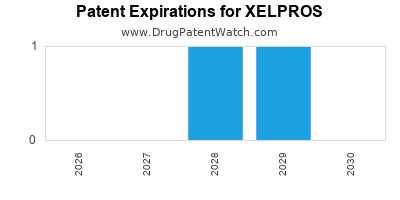
Quick answer: XELPROS’s ability to sustain revenue depends on the timing of patent expiry and any patent term extensions that delay generic entry under US law; the sales trajectory is typically strongest through the last meaningful US patent expiration.
Patent estate mechanics that matter to revenue
- Composition of matter: governs active ingredient claims
- Formulation/delivery claims: govern concentration, vehicle, and manufacturing-related features
- Method-of-use claims: can delay certain “skinny” or carve-out generic pathways, though ophthalmic generic pathways usually target product-level claims
- Orange Book listings: determine which patents can be challenged via Paragraph IV
How expiration timing translates to sales impact
- Revenue usually begins to decline when:
- a court decision increases probability of generic launch
- a generic files Paragraph IV and signals entry timing
- major payers reprice or narrow coverage ahead of entry
What to watch on the legal calendar
- US district court outcome for any generic challenge
- Federal Circuit affirmance or remand decisions
- Potential settlements that establish “design-around” timelines
When does XELPROS lose exclusivity in the US and how does it compare with the EU/UK?
Quick answer: US market exclusivity ends based on patent expiry and any regulatory data exclusivity that may apply; the European and UK paths depend on whether additional SPCs or national patent regimes extend protection.
US: exclusivity vs patent expiry
- Generic launch risk turns on:
- last listed Orange Book patent expiration
- any adjusted expiration for patent term and regulatory exclusivity
- litigation outcomes tied to patent validity and infringement
EU/UK: regulatory protection and SPC
- EU marketing authorization protection and supplementary protection certificates can extend the effective end date.
- UK outcomes follow the post-Brexit regime for SPC enforcement and pending litigation.
What generic entry risks exist for XELPROS under Paragraph IV ANDA pathways?
Quick answer: If a generic files an ANDA with Paragraph IV certifications, XELPROS faces a time-bound entry risk tied to the 30-month stay and any subsequent litigation outcomes.
ANDA pathway dynamics
- Paragraph IV filing triggers:
- 30-month litigation stay unless:
- earlier final court decision is issued
- settlement ends the stay earlier
- After exclusivity/patent expiry:
- the generic can launch immediately upon FDA approval and labeling readiness
Revenue exposure logic
- The most revenue-sensitive phase is typically the period:
- between Paragraph IV filing and final decision/settlement
- when payers can re-contract pricing
- when wholesalers and channel inventory adapt to expected lower-cost supply
How strong is the patent estate for XELPROS versus other glaucoma brands?
Quick answer: Patent strength in this category is often decisive because glaucoma competitors can use generic pricing pressure quickly once product-level claims end.
Comparison points that influence litigation leverage
- Number of Orange Book-listed patents covering:
- active ingredient
- formulation/physicochemical properties
- method-of-use indications
- Claim breadth and survivability:
- whether remaining dependent claims are likely to withstand validity challenges
- Geographic robustness:
- whether the same inventions are enforced across US and major EU jurisdictions
What formulations and dosage strengths are protected for XELPROS?
Quick answer: Ophthalmic product claims usually cover the active concentration and formulation vehicle, which matters because generic entrants can seek design-around routes if only narrow formulation claims remain.
Ophthalmic formulation claim zones that matter
- Concentration and composition ranges
- Buffer systems and pH stability profiles
- Stabilizers and surfactants affecting shelf-life and performance
- Container-closure and sterility assurance-related manufacturing constraints
What XELPROS competitors are most relevant commercially?
Quick answer: The commercial battle in glaucoma is dominated by:
- generic prostaglandin analogs (low-cost baseline pressure)
- branded prostaglandin alternatives and combination products that offer perceived IOP advantage
- patient-support and copay programs that influence switching
Where XELPROS differentiates
- PG-NO mechanism is positioned to provide IOP reduction with distinct tolerability and response profile claims versus prostaglandin-only options.
How competition changes net pricing
- New entrant pricing leads to:
- formulary reevaluation
- contraction of preferred coverage for non-preferred brands
- escalation in rebates to preserve access
What is the Orange Book status of XELPROS and what does it imply for generic timing?
Quick answer: Orange Book listings define the patent(s) eligible for ANDA Paragraph IV challenges; the last listed patent governs generic launch freedom.
Orange Book read-through for business planning
- Patents listed with:
- “expires” dates aligned with the litigation calendar shape probability-weighted launch scenarios.
- If multiple patents expire serially:
- investors model a “stair-step” decline rather than a single cliff.
What FDA status does XELPROS have and what matters for regulatory competition?
Quick answer: FDA status affects market entry timing only insofar as it controls labeling, manufacturing changes, and generic bioequivalence requirements for ophthalmics.
Regulatory pathway implications
- Ophthalmic generics typically rely on:
- evidence of pharmaceutical equivalence and performance comparisons
- Any changes in labeling or indications can affect:
- exclusivity scope
- “skinny label” opportunities
How much revenue exposure does XELPROS have from exclusivity and legal outcomes?
Quick answer: Revenue exposure is highest when:
- late-stage litigation reduces uncertainty around generic launch date
- payer contracts anticipate future pricing and restrict coverage
Scenario mapping business teams use
- Base case: extended exclusivity through the last patent term, steady volume with gradual margin pressure
- Downside case: earlier-than-expected adverse court outcomes or settlement enables earlier entry and pricing reset
- Upside case: settlements delay entry or narrow the entry label scope
What XELPROS patent litigation affects market timing?
Quick answer: Litigation affects timing via:
- injunction and stay effects after Paragraph IV filing
- settlement-triggered launch dates
- appellate outcomes that shift probability around patent validity
Milestone categories
- District court validity/infringement rulings
- Federal Circuit appeals
- Settlement terms controlling launch timing and labeling
What settlements typically change in ophthalmic patent cases?
Quick answer: Settlements in US pharma commonly set:
- a date certain for generic launch
- limits on labeling and/or composition changes
- provisions governing design-around work and future regulatory submissions
How settlements influence revenue right before the “cliff”
- Payer contracting becomes more aggressive as launch dates approach
- Patient access declines when alternative products become preferred and supported
Key Takeaways
- XELPROS revenue trajectory is primarily driven by formulary access, step therapy behavior, and net pricing pressure in a category dominated by generics.
- Patent and Orange Book end dates control generic entry risk; the last meaningful US patent expiry typically defines the most sensitive revenue window.
- Paragraph IV ANDA litigation and any settlements can compress timelines by shifting payer expectations and enabling earlier discounted supply.
- Competitive pressure from prostaglandin and PG-NO alternatives usually changes net sales through rebates and coverage tiering rather than immediate wholesale displacement.
FAQs
- How do step-therapy and prior authorization rules influence XELPROS net sales vs. list price?
- What Orange Book patent type most reliably blocks ANDA launches for ophthalmic products like XELPROS?
- Do generic ophthalmic entrants typically launch at the same label scope as the reference product, and how does that affect XELPROS volume?
- How do settlements in US patent litigation typically affect “date certain” generic launch planning for branded ophthalmics?
- Which factors in ophthalmic manufacturing and formulation can create IP barriers for generic switching from XELPROS?
References
- FDA. Orange Book: Approved Drug Products with Therapeutic Equivalence Evaluations. US FDA. https://www.accessdata.fda.gov/scripts/cder/daf/
- FDA. Drug Approval Packages and Labeling (access via Drugs@FDA). US FDA. https://www.accessdata.fda.gov/scripts/cder/daf/
- FDA. Hatch-Waxman 30-month stay overview (ANDAs and Paragraph IV certifications). US FDA. https://www.fda.gov/