You're using a free limited version of DrugPatentWatch: Upgrade for Complete Access

Last Updated: December 19, 2025

VYNDAMAX Drug Patent Profile


✉ Email this page to a colleague

« Back to Dashboard


When do Vyndamax patents expire, and when can generic versions of Vyndamax launch?

Vyndamax is a drug marketed by Foldrx Pharms and is included in one NDA. There are three patents protecting this drug and one Paragraph IV challenge.

This drug has sixty-six patent family members in twenty-seven countries.

The generic ingredient in VYNDAMAX is tafamidis. One supplier is listed for this compound. Additional details are available on the tafamidis profile page.

DrugPatentWatch® Generic Entry Outlook for Vyndamax

Vyndamax was eligible for patent challenges on May 3, 2023.

By analyzing the patents and regulatory protections it appears that the earliest date for generic entry will be August 31, 2035. This may change due to patent challenges or generic licensing.

There have been three patent litigation cases involving the patents protecting this drug, indicating strong interest in generic launch. Recent data indicate that 63% of patent challenges are decided in favor of the generic patent challenger and that 54% of successful patent challengers promptly launch generic drugs.

Indicators of Generic Entry

< Available with Subscription >

  Get Started Free

AI Deep Research
Questions you can ask:
  • What is the 5 year forecast for VYNDAMAX?
  • What are the global sales for VYNDAMAX?
  • What is Average Wholesale Price for VYNDAMAX?
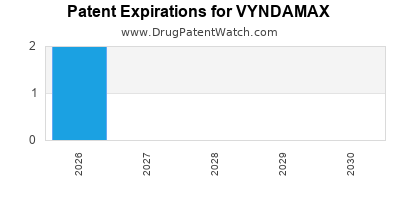
Drug patent expirations by year for VYNDAMAX
Drug Prices for VYNDAMAX

See drug prices for VYNDAMAX

DrugPatentWatch® Estimated Loss of Exclusivity (LOE) Date for VYNDAMAX
Generic Entry Date for VYNDAMAX*:
Constraining patent/regulatory exclusivity:
NDA:
Dosage:
CAPSULE;ORAL

*The generic entry opportunity date is the latter of the last compound-claiming patent and the last regulatory exclusivity protection. Many factors can influence early or later generic entry. This date is provided as a rough estimate of generic entry potential and should not be used as an independent source.

Paragraph IV (Patent) Challenges for VYNDAMAX
Tradename Dosage Ingredient Strength NDA ANDAs Submitted Submissiondate
VYNDAMAX Capsules tafamidis 61 mg 212161 3 2023-05-03

US Patents and Regulatory Information for VYNDAMAX

VYNDAMAX is protected by three US patents and one FDA Regulatory Exclusivity.

Based on analysis by DrugPatentWatch, the earliest date for a generic version of VYNDAMAX is ⤷  Get Started Free.

This potential generic entry date is based on patent ⤷  Get Started Free.

Generics may enter earlier, or later, based on new patent filings, patent extensions, patent invalidation, early generic licensing, generic entry preferences, and other factors.

Applicant Tradename Generic Name Dosage NDA Approval Date TE Type RLD RS Patent No. Patent Expiration Product Substance Delist Req. Exclusivity Expiration
Foldrx Pharms VYNDAMAX tafamidis CAPSULE;ORAL 212161-001 May 3, 2019 RX Yes Yes ⤷  Get Started Free ⤷  Get Started Free Y Y ⤷  Get Started Free
Foldrx Pharms VYNDAMAX tafamidis CAPSULE;ORAL 212161-001 May 3, 2019 RX Yes Yes ⤷  Get Started Free ⤷  Get Started Free ⤷  Get Started Free
>Applicant >Tradename >Generic Name >Dosage >NDA >Approval Date >TE >Type >RLD >RS >Patent No. >Patent Expiration >Product >Substance >Delist Req. >Exclusivity Expiration

EU/EMA Drug Approvals for VYNDAMAX

Company Drugname Inn Product Number / Indication Status Generic Biosimilar Orphan Marketing Authorisation Marketing Refusal
Pfizer Europe MA EEIG Vyndaqel tafamidis EMEA/H/C/002294Vyndaqel is indicated for the treatment of transthyretin amyloidosis in adult patients with stage-1 symptomatic polyneuropathy to delay peripheral neurologic impairment. Authorised no no yes 2011-11-16
>Company >Drugname >Inn >Product Number / Indication >Status >Generic >Biosimilar >Orphan >Marketing Authorisation >Marketing Refusal

International Patents for VYNDAMAX

When does loss-of-exclusivity occur for VYNDAMAX?

Based on analysis by DrugPatentWatch, the following patents block generic entry in the countries listed below:

Argentina

Patent: 1778
Patent: FORMAS SÓLIDAS CRISTALINAS DE 6-CARBOXI-2-(3,5-DICLOROFENIL)-BENZOXAZOL
Estimated Expiration: ⤷  Get Started Free

Australia

Patent: 15313875
Patent: Crystalline solid forms of 6-carboxy-2-(3,5-dichlorophenyl)-benzoxazole
Estimated Expiration: ⤷  Get Started Free

Brazil

Patent: 2017003421
Patent: formas sólidas cristalinas de 6-carbóxi-2-(3,5-diclorofenil)-benzoxazol
Estimated Expiration: ⤷  Get Started Free

Canada

Patent: 03194
Patent: FORMES CRISTALLINES SOLIDES DE 6-CARBOXY-2-(3,5-DICHLOROPHENYL)-BENZOXAZOLE (CRYSTALLINE SOLID FORMS OF 6-CARBOXY-2-(3,5-DICHLOROPHENYL)-BENZOXAZOLE)
Estimated Expiration: ⤷  Get Started Free

China

Patent: 6715405
Patent: 6‑羧基‑2‑(3,5‑二氯苯基)苯并噁唑的结晶固体形式 (Crystalline solid forms of 6-carboxy-2-(3,5-dichlorophenyl)-benzoxazole)
Estimated Expiration: ⤷  Get Started Free

Patent: 5368313
Patent: 6-羧基-2-(3,5-二氯苯基)苯并噁唑的结晶固体形式 (Crystalline solid forms of 6-carboxy-2-(3, 5-dichlorophenyl) benzoxazole)
Estimated Expiration: ⤷  Get Started Free

Croatia

Patent: 0211834
Estimated Expiration: ⤷  Get Started Free

Cyprus

Patent: 24843
Estimated Expiration: ⤷  Get Started Free

European Patent Office

Patent: 91461
Patent: FORMES CRISTALLINES SOLIDES DU 6-CARBOXY-2-(3,5-DICHLOROPHÉNYL)-BENZOXAZOLE (CRYSTALLINE SOLID FORMS OF 6-CARBOXY-2-(3,5-DICHLOROPHENYL)-BENZOXAZOLE)
Estimated Expiration: ⤷  Get Started Free

Patent: 77993
Patent: FORMES CRISTALLINES SOLIDES DU 6-CARBOXY-2-(3,5-DICHLOROPHÉNYL)-BENZOXAZOLE POUR L'UTILISATION COMME MÉDICAMENTS (CRYSTALLINE SOLID FORMS OF 6-CARBOXY-2-(3,5-DICHLOROPHENYL)-BENZOXAZOLE FOR USE AS A MEDICAMENT)
Estimated Expiration: ⤷  Get Started Free

Hungary

Patent: 56583
Estimated Expiration: ⤷  Get Started Free

Japan

Patent: 57525
Estimated Expiration: ⤷  Get Started Free

Patent: 16065042
Patent: 6−カルボキシ−2−(3,5−ジクロロフェニル)−ベンゾオキサゾールの結晶性固体形態 (CRYSTALLINE SOLID FORMS OF 6-CARBOXY-2-(3,5-DICHLOROPHENYL)-BENZOXAZOLE)
Estimated Expiration: ⤷  Get Started Free

Patent: 20055832
Patent: 6−カルボキシ−2−(3,5−ジクロロフェニル)−ベンゾオキサゾールの結晶性固体形態 (CRYSTALLINE SOLID FORMS OF 6-CARBOXY-2-(3,5-DICHLOROPHENYL)-BENZOXAZOLE)
Estimated Expiration: ⤷  Get Started Free

Patent: 22024014
Patent: 6-カルボキシ-2-(3,5-ジクロロフェニル)-ベンゾオキサゾールの結晶性固体形態
Estimated Expiration: ⤷  Get Started Free

Patent: 23134645
Patent: 6-カルボキシ-2-(3,5-ジクロロフェニル)-ベンゾオキサゾールの結晶性固体形態 (CRYSTALLINE SOLID FORMS OF 6-CARBOXY-2-(3,5-DICHLOROPHENYL)-BENZOXAZOLE)
Estimated Expiration: ⤷  Get Started Free

Lithuania

Patent: 91461
Estimated Expiration: ⤷  Get Started Free

Mexico

Patent: 17002954
Patent: FORMAS SOLIDAS CRISTIALINAS DE 6-CARBOXI-2-(3,5-DICLOROFENIL)-BENZ OXAZOL. (CRYSTALLINE SOLID FORMS OF 6-CARBOXY-2-(3,5-DICHLOROPHENYL)-BENZO XAZOLE.)
Estimated Expiration: ⤷  Get Started Free

Poland

Patent: 91461
Estimated Expiration: ⤷  Get Started Free

Portugal

Patent: 91461
Estimated Expiration: ⤷  Get Started Free

Russian Federation

Patent: 92252
Patent: КРИСТАЛЛИЧЕСКИЕ ТВЕРДЫЕ ФОРМЫ 6-КАРБОКСИ-2-(3,5-ДИХЛОРФЕНИЛ)БЕНЗОКСАЗОЛА (CRYSTALLINE SOLID FORMS OF 6-CARBOXY-2-(3,5-DICHLOROPHENYL)BENZOXAZOLE)
Estimated Expiration: ⤷  Get Started Free

Patent: 17107235
Patent: КРИСТАЛЛИЧЕСКИЕ ТВЕРДЫЕ ФОРМЫ 6-КАРБОКСИ-2-(3,5-ДИХЛОРФЕНИЛ)БЕНЗОКСАЗОЛА
Estimated Expiration: ⤷  Get Started Free

Serbia

Patent: 634
Patent: ČVRSTI KRISTALNI OBLICI 6-KARBOKSI-2-(3,5-DIHLOROFENIL)-BENZOKSAZOLA (CRYSTALLINE SOLID FORMS OF 6-CARBOXY-2-(3,5-DICHLOROPHENYL)-BENZOXAZOLE)
Estimated Expiration: ⤷  Get Started Free

Singapore

Patent: 201700958Y
Patent: CRYSTALLINE SOLID FORMS OF 6-CARBOXY-2-(3,5-DICHLOROPHENYL)-BENZOXAZOLE
Estimated Expiration: ⤷  Get Started Free

Slovenia

Patent: 91461
Estimated Expiration: ⤷  Get Started Free

South Korea

Patent: 2004059
Estimated Expiration: ⤷  Get Started Free

Patent: 170040314
Patent: 6-카르복시-2--벤족사졸의 결정질 고체 형태 (6--2-35-- CRYSTALLINE SOLID FORMS OF 6-CARBOXY-2-35-DICHLOROPHENYL-BENZOXAZOLE)
Estimated Expiration: ⤷  Get Started Free

Spain

Patent: 01785
Estimated Expiration: ⤷  Get Started Free

Taiwan

Patent: 44902
Estimated Expiration: ⤷  Get Started Free

Patent: 1613880
Patent: Crystalline solid forms of 6-carboxy-2-(3,5-dichlorophenyl)-benzoxazole
Estimated Expiration: ⤷  Get Started Free

Generics may enter earlier, or later, based on new patent filings, patent extensions, patent invalidation, early generic licensing, generic entry preferences, and other factors.

See the table below for additional patents covering VYNDAMAX around the world.

Country Patent Number Title Estimated Expiration
Taiwan I644902 ⤷  Get Started Free
European Patent Office 3191461 FORMES CRISTALLINES SOLIDES DU 6-CARBOXY-2-(3,5-DICHLOROPHÉNYL)-BENZOXAZOLE (CRYSTALLINE SOLID FORMS OF 6-CARBOXY-2-(3,5-DICHLOROPHENYL)-BENZOXAZOLE) ⤷  Get Started Free
Spain 2312857 ⤷  Get Started Free
>Country >Patent Number >Title >Estimated Expiration

Supplementary Protection Certificates for VYNDAMAX

Patent Number Supplementary Protection Certificate SPC Country SPC Expiration SPC Description
1587821 CA 2012 00006 Denmark ⤷  Get Started Free
1587821 6/2012 Austria ⤷  Get Started Free PRODUCT NAME: TAFAMIDIS; REGISTRATION NO/DATE: EU/1/11/717/001 20111116
1587821 C300516 Netherlands ⤷  Get Started Free PRODUCT NAME: TAFAMIDIS, DESGEWENST IN DE VORM VAN EEN FARMACEUTISCH AANVAARDBAAR ZOUT, IN HET BIJZONDER TAFAMIDIS MEGLUMINE ZOUT; REGISTRATION NO/DATE: EU/1/11/717/001 20111116
>Patent Number >Supplementary Protection Certificate >SPC Country >SPC Expiration >SPC Description

Market Dynamics and Financial Trajectory for Vyndamax: An In-Depth Analysis

Last updated: July 27, 2025

Introduction

Vyndamax (tafamidis) represents a significant advancement in the treatment of transthyretin amyloid cardiomyopathy (ATTR-CM), a progressive and often fatal cardiac disorder. Approved by the FDA in 2019 for this indication, Vyndamax has generated notable interest from pharmaceutical stakeholders due to its potential to address an unmet medical need and carve a specialized niche in the neuroscience and cardiology markets. This analysis delineates the evolving market landscape, competitive positioning, and future financial trajectory of Vyndamax, emphasizing the drivers, challenges, and strategic opportunities shaping its commercial prospects.

Market Landscape and Unmet Needs

Prevalence and Diagnostic Challenges

ATTR-CM affects approximately 200,000 to 300,000 patients in the United States alone, with prevalence expected to grow due to aging populations and improved diagnostic awareness. According to the Amyloidosis Research Consortium, underdiagnosis remains prevalent, with many patients diagnosed post-mortem, highlighting critical gaps in early recognition and intervention (1).

Existing Therapeutic Options and Market Gaps

Prior to tafamidis’s approval, no FDA-approved treatments targeted the underlying pathophysiology of ATTR-CM; management primarily involved symptom alleviation and heart failure management. This therapeutic void created an attractive market opportunity for disease-modifying agents like tafamidis.

Regulatory Milestones and Global Outreach

Following initial FDA approval for cardiomyopathy, Vyndamax also gained approval in Europe and other territories, expanding its geographic footprint. Its orphan drug designation further enhances its market exclusivity and commercial appeal.

Market Dynamics Influencing Vyndamax

Physician Adoption and Diagnostic Advancements

Enhanced diagnostic tools, such as technetium-99m pyrophosphate (Tc-99m PYP) scans, facilitate earlier detection, thereby expanding the eligible patient population. Physician awareness campaigns and guidelines, such as those from the American College of Cardiology, bolster adoption rates.

Pricing Strategy and Reimbursement Landscape

Vyndamax is positioned at a premium price point, with launch pricing approximately $50,000–$54,000 annually per patient. Payer negotiations and formulary placements significantly influence market penetration. Complex reimbursement pathways and prior authorization processes pose barriers but are gradually improving as clinical value is demonstrated.

Competitive Landscape and Pipeline Developments

Although currently the primary licensed treatment, Vyndamax faces potential competition from pipeline agents, gene therapies, and alternative small molecules targeting transthyretin stabilization or amyloid clearance. Notably, derived or combination therapies could erode its market share over time.

Financial Trajectory: Revenue Projections and Growth Drivers

Historical Performance Post-Launch

Initial sales in 2020 approached $150 million globally, driven by early access and adoption in specialized centers (2). For 2022, revenues surpassed $250 million, with continued growth driven by increased diagnoses and expanded payer access (3). Precise financials remain confidential due to ongoing commercialization efforts.

Forecasted Growth Pathways

Analysts project a compound annual growth rate (CAGR) of approximately 20-25% over the next five years, driven by several factors:

  • Increasing diagnosed prevalence due to improved detection.
  • Expanded geographic markets, including Japan and European countries.
  • Broader indications, such as early-stage disease or polyneuropathy (pending regulatory approval).
  • Increased clinical adoption as real-world evidence establishes efficacy.

Market Penetration and Sales Potential

By 2030, revenues could reach $1 billion annually in global markets, assuming sustained adoption and absence of disruptive competition. The size and growth of the ATTR-CM patient base fundamentally underpin this trajectory. Notably, the therapy’s high efficacy and safety profile support its continued use as a first-line treatment.

Challenges to Financial Growth

Potential obstacles include:

  • Pricing pressures and reimbursement constraints.
  • Emerging competitors and pipeline agents.
  • Diagnostic underdiagnosis limiting available patient numbers.
  • Regulatory delays in expanding indications.

Strategic Opportunities and Risks

Expansion into Related Indications

Vyndamax’s mechanism suggests applicability in other transthyretin-mediated diseases, such as hereditary ATTR polyneuropathy. Pending FDA and EMA approvals, this expansion could significantly augment revenues.

Market Penetration Strategies

Strengthening partnerships with cardiology and neurology specialists, expanding diagnostic capacity, and advocating for early screening protocols will accelerate market penetration.

Risks and Uncertainties

Market saturation, potential price erosion, regulatory delays, and unforeseen clinical data setbacks pose inherent risks. Maintaining a robust pipeline and market access strategy is crucial.

Key Takeaways

  • Growing Prevalence: Rising diagnosis rates and aging populations will expand the accessible patient pool for Vyndamax.
  • Pricing and Reimbursement: Premium pricing, balanced by strong clinical efficacy, sustains revenue potential, but reimbursement dynamics require vigilant management.
  • Pipeline and Competition: Future competition from emerging therapies and gene editing solutions threaten to undercut market share; proactive pipeline development is essential.
  • Global Expansion: International markets and new indications offer substantial upside, contingent on regulatory approval and local healthcare policies.
  • Diagnostic Evolution: Advancements in non-invasive testing will be pivotal in early diagnosis, enabling timely treatment initiation and enhancing market growth.

Conclusion

Vyndamax’s market dynamics are shaped by demographic shifts, diagnostic improvements, and strategic positioning within a niche that historically lacked targeted therapies. Its financial trajectory hinges on sustained adoption, expansion of indications, and efficient market access. While the current outlook appears robust, ongoing innovation and competitive vigilance will determine its long-term dominance in the transthyretin amyloid cardiomyopathy landscape.

FAQs

  1. What is the primary therapeutic advantage of Vyndamax over existing treatments?
    Vyndamax provides a disease-modifying approach by stabilizing transthyretin, thus slowing amyloid formation, in contrast to symptomatic treatments that address only heart failure symptoms.

  2. How does the pricing of Vyndamax impact its market potential?
    While high-priced, its targeted efficacy justifies premium pricing, supported by insurance reimbursement and clinical value. Price negotiations and patient access programs are critical to maximizing market reach.

  3. What are the main factors driving Vyndamax’s growth prospects?
    Increased diagnosis rates, expanded geographic availability, potential new indications, and positive real-world evidence are primary drivers.

  4. What challenges could impede Vyndamax’s market expansion?
    Reimbursement hurdles, diagnostic underdiagnosis, competition from pipeline therapies, and regulatory delays may constrain growth.

  5. How might future developments influence Vyndamax’s competitive position?
    Introduction of gene therapies, alternative small-molecule stabilizers, or combination treatments could challenge its market dominance, but ongoing innovation can maintain its competitive edge.


References

[1] Amyloidosis Research Consortium. ATTR-CM prevalence and diagnostics. 2022.
[2] IQVIA. Pharmaceutical Market Report: Vyndamax Launch Review. 2021.
[3] Company Financial Reports. Vyndamax Sales and Market Outlook. 2022.

More… ↓

⤷  Get Started Free

Make Better Decisions: Try a trial or see plans & pricing

Drugs may be covered by multiple patents or regulatory protections. All trademarks and applicant names are the property of their respective owners or licensors. Although great care is taken in the proper and correct provision of this service, thinkBiotech LLC does not accept any responsibility for possible consequences of errors or omissions in the provided data. The data presented herein is for information purposes only. There is no warranty that the data contained herein is error free. We do not provide individual investment advice. This service is not registered with any financial regulatory agency. The information we publish is educational only and based on our opinions plus our models. By using DrugPatentWatch you acknowledge that we do not provide personalized recommendations or advice. thinkBiotech performs no independent verification of facts as provided by public sources nor are attempts made to provide legal or investing advice. Any reliance on data provided herein is done solely at the discretion of the user. Users of this service are advised to seek professional advice and independent confirmation before considering acting on any of the provided information. thinkBiotech LLC reserves the right to amend, extend or withdraw any part or all of the offered service without notice.