VRAYLAR Drug Patent Profile
✉ Email this page to a colleague
When do Vraylar patents expire, and when can generic versions of Vraylar launch?
Vraylar is a drug marketed by Abbvie and is included in one NDA. There are five patents protecting this drug and one Paragraph IV challenge.
The generic ingredient in VRAYLAR is cariprazine hydrochloride. There is one drug master file entry for this compound. One supplier is listed for this compound. Additional details are available on the cariprazine hydrochloride profile page.
DrugPatentWatch® Generic Entry Outlook for Vraylar
Vraylar was eligible for patent challenges on September 17, 2019.
By analyzing the patents and regulatory protections it appears that the earliest date
for generic entry will be June 20, 2029. This may change due to patent challenges or generic licensing.
There have been two patent litigation cases involving the patents protecting this drug, indicating strong interest in generic launch. Recent data indicate that 63% of patent challenges are decided in favor of the generic patent challenger and that 54% of successful patent challengers promptly launch generic drugs.
Indicators of Generic Entry
AI Deep Research
Questions you can ask:
- What is the 5 year forecast for VRAYLAR?
- What are the global sales for VRAYLAR?
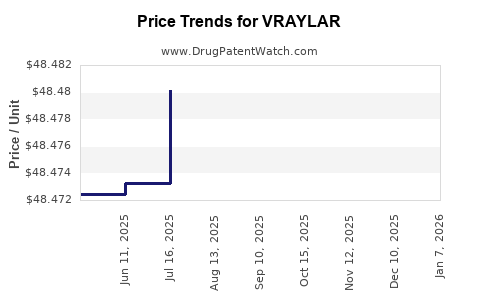
- What is Average Wholesale Price for VRAYLAR?
Summary for VRAYLAR
| US Patents: | 5 |
| Applicants: | 1 |
| NDAs: | 1 |
| Finished Product Suppliers / Packagers: | 1 |
| Raw Ingredient (Bulk) Api Vendors: | 44 |
| Clinical Trials: | 9 |
| Patent Applications: | 131 |
| Drug Prices: | Drug price information for VRAYLAR |
| Patent Litigation and PTAB cases: | See patent lawsuits and PTAB cases for VRAYLAR |
| What excipients (inactive ingredients) are in VRAYLAR? | VRAYLAR excipients list |
| DailyMed Link: | VRAYLAR at DailyMed |
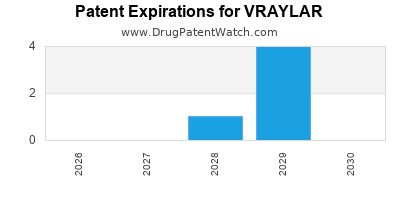
DrugPatentWatch® Estimated Loss of Exclusivity (LOE) Date for VRAYLAR
Generic Entry Date for VRAYLAR*:
Constraining patent/regulatory exclusivity:
NDA:
Dosage:
CAPSULE;ORAL |
*The generic entry opportunity date is the latter of the last compound-claiming patent and the last regulatory exclusivity protection. Many factors can influence early or later generic entry. This date is provided as a rough estimate of generic entry potential and should not be used as an independent source.
Recent Clinical Trials for VRAYLAR
Identify potential brand extensions & 505(b)(2) entrants
| Sponsor | Phase |
|---|---|
| The Medical Research Network | Phase 4 |
| AbbVie | Phase 4 |
| AbbVie | Phase 3 |
Pharmacology for VRAYLAR
| Drug Class | Atypical Antipsychotic |
Paragraph IV (Patent) Challenges for VRAYLAR
| Tradename | Dosage | Ingredient | Strength | NDA | ANDAs Submitted | Submissiondate |
|---|---|---|---|---|---|---|
| VRAYLAR | Capsules | cariprazine hydrochloride | 1.5 mg, 3 mg, 4.5 mg and 6 mg | 204370 | 3 | 2019-09-17 |
US Patents and Regulatory Information for VRAYLAR
VRAYLAR is protected by six US patents and three FDA Regulatory Exclusivities.
Based on analysis by DrugPatentWatch, the earliest date for a generic version of VRAYLAR is ⤷ Start Trial.
This potential generic entry date is based on patent ⤷ Start Trial.
Generics may enter earlier, or later, based on new patent filings, patent extensions, patent invalidation, early generic licensing, generic entry preferences, and other factors.
| Applicant | Tradename | Generic Name | Dosage | NDA | Approval Date | TE | Type | RLD | RS | Patent No. | Patent Expiration | Product | Substance | Delist Req. | Exclusivity Expiration |
|---|---|---|---|---|---|---|---|---|---|---|---|---|---|---|---|
| Abbvie | VRAYLAR | cariprazine hydrochloride | CAPSULE;ORAL | 204370-002 | Sep 17, 2015 | RX | Yes | No | ⤷ Start Trial | ⤷ Start Trial | ⤷ Start Trial | ||||
| Abbvie | VRAYLAR | cariprazine hydrochloride | CAPSULE;ORAL | 204370-004 | Sep 17, 2015 | RX | Yes | No | ⤷ Start Trial | ⤷ Start Trial | Y | ⤷ Start Trial | |||
| Abbvie | VRAYLAR | cariprazine hydrochloride | CAPSULE;ORAL | 204370-002 | Sep 17, 2015 | RX | Yes | No | ⤷ Start Trial | ⤷ Start Trial | Y | ⤷ Start Trial | |||
| Abbvie | VRAYLAR | cariprazine hydrochloride | CAPSULE;ORAL | 204370-002 | Sep 17, 2015 | RX | Yes | No | ⤷ Start Trial | ⤷ Start Trial | Y | ⤷ Start Trial | |||
| Abbvie | VRAYLAR | cariprazine hydrochloride | CAPSULE;ORAL | 204370-005 | Dec 18, 2025 | RX | Yes | No | ⤷ Start Trial | ⤷ Start Trial | Y | ⤷ Start Trial | |||
| Abbvie | VRAYLAR | cariprazine hydrochloride | CAPSULE;ORAL | 204370-001 | Sep 17, 2015 | RX | Yes | Yes | ⤷ Start Trial | ⤷ Start Trial | Y | ⤷ Start Trial | |||
| Abbvie | VRAYLAR | cariprazine hydrochloride | CAPSULE;ORAL | 204370-001 | Sep 17, 2015 | RX | Yes | Yes | ⤷ Start Trial | ⤷ Start Trial | ⤷ Start Trial | ||||
| >Applicant | >Tradename | >Generic Name | >Dosage | >NDA | >Approval Date | >TE | >Type | >RLD | >RS | >Patent No. | >Patent Expiration | >Product | >Substance | >Delist Req. | >Exclusivity Expiration |
International Patents for VRAYLAR
When does loss-of-exclusivity occur for VRAYLAR?
Based on analysis by DrugPatentWatch, the following patents block generic entry in the countries listed below:
Australia
Patent: 08249772
Estimated Expiration: ⤷ Start Trial
Brazil
Patent: 0811199
Estimated Expiration: ⤷ Start Trial
Canada
Patent: 84404
Estimated Expiration: ⤷ Start Trial
China
Patent: 1679315
Estimated Expiration: ⤷ Start Trial
Colombia
Patent: 41112
Estimated Expiration: ⤷ Start Trial
Croatia
Patent: 0170918
Estimated Expiration: ⤷ Start Trial
Cyprus
Patent: 19076
Estimated Expiration: ⤷ Start Trial
Denmark
Patent: 55696
Estimated Expiration: ⤷ Start Trial
Ecuador
Patent: 099772
Estimated Expiration: ⤷ Start Trial
Eurasian Patent Organization
Patent: 7270
Estimated Expiration: ⤷ Start Trial
Patent: 0971046
Estimated Expiration: ⤷ Start Trial
European Patent Office
Patent: 55696
Estimated Expiration: ⤷ Start Trial
Georgia, Republic of
Patent: 0125522
Estimated Expiration: ⤷ Start Trial
Hong Kong
Patent: 40473
Estimated Expiration: ⤷ Start Trial
Hungary
Patent: 0748
Estimated Expiration: ⤷ Start Trial
Patent: 00339
Estimated Expiration: ⤷ Start Trial
Patent: 34796
Estimated Expiration: ⤷ Start Trial
Patent: 700339
Estimated Expiration: ⤷ Start Trial
Japan
Patent: 10526861
Estimated Expiration: ⤷ Start Trial
Lithuania
Patent: 55696
Estimated Expiration: ⤷ Start Trial
Malaysia
Patent: 8078
Estimated Expiration: ⤷ Start Trial
Mexico
Patent: 09012182
Estimated Expiration: ⤷ Start Trial
Morocco
Patent: 434
Estimated Expiration: ⤷ Start Trial
New Zealand
Patent: 0642
Estimated Expiration: ⤷ Start Trial
Nicaragua
Patent: 0900203
Estimated Expiration: ⤷ Start Trial
Poland
Patent: 55696
Estimated Expiration: ⤷ Start Trial
Portugal
Patent: 55696
Estimated Expiration: ⤷ Start Trial
Serbia
Patent: 036
Patent: SOLI PIPERAZINA KAO D3/D2 ANTAGONISTI (PIPERAZINE SALTS AS D3/D2 ANTAGONISTS)
Estimated Expiration: ⤷ Start Trial
Slovenia
Patent: 55696
Estimated Expiration: ⤷ Start Trial
South Africa
Patent: 0907511
Patent: Novel piperazine salts as D3/D2 antagonists
Estimated Expiration: ⤷ Start Trial
South Korea
Patent: 1668973
Estimated Expiration: ⤷ Start Trial
Patent: 100018493
Estimated Expiration: ⤷ Start Trial
Patent: 150090264
Estimated Expiration: ⤷ Start Trial
Spain
Patent: 28025
Estimated Expiration: ⤷ Start Trial
Taiwan
Patent: 1002323
Patent: Novel piperazine salts as D3/D2 antagonists
Estimated Expiration: ⤷ Start Trial
Patent: 24846
Estimated Expiration: ⤷ Start Trial
Tunisia
Patent: 09000458
Patent: NOVEL PIPERAZINE SALTS AS D3/D2ANTAGONISTS
Estimated Expiration: ⤷ Start Trial
Ukraine
Patent: 2225
Patent: СОЛІ ПОХІДНИХ ПІПЕРАЗИНУ ЯК D3/D2-АНТАГОНІСТИ (SALTS OF PIPERAZINE DERIVATIVES AS D3/D2 ANTAGONISTS)
Estimated Expiration: ⤷ Start Trial
Generics may enter earlier, or later, based on new patent filings, patent extensions, patent invalidation, early generic licensing, generic entry preferences, and other factors.
See the table below for additional patents covering VRAYLAR around the world.
| Country | Patent Number | Title | Estimated Expiration |
|---|---|---|---|
| Australia | 2004261490 | (thio) carbamoyl-cyclohexane derivatives as D3/D2 receptor antagonists | ⤷ Start Trial |
| Brazil | PI0413283 | derivados de (tio)carbamoil-ciclohexano como antagonistas de receptor d3/d2 | ⤷ Start Trial |
| Canada | 2532818 | DERIVES DE (THIO) CARBAMOYL-CYCLOHEXANE UTILISES EN TANT QU'ANTAGONISTES DES RECEPTEURS D3/D2 ((THIO) CARBAMOYL-CYCLOHEXANE DERIVATIVES AS D3/D2 RECEPTOR ANTAGONISTS) | ⤷ Start Trial |
| China | 1829703 | (Thio)carbamoyl-cyclohexane derivatives as D3/D2 receptor antagonists | ⤷ Start Trial |
| Cyprus | 1113099 | ⤷ Start Trial | |
| Denmark | 1663996 | ⤷ Start Trial | |
| Eurasian Patent Organization | 009022 | ПРОИЗВОДНЫЕ (ТИО)КАРБАМОИЛЦИКЛОГЕКСАНА В КАЧЕСТВЕ АНТАГОНИСТОВ D/DРЕЦЕПТОРА ((THIO) CARBAMOYL-CYCLOHEXANE DERIVATIVES AS D3/D2 RECEPTOR ANTAGONISTS) | ⤷ Start Trial |
| >Country | >Patent Number | >Title | >Estimated Expiration |
Supplementary Protection Certificates for VRAYLAR
| Patent Number | Supplementary Protection Certificate | SPC Country | SPC Expiration | SPC Description |
|---|---|---|---|---|
| 1663996 | PA2017027 | Lithuania | ⤷ Start Trial | PRODUCT NAME: KARIPRAZINAS, DRUSKOS FORMOS, KONKRECIAI JO HIDROCHLORIDO DRUSKOS FORMOS, T.Y. KARIPRAZINO HIDROCHLORIDAS; REGISTRATION NO/DATE: EU/1/17/1209 20170713 |
| 1663996 | CR 2017 00042 | Denmark | ⤷ Start Trial | PRODUCT NAME: CARIPRAZINE, OPTIONALLY IN THE FORM OF A SALT, INCLUDING THE CARIPRAZINE HYDROCHLORIDE; REG. NO/DATE: EU/1/17/1209 20170717 |
| 1663996 | 122017000083 | Germany | ⤷ Start Trial | PRODUCT NAME: CARIPRAZIN, GEGEBENENFALLS IN FORM EINES SALZES, EINSCHLIESSLICH CARIPRAZINHYDROCHLORID; REGISTRATION NO/DATE: EU/1/17/1209 20170713 |
| 1663996 | 300913 | Netherlands | ⤷ Start Trial | PRODUCT NAME: CARIPRAZINE, OPTIONEEL IN DE VORM VAN EEN ZOUT, WAARONDER CARIPRAZINE HYDROCHLORIDE; REGISTRATION NO/DATE: EU/1/17/1209 20170717 |
| 1663996 | 47/2017 | Austria | ⤷ Start Trial | PRODUCT NAME: CARIPRAZIN, GEGEBENENFALLS IN FORM EINES SALZES, EINSCHLIESSLICH CARIPRAZIN HYDROCHLORID; REGISTRATION NO/DATE: EU/1/17/1209 (MITTEILUNG) 20170717 |
| 1663996 | LUC00039 | Luxembourg | ⤷ Start Trial | PRODUCT NAME: CARIPRAZINE, OPTIONALLY IN THE FORM OF A SALT, INCLUDING THE CARIPRAZINE HYDROCHLORIDE; AUTHORISATION NUMBER AND DATE: EU/1/17/1209 20170717 |
| 1663996 | 2017C/045 | Belgium | ⤷ Start Trial | PRODUCT NAME: CARIPRAZINE, EVENTUELLEMENT SOUS LA FORME D'UN SEL, Y COMPRIS L'HYDROCHLORURE DE CARIPRAZINE; AUTHORISATION NUMBER AND DATE: EU/1/17/1209 20170717 |
| >Patent Number | >Supplementary Protection Certificate | >SPC Country | >SPC Expiration | >SPC Description |
VRAYLAR (cariprazine) market dynamics and financial trajectory: exclusivity, competitive threats, and earnings exposure
More… ↓
DrugChatter Q&A for VRAYLAR
Make Better Decisions: Try a trial or see plans & pricing
Drugs may be covered by multiple patents or regulatory protections. All trademarks and applicant names are the property of their respective owners or licensors. Although great care is taken in the proper and correct provision of this service, thinkBiotech LLC does not accept any responsibility for possible consequences of errors or omissions in the provided data. The data presented herein is for information purposes only. There is no warranty that the data contained herein is error free. We do not provide individual investment advice. This service is not registered with any financial regulatory agency. The information we publish is educational only and based on our opinions plus our models. By using DrugPatentWatch you acknowledge that we do not provide personalized recommendations or advice. thinkBiotech performs no independent verification of facts as provided by public sources nor are attempts made to provide legal or investing advice. Any reliance on data provided herein is done solely at the discretion of the user. Users of this service are advised to seek professional advice and independent confirmation before considering acting on any of the provided information. thinkBiotech LLC reserves the right to amend, extend or withdraw any part or all of the offered service without notice.
ISSN: 2162-2639

Privacy and Cookies
Terms & Conditions
Site Map
DrugPatentWatch Alternatives
LOE / Major Patent Expirations 2026 - 2027
NCE-1 Patent Challenge Dates 2026 - 2027
Friedman, Yali. "DrugPatentWatch" DrugPatentWatch, thinkBiotech, 2026, www.DrugPatentWatch.com.
See Primary Research Papers Citing DrugPatentWatch