Last updated: September 24, 2026
Vivitrol, Alkermes plc's extended-release injectable naltrexone, remains a durable specialty pharmaceutical franchise despite competition from oral naltrexone, buprenorphine products, methadone, and newer long-acting opioid-use-disorder therapies. Its commercial strengths are monthly dosing, opioid-antagonist pharmacology, and use in criminal-justice, public-sector, and addiction-treatment programs. Its main risks are injection-site administration, reimbursement friction, patient-initiation requirements, and potential generic competition for the long-acting microsphere formulation.
Alkermes has reported sustained Vivitrol revenue growth in recent years, supported by demand for opioid-use-disorder treatment and alcohol-dependence therapy. The product is not a biologic, so biosimilar substitution is not the relevant risk. Any follow-on product would generally proceed through the abbreviated new drug application pathway, subject to formulation, bioequivalence, device, manufacturing, and patent barriers.
What is Vivitrol and how does it generate revenue?
Vivitrol is a once-monthly intramuscular injection containing extended-release naltrexone. The FDA approved it for:
- Prevention of relapse to opioid dependence after opioid detoxification.
- Alcohol dependence in patients able to abstain from drinking in an outpatient setting.
- Reduction of opioid use when used with psychosocial support in the opioid-dependence indication.
Vivitrol blocks opioid receptors rather than providing opioid agonism. Patients must be opioid-free before administration because precipitated withdrawal can occur if residual opioids are present. The product is administered by a health-care professional and cannot be self-injected.
The commercial model differs from oral naltrexone and many buprenorphine products. Alkermes and its distribution partners sell a controlled, office-administered treatment that can be purchased by clinics, correctional systems, government programs, hospitals, and specialty providers. The model supports adherence monitoring but creates acquisition, storage, administration, and reimbursement costs.
How has Vivitrol revenue changed over time?
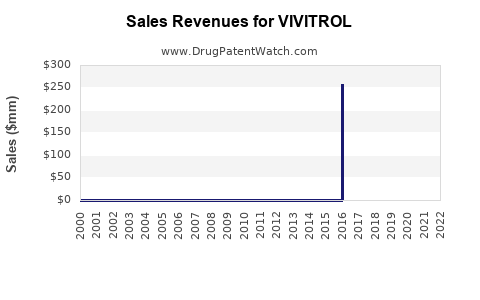
Vivitrol has remained one of Alkermes' principal marketed products. Public company filings show a generally rising revenue trajectory, although annual growth has varied with government purchasing, treatment-site activity, payer mix, and inventory timing.
| Fiscal year |
Vivitrol commercial position |
Financial direction |
| 2020 |
Established opioid-use-disorder franchise |
Demand affected by COVID-19 disruption to clinics and treatment access |
| 2021 |
Recovery in treatment activity |
Revenue increased as treatment capacity normalized |
| 2022 |
Continued franchise expansion |
Growth supported by government and institutional demand |
| 2023 |
Large established product with continued uptake |
Alkermes reported further Vivitrol revenue growth |
| 2024 |
Mature but expanding specialty product |
Continued contribution to Alkermes' proprietary-products portfolio |
Alkermes' annual reports identify Vivitrol as a major revenue contributor alongside Aristada and the company's central-nervous-system products. Vivitrol revenue has been in the hundreds of millions of dollars annually, while total Alkermes revenue has increasingly diversified through Lybalvi, Aristada, and other proprietary products.[1-4]
The main financial conclusion is that Vivitrol is a mature growth asset rather than a launch-stage product. Its value comes from recurring monthly dosing and institutional demand, not from rapid expansion of the treated population through a novel mechanism.
What market forces are driving Vivitrol demand?
The largest demand driver is the persistent treatment gap in opioid-use disorder. The United States has a large population with opioid-use disorder, while medication-assisted treatment remains underused. Expanded federal, state, Medicaid, employer, and criminal-justice treatment programs support demand for long-acting therapies.[5]
Public-sector and correctional-system demand
Vivitrol has benefited from adoption by government agencies and correctional systems. A monthly injection allows treatment administrators to verify administration and reduce concerns about daily diversion or nonadherence. These attributes are commercially important in settings where medication access and follow-up are difficult to control.
Government purchasing also creates concentration risk. Changes in state formularies, Medicaid policies, grant allocation, or correctional-health contracts can affect quarterly sales.
Alcohol-dependence demand
Alcohol dependence provides a second approved market. Vivitrol competes with oral naltrexone, acamprosate, disulfiram, behavioral therapy, and off-label pharmacological approaches. The injectable formulation can address adherence problems, but uptake is constrained by injection cost, provider capacity, and the need for regular visits.
Treatment infrastructure
Vivitrol demand depends on clinics capable of screening patients, confirming opioid abstinence, administering intramuscular injections, and managing adverse reactions. Growth in treatment infrastructure supports the product. Limited access to trained providers and inconsistent reimbursement restricts expansion.
How does Vivitrol compare with competing opioid-use-disorder drugs?
Vivitrol is differentiated by opioid antagonism and monthly dosing, but it does not have the same initiation profile as buprenorphine or methadone.
| Product or class |
Active ingredient |
Dosing |
Main commercial advantage |
Main limitation |
| Vivitrol |
Extended-release naltrexone |
Monthly injection |
No opioid agonist activity; observed administration |
Requires opioid-free period before initiation |
| Sublocade |
Buprenorphine |
Monthly injection |
Long-acting agonist treatment with established buprenorphine pathway |
Controlled-substance requirements and opioid-related risks |
| Brixadi |
Buprenorphine |
Weekly or monthly injection |
Flexible long-acting dosing |
Controlled-substance and initiation considerations |
| Oral buprenorphine |
Buprenorphine |
Daily or flexible |
Broad availability and lower acquisition cost |
Diversion, adherence, and daily dosing issues |
| Methadone |
Methadone |
Daily, generally through opioid-treatment programs |
Long clinical history and established efficacy |
Highly regulated dispensing structure |
| Oral naltrexone |
Naltrexone |
Daily |
Low acquisition cost and no opioid agonism |
Adherence risk |
Vivitrol's principal clinical-commercial disadvantage is the required opioid-free interval. Patients actively using opioids may prefer, or clinicians may choose, buprenorphine-based treatment because buprenorphine can be initiated during treatment of opioid withdrawal under established protocols.
The strongest competitive position for Vivitrol is in patients who prefer an opioid-antagonist approach, in programs emphasizing observed monthly treatment, and in institutional settings where diversion control is a priority.
What patents protect Vivitrol?
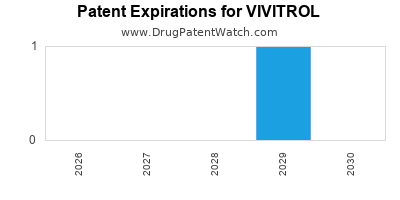
Vivitrol's intellectual-property protection is centered on the extended-release naltrexone microsphere formulation, manufacturing processes, dosage form, and method-of-use claims. The relevant portfolio is distinct from patents covering ordinary oral naltrexone.
The FDA Orange Book is the primary source for patents and regulatory exclusivity associated with the approved NDA. The current listing must be evaluated by product strength, approved indication, listed patent, and expiration date because a patent covering one aspect of Vivitrol may not prevent every possible follow-on product.[6]
What formulation patents protect Vivitrol?
The commercial barrier is the long-acting injectable formulation. A generic developer must reproduce a clinically and pharmaceutically equivalent extended-release microsphere product, not merely formulate naltrexone in an oral dosage form.
Key technical barriers include:
- Microsphere particle-size distribution.
- Polymer composition and degradation profile.
- Drug loading and release kinetics.
- Reconstitution and suspension characteristics.
- Injection-site tolerability.
- Manufacturing reproducibility at commercial scale.
- Demonstration of bioequivalence for a complex injectable product.
A follow-on manufacturer may need substantial development work even if the core composition claims have expired. The practical barrier is therefore a combination of patent scope, FDA requirements, manufacturing capability, and commercial economics.
What method-of-use patents cover Vivitrol?
Method-of-use protection can cover treatment of alcohol dependence, opioid dependence, relapse prevention, or patient populations receiving extended-release naltrexone. Method patents are potentially relevant to Paragraph IV litigation, but their practical value depends on claim breadth, induced-infringement theories, labeling, and the ability of a generic applicant to pursue a carve-out.
Unlike composition and formulation claims, method-of-use patents may not prevent all sales of a product if an applicant can omit the patented indication from its label. Their commercial impact depends on whether the protected indication is central to the product's demand.
When does Vivitrol lose exclusivity?
Vivitrol's regulatory exclusivity has expired. The product was approved in 2006, and the principal commercial question is patent-based generic entry rather than remaining new-drug exclusivity.[7]
There is no biosimilar exclusivity framework for Vivitrol because naltrexone is a small molecule, not a biologic. A competitor would normally seek approval through an ANDA, although the complexity of the injectable microsphere formulation could create regulatory hurdles beyond those associated with conventional tablets or capsules.
The precise loss-of-exclusivity date cannot be reduced to a single headline date without matching each current Orange Book listing to the applicant's proposed product and Paragraph IV certification. Patent expiration may remove one barrier while leaving other formulation, process, or method claims in force.
Which companies are challenging Vivitrol?
Publicly disclosed generic competition has centered on the possibility of ANDA filings for extended-release injectable naltrexone. The relevant competitive set includes generic-drug manufacturers with complex injectable capabilities, not only conventional oral-generic companies.
The principal risks are:
- An ANDA applicant files a Paragraph IV certification against one or more Orange Book patents.
- Alkermes files patent litigation within the statutory 45-day period.
- FDA approval is stayed for up to 30 months unless the litigation is resolved earlier or the court grants relief.
- The parties settle, the patents are invalidated or not infringed, or the applicant receives approval after the stay.
A public conclusion that a specific company has defeated Vivitrol patents requires a confirmed ANDA disclosure, district-court docket, settlement filing, or FDA approval record. The financial implication of a Paragraph IV filing would depend on the challenged patents, the lawsuit date, and the first-filer status.
What is the FDA regulatory status of Vivitrol?
Vivitrol is FDA-approved and commercially marketed in the United States under NDA 021897. It is a prescription, provider-administered intramuscular injection. The product is not a controlled substance because naltrexone is an opioid antagonist rather than an opioid agonist.[7]
The regulatory obligations that matter commercially include:
- Opioid screening before administration.
- Warning for precipitated opioid withdrawal.
- Risk of vulnerability to opioid overdose after treatment interruption.
- Injection-site reactions, including rare severe reactions.
- Administration only by a qualified health-care provider.
- Compliance with approved storage, preparation, and injection procedures.
The product's safety profile and administration requirements can increase medical liability concerns and limit use in low-resource settings.
What patent litigation and settlement risks affect Vivitrol?
The key litigation risk is a complex-injectable challenge rather than a conventional tablet patent case. A generic applicant may contest:
- Validity of formulation claims.
- Written-description and enablement requirements.
- Obviousness of the microsphere formulation.
- Infringement by a proposed generic composition.
- Scope of method-of-use patents.
- FDA listing accuracy under the Hatch-Waxman framework.
Settlement agreements could provide a generic entry date before full patent expiration. The economic effect would depend on whether entry is licensed, whether the first applicant receives exclusivity, and whether multiple generic entrants can launch simultaneously.
A successful challenge to core formulation claims would create substantially more risk than a challenge to a narrow method-of-use patent. Litigation analysis should therefore rank patents by the portion of Vivitrol sales they can practically block.
How strong is the Vivitrol patent estate?
The estate is commercially meaningful but weaker than that of a recently launched product with unexpired composition patents and long remaining exclusivity.
| Patent-estate factor |
Assessment |
| Regulatory exclusivity |
Expired |
| Biologic exclusivity |
Not applicable |
| Core active ingredient |
Mature and widely available |
| Long-acting formulation |
Technically difficult and potentially protected by claim-specific patents |
| Manufacturing know-how |
Important barrier, particularly for microsphere reproducibility |
| Method-of-use claims |
Potentially relevant but vulnerable to label carve-outs |
| Generic substitution risk |
Material, but timing depends on ANDA and litigation outcomes |
| Commercial durability |
Supported by institutional relationships and treatment infrastructure |
The strongest protection is likely the combined effect of formulation know-how, complex manufacturing, provider relationships, and market access. Patent protection alone is less likely to sustain long-term exclusivity than the full commercial system surrounding the product.
What generic launch scenarios exist for Vivitrol?
Early negotiated entry
Alkermes could settle with an ANDA applicant for a licensed entry date before the latest asserted patent expiration. This would reduce litigation uncertainty but accelerate price pressure.
Single generic entry
One approved generic could initially obtain limited market share while Alkermes retains substantial branded volume through institutional contracts, patient-support programs, and prescriber familiarity.
Multi-generic entry
Multiple approvals would increase discounting and payer substitution. Complex-injectable markets often have fewer suppliers than oral-generic markets, which could moderate erosion if manufacturing capacity remains constrained.
No near-term generic entry
A lack of approval could preserve Vivitrol revenue if formulation patents, FDA requirements, or manufacturing challenges delay competitors. This outcome would support continued cash generation but would not eliminate longer-term erosion risk.
What licensing deals and partnerships support Vivitrol?
Vivitrol's commercial value has been developed primarily through Alkermes' own product platform and commercial organization rather than through a high-profile recent external licensing transaction. The product benefits from relationships with public agencies, health systems, addiction-treatment providers, correctional systems, and specialty distributors.
For investors and business-development teams, the relevant partnership assets are:
- Government and Medicaid contracting experience.
- Provider education and injection infrastructure.
- Distribution and specialty-pharmacy access.
- Patient-assistance and reimbursement support.
- Institutional relationships that may be difficult for a new generic entrant to replicate.
These relationships can slow branded erosion but generally do not prevent pharmacy-level substitution where payer policies favor an approved generic.
What is the revenue exposure if Vivitrol faces generic competition?
Vivitrol is material to Alkermes but is no longer the company's only major commercial growth driver. The company also generates revenue from Aristada, Lybalvi, and other proprietary products. This diversification reduces the risk that Vivitrol erosion alone would destabilize the company.
A reasonable commercial stress framework is:
| Scenario |
Vivitrol impact |
Alkermes implication |
| No generic through the medium term |
Continued stable growth or plateau |
Supports cash flow and commercial investment |
| One generic with limited institutional uptake |
Moderate price and volume pressure |
Manageable if Lybalvi and Aristada grow |
| Broad multi-generic substitution |
Sharp net-price erosion |
Material pressure on margins and revenue mix |
| Product-specific manufacturing failure |
Temporary supply disruption |
Potential loss of contracts and prescriber confidence |
| Payer preference for buprenorphine injectables |
Slower volume growth |
Structural market-share pressure |
The financial risk is higher if generic entry occurs during a period of weak growth in Alkermes' other proprietary products. It is lower if Lybalvi and Aristada continue to offset Vivitrol erosion.
Key Takeaways
- Vivitrol is a mature, high-value injectable naltrexone franchise owned and marketed by Alkermes.
- Its core commercial advantages are monthly observed dosing, no opioid agonist activity, and strong use cases in public-sector and institutional treatment.
- Its main weaknesses are the opioid-free initiation requirement, injection administration, reimbursement complexity, and competition from buprenorphine products.
- Regulatory exclusivity has expired. The central exclusivity question is the remaining scope and duration of formulation, manufacturing, and method-of-use patents.
- Vivitrol is not exposed to biosimilar competition. A follow-on product would generally use the ANDA pathway.
- Generic entry could be delayed by complex microsphere manufacturing and FDA bioequivalence requirements, but those barriers do not eliminate long-term substitution risk.
- Alkermes' diversified portfolio reduces, but does not remove, the financial impact of Vivitrol price erosion.
- The most important forward indicators are Orange Book changes, Paragraph IV notices, ANDA litigation, settlement dates, FDA approvals, institutional contract renewals, and Vivitrol quarterly revenue.
FAQs About Vivitrol Patents, Generic Competition, and Market Outlook
Can Vivitrol be replaced by a generic naltrexone tablet?
No. Oral naltrexone is therapeutically related but is not equivalent to monthly extended-release injectable naltrexone. A generic Vivitrol competitor would need to demonstrate equivalence for the long-acting injectable dosage form.
Is Vivitrol a biologic drug?
No. Vivitrol contains naltrexone, a small-molecule active ingredient. Biosimilar approval rules do not apply.
Does Vivitrol have an orphan-drug exclusivity period?
Vivitrol's principal U.S. regulatory protection is not currently based on active orphan exclusivity. The product's commercial protection depends on patents, manufacturing, market access, and clinical adoption.
Why is Vivitrol harder to genericize than oral naltrexone?
The generic developer must reproduce the extended-release microsphere system, release profile, injection performance, and manufacturing consistency. These requirements are more complex than those for a conventional oral tablet.
What would most quickly reduce Vivitrol sales?
The most significant near-term threats would be approval of a therapeutically substitutable long-acting generic, broad payer-mandated substitution, loss of major government contracts, or continued market-share migration to long-acting buprenorphine products.
References
-
Alkermes plc. (2021). Annual report pursuant to Section 13 or 15(d) of the Securities Exchange Act of 1934 for the fiscal year ended December 31, 2020.
-
Alkermes plc. (2022). Annual report pursuant to Section 13 or 15(d) of the Securities Exchange Act of 1934 for the fiscal year ended December 31, 2021.
-
Alkermes plc. (2023). Annual report pursuant to Section 13 or 15(d) of the Securities Exchange Act of 1934 for the fiscal year ended December 31, 2022.
-
Alkermes plc. (2024). Annual report pursuant to Section 13 or 15(d) of the Securities Exchange Act of 1934 for the fiscal year ended December 31, 2023.
-
Substance Abuse and Mental Health Services Administration. (2023). 2023 National Survey on Drug Use and Health.
-
U.S. Food and Drug Administration. (2024). Approved drug products with therapeutic equivalence evaluations: Orange Book.
-
U.S. Food and Drug Administration. (2023). Vivitrol prescribing information. Alkermes, Inc.