Last updated: August 13, 2026
Vivelle-Dot is a mature estradiol transdermal patch with limited remaining brand protection and substantial generic competition. Its commercial value now depends on prescription retention, supply reliability, payer coverage, and the broader growth of menopausal hormone therapy rather than on exclusivity. Vivelle-Dot is a small-molecule product, so biosimilar risk is not relevant; generic estradiol patches are the primary competitive threat.
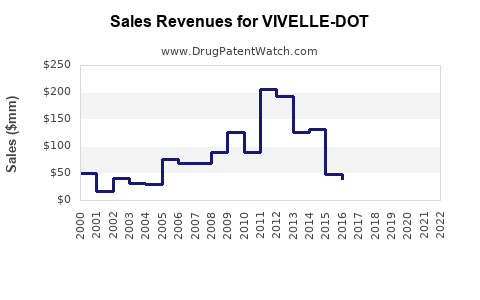
Standalone Vivelle-Dot revenue is not publicly reported. The product is part of a broader transdermal estrogen market that includes generic estradiol systems, Minivelle, Climara, Alora, generic equivalents, and oral estrogen products. The financial trajectory is therefore best characterized as a mature-brand decline or stabilization opportunity, not a growth product supported by patent exclusivity.
What is Vivelle-Dot and how does it compete in menopausal hormone therapy?
Vivelle-Dot is an estradiol transdermal system indicated for systemic estrogen replacement. The patch delivers 17-beta estradiol through the skin and is available in multiple strengths, including 0.025 mg/day, 0.0375 mg/day, 0.05 mg/day, 0.075 mg/day, and 0.1 mg/day products.[1]
The product is used for indications including:
- Treatment of moderate-to-severe vasomotor symptoms associated with menopause.
- Treatment of vulvar and vaginal atrophy.
- Prevention of postmenopausal osteoporosis in appropriate patients.
- Hypoestrogenism associated with female hypogonadism, although labeling and indication scope depend on the specific product.
Transdermal delivery avoids first-pass hepatic metabolism and is often selected when prescribers seek a lower-impact estrogen delivery route for certain thromboembolic or metabolic risk considerations. The product still carries the class-wide boxed warning for estrogen therapy, including risks related to endometrial cancer, cardiovascular disease, breast cancer, and probable dementia in relevant populations.[1]
The commercial differentiation of Vivelle-Dot is based primarily on patch size, dosing flexibility, adhesion, tolerability, and prescribing familiarity. Those advantages are difficult to protect indefinitely once generic transdermal systems are available.
What is the FDA regulatory status of Vivelle-Dot?
Vivelle-Dot was approved under FDA New Drug Application 020375. The product is an estradiol transdermal system manufactured and marketed through Noven-related entities. The FDA-approved product remains represented in U.S. drug-reference and labeling databases, although product availability can vary by strength, distributor, and pharmacy channel.[1][2]
| Regulatory attribute |
Vivelle-Dot status |
| Active ingredient |
Estradiol |
| Dosage form |
Transdermal patch |
| FDA pathway |
NDA 020375 |
| Therapeutic category |
Estrogen replacement therapy |
| Product type |
Small-molecule prescription drug |
| Primary competition |
Generic estradiol transdermal systems |
| Biosimilar pathway |
Not applicable |
| FDA exclusivity profile |
Mature and expired for practical commercial purposes |
| Orange Book relevance |
NDA and listed patents, if any, are the relevant reference-product framework |
FDA labeling identifies Vivelle-Dot as an estradiol transdermal system. The regulatory franchise is therefore tied to the reference product’s NDA, while generic applicants may rely on the product’s safety and efficacy findings through the abbreviated new drug application pathway.[1][3]
When did Vivelle-Dot lose exclusivity?
Vivelle-Dot’s core market exclusivity expired years ago. The product’s commercial protection was based on formulation, delivery-system, and product-specific patent rights rather than a currently active period of FDA new chemical entity exclusivity.
The practical loss of exclusivity occurred when FDA-approved generic estradiol patches entered the market. Generic transdermal estradiol products have been available from multiple manufacturers, including Mylan or Viatris, Sandoz, Teva, and other abbreviated new drug application sponsors depending on strength and market period.[3]
The key commercial conclusion is that Vivelle-Dot cannot rely on patent exclusivity to prevent substitution. Pharmacy substitution, payer formularies, rebate economics, and wholesale acquisition cost differences now determine much of the competitive outcome.
Vivelle-Dot patent expiration dates
The historical patent estate for estradiol transdermal products included claims directed to transdermal delivery systems, adhesive layers, drug reservoirs, and related formulation architecture. Patent terms associated with the original Vivelle and Vivelle-Dot development program have expired or are no longer sufficient to block routine generic entry.
A precise current patent-expiration date for each historical Vivelle-Dot patent is less commercially important than the generic approval record. The reference product has already experienced generic entry, demonstrating that surviving patent rights do not provide an effective market barrier.
| Protection category |
Commercial status |
| Estradiol active ingredient |
Long off-patent |
| Core transdermal delivery concept |
Long off-patent |
| Historical patch formulation patents |
Expired or commercially bypassed |
| FDA exclusivity |
Expired |
| Product-specific generic blocking position |
No longer effective |
| Current competitive barrier |
Manufacturing, supply, contracting, and brand demand |
How many patents protect Vivelle-Dot today?
No active patent estate appears to provide Vivelle-Dot with meaningful exclusionary control over the U.S. estradiol patch market. Historical patents may remain visible in patent databases or regulatory records, but their presence does not establish a current ability to prevent generic competition.
The relevant distinction is between:
- Patents historically associated with Vivelle-Dot or related estradiol patches.
- Patents listed in FDA regulatory records.
- Unexpired patents that can be asserted against a specific generic product.
- Patents with claims broad enough to cover commercially important patch designs.
For a mature transdermal product, manufacturing know-how may matter more than patents. Adhesive performance, drug crystallization control, release-rate consistency, pouch stability, skin tolerability, and scale-up reliability can create practical barriers without producing durable exclusivity.
Which companies are challenging Vivelle-Dot?
Generic competition has already replaced the traditional Paragraph IV challenge as the central commercial issue. Manufacturers of generic estradiol transdermal systems compete on approval status, supply continuity, contract pricing, and availability across dosage strengths.
Potential or historical competitors include:
- Viatris and legacy Mylan operations.
- Sandoz.
- Teva Pharmaceuticals.
- Other FDA-approved abbreviated new drug application sponsors.
- Authorized or private-label distributors sourcing approved generic patches.
Paragraph IV litigation is not the principal current risk profile for Vivelle-Dot. Paragraph IV certifications matter during the initial generic-entry phase, when an ANDA applicant challenges an unexpired listed patent. Once relevant patents expire or no longer support an injunction, competition shifts to ordinary generic commercialization.
What formulation patents protect Vivelle-Dot?
Vivelle-Dot’s product value historically depended on its matrix patch and transdermal delivery design. Formulation and device-related protection can cover:
- Estradiol concentration and dosage loading.
- Adhesive composition.
- Drug-release characteristics.
- Patch size and surface area.
- Backing layers and release liners.
- Stability during storage.
- Skin adhesion and removal performance.
- Manufacturing processes for coating and laminating the patch.
These attributes can affect clinical usability and manufacturing yield. They do not necessarily prevent generic competition because an ANDA applicant may develop a non-infringing formulation that demonstrates pharmaceutical equivalence and bioequivalence.
For investors and licensing teams, the relevant question is whether a formulation claim is both unexpired and broad enough to cover competing patches. For Vivelle-Dot, the existence of historical formulation patents does not support a current high-strength patent valuation.
Does Vivelle-Dot have method-of-use patent protection?
Method-of-use protection is not the main commercial defense for Vivelle-Dot. The product’s principal indications are established estrogen-replacement uses with extensive prior art and long clinical histories.
Potential method-of-use claims could involve:
- Treatment of vasomotor symptoms.
- Prevention of postmenopausal bone loss.
- Treatment of vulvar or vaginal atrophy.
- Patient-specific dosing or risk-management protocols.
Generic estrogen products can face labeling and carve-out issues for patented indications, but the broad menopausal hormone-therapy indications associated with Vivelle-Dot are mature. Method-of-use patents therefore do not create a meaningful current barrier comparable to a first-in-class therapy with a narrow, newly patented indication.
What is the Orange Book status of Vivelle-Dot?
The FDA Orange Book remains the relevant source for identifying the reference-listed drug, approved strengths, therapeutic equivalence codes, and any listed patents or exclusivity information.[3]
For business analysis, Vivelle-Dot’s Orange Book position should be interpreted as follows:
- The product is a reference NDA rather than a protected new chemical entity.
- Generic estradiol patches can compete through ANDA approvals.
- Therapeutic-equivalence designations support pharmacy and payer substitution where applicable.
- Historical patent listings do not establish current commercial exclusivity.
- The principal risk is generic price erosion, not a new wave of patent litigation.
The Orange Book does not measure brand loyalty, supply-chain reliability, physician preference, or manufacturer quality. Those factors can still produce meaningful differences between products carrying the same active ingredient.
What is the financial trajectory for Vivelle-Dot?
Vivelle-Dot’s standalone revenue is not separately disclosed in public financial reporting. Parent companies and commercial partners generally report broader women’s-health, hormone-therapy, or prescription-product revenue rather than product-level Vivelle-Dot sales.
The financial trajectory has four identifiable phases.
Launch and brand-building phase
Vivelle-Dot benefited from the expansion of transdermal estrogen therapy and from prescriber familiarity with patch-based hormone replacement. Product differentiation came from low-dose options, patch dimensions, dosing convenience, and a recognized brand.
Pre-generic commercialization
Before generic competition, revenue was supported by brand pricing, formulary positioning, and the absence of direct therapeutic equivalents. The product’s value was higher because the manufacturer controlled both price and distribution.
Generic-entry erosion
Generic estradiol patches reduced pricing power and increased substitution. The typical effects were:
- Lower average selling price.
- Reduced prescription share.
- Higher rebate and contracting pressure.
- Greater sensitivity to pharmacy inventory.
- Declining value of brand promotion.
- Increased importance of low-cost manufacturing.
Mature-market stabilization
After the initial erosion, demand can stabilize around a smaller base. Brand sales may persist when patients prefer a specific patch, clinicians value product consistency, or pharmacies experience generic shortages. Stabilization does not restore the former exclusivity economics.
| Financial driver |
Effect on Vivelle-Dot |
| Generic availability |
Strong negative pressure on volume and price |
| Menopausal hormone-therapy demand |
Supports category demand |
| Transdermal estrogen preference |
Supports patch segment |
| Brand familiarity |
Preserves a residual branded share |
| Payer substitution |
Accelerates generic conversion |
| Supply shortages |
Can temporarily support brand or alternative suppliers |
| Patent expiry |
Removes premium pricing protection |
| Manufacturing quality |
Can preserve contracts and repeat use |
How large is the market opportunity for transdermal estradiol?
The market remains commercially relevant because menopause care is a large recurring-prescription category and because transdermal estrogen is an established delivery route. Demand is influenced by:
- The number of women entering or living through menopause.
- Clinical interest in individualized hormone therapy.
- Prescriber preference for nonoral delivery.
- Patient adherence and patch tolerability.
- Availability of multiple low-dose strengths.
- Public discussion of menopause treatment and symptom management.
The category is not equivalent to a high-growth specialty pharmaceutical market. Transdermal estradiol is a mature genericized therapy. Growth in prescription volume can coexist with declining brand revenue if generic substitution captures incremental demand.
What generic entry risks exist for Vivelle-Dot?
The principal risks are ongoing generic substitution and further price compression. The risk is highest for strengths with several approved suppliers and lowest when supply is constrained.
Generic entry scenarios include:
| Scenario |
Expected commercial effect |
| One or two reliable generic suppliers |
Moderate price erosion; brand retains some share |
| Several competing generic suppliers |
Severe price and volume pressure |
| Generic manufacturing disruption |
Temporary brand or alternative-generic recovery |
| Payer-mandated substitution |
Rapid brand-volume decline |
| Product-specific adhesive or tolerability concerns |
Limited brand retention opportunity |
| New low-cost transdermal entrant |
Further market-share fragmentation |
Because Vivelle-Dot is a small molecule, biosimilar development does not create a separate risk category. The relevant regulatory competitors are ANDA-approved generic estradiol patches.
What manufacturing and intellectual-property barriers remain?
The remaining barriers are operational rather than exclusionary. Transdermal systems require consistent coating, lamination, drug distribution, adhesion, packaging, and stability performance. Manufacturing failures can trigger shortages, recalls, or loss of pharmacy and payer confidence.
Important technical risks include:
- Estradiol crystallization within the adhesive matrix.
- Variable drug release.
- Poor adhesion under heat, moisture, or movement.
- Skin irritation.
- Dose uniformity failures.
- Packaging-related stability problems.
- Limited manufacturing capacity for specific strengths.
- Quality-system deficiencies at contract manufacturing sites.
These barriers can support a premium for a reliable supplier, but they do not create patent-like market control.
How does Vivelle-Dot compare with other estrogen patches?
| Product or category |
Main competitive position |
Patent strength |
Commercial outlook |
| Vivelle-Dot |
Established brand, broad dose familiarity |
Weak as a current exclusionary estate |
Mature brand with residual demand |
| Generic estradiol patches |
Low-cost substitutes |
Generally no meaningful brand-level barrier |
Primary volume competitors |
| Climara and generic equivalents |
Weekly patch alternative |
Mature and genericized |
Competes on dosing frequency |
| Minivelle and generic equivalents |
Low-dose transdermal estrogen |
Mature and genericized |
Competes on low-dose prescribing |
| Oral estradiol |
Lower-cost systemic estrogen option |
Genericized |
Competes on price and route |
| Vaginal estrogen products |
Local therapy, different clinical use |
Product-specific |
Partial rather than direct substitution |
Vivelle-Dot’s strongest defensible attributes are prescribing familiarity, dose availability, and patient experience. Its weakest attributes are price, patent protection, and generic substitution resistance.
What litigation and settlement agreements affect Vivelle-Dot?
No current major patent-litigation pattern defines the commercial outlook for Vivelle-Dot. The relevant litigation window was the period when generic applicants challenged listed patents or sought entry around historical transdermal estradiol patents.
Settlement agreements, where applicable, would have mattered primarily by delaying generic launch, setting an authorized-generic framework, or allocating entry dates. Those mechanisms have limited present value because generic estradiol patches are already established in the market.
The current legal exposure is more likely to involve product liability, labeling, manufacturing quality, supply contracts, or ordinary ANDA disputes than a high-value exclusivity case.
What licensing deals influenced the Vivelle-Dot franchise?
Vivelle-Dot’s commercial history has involved branded pharmaceutical and women’s-health companies, including Novartis-associated commercialization and Noven-related ownership or marketing arrangements. Noven was acquired by Hisamitsu Pharmaceutical, expanding Hisamitsu’s position in transdermal and women’s-health products.[4]
The strategic value of the franchise in licensing or acquisition transactions is unlikely to rest on patent exclusivity alone. A buyer would evaluate:
- Remaining branded prescription volume.
- Manufacturing and supply rights.
- Geographic rights.
- Portfolio fit with other transdermal products.
- Payer contracts.
- Regulatory obligations.
- Product liability exposure.
- Ability to use the product as part of a broader menopause portfolio.
What is the geographic coverage of Vivelle-Dot?
Vivelle-Dot has had its strongest commercial relevance in the United States. International estradiol patch markets often use different brand names, dosage conventions, regulatory sponsors, and reimbursement systems.
Geographic value depends on:
- Local approval of the patch and strengths.
- National reimbursement rules.
- Generic substitution policy.
- Local patent and supplementary protection regimes.
- Manufacturing and distribution rights.
- Menopause-therapy prescribing patterns.
U.S. value is primarily a mature-brand and supply-chain proposition. International value requires country-by-country confirmation of marketing authorization and current commercial availability.
Key Takeaways
- Vivelle-Dot is an established estradiol transdermal patch marketed under FDA NDA 020375.
- Its core patents and regulatory exclusivity are no longer effective commercial barriers.
- Generic estradiol patches are the primary competitive threat.
- Biosimilar risk does not apply because estradiol is a small molecule.
- Standalone Vivelle-Dot revenue is not publicly disclosed.
- Revenue has likely followed the standard mature-brand pattern: pre-generic strength, generic-entry erosion, and residual stabilization.
- Current value rests on brand recognition, dosing options, patient experience, supply reliability, and prescriber familiarity.
- Formulation and manufacturing know-how remain operationally important but do not recreate patent exclusivity.
- The principal legal risks are ordinary generic, labeling, quality, and product-liability matters rather than a major live patent battle.
- Commercial upside is tied to growth in menopausal hormone therapy, while financial upside is constrained by generic pricing and substitution.
FAQs about Vivelle-Dot market dynamics and exclusivity
Is Vivelle-Dot still available by prescription?
Vivelle-Dot remains represented in FDA labeling and drug-reference records, but availability can vary by strength, manufacturer supply, wholesaler inventory, and pharmacy coverage.
Is generic estradiol patch the same as Vivelle-Dot?
FDA-approved generic estradiol patches are intended to provide pharmaceutical equivalents, but patients may notice differences in patch size, adhesive behavior, application experience, or skin tolerability.
Can a pharmacy automatically substitute generic estradiol for Vivelle-Dot?
Substitution depends on the product’s FDA therapeutic-equivalence designation, state pharmacy law, payer policy, and prescriber instructions.
Does Vivelle-Dot have pediatric or oncology market potential?
Its principal commercial market is menopausal and estrogen-replacement therapy. Pediatric and oncology uses are not the primary drivers of the product’s current financial value.
What would most improve Vivelle-Dot’s commercial value?
The strongest near-term commercial levers would be reliable supply, competitive contracting, differentiated patient-support services, favorable formulary placement, and evidence supporting patch tolerability or adherence. New patent exclusivity is not the central value driver.
References
-
U.S. Food and Drug Administration. (2022). Vivelle-Dot (estradiol transdermal system) prescribing information. https://www.accessdata.fda.gov/drugsatfda_docs/label/2022/020375s039lbl.pdf
-
National Library of Medicine. (n.d.). DailyMed: Vivelle-Dot estradiol transdermal system. https://dailymed.nlm.nih.gov/
-
U.S. Food and Drug Administration. (n.d.). Approved drug products with therapeutic equivalence evaluations, Orange Book. https://www.accessdata.fda.gov/scripts/cder/ob/
-
Hisamitsu Pharmaceutical Co., Inc. (2016). Annual report and corporate information regarding the acquisition of Noven Pharmaceuticals. https://www.hisamitsu.co.jp/eng/