Share This Page
Drug Sales Trends for VIVELLE-DOT
✉ Email this page to a colleague
Payment Methods and Pharmacy Types for VIVELLE-DOT (2022)
Revenues by Pharmacy Type
Units Sold by Pharmacy Type
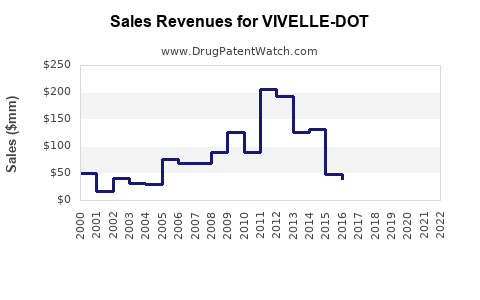
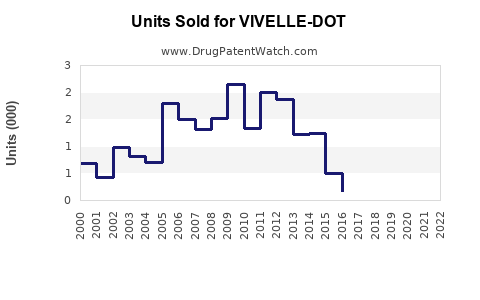
Annual Sales Revenues and Units Sold for VIVELLE-DOT
| Drug Name | Revenues (USD) | Units | Year |
|---|---|---|---|
| VIVELLE-DOT | ⤷ Start Trial | ⤷ Start Trial | 2022 |
| VIVELLE-DOT | ⤷ Start Trial | ⤷ Start Trial | 2021 |
| VIVELLE-DOT | ⤷ Start Trial | ⤷ Start Trial | 2020 |
| >Drug Name | >Revenues (USD) | >Units | >Year |
VIVELLE-DOT Market Analysis, Patent Status, Competitive Position, and Sales Projections
Vivelle-Dot is a transdermal estradiol product used for menopausal vasomotor symptoms, vulvar and vaginal atrophy, and estrogen-deficiency indications. Its commercial opportunity is now limited by generic estradiol patches, long-expired regulatory exclusivity, and multiple competing hormone-therapy delivery systems. The product remains commercially relevant as a brand benchmark, but its value is primarily in prescription retention, pharmacy availability, and patient familiarity rather than patent protection.
A modeled U.S. market estimate places Vivelle-Dot brand net sales at approximately $5 million to $15 million annually in the near term, with a base-case forecast of $8 million in 2025, declining to about $6 million by 2029. The broader U.S. estradiol patch market is estimated at roughly $100 million to $180 million in annual sales, depending on prescription volume, payer mix, and average realized price. These figures are market-model estimates, not reported company guidance.
What is Vivelle-Dot and how is it positioned in the hormone-therapy market?
Vivelle-Dot is an estradiol transdermal system. It delivers 17-beta estradiol through the skin at multiple dosage strengths, including 0.025 mg/day, 0.0375 mg/day, 0.05 mg/day, 0.075 mg/day, and 0.1 mg/day configurations. The patch is generally replaced twice weekly, which differentiates it from once-weekly products such as Climara.
The product is used in hormone replacement therapy for:
- Moderate-to-severe vasomotor symptoms associated with menopause.
- Moderate-to-severe symptoms of vulvar and vaginal atrophy.
- Hypoestrogenism caused by hypogonadism, castration, or primary ovarian failure.
- Prevention of postmenopausal osteoporosis in selected patients when alternatives are inappropriate.
The FDA label states that systemic estrogen therapy carries risks that must be evaluated against individual patient factors, including cardiovascular, thromboembolic, breast-cancer, and endometrial risks. Patients with an intact uterus generally require appropriate progestogen protection when systemic estrogen is prescribed. (U.S. Food and Drug Administration, 2023)
How large is the U.S. estradiol patch market?
The transdermal estradiol market is a specialized segment within menopausal hormone therapy. It competes with oral estradiol, topical gels, sprays, vaginal estrogen products, compounded preparations, and nonhormonal therapies.
Estimated market structure
| Segment | Estimated U.S. annual value | Primary products |
|---|---|---|
| Estradiol transdermal patches | $100 million-$180 million | Generic estradiol, Vivelle-Dot, Dotti, Climara |
| Oral estradiol | $150 million-$250 million | Generic oral estradiol |
| Estradiol gels and sprays | $75 million-$150 million | EstroGel, Divigel, Evamist |
| Vaginal estrogen products | $500 million-$800 million | Estradiol tablets, creams, rings, inserts |
| Combined estrogen/progestin products | $200 million-$350 million | Bijuva, Activella, Combipatch and generics |
These estimates reflect market structure and publicly available product information rather than audited product-level sales. Retail prices vary substantially by payer, dosage strength, package size, rebates, and dispensing channel.
The patch segment has several attractive clinical characteristics:
- Transdermal delivery avoids first-pass hepatic metabolism.
- The product permits lower systemic exposure at selected doses.
- Patch therapy is familiar to clinicians and patients.
- Twice-weekly dosing creates a recurring prescription base.
- The segment benefits from continued use of menopausal hormone therapy in appropriately selected patients.
The main commercial constraint is substitution. Generic estradiol patches are therapeutically close substitutes, and prescribers often accept automatic pharmacy substitution where state law and payer policy permit it.
What are Vivelle-Dot sales and revenue projections?
Novartis and later product owners have not provided a recent standalone public revenue series for Vivelle-Dot. The forecast below uses a bottom-up market model based on estimated U.S. patch volume, average realized revenue, generic penetration, and brand retention.
Base-case sales forecast
| Year | Estimated U.S. estradiol patch market | Vivelle-Dot share assumption | Estimated Vivelle-Dot net sales |
|---|---|---|---|
| 2024 | $105 million-$165 million | 5%-8% | $6 million-$11 million |
| 2025 | $110 million-$170 million | 4%-7% | $6 million-$10 million |
| 2026 | $115 million-$175 million | 4%-6% | $5 million-$9 million |
| 2027 | $120 million-$180 million | 3%-6% | $5 million-$8 million |
| 2028 | $125 million-$185 million | 3%-5% | $4 million-$8 million |
| 2029 | $130 million-$190 million | 3%-5% | $4 million-$7 million |
The base-case point estimate is:
| Year | Point estimate |
|---|---|
| 2025 | $8 million |
| 2026 | $7 million |
| 2027 | $6.5 million |
| 2028 | $6 million |
| 2029 | $6 million |
The forecast assumes that the total transdermal estradiol market grows at approximately 2% to 4% annually, supported by population aging and continued demand for menopausal symptom treatment. That growth is offset by generic price pressure and declining brand share.
Bull and bear cases
| Scenario | 2025 sales | 2029 sales | Core assumptions |
|---|---|---|---|
| Bull case | $14 million | $13 million | Brand retention, supply reliability, limited formulary substitution |
| Base case | $8 million | $6 million | Continued generic erosion with stable category growth |
| Bear case | $3 million | $1 million-$2 million | Broad formulary exclusion, further generic price compression, reduced brand availability |
The most material variable is not clinical demand. It is the percentage of prescriptions dispensed as branded Vivelle-Dot rather than generic estradiol.
What companies compete with Vivelle-Dot?
Vivelle-Dot competes with branded and generic transdermal products.
Direct patch competitors
| Product | Active ingredient | Dosing profile | Competitive position |
|---|---|---|---|
| Generic estradiol transdermal system | Estradiol | Usually twice weekly | Primary substitution threat |
| Dotti | Estradiol | Twice weekly | Close branded/generic alternative |
| Climara | Estradiol | Once weekly | Competes on dosing convenience |
| Minivelle | Estradiol | Twice weekly | Similar product profile; availability varies |
| Generic estradiol matrix patches | Estradiol | Twice weekly or weekly | Price-led competition |
The key competitive distinction is dosing frequency. Vivelle-Dot and Dotti are associated with twice-weekly delivery, while Climara is generally used once weekly. Some patients prefer twice-weekly patches because of smaller systems or perceived adhesion and symptom-control characteristics. Others prefer once-weekly administration.
Indirect competitors
Indirect competitors include:
- Oral estradiol.
- Estrogen gels, including EstroGel and Divigel.
- Estrogen sprays.
- Vaginal estrogen products for predominantly genitourinary symptoms.
- Combined estrogen/progestin products.
- Selective estrogen receptor modulators and tissue-selective estrogen complexes.
- Nonhormonal treatments for vasomotor symptoms.
The commercial threat from oral estradiol is significant because it is inexpensive and widely available. The patch retains a clinical positioning advantage for patients and prescribers seeking transdermal administration.
What patents protect Vivelle-Dot?
Vivelle-Dot no longer has a meaningful patent-based exclusivity position in the United States. The product’s principal commercial protections were associated with the transdermal delivery system, patch construction, adhesive design, and estradiol delivery technology. Those protections have expired or no longer prevent generic competition.
Patent and exclusivity summary
| Protection category | Status |
|---|---|
| FDA new-drug exclusivity | Expired |
| Primary product patents | Expired or no longer commercially blocking |
| Formulation and patch-adhesion patents | No known active protection that prevents generic estradiol patch competition |
| Method-of-use patents | Not a material barrier to current generic substitution |
| Orphan-drug exclusivity | Not applicable |
| Biosimilar exclusivity | Not applicable |
| Current market exclusivity | None identified in the FDA product records cited |
The FDA approved generic estradiol transdermal systems through the abbreviated new drug application pathway. Generic applicants can rely on the reference product’s safety and efficacy findings while demonstrating pharmaceutical equivalence and bioequivalence under the applicable FDA requirements. (U.S. Food and Drug Administration, 2024a)
What is the Orange Book status of Vivelle-Dot?
The Orange Book is the relevant FDA source for listed patents and regulatory exclusivity associated with approved drug products. Vivelle-Dot does not have an active Orange Book patent position that materially delays generic entry in the United States.
The commercial consequences are direct:
- Generic manufacturers can compete without waiting for a future patent expiry date.
- Pharmacy substitution can occur where permitted by state law and payer rules.
- Brand pricing is constrained by generic reimbursement benchmarks.
- Any remaining brand premium must be supported by supply reliability, prescriber loyalty, patient preference, or formulary treatment.
The product’s regulatory status is therefore mature rather than protected. FDA approval remains important for continued marketing, but approval does not provide exclusivity once applicable patents and regulatory protections have expired. (U.S. Food and Drug Administration, 2024b)
When did Vivelle-Dot lose exclusivity?
Vivelle-Dot lost meaningful U.S. exclusivity after the expiry of its applicable product and delivery-system patents and the subsequent approval of generic estradiol patches. Generic competition was established years ago, and the product is no longer in a market protected by new-drug exclusivity.
The exclusivity timeline is broadly:
| Period | Event |
|---|---|
| 1990s-early 2000s | Development and commercialization of estradiol transdermal systems |
| 2002 | FDA approval of Vivelle-Dot formulation under its approved new drug application |
| Late 2000s-2010s | Patent expiry and increasing generic competition |
| 2010s | Wider availability of generic estradiol patch products |
| 2020s | Mature, price-sensitive patch market with limited brand protection |
Exact patent-by-patent expiry analysis depends on the specific patent family, terminal disclaimers, patent-term adjustments, and jurisdiction. None of those factors restores a practical U.S. exclusivity barrier for Vivelle-Dot.
Were there Paragraph IV challenges to Vivelle-Dot?
Generic manufacturers commonly use Paragraph IV certifications when asserting that listed patents are invalid, unenforceable, or not infringed. Historical generic entry into the estradiol patch category included patent certification and litigation risk analysis.
For Vivelle-Dot, Paragraph IV activity is no longer a major commercial issue because the relevant patent barriers have expired or ceased to block generic sales. The present risk is ordinary generic competition rather than a pending Paragraph IV event.
No current Paragraph IV proceeding is required to explain the product’s market erosion. The primary drivers are:
- Expired patent protection.
- Multiple approved generic products.
- Payer preference for lower-cost alternatives.
- Pharmacy-level substitution.
- Low switching costs among equivalent estradiol patch products.
What formulation patents protect the Vivelle-Dot patch?
Vivelle-Dot’s technical differentiation is tied to its patch construction and transdermal delivery system. Relevant product attributes include:
- Estradiol release through a matrix patch.
- Adhesive performance.
- Small patch size.
- Twice-weekly administration.
- Controlled drug release across the skin.
- Packaging and stability characteristics.
Those characteristics may support product differentiation, but they do not create a current blocking patent estate. Generic manufacturers can market equivalent estradiol transdermal systems after satisfying FDA requirements for pharmaceutical equivalence, bioequivalence, quality, and manufacturing controls.
The practical barrier is therefore manufacturing execution rather than enforceable exclusivity. Patch manufacture requires control of:
- Drug loading and content uniformity.
- Adhesive composition.
- In-process coating and lamination.
- Release-rate consistency.
- Packaging integrity.
- Stability through the labeled shelf life.
- Skin adhesion and residual drug performance.
These requirements can create operational barriers for new entrants, but they are not comparable with the development barriers associated with biologics or complex injectable products.
Does Vivelle-Dot face biosimilar competition?
No. Vivelle-Dot is a chemically synthesized estradiol transdermal system, not a biologic. Biosimilar regulation under the Public Health Service Act does not apply.
The relevant competitors are generic drugs approved under the abbreviated new drug application pathway. Competitive risk is therefore driven by generic abbreviated approvals, manufacturing capacity, pricing, and pharmacy substitution rather than biosimilar interchangeability.
What litigation and settlement agreements affect Vivelle-Dot?
Vivelle-Dot’s current commercial outlook is not dependent on a major active patent litigation settlement. Historical patent disputes may have affected the timing or conditions of generic entry, but those disputes no longer provide a durable barrier to competition.
For investment and licensing analysis, the relevant conclusion is that litigation optionality is low. A potential acquirer would not be buying a litigation-protected asset. It would be acquiring a mature prescription product with limited legal leverage and a declining brand premium.
Who owns or markets Vivelle-Dot?
Vivelle-Dot was originally associated with Novartis. Product commercialization later involved Noven Pharmaceuticals, a company known for transdermal drug-delivery products. Noven was acquired by Hisamitsu Pharmaceutical in 2016. Product ownership, manufacturing, and marketing arrangements can vary by territory and time period.
The commercial chain should be evaluated separately from patent ownership. A company may hold marketing rights without controlling legacy patents, manufacturing know-how, or global regulatory rights.
Geographic coverage
The United States remains the most commercially important market for the Vivelle-Dot brand. Estradiol patch products are also marketed internationally under different brand names, strengths, packaging, and regulatory labels. European, Canadian, Australian, and Asian markets have different reimbursement systems and may not use the Vivelle-Dot name.
International revenue estimates are less reliable because:
- Brand names differ by country.
- Generic substitution rules vary.
- Estradiol patch availability is uneven.
- Public product-level sales data are limited.
- Some territories use centralized or tender-based purchasing.
A reasonable commercial assumption is that non-U.S. Vivelle-Dot-branded revenue is materially smaller than the combined global estradiol transdermal market.
How strong is the Vivelle-Dot commercial position?
Vivelle-Dot has moderate clinical recognition but weak legal protection.
| Factor | Assessment |
|---|---|
| Clinical utility | Established |
| Prescriber familiarity | Moderate to high |
| Brand recognition | Moderate |
| Patent strength | Weak or none for current market protection |
| Generic substitution risk | High |
| Manufacturing complexity | Moderate |
| Pricing power | Low |
| Regulatory risk | Low for an approved mature product |
| Revenue growth potential | Low |
| Licensing value | Limited unless bundled with a broader women’s-health portfolio |
The strongest remaining assets are brand familiarity, an established label, commercial relationships, and a known twice-weekly delivery format. The weakest assets are exclusivity, pricing power, and protection against generic substitution.
What generic launch scenarios exist?
Scenario one: stable generic substitution
Generic estradiol remains widely available, but supply interruptions or uneven wholesaler coverage allow Vivelle-Dot to retain a small branded share. Brand sales decline gradually, with annual revenue stabilizing near $5 million to $8 million.
Scenario two: accelerated brand erosion
Payers and pharmacy benefit managers move Vivelle-Dot to nonpreferred status. Generic products capture most new prescriptions and a growing share of refill prescriptions. Brand sales fall below $5 million annually.
Scenario three: supply-driven brand recovery
A shortage or quality issue affects one or more generic manufacturers. Vivelle-Dot gains temporary prescription share, particularly among patients who cannot tolerate switching. The effect would likely be temporary unless the manufacturer expands contracting and payer access.
Scenario four: product withdrawal or restricted availability
If manufacturing economics deteriorate, reduced distribution or discontinuation could shift remaining demand to Dotti, generic estradiol, Climara, and other transdermal products. This is a credible long-term risk for mature low-margin brands.
Key Takeaways
- Vivelle-Dot is an established estradiol transdermal patch with no meaningful remaining U.S. patent exclusivity.
- Generic estradiol patches are the primary competitive threat.
- The U.S. estradiol patch market is estimated at $100 million to $180 million annually.
- Vivelle-Dot brand sales are modeled at approximately $6 million to $11 million in 2024 and $4 million to $7 million by 2029.
- A base-case forecast places 2025 brand sales at approximately $8 million.
- Paragraph IV litigation and biosimilar risk are not major current drivers.
- The principal value drivers are manufacturing reliability, pharmacy availability, payer access, and brand retention.
- The product has limited standalone licensing value unless included in a broader menopause or women’s-health portfolio.
FAQs
Is Vivelle-Dot still available in the United States?
Vivelle-Dot has been marketed as an FDA-approved estradiol transdermal system, but availability can vary by wholesaler, pharmacy, dosage strength, and manufacturer distribution decisions. Generic estradiol patches are more broadly used.
Is generic estradiol patch equivalent to Vivelle-Dot?
FDA-approved generic estradiol patches must meet applicable requirements for pharmaceutical equivalence and bioequivalence. Patch size, adhesive characteristics, packaging, and patient experience may differ even when the products contain the same active ingredient and deliver labeled doses.
Is Vivelle-Dot more profitable than generic estradiol?
Generally, no. Vivelle-Dot may command a brand premium in selected channels, but generic substitution and payer reimbursement limits reduce its realized margin and revenue potential.
What is the main reason to prescribe Vivelle-Dot instead of oral estradiol?
The main reason is transdermal delivery. Some clinicians prefer patches for patients where avoiding first-pass hepatic metabolism or using a transdermal route is clinically appropriate.
Could a new patent revive Vivelle-Dot exclusivity?
A new patent would need to cover a genuinely novel and non-obvious product, formulation, manufacturing process, or approved use. A new patent would not automatically restore broad exclusivity over the existing Vivelle-Dot product or prevent existing generic estradiol patch competition.
References
-
Hisamitsu Pharmaceutical Co., Inc. (2016). Acquisition of Noven Pharmaceuticals, Inc. https://www.hisamitsu.co.jp/english/
-
U.S. Food and Drug Administration. (2023). Vivelle-Dot prescribing information. https://www.accessdata.fda.gov/drugsatfda_docs/label/
-
U.S. Food and Drug Administration. (2024a). Approved drug products with therapeutic equivalence evaluations. https://www.accessdata.fda.gov/scripts/cder/ob/
-
U.S. Food and Drug Administration. (2024b). Drugs@FDA: FDA-approved drugs. https://www.accessdata.fda.gov/scripts/cder/daf/
-
U.S. Food and Drug Administration. (2024c). Orange Book: Approved drug products with therapeutic equivalence evaluations. https://www.fda.gov/drugs/drug-approvals-and-databases/orange-book-data-files.
More… ↓
