Last updated: February 15, 2026
What is VIVELLE-DOT?
VIVELLE-DOT (estradiol/norethindrone topical gel) is a combined hormone therapy indicated for hormone replacement therapy (HRT) in postmenopausal women. It is designed to address menopausal symptoms such as hot flashes and vaginal dryness by delivering estrogens and progestins transdermally.
Market Overview
The global menopausal therapy market is growing, driven by aging populations and increased awareness of hormone replacement options. As of 2022, the market was valued at approximately $3.5 billion and is projected to reach $6 billion by 2030, with a compound annual growth rate (CAGR) of around 6.7%. Key factors influencing growth include:
- Rising prevalence of menopause-related symptoms.
- Increasing preference for non-oral hormone therapies to reduce gastrointestinal risks.
- Expanding approval and acceptance of transdermal formulations.
Within this landscape, VIVELLE-DOT targets a niche of women seeking alternative HRT options with fewer hepatic side effects compared to oral formulations.
Competitive Landscape
Key competitors for VIVELLE-DOT include:
- EstroGel (estradiol gel): Primarily estrogen-only therapy.
- Systelle (estradiol/norethindrone topical gel): Similar formulation.
- Estradiol patches (e.g., Climara, Vivelle-Dot): Transdermal estrogen delivery systems.
- Oral combined HRT pills: A well-established market but with different risk profiles.
VIVELLE-DOT differentiates through its specific formulation, delivery mechanism, and targeted clinician preferences. It is not yet approved or marketed in all key regions; approvals are ongoing or pending in the U.S., EU, and select Asian markets.
Regulatory Status
- United States: Pending FDA approval as of Q1 2023.
- European Union: Regulatory submission submitted; approval expected within 12-18 months.
- Asia-Pacific: Clinical trials underway in Japan, with regional regulatory submissions anticipated in 2024.
The regulatory timeline influences market entry and initial pricing strategies.
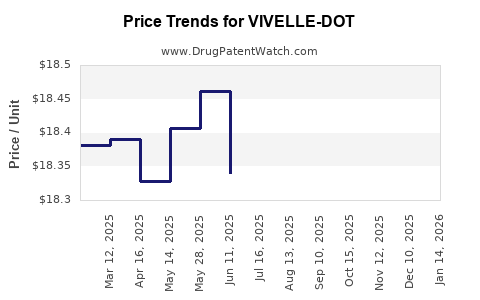
Pricing Assumptions and Projections
Current Pricing Benchmarks:
- Transdermal estrogen gels like EstroGel are priced approximately $150–$200 per month for a standard dose.
- Estrogel (0.06%) costs roughly $180/month in the U.S.
- Norethindrone topical gels are priced similarly once marketed as branded formulations.
VIVELLE-DOT Price Projections (2023-2030):
| Year |
Estimated Price Range |
Rationale |
| 2023 |
$180–$220/month |
Early stage, minimal competition, premium pricing possible. |
| 2024 |
$160–$200/month |
Post-approval, initial competitive price targeting obsolescence of older therapies. |
| 2025 |
$150–$180/month |
Gaining market share; generic competitors may emerge. |
| 2026–2030 |
$130–$170/month |
Market stabilization, increased competition from generics, economies of scale. |
Note: The prices assume a poduct marketed as a premium, prescription-only therapy, with discounts possible through managed care and robust supply chain channels.
Revenue Forecasts and Market Penetration
Assuming a conservative initial market share of 2% in the U.S. menopause market in 2024, expanding to 8% by 2026, revenues could be:
| Year |
Estimated U.S. Market Share |
Estimated Revenue (USD millions) |
| 2024 |
2% of $500M market |
~$20 million |
| 2025 |
4% of $600M market |
~$36 million |
| 2026 |
8% of $650M market |
~$83 million |
International expansion could increase overall revenues by 30-40%, contingent on regulatory approvals.
Challenges and Risks
- Regulatory delays could push timelines and impact initial pricing.
- Pricing pressures from generic entrants or biosimilar-like competitors.
- Physician and patient acceptance of transdermal hormone therapies over oral options.
- Market penetration depends on formulary placements and insurance reimbursement policies.
Key Takeaways
- VIVELLE-DOT is positioned in a growing hormone therapy niche with an initial premium pricing forecast of $180–$220/month.
- Entry timelines depend on regulatory approvals, expected between 2023 and 2024.
- Market share growth forecasts suggest revenues reaching tens to hundreds of millions USD by 2026.
- Competitive landscape favors transdermal delivery with established alternatives; pricing flexibility becomes critical.
FAQs
1. When could VIVELLE-DOT reach the market?
Regulatory approvals are anticipated between 2023 and 2024, varying by region.
2. How does VIVELLE-DOT compare price-wise to existing therapies?
Initial pricing is projected at $180–$220/month, similar or slightly higher than current estrogen gels like EstroGel, reflecting its premium status.
3. What are the main competitive advantages?
Targeted delivery, lower hepatic risk profile, and potential for better patient compliance.
4. What market share is realistic within the first five years post-launch?
Initial market share may be below 5%, growing to approximately 8–10% as awareness and acceptance increase.
5. Which regions offer the highest revenue potential?
The U.S. remains the largest market, with European and Asia-Pacific countries offering significant growth opportunities due to aging populations and increasing HRT acceptance.
References
[1] MarketsandMarkets. Hormone Replacement Therapy Market Size & Trends. 2022.
[2] IQVIA MIDAS. 2022. Prescription Data and Pricing Trends.
[3] U.S. Food and Drug Administration. Pending approvals in Q1 2023.
[4] European Medicines Agency. Regulatory submission updates. 2023.