Last Updated: November 16, 2026

VAFSEO Drug Patent Profile

« Back to Dashboard


Which patents cover Vafseo, and when can generic versions of Vafseo launch?

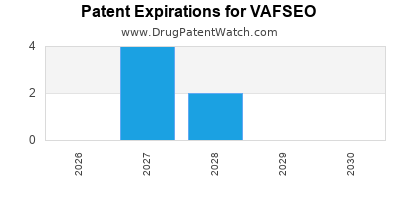
Vafseo is a drug marketed by Akebia and is included in one NDA. There are fourteen patents protecting this drug.

The generic ingredient in VAFSEO is vadadustat. There is one drug master file entry for this compound. One supplier is listed for this compound. Additional details are available on the vadadustat profile page.

DrugPatentWatch® Generic Entry Outlook for Vafseo

Vafseo will be eligible for patent challenges on March 27, 2028. This date may extended up to six months if a pediatric exclusivity extension is applied to the drug's patents.

By analyzing the patents and regulatory protections it appears that the earliest date for generic entry will be March 31, 2036. This may change due to patent challenges or generic licensing.

There has been one patent litigation case involving the patents protecting this drug, indicating strong interest in generic launch. Recent data indicate that 63% of patent challenges are decided in favor of the generic patent challenger and that 54% of successful patent challengers promptly launch generic drugs.

Indicators of Generic Entry

< Available with Subscription >

  Start Trial

AI Deep Research
Questions you can ask:
  • What is the 5 year forecast for VAFSEO?
  • What are the global sales for VAFSEO?
  • What is Average Wholesale Price for VAFSEO?
Summary for VAFSEO
DrugPatentWatch® Estimated Loss of Exclusivity (LOE) Date for VAFSEO
Generic Entry Date for VAFSEO*:
Constraining patent/regulatory exclusivity:
NDA:
Dosage:

TABLET;ORAL

*The generic entry opportunity date is the latter of the last compound-claiming patent and the last regulatory exclusivity protection. Many factors can influence early or later generic entry. This date is provided as a rough estimate of generic entry potential and should not be used as an independent source.

Recent Clinical Trials for VAFSEO

Identify potential brand extensions & 505(b)(2) entrants

SponsorPhase
Akebia TherapeuticsPHASE3
USRC Kidney ResearchPHASE3

See all VAFSEO clinical trials

US Patents and Regulatory Information for VAFSEO

VAFSEO is protected by fourteen US patents and one FDA Regulatory Exclusivity.

Based on analysis by DrugPatentWatch, the earliest date for a generic version of VAFSEO is ⤷  Start Trial.

This potential generic entry date is based on patent ⤷  Start Trial.

Generics may enter earlier, or later, based on new patent filings, patent extensions, patent invalidation, early generic licensing, generic entry preferences, and other factors.

Applicant Tradename Generic Name Dosage NDA Approval Date TE Type RLD RS Patent No. Patent Expiration Product Substance Delist Req. Exclusivity Expiration
Akebia VAFSEO vadadustat TABLET;ORAL 215192-003 Mar 27, 2024 DISCN Yes No ⤷  Start Trial ⤷  Start Trial Y Y ⤷  Start Trial
Akebia VAFSEO vadadustat TABLET;ORAL 215192-003 Mar 27, 2024 DISCN Yes No ⤷  Start Trial ⤷  Start Trial ⤷  Start Trial
Akebia VAFSEO vadadustat TABLET;ORAL 215192-002 Mar 27, 2024 RX Yes No ⤷  Start Trial ⤷  Start Trial Y Y ⤷  Start Trial
Akebia VAFSEO vadadustat TABLET;ORAL 215192-003 Mar 27, 2024 DISCN Yes No ⤷  Start Trial ⤷  Start Trial ⤷  Start Trial
Akebia VAFSEO vadadustat TABLET;ORAL 215192-002 Mar 27, 2024 RX Yes No ⤷  Start Trial ⤷  Start Trial Y ⤷  Start Trial
Akebia VAFSEO vadadustat TABLET;ORAL 215192-001 Mar 27, 2024 RX Yes No ⤷  Start Trial ⤷  Start Trial ⤷  Start Trial
>Applicant >Tradename >Generic Name >Dosage >NDA >Approval Date >TE >Type >RLD >RS >Patent No. >Patent Expiration >Product >Substance >Delist Req. >Exclusivity Expiration

EU/EMA Drug Approvals for VAFSEO

Company Drugname Inn Product Number / Indication Status Generic Biosimilar Orphan Marketing Authorisation Marketing Refusal
Akebia Europe Limited Vafseo vadadustat EMEA/H/C/005131Vafseo is indicated for the treatment of symptomatic anaemia associated with chronic kidney disease (CKD) in adults on chronic maintenance dialysis. Authorised no no no 2023-04-24
>Company >Drugname >Inn >Product Number / Indication >Status >Generic >Biosimilar >Orphan >Marketing Authorisation >Marketing Refusal

International Patents for VAFSEO

When does loss-of-exclusivity occur for VAFSEO?

Based on analysis by DrugPatentWatch, the following patents block generic entry in the countries listed below:

Argentina

Patent: 4157
Estimated Expiration: ⤷  Start Trial

Patent: 4840
Estimated Expiration: ⤷  Start Trial

Australia

Patent: 16243700
Estimated Expiration: ⤷  Start Trial

Patent: 20273282
Estimated Expiration: ⤷  Start Trial

Patent: 23200252
Estimated Expiration: ⤷  Start Trial

Brazil

Patent: 2017021097
Estimated Expiration: ⤷  Start Trial

Canada

Patent: 81176
Estimated Expiration: ⤷  Start Trial

Chile

Patent: 17002456
Estimated Expiration: ⤷  Start Trial

Patent: 19001927
Estimated Expiration: ⤷  Start Trial

China

Patent: 7645953
Estimated Expiration: ⤷  Start Trial

Patent: 5607521
Estimated Expiration: ⤷  Start Trial

Colombia

Patent: 17011200
Estimated Expiration: ⤷  Start Trial

Costa Rica

Patent: 170450
Estimated Expiration: ⤷  Start Trial

Patent: 210248
Estimated Expiration: ⤷  Start Trial

Croatia

Patent: 0211862
Estimated Expiration: ⤷  Start Trial

Cuba

Patent: 170126
Estimated Expiration: ⤷  Start Trial

Cyprus

Patent: 24869
Estimated Expiration: ⤷  Start Trial

Denmark

Patent: 77270
Estimated Expiration: ⤷  Start Trial

Ecuador

Patent: 17073209
Estimated Expiration: ⤷  Start Trial

Eurasian Patent Organization

Patent: 6920
Estimated Expiration: ⤷  Start Trial

Patent: 1792182
Estimated Expiration: ⤷  Start Trial

European Patent Office

Patent: 77270
Estimated Expiration: ⤷  Start Trial

Patent: 95138
Estimated Expiration: ⤷  Start Trial

Hong Kong

Patent: 48590
Estimated Expiration: ⤷  Start Trial

Hungary

Patent: 56958
Estimated Expiration: ⤷  Start Trial

Israel

Patent: 4710
Estimated Expiration: ⤷  Start Trial

Patent: 2262
Estimated Expiration: ⤷  Start Trial

Patent: 5910
Estimated Expiration: ⤷  Start Trial

Japan

Patent: 29785
Estimated Expiration: ⤷  Start Trial

Patent: 70688
Estimated Expiration: ⤷  Start Trial

Patent: 29049
Estimated Expiration: ⤷  Start Trial

Patent: 18510178
Estimated Expiration: ⤷  Start Trial

Patent: 21181478
Estimated Expiration: ⤷  Start Trial

Patent: 23093684
Estimated Expiration: ⤷  Start Trial

Patent: 25069280
Estimated Expiration: ⤷  Start Trial

Lithuania

Patent: 77270
Estimated Expiration: ⤷  Start Trial

Malaysia

Patent: 2705
Estimated Expiration: ⤷  Start Trial

Mexico

Patent: 4909
Estimated Expiration: ⤷  Start Trial

Patent: 6796
Estimated Expiration: ⤷  Start Trial

Patent: 17012460
Estimated Expiration: ⤷  Start Trial

Patent: 20009415
Estimated Expiration: ⤷  Start Trial

Patent: 21012155
Estimated Expiration: ⤷  Start Trial

Morocco

Patent: 863
Estimated Expiration: ⤷  Start Trial

New Zealand

Patent: 5973
Estimated Expiration: ⤷  Start Trial

Patent: 3901
Estimated Expiration: ⤷  Start Trial

Peru

Patent: 180189
Estimated Expiration: ⤷  Start Trial

Philippines

Patent: 017501789
Estimated Expiration: ⤷  Start Trial

Poland

Patent: 77270
Estimated Expiration: ⤷  Start Trial

Portugal

Patent: 77270
Estimated Expiration: ⤷  Start Trial

Saudi Arabia

Patent: 7390054
Estimated Expiration: ⤷  Start Trial

Singapore

Patent: 201707994U
Estimated Expiration: ⤷  Start Trial

Slovenia

Patent: 77270
Estimated Expiration: ⤷  Start Trial

South Africa

Patent: 1706681
Estimated Expiration: ⤷  Start Trial

Patent: 2006107
Estimated Expiration: ⤷  Start Trial

South Korea

Patent: 2647879
Estimated Expiration: ⤷  Start Trial

Patent: 2866021
Estimated Expiration: ⤷  Start Trial

Patent: 170132865
Estimated Expiration: ⤷  Start Trial

Patent: 240038132
Estimated Expiration: ⤷  Start Trial

Patent: 250150155
Estimated Expiration: ⤷  Start Trial

Spain

Patent: 00481
Estimated Expiration: ⤷  Start Trial

Taiwan

Patent: 1642839
Estimated Expiration: ⤷  Start Trial

Patent: 2140001
Estimated Expiration: ⤷  Start Trial

Patent: 2320770
Estimated Expiration: ⤷  Start Trial

Patent: 2421140
Estimated Expiration: ⤷  Start Trial

Patent: 2602440
Estimated Expiration: ⤷  Start Trial

Patent: 18138
Estimated Expiration: ⤷  Start Trial

Patent: 94725
Estimated Expiration: ⤷  Start Trial

Patent: 36883
Estimated Expiration: ⤷  Start Trial

Patent: 81714
Estimated Expiration: ⤷  Start Trial

Ukraine

Patent: 3308
Estimated Expiration: ⤷  Start Trial

Generics may enter earlier, or later, based on new patent filings, patent extensions, patent invalidation, early generic licensing, generic entry preferences, and other factors.

See the table below for additional patents covering VAFSEO around the world.

Country Patent Number Title Estimated Expiration
Argentina 099354 ⤷  Start Trial
Argentina 128483 ⤷  Start Trial
Australia 2014348523 ⤷  Start Trial
Australia 2019202144 ⤷  Start Trial
Australia 2020294308 ⤷  Start Trial
Australia 2022259767 ⤷  Start Trial
Brazil 112016011065 ⤷  Start Trial
>Country >Patent Number >Title >Estimated Expiration

Supplementary Protection Certificates for VAFSEO

Patent Number Supplementary Protection Certificate SPC Country SPC Expiration SPC Description
3007695 301278 Netherlands ⤷  Start Trial PRODUCT NAME: VADADUSTAT; REGISTRATION NO/DATE: EU/1/23/1725 20230425
3007695 CA 2024 00026 Denmark ⤷  Start Trial PRODUCT NAME: VADADUSTAT; REG. NO/DATE: EU/1/23/1725 20230425
3007695 PA2024521 Lithuania ⤷  Start Trial PRODUCT NAME: VADADUSTATAS; REGISTRATION NO/DATE: EU/1/23/1725 20230424
3007695 LUC00347 Luxembourg ⤷  Start Trial PRODUCT NAME: VADADUSTAT; AUTHORISATION NUMBER AND DATE: EU/1/23/1725 20230425
3007695 2024C/524 Belgium ⤷  Start Trial PRODUCT NAME: VADADUSTAT; AUTHORISATION NUMBER AND DATE: EU/1/23/1725 20230425
3007695 24/2024 Austria ⤷  Start Trial PRODUCT NAME: VADADUSTAT ODER EIN PHARMAZEUTISCH AKZEPTABLES SALZ DAVON; REGISTRATION NO/DATE: EU/1/23/1725 (MITTEILUNG) 20230425
3007695 122024000039 Germany ⤷  Start Trial PRODUCT NAME: VADADUSTAT (VAFSEO); REGISTRATION NO/DATE: EU/1/23/1725 20230424
>Patent Number >Supplementary Protection Certificate >SPC Country >SPC Expiration >SPC Description

Vafseo Market Dynamics and Financial Trajectory: Vadadustat Sales, Competition, Exclusivity and Commercial Outlook

Last updated: August 31, 2026

Vafseo, Akebia Therapeutics’ vadadustat, is a hypoxia-inducible factor prolyl hydroxylase inhibitor approved in the United States for anemia caused by chronic kidney disease in adults receiving dialysis. Its commercial opportunity is concentrated in the U.S. dialysis market, where it competes primarily with injectable erythropoiesis-stimulating agents rather than with broad-spectrum oral anemia drugs. The main investment variables are formulary access, dialysis-provider contracting, conversion from epoetin and darbepoetin, Medicare reimbursement, and the durability of Akebia’s U.S. exclusivity.

What is Vafseo and what is it approved to treat?

Vafseo is the brand name for vadadustat, an oral hypoxia-inducible factor prolyl hydroxylase inhibitor, or HIF-PHI. The FDA approved Vafseo on March 27, 2024, for anemia due to chronic kidney disease in adults who have been receiving dialysis for at least three months [1].

The approval is narrower than the initial development strategy. Vafseo is not approved for adults with CKD who are not on dialysis. The FDA label includes warnings concerning increased risks of death, myocardial infarction, stroke and thromboembolic events in certain CKD populations [1].

Attribute Vafseo
Active ingredient Vadadustat
Developer and U.S. marketer Akebia Therapeutics
Therapeutic area Anemia associated with CKD
U.S. indication Adults on dialysis for at least three months
Dosage form Oral tablets
FDA approval March 27, 2024
Primary commercial competitors Epoetin alfa, darbepoetin alfa, methoxy polyethylene glycol-epoetin beta, roxadustat outside the U.S.
U.S. launch 2024
U.S. regulatory exclusivity New Chemical Entity exclusivity generally runs through March 2029, subject to statutory adjustments and any pediatric exclusivity

How large is the Vafseo market opportunity?

The immediate U.S. market is the dialysis anemia segment, not the entire CKD anemia population. U.S. dialysis patients generally receive anemia management through dialysis organizations, nephrologists, hospital systems and specialty pharmacies. This structure gives large providers significant influence over product selection.

Vafseo’s commercial opportunity has four constraints:

  1. The FDA label excludes nondialysis CKD patients.
  2. Existing ESAs have established clinical protocols and purchasing relationships.
  3. Dialysis providers evaluate drug cost within bundled reimbursement economics.
  4. Vafseo must demonstrate operational and economic value in a market accustomed to injectable treatment.

The product’s oral administration is its principal commercial differentiator. It may reduce injection burden, simplify administration in selected patients and provide an alternative for patients with ESA-management challenges. Those advantages must offset the cost and clinical familiarity of established ESAs.

Which companies compete with Vafseo?

The U.S. competitive set includes:

Competitor Company Product class Commercial relevance
Epogen and biosimilar epoetin products Amgen, Retacrit manufacturers and others ESA Long-established dialysis standard
Aranesp Amgen Long-acting ESA Established use in CKD anemia
Mircera Roche Long-acting ESA Competes in dialysis anemia
Vafseo Akebia HIF-PHI Oral alternative approved for dialysis patients
Roxadustat FibroGen/AstraZeneca partners in certain markets HIF-PHI International comparator; not an FDA-approved U.S. product

Vafseo does not compete against a single branded incumbent. Its principal challenge is conversion from an entrenched treatment class with established reimbursement and clinical workflows.

How is Akebia positioning Vafseo commercially?

Akebia has positioned Vafseo around oral administration, dialysis-specific labeling and potential treatment flexibility. The company’s commercial strategy depends heavily on institutional access rather than direct-to-consumer demand.

Key commercial channels include:

  • National and regional dialysis organizations.
  • Nephrology practices.
  • Hospital outpatient dialysis centers.
  • Specialty pharmacies.
  • Medicare-related reimbursement and formulary arrangements.
  • Distribution and patient-support programs.

Dialysis organizations can influence a large share of prescription volume. A favorable contract with one major provider can materially affect uptake, while exclusion from a major formulary can slow adoption even if physicians view the product positively.

Akebia also has an established renal-disease commercial infrastructure from its prior development and commercialization activities. That reduces the need to build a wholly new specialty organization, but the company remains dependent on execution in a concentrated provider market.

What is the financial trajectory for Vafseo?

Vafseo is the central commercial asset in Akebia’s transition from a development-stage company to a revenue-generating specialty pharmaceutical company. U.S. sales began after the 2024 approval, so reported revenue initially reflects launch timing, inventory movements, contracting and early account conversion rather than mature demand.

The financial trajectory is likely to develop in three stages.

2024: launch and access-building

The first commercial year was dominated by:

  • Payer and dialysis-provider contracting.
  • Initial stocking and distribution.
  • Physician education.
  • Patient-support activation.
  • Conversion of selected dialysis patients from ESAs.
  • Establishment of reimbursement procedures.

Launch-year revenue is therefore a weak indicator of long-term market share. The more relevant metrics are new account additions, recurring prescription volume, refill rates and gross-to-net deductions.

2025 to 2026: formulary penetration and recurring demand

The second phase depends on broader institutional access. Revenue growth should be driven by:

  • Expansion across dialysis organizations.
  • Higher patient conversion within contracted accounts.
  • Repeat prescriptions.
  • Greater physician familiarity.
  • Use in patients with ESA-management limitations.
  • Potential improvement in manufacturing scale and gross margin.

Akebia’s public financial guidance has emphasized substantial growth in Vafseo net product revenue following the 2024 U.S. launch [2]. The company’s operating leverage should improve as sales rise because commercial infrastructure and regulatory costs are spread over a larger revenue base.

2027 onward: maturity, competition and exclusivity risk

By the later part of the decade, market performance will depend on whether Vafseo becomes a routine first-line or preferred oral option in dialysis anemia. If adoption remains limited to selected patients, revenue may plateau below peak expectations. If dialysis providers incorporate the drug into standard protocols, Vafseo could become a durable branded product before generic or competing HIF-PHI pressure increases.

Akebia’s financial exposure is concentrated. Vafseo revenue growth, pricing, gross margin and payer access have a direct effect on corporate valuation because the company does not have a comparable second marketed product of similar scale.

What are the main drivers of Vafseo revenue?

The most important revenue drivers are:

Driver Potential effect on sales
Dialysis-organization contracts Determines reach to high-volume patient populations
Formulary tier and reimbursement Affects physician willingness to prescribe
Net price after rebates Determines provider economics under bundled payment
Patient conversion rate Controls volume growth from the ESA base
Persistence and refill frequency Determines recurring revenue
Oral-administration preference Supports use in selected patients
Safety perceptions Can slow uptake if monitoring concerns increase
Manufacturing cost Affects gross margin and cash generation
Label breadth Limits access to nondialysis CKD patients

The bundled nature of dialysis reimbursement makes provider economics unusually important. A product that is clinically acceptable but materially more expensive than an incumbent ESA may encounter resistance unless it reduces administration burden or addresses a specific treatment gap.

What is the FDA exclusivity status of Vafseo?

Vafseo received FDA approval as a new chemical entity. New Chemical Entity exclusivity generally prevents FDA approval of an abbreviated new drug application relying on the product’s active ingredient for five years from approval, subject to statutory exceptions. On that basis, ordinary ANDA-based generic approval would generally be blocked until March 2029, absent a valid Paragraph IV pathway or other applicable statutory route [1].

The practical exclusivity position can last longer than the NCE period if Akebia has enforceable patents covering vadadustat, its formulations, manufacturing processes or approved methods of use. Patent-based timing depends on the specific U.S. patents listed in the FDA’s Orange Book, patent term adjustments, patent-term extension, pediatric exclusivity and any litigation outcomes.

What generic entry risks exist for Vafseo?

The most immediate generic risk is limited before the end of statutory NCE exclusivity. Later risk will depend on the patent estate and the type of abbreviated application filed.

Potential entry routes include:

  • Paragraph IV certification against listed patents.
  • A Paragraph III certification delaying approval until patent expiry.
  • A section viii statement carving out patented methods of use.
  • A later 505(b)(2) application for a modified product or indication.
  • Generic entry after expiration or invalidation of relevant patents.

The commercial risk is greater if Vafseo relies mainly on a single composition patent with an early expiry date. It is lower if Akebia has layered protection covering active ingredient composition, tablet formulations, dosing regimens and manufacturing methods.

What patent and manufacturing protections matter most?

For Vafseo, the commercially relevant patent categories are:

  1. Vadadustat composition-of-matter patents.
  2. Solid-state, salt or crystalline-form patents.
  3. Tablet formulation and stability patents.
  4. Dosing and titration patents.
  5. Treatment-method patents for dialysis patients.
  6. Manufacturing and process patents.
  7. Combination or coadministration patents.

Formulation and process patents may not prevent all generic competition if a rival can design around them. Composition patents generally provide stronger protection, while method-of-use patents depend on label language, induced-infringement theories and the scope of the approved indication.

Manufacturing protection may have commercial value even when it does not block a generic indefinitely. A complex or technically demanding process can delay reliable supply, increase development costs and create quality-control hurdles. For an oral small molecule such as vadadustat, manufacturing barriers are less likely to create the same level of entry difficulty seen with biologics, although process know-how can still support supply reliability and margin protection.

What licensing deals affect Vafseo?

Vafseo has an international partnering history involving Akebia and Mitsubishi Tanabe Pharma. Akebia also entered into a commercialization arrangement with Vifor Pharma, now part of CSL, covering certain territories and dialysis-related commercial activities [3].

The strategic effect of these arrangements is mixed:

  • Licensing can accelerate international commercialization.
  • Regional partners can provide dialysis-provider access and reimbursement expertise.
  • Royalty and profit-sharing obligations reduce Akebia’s retained economics.
  • Geographic rights limit the portion of global sales directly captured by Akebia.
  • Partner performance affects launch speed outside the United States.

The United States remains the most important market for Akebia’s direct commercial economics because the company controls U.S. commercialization.

What is the international regulatory status of vadadustat?

Vadadustat has received approvals or commercial authorization in selected markets outside the United States under regional brand and partnership arrangements. The regulatory profile is not uniform because some jurisdictions permit broader use in CKD anemia than the U.S. label, while others impose different safety restrictions, dosing requirements or reimbursement conditions.

International revenue is therefore shaped by:

  • Country-specific label scope.
  • National reimbursement decisions.
  • Dialysis-provider concentration.
  • Local HIF-PHI competition.
  • Partner launch timing.
  • Currency and transfer-pricing effects.

The U.S. label limitation to patients on dialysis materially narrows the domestic addressable population compared with a product approved across both dialysis and nondialysis CKD.

How strong is the Vafseo commercial and patent estate?

Vafseo has a moderate-to-strong commercial position in a defined niche, but its risk profile differs from that of a broad primary-care product.

Commercial strengths

  • Oral administration.
  • FDA approval in a large, organized dialysis market.
  • Akebia’s renal-focused commercial expertise.
  • Potential utility for patients requiring an alternative to injectable ESAs.
  • Concentrated customer base that can support efficient account targeting.

Commercial weaknesses

  • U.S. indication excludes nondialysis CKD.
  • Dialysis providers have substantial bargaining power.
  • ESA products have deep clinical and operational entrenchment.
  • Bundled reimbursement can pressure net pricing.
  • Safety warnings may restrict rapid conversion.
  • Revenue is concentrated in one primary asset.

Patent strengths

  • Potential combination of composition, formulation, method and process protection.
  • FDA regulatory exclusivity through approximately 2029, subject to legal adjustments.
  • Possible patent-term extensions or pediatric exclusivity.

Patent weaknesses

  • Small-molecule products are generally more exposed to ANDA competition than biologics.
  • Method-of-use patents may be easier to design around.
  • The commercial value of formulation patents depends on whether the protected formulation is necessary for generic equivalence.
  • Any Paragraph IV litigation could compress the effective exclusivity period.

What generic launch scenarios should investors monitor?

Scenario Commercial consequence
No challenge before 2029 Akebia receives a relatively clear NCE-protected period
Paragraph IV filing with settlement Entry date may be fixed before patent expiry
Patent invalidation Earlier generic launch and rapid price erosion
Section viii carve-out Narrow generic label may enter while Vafseo retains some indication protection
Delayed generic development Longer branded revenue runway
Competing HIF-PHI approval Share pressure without immediate generic erosion
Formulary exclusion Slower uptake even during regulatory exclusivity

The key dates are the FDA approval date, the end of NCE exclusivity, Orange Book patent expirations, any Paragraph IV notice date, and the date of a litigation settlement or court judgment.

What litigation and settlement issues affect Vafseo?

A Paragraph IV challenge would trigger litigation under the Hatch-Waxman framework if Akebia sued within the statutory period. The case could create an automatic stay of FDA approval for up to 30 months, subject to statutory exceptions and court actions [4].

No litigation outcome should be treated as commercially decisive until the asserted patents, ANDA product, proposed launch date and settlement terms are public. A settlement can preserve branded pricing while establishing an agreed generic entry date. A court invalidity ruling can have the opposite effect, particularly if the challenged patent is the principal remaining barrier.

How does Vafseo compare with other CKD anemia drugs?

Vafseo’s clearest differentiation is route of administration. ESAs are injectable and deeply embedded in dialysis care. Vafseo is oral but carries the class-level safety and monitoring considerations associated with HIF-PHI therapy.

Compared with an ESA, Vafseo may offer:

  • Reduced injection dependence.
  • A different mechanism of erythropoiesis stimulation.
  • Potential operational advantages in selected dialysis settings.

Compared with a broader-label HIF-PHI in markets where roxadustat or other HIF-PHIs are available, Vafseo’s U.S. limitation to dialysis patients reduces its addressable population. Its commercial performance will therefore depend less on total CKD prevalence than on penetration of the U.S. dialysis treatment pathway.

Key Takeaways

  • Vafseo is Akebia’s oral vadadustat product for anemia due to CKD in U.S. adults receiving dialysis.
  • FDA approval occurred on March 27, 2024, with a label narrower than the broader CKD anemia population.
  • The commercial market is controlled by dialysis organizations, Medicare economics and established ESA treatment protocols.
  • Vafseo’s revenue trajectory depends on formulary access, patient conversion, refill persistence and net pricing.
  • Akebia’s near-term financial performance is highly concentrated in Vafseo.
  • FDA new chemical entity exclusivity generally supports protection until approximately March 2029.
  • Longer protection depends on the scope and enforceability of Orange Book-listed patents and any later litigation.
  • The principal competitive threat before generic entry is ESA entrenchment and provider pricing pressure.
  • The principal post-exclusivity threat is Paragraph IV-driven generic entry and resulting price erosion.
  • International licensing and commercialization arrangements expand reach but reduce Akebia’s retained economics in partnered territories.

FAQs About Vafseo Market Dynamics

When could the first Vafseo generic launch in the United States?

Ordinary ANDA-based generic approval would generally be blocked by NCE exclusivity until approximately March 2029, but patent challenges, settlements, statutory adjustments and regulatory outcomes could change the effective entry date.

Is Vafseo approved for nondialysis chronic kidney disease?

No. The U.S. approval covers adults with CKD anemia who have received dialysis for at least three months. It is not approved for nondialysis CKD patients.

Does Vafseo compete with Ozempic or other diabetes drugs?

No. Vafseo competes in CKD anemia management, primarily against ESAs such as epoetin alfa and darbepoetin alfa. It is not a diabetes or metabolic drug.

What would increase Vafseo’s peak sales potential?

Broader dialysis-provider contracts, higher conversion from injectable ESAs, durable refill rates, favorable reimbursement and evidence supporting routine use in dialysis protocols would increase peak-sales potential.

Why is Vafseo’s label narrower than its potential CKD market?

The FDA’s approval decision reflected the clinical evidence and safety profile submitted for the product. The approved U.S. indication is limited to dialysis patients, leaving nondialysis CKD as an unapproved commercial segment.

References

  1. U.S. Food and Drug Administration. (2024). Vafseo (vadadustat) prescribing information.
  2. Akebia Therapeutics, Inc. (2024-2025). Form 10-K, Form 10-Q filings and quarterly financial disclosures.
  3. CSL Limited. (2023-2024). Annual reports and pharmaceutical product disclosures.
  4. U.S. Food and Drug Administration. (n.d.). Hatch-Waxman amendments and abbreviated new drug application approvals.

More… ↓

⤷  Start Trial

Make Better Decisions: Try a trial or see plans & pricing

Drugs may be covered by multiple patents or regulatory protections. All trademarks and applicant names are the property of their respective owners or licensors. Although great care is taken in the proper and correct provision of this service, thinkBiotech LLC does not accept any responsibility for possible consequences of errors or omissions in the provided data. The data presented herein is for information purposes only. There is no warranty that the data contained herein is error free. We do not provide individual investment advice. This service is not registered with any financial regulatory agency. The information we publish is educational only and based on our opinions plus our models. By using DrugPatentWatch you acknowledge that we do not provide personalized recommendations or advice. thinkBiotech performs no independent verification of facts as provided by public sources nor are attempts made to provide legal or investing advice. Any reliance on data provided herein is done solely at the discretion of the user. Users of this service are advised to seek professional advice and independent confirmation before considering acting on any of the provided information. thinkBiotech LLC reserves the right to amend, extend or withdraw any part or all of the offered service without notice.