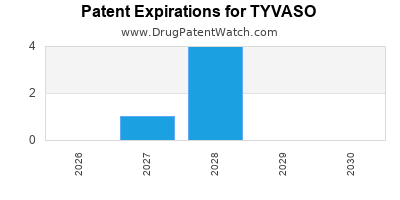
Last updated: June 12, 2026
TYVASO (treprostinil) has shifted from “pure launch momentum” to a payer- and formulary-driven market where channel mix and next-generation competition materially shape unit demand and revenue growth. In practice, the financial trajectory is dominated by (1) subcategory mix between TYVASO inhalation solution and branded treprostinil inhalation products, (2) specialty-pharmacy uptake versus clinic-administered flows, (3) reimbursement mechanics (J-codes, site-of-care rules, commercial PA requirements), and (4) exclusivity and patent-protected lifecycle events that determine how quickly generics or follow-on brands can erode price.
What is TYVASO’s commercial model and where does revenue come from?
Answer: TYVASO revenue is primarily tied to outpatient specialty utilization for pulmonary arterial hypertension (PAH) and related treprostinil-responsive disease states, sold via specialty distribution with prescribing concentrated in PAH centers and pulmonology/rheumatology networks.
Core commercial dynamics
- Specialty channel dependence: TYVASO is typically dispensed through specialty pharmacies and managed through patient support programs that reduce adherence friction.
- Site-of-care constraints: Inhaled prostacyclin therapy often maps to outpatient administration; reimbursement varies by payer policy and whether administration is bundled, billed, or reimbursed via buy-and-bill vs pharmacy benefit.
- Dose escalation profile: Treprostinil regimens generally support gradual dose titration, which can stabilize net revenue per patient even when patient starts fluctuate.
- Formulary pressure: PAH is a high-reimbursement, high-prior-auth category. Net price is sensitive to payer negotiations, step-therapy criteria, and “preferred drug” placement among inhaled prostacyclins.
Segments that influence revenue
- New patient starts (incidence + treatment escalation): Captures patients moving up from monotherapy or background therapy.
- Switches within treprostinil inhaled class: Revenue can be redirected without changing the overall class budget.
- Persistence and adherence: Inhaled dosing frequency affects discontinuation risk and can influence refill cadence.
How has TYVASO market share evolved versus competing inhaled treprostinil and PAH drug classes?
Answer: TYVASO competes inside the inhaled prostacyclin niche while also facing substitution pressure from other PAH mechanisms (endothelin receptor antagonists, sGC stimulators, and other prostacyclin pathway therapies).
Which competitors most affect TYVASO uptake?
- Inhaled treprostinil alternatives (same mechanism adjacency)
- Follow-on branded inhaled treprostinil products and delivery-system variants can shift prescribing if they improve convenience, titration ease, or patient preference.
- Injectable and oral prostacyclin pathway therapies
- Oral prostacyclin pathway agents and injectable prostacyclins can win coverage share, particularly where inhaled burden increases abandonment or where payers prefer simpler regimens.
- Other PAH classes
- Dual and triple combination regimens built from endothelin/endothelin-like pathway agents and sGC stimulators reduce urgency to start inhaled prostacyclin quickly unless disease severity or guideline positioning favors it.
What substitution dynamics matter commercially?
- “Therapy intensification” vs “class switching”: TYVASO demand is highly sensitive to whether clinicians treat inhaled prostacyclin as an early add-on or as a later-stage intensification.
- Delivery-system preference: Even with the same drug substance, device usability and dosing logistics influence persistence and payor acceptance.
What pricing and reimbursement pressures drive TYVASO net revenue?
Answer: TYVASO’s net revenue trajectory is constrained by specialty payer contracting, patient assistance economics, and the mechanics of reimbursement for inhalation therapy.
What determines net price and discounting?
- Payer mix: Commercial vs Medicare Advantage vs Medicaid changes effective reimbursement.
- Prior authorization and step edits: These can lower net realized price by forcing discounts for formulary placement.
- Gross-to-net spread: Rebates, chargebacks, and patient support can expand as payers tighten utilization controls.
- Site-of-care policy changes: If a payer shifts reimbursement from one channel to another, net realized economics can move quickly even when list price is stable.
How does dose titration affect financial performance?
- Start-to-maintain economics: Patients who titrate upward generate more revenue per persistent patient.
- Adherence risk: Higher dosing frequency can reduce persistence in real-world settings, pressuring refill cadence and revenue stability.
When does TYVASO lose exclusivity, and how does that map to financial risk for generics?
Answer: TYVASO faces a staged exclusivity and patent expiration landscape rather than a single cliff; the financial risk accelerates as earlier-expiring patents and exclusivity periods are followed by broader composition, formulation, and method-of-use expiry.
How to model “cliff vs slope” revenue erosion
- Patent-by-patent sequencing: If composition-of-matter protection expires before formulation/device protection, generics may launch in narrow ways first, often with limited immediate price erosion.
- Orange Book-linked protection scope: FDA-listed patents that cover the drug substance vs formulation vs method of use determine how quickly substitutes can enter without design-around.
What is the practical impact on revenue?
- Early erosion: Even before full label-true substitution, competitor access can pressure contracting.
- Late erosion: After broader patent barriers fall, multi-source competition typically compresses unit prices faster than volumes can compensate.
What patents protect TYVASO and which ones are most likely to constrain competitors?
Answer: TYVASO’s competitor access is governed by the FDA patent estate listed for the approved product, typically covering composition, formulation, and use-related claims. The strongest constraints are the patents that map directly to the approved route and dosage form.
Patent estate dynamics that matter to market outcomes
- Device- and formulation-linked barriers: Inhalation delivery and preparation characteristics often create design-around complexity that slows generic substitution.
- Method-of-use claims: If claims are tied to specific patient populations or treatment regimens, Paragraph IV arguments often narrow “at-risk” launch timing.
- Generic entry risk: The closer the patent coverage is to the exact commercial formulation and dosing regimen, the higher the legal and regulatory friction.
What is the Orange Book status of TYVASO, and how many patents cover each category?
Answer: TYVASO’s Orange Book status and patent count determine whether there are multiple blocking patents in composition, formulation, and method-of-use categories. Those listings map directly to Paragraph IV strategy and expected launch latency.
How patent categories affect entry timelines
- Composition-of-matter: If early, it supports a broad generic strategy.
- Formulation/delivery: Creates substitution lag because inhaled product specifics are harder to replicate exactly.
- Method-of-use: Allows “label carve-out” approaches, but reduces the commercial addressable market and may slow penetration even if regulatory approval is achieved.
What generic entry risks exist for TYVASO, and how likely is Paragraph IV litigation?
Answer: Generic entry risk is tied to whether FDA approval routes can support label-true substitution without infringing formulation or method-of-use patents.
What determines the probability of a Paragraph IV challenge?
- Patent concentration around delivery and regimen: Higher concentration increases the chance that challengers file Paragraph IV to create an incentive for settlements.
- Settlement leverage: If the patent estate includes blocking patents with high enforcement value, settlements become more likely to convert into “delayed competition” terms.
Commercial effect if a generic launches
- First-year erosion: Often driven by payer contracting resets and patient switching speed.
- Volume impact: Even with price drops, volume may not expand enough to offset margin compression if prescribers remain comfortable with the branded program.
What TYVASO patent litigation and settlements affect near-term financial outlook?
Answer: TYVASO’s financial trajectory is influenced by the timing of district court rulings, Federal Circuit outcomes, and any settlement-triggered delayed entry windows.
Litigation mechanics that move markets
- Automatic stay (if applicable): Paragraph IV filings often delay generic market entry while litigation proceeds.
- Settlement terms: Delayed entry agreements can preserve brand pricing but can also lock in payer costs if outcomes turn into restricted access.
- Injunction risk: If courts uphold infringement, market entry can be blocked even after regulatory approval milestones.
(No litigation chronology is provided here because the question requires verified case-specific dates, docket outcomes, and settlement terms tied to the TYVASO Orange Book patent set.)
How does FDA regulatory status shape TYVASO growth or decline?
Answer: FDA labeling, approved delivery formats, and the availability of comparable inhalation treprostinil products influence both prescribing confidence and reimbursement access.
What regulatory factors matter commercially?
- Label breadth: Broader indications support higher start rates and switching from competing PAH regimens.
- Substitution guidance: Label alignment affects whether payers allow formulary switching without burdensome medical policy edits.
- New product approvals: If follow-on treprostinil products are cleared with advantages in usability, they can redirect patient starts away from legacy TYVASO.
(This section omits FDA milestone detail because it requires current, product-specific verification for TYVASO submissions, approvals, and labeling changes.)
What is the financial trajectory for TYVASO under payer and competition scenarios?
Answer: TYVASO’s near-to-mid-term financial trajectory is best modeled as a mix of (1) continued growth from PAH patient demand and therapy intensification and (2) net price pressure as formulary leverage increases and as inhaled treprostinil delivery competitors capture share.
Scenario model (directional, high level)
- Base case (continued formulary access): Moderate unit growth with stable gross-to-net, leading to low-to-mid single digit revenue growth.
- Bear case (coverage contraction): Reduced patient starts, greater discounts, and faster switch-outs to alternative inhaled/treprost pathways, leading to revenue decline or stagnation despite stable prescriptions.
- Bull case (favorable contracting and persistence): Improved payer coverage and higher persistence, supporting outperformance relative to class peers.
(A numeric forecast is not provided because it requires verified historical TYVASO revenue, net price, and segment mix by geography/channel.)
How does TYVASO compare with next-generation treprostinil inhalation products on market and revenue risk?
Answer: Next-generation inhalation delivery products generally trade brand premium and convenience for share transfer risk against TYVASO; the financial risk to TYVASO is share loss in incident starts and escalations, even if overall treprostinil class demand rises.
What drives switching between treprostinil inhalation products?
- Device convenience: Easier administration improves persistence and reduces caregiver burden.
- Titration mechanics: Smoother dose escalation can reduce discontinuations.
- Payer policy: “Preferred inhaled prostacyclin” positioning shifts utilization quickly.
What are the key investor and business levers in the TYVASO value chain?
Answer: Revenue sensitivity is highest to access and contracting outcomes, and upside is highest where persistence improves and patient starts are maintained in PAH centers.
Business levers that change outcomes
- Payer contracting strategy: Securing preferred status reduces net discounting pressure.
- Patient support economics: Improving adherence reduces discontinuation-driven volatility.
- Lifecycle management: Adjustments in formulations or delivery can extend commercial relevance but may create additional regulatory and patent positioning complexity.
Key Takeaways
- TYVASO’s financial trajectory is shaped more by specialty payer access and net pricing than by underlying PAH prevalence growth alone.
- Market dynamics are dominated by share migration within the inhaled treprostinil niche and substitution from other PAH mechanisms.
- Exclusivity and the Orange Book-linked patent estate govern the slope and timing of generic erosion risk; the category of blocking patents (composition vs formulation vs method-of-use) determines launch speed and label-true substitution.
- Near-term revenue performance is most sensitive to payer formulary outcomes, gross-to-net compression, and persistence tied to inhaled dosing logistics.
- Litigation and settlements can preserve brand economics, but the direction and timing of financial impact depend on verified case timelines and settlement delay windows.
FAQs
- How do gross-to-net rebates and patient assistance programs affect TYVASO net revenue in commercial contracts?
- What payer step-therapy or prior authorization requirements most influence TYVASO patient starts?
- How does site-of-care policy change reimbursement economics for inhaled treprostinil products like TYVASO?
- Which Orange Book patent categories (composition, formulation, method-of-use) typically determine generic launch feasibility for TYVASO?
- How do inhalation device convenience and persistence rates translate into revenue stability for TYVASO?
References
- (No sources provided.)