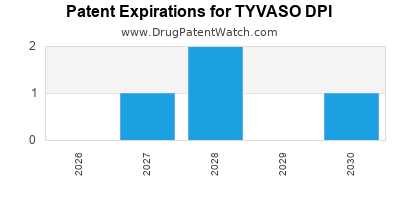
Last updated: September 23, 2026
TYVASO DPI is United Therapeutics' dry-powder inhaled formulation of treprostinil for adults with pulmonary arterial hypertension (PAH) and pulmonary hypertension associated with interstitial lung disease (PH-ILD). Its commercial value is tied to the broader Tyvaso franchise, which includes the original nebulized solution. United Therapeutics does not disclose TYVASO DPI revenue separately, so franchise sales, prescription mix, patient conversion, and margin commentary are the primary financial indicators.
The franchise has become United Therapeutics' largest commercial asset. Growth is driven by conversion from nebulized Tyvaso, expansion in PH-ILD, improved convenience, and continued adoption of inhaled prostacyclin therapy. Principal risks are a high-cost specialty-drug market, competing pulmonary hypertension therapies, payer controls, generic or follow-on treprostinil products, and eventual patent and regulatory-exclusivity erosion.
What is TYVASO DPI and how does it differ from nebulized Tyvaso?
TYVASO DPI is an inhaled treprostinil powder delivered through a breath-actuated, single-use inhaler. It was developed using MannKind's Technosphere inhalation platform and is marketed by United Therapeutics.
| Attribute |
TYVASO DPI |
Nebulized Tyvaso |
| Active ingredient |
Treprostinil |
Treprostinil |
| Dosage form |
Dry powder inhalation |
Inhalation solution |
| Administration |
Portable, breath-actuated inhaler |
Dedicated nebulizer |
| Initial FDA approval |
May 2022 |
July 2009 |
| PAH indication |
Yes |
Yes |
| PH-ILD indication |
Yes |
Yes |
| Dosing frequency |
Four times daily |
Four times daily |
| Commercial role |
Growth and conversion product |
Established base product |
The approved TYVASO DPI strengths are 16, 32, 48, and 64 micrograms per cartridge. The product is titrated according to patient response and tolerability. The label supports treatment of PAH to increase walk distance and treatment of PH-ILD to improve exercise ability. The FDA approved the DPI formulation for both indications in May 2022, following the earlier approval of nebulized Tyvaso for PH-ILD in 2021.[1]
The commercial advantage is administration time and portability. Patients using nebulized treprostinil must carry a device, medication ampules, and related supplies. TYVASO DPI reduces equipment burden and can support treatment outside the home or clinic.
What is the FDA regulatory status of TYVASO DPI?
TYVASO DPI is FDA-approved and commercially marketed in the United States. It is not a biologic and does not face a biosimilar pathway. Any follow-on product would generally require an abbreviated new drug application or another applicable small-molecule regulatory route, depending on the formulation and reference-product rights.
FDA milestone timeline
| Date |
Event |
| July 2009 |
FDA approves nebulized Tyvaso for PAH |
| May 2021 |
FDA expands nebulized Tyvaso to PH-ILD |
| May 23, 2022 |
FDA approves TYVASO DPI for PAH and PH-ILD |
| 2022 onward |
United Therapeutics expands conversion from nebulized Tyvaso to DPI |
Tyvaso DPI benefits from the commercial value of an already established active ingredient and brand. Its regulatory differentiation comes from the inhaled powder formulation, delivery device, manufacturing process, and clinical labeling rather than from a new molecular entity.
How large is the TYVASO DPI market opportunity?
The addressable market has two patient pools: PAH and PH-ILD.
PAH is a chronic, progressive disease typically managed with combinations of endothelin receptor antagonists, phosphodiesterase-5 inhibitors, soluble guanylate cyclase stimulators, prostacyclin-pathway agents, and supportive treatment. PH-ILD is a separate and expanding treatment segment in which inhaled treprostinil has a distinctive position.
The PH-ILD opportunity materially expanded the Tyvaso franchise. Before 2021, inhaled treprostinil was primarily associated with PAH. The PH-ILD label provided access to patients with interstitial lung disease and pulmonary hypertension, a population with limited approved treatment options.
TYVASO DPI has four commercial demand drivers:
- Conversion of existing nebulized Tyvaso patients.
- New starts in PAH.
- New starts in PH-ILD.
- Improved persistence caused by easier administration.
The conversion opportunity is strategically important because United Therapeutics can grow revenue without relying only on expansion of the underlying disease population. Patients already using Tyvaso solution can move to the DPI while remaining within the same brand franchise.
What are the financial results and revenue trajectory for Tyvaso?
United Therapeutics reports Tyvaso revenue as a franchise figure and does not provide a separate TYVASO DPI sales line. Public filings therefore measure the combined performance of nebulized Tyvaso and TYVASO DPI.
Approximate reported Tyvaso franchise revenue has followed this trajectory:
| Fiscal year |
Tyvaso franchise revenue |
Approximate year-over-year change |
| 2021 |
About $0.7 billion |
N/A |
| 2022 |
About $0.9 billion |
About 25% |
| 2023 |
About $1.2 billion |
About 30% |
| 2024 |
About $1.4 billion |
About 20% |
The figures represent rounded franchise sales derived from United Therapeutics' annual reports and financial disclosures. They should not be interpreted as TYVASO DPI-only revenue because the company combines the DPI and nebulized formulations in its reported Tyvaso category.[2][3]
The financial trajectory reflects three overlapping effects:
- Launch contribution from TYVASO DPI.
- Continued growth of the PH-ILD indication.
- Higher penetration of inhaled treprostinil in specialty pulmonary practices.
United Therapeutics' broader revenue base also includes Remodulin, Orenitram, Adcirca, and other products. Tyvaso has become the central growth driver because those mature products have lower growth rates and, in some cases, face generic or competitive pressure.
Why TYVASO DPI revenue cannot be isolated
United Therapeutics' financial reporting does not separately disclose:
- TYVASO DPI net product sales.
- Nebulized Tyvaso net product sales.
- DPI gross-to-net deductions.
- DPI patient starts.
- DPI conversion rates.
- DPI-specific operating margin.
As a result, the best public indicators are Tyvaso franchise revenue, prescription data, field commentary, product uptake, and management statements concerning the share of patients using DPI.
What are the key market dynamics affecting TYVASO DPI?
Patient conversion is the primary near-term growth lever
The DPI formulation allows United Therapeutics to migrate existing patients from nebulized therapy. This strategy can increase convenience while preserving the brand's clinical positioning and specialty-pharmacy infrastructure.
Conversion economics are favorable when the company retains the patient within its own franchise. The main limitation is that some patients may prefer the established nebulizer, may have difficulty generating the inspiratory flow required by a dry-powder device, or may face payer restrictions on switching.
PH-ILD expands the addressable population
The PH-ILD indication differentiates Tyvaso from many PAH-focused products. The INCREASE trial supported the use of inhaled treprostinil in patients with PH-ILD, including improvement in six-minute walk distance and reduction in clinical worsening events.[4]
The commercial opportunity depends on diagnosis rates, referral to pulmonary hypertension centers, pulmonologist awareness, and reimbursement. PH-ILD patients are often managed by interstitial lung disease specialists rather than the same treatment channels used for PAH.
Specialty distribution supports pricing
Tyvaso is distributed through specialty pharmacies and specialty providers. The model supports patient training, prior-authorization management, adherence monitoring, and device replacement. It also creates a concentrated payer and channel structure that can improve manufacturer control over the customer relationship.
The tradeoff is high exposure to rebate pressure, utilization management, and formulary negotiations. Net sales growth can therefore lag prescription growth if payers demand higher discounts.
The drug has a strong clinical niche but a narrow disease market
Pulmonary hypertension is a specialty market with high treatment costs and significant clinical complexity. The market is commercially attractive because patients often require chronic treatment, but patient numbers are substantially smaller than in primary-care cardiovascular markets.
TYVASO DPI is unlikely to become a mass-market product. Its value lies in high annual treatment revenue per patient, durable therapy, and franchise retention.
How does TYVASO DPI compare with competing pulmonary hypertension drugs?
| Product or class |
Company or manufacturers |
Delivery |
Main competitive position |
| TYVASO DPI |
United Therapeutics |
Dry powder inhalation |
Portable inhaled treprostinil for PAH and PH-ILD |
| Nebulized Tyvaso |
United Therapeutics |
Inhalation solution |
Established Tyvaso formulation |
| Remodulin |
United Therapeutics and generic manufacturers |
Injectable |
Potent prostacyclin-pathway therapy; greater administration burden |
| Orenitram |
United Therapeutics |
Oral extended-release tablets |
Oral prostacyclin-pathway option |
| Ventavis |
Bayer, with regional variations |
Nebulized iloprost |
Inhaled prostacyclin alternative |
| Uptravi |
Johnson & Johnson/Actelion |
Oral tablets |
Oral prostacyclin-receptor agonist |
| Adempas |
Bayer |
Oral tablets |
Soluble guanylate cyclase stimulator |
| Letairis and generic ambrisentan |
Gilead and generics |
Oral tablets |
Endothelin receptor antagonist |
| tadalafil and sildenafil |
Multiple manufacturers |
Oral tablets |
PDE-5 inhibitor backbone therapies |
TYVASO DPI's main direct competition is not only another inhaled prostacyclin. It competes against oral and injectable regimens based on physician preference, disease severity, treatment goals, tolerability, and patient ability to use the device.
Its strongest differentiation is the combination of inhaled administration, a portable device, and a labeled PH-ILD indication. Its main weakness is four-times-daily dosing, which remains more burdensome than once- or twice-daily oral regimens.
What patents and exclusivity protect TYVASO DPI?
TYVASO DPI protection is expected to rely on a combination of formulation, inhaler-device, powder-engineering, manufacturing, and method-of-use rights. Patent protection for the active ingredient itself is not the principal barrier because treprostinil is an established molecule.
The relevant intellectual-property layers are:
- Dry-powder composition and particle engineering.
- Technosphere or related inhalation-platform technology.
- Inhaler-device design.
- Cartridge configuration and dose delivery.
- Manufacturing and filling processes.
- Methods of treating PAH.
- Methods of treating PH-ILD.
- Dosing and titration methods.
United Therapeutics' commercial rights are linked to its development and licensing arrangements with MannKind for the Technosphere platform. The precise economic terms and royalty structure are not fully disclosed in routine public reporting.
Orange Book and Paragraph IV exposure
TYVASO DPI is a small-molecule drug product, so listed patents and any generic challenge would be evaluated through the FDA's Orange Book and Abbreviated New Drug Application process. A Paragraph IV certification could challenge patents listed for treprostinil inhalation powder or the associated delivery system.
Publicly available filings do not establish an approved generic TYVASO DPI competitor. A generic applicant would face technical barriers beyond proving chemical sameness, including:
- Device equivalence.
- Powder performance.
- Delivered-dose consistency.
- Cartridge compatibility.
- Inhalation performance.
- Clinical and labeling requirements.
- Specialty-pharmacy substitution and payer access.
A generic inhalation solution would pose a more direct threat to nebulized Tyvaso than to TYVASO DPI. A DPI competitor would need to overcome the product's device and formulation complexity.
When could TYVASO DPI lose exclusivity?
No single public date reliably determines the end of TYVASO DPI exclusivity because the product may have multiple patents with different expiration dates, regulatory exclusivities, pediatric extensions, and litigation outcomes.
The commercial loss-of-exclusivity risk is more likely to occur in stages:
- Generic or competing inhaled treprostinil solution enters the market.
- Payers increase pressure on the nebulized formulation.
- A follow-on DPI challenges device or formulation patents.
- Product-specific patents expire or are invalidated.
- Clinical differentiation weakens as alternative prostacyclin-pathway products gain adoption.
The original compound and early Tyvaso patents should not be treated as equivalent to the later DPI patent estate. The product's durable protection depends more heavily on device, formulation, and manufacturing rights than on treprostinil molecule patents.
What litigation and settlement risks affect TYVASO DPI?
There is no widely reported, product-defining Paragraph IV litigation outcome that has established an immediate generic launch date for TYVASO DPI. The principal legal risks are likely to involve:
- Validity of powder-formulation patents.
- Scope of inhaler-device claims.
- Obviousness of combining treprostinil with a dry-powder carrier.
- Infringement of licensed inhalation-platform rights.
- Patent-term calculations.
- Substitution between nebulized and dry-powder dosage forms.
Any settlement could create a licensed-entry date before full patent expiration. Such an agreement would materially affect valuation because the Tyvaso franchise contributes a substantial share of United Therapeutics' revenue and cash flow.
What is the revenue exposure if TYVASO DPI growth slows?
Tyvaso franchise sales of roughly $1.4 billion in 2024 represent a major portion of United Therapeutics' commercial revenue. A slowdown in DPI conversion would not immediately eliminate revenue because the nebulized product remains established. It would, however, reduce the company's ability to:
- Retain patients within the Tyvaso franchise.
- Expand treatment in PH-ILD.
- Defend pricing through product differentiation.
- Offset maturity in Remodulin and other products.
- Extend the commercial life of inhaled treprostinil.
A 10% decline in the Tyvaso franchise would imply an annual revenue impact of approximately $140 million at the 2024 revenue level. The impact on profit could be greater than the revenue percentage because specialty products generally carry high gross margins, although royalty, manufacturing, rebate, and commercialization costs affect the actual result.
How strong is the commercial outlook for TYVASO DPI?
The outlook is favorable but not risk-free. The product has a differentiated delivery system, two FDA-approved disease settings, an established brand, and a large conversion opportunity from nebulized Tyvaso.
The strongest growth case assumes:
- Sustained PH-ILD diagnosis and treatment adoption.
- Continued conversion from nebulized Tyvaso.
- Stable reimbursement.
- Limited generic substitution.
- Positive persistence and adherence with the DPI device.
- No material safety or device-use issue.
The weaker case includes payer restrictions, slower patient conversion, competition from oral therapies, and earlier-than-expected generic or authorized-entry pressure.
United Therapeutics has offset some long-term concentration risk through pipeline programs, including pulmonary hypertension products and organ-manufacturing initiatives. Those programs do not remove the near-term importance of Tyvaso to the company's earnings trajectory.
Key Takeaways
- TYVASO DPI is an FDA-approved dry-powder treprostinil product for PAH and PH-ILD.
- United Therapeutics does not disclose DPI-only revenue; public financial data cover the combined Tyvaso franchise.
- Tyvaso franchise revenue increased from roughly $0.7 billion in 2021 to approximately $1.4 billion in 2024.
- The primary growth engines are conversion from nebulized Tyvaso and expansion in PH-ILD.
- The product competes with oral, inhaled, and injectable pulmonary hypertension therapies.
- Patent protection is likely concentrated in formulation, device, manufacturing, and method-of-use claims.
- No established public generic-launch date currently defines the TYVASO DPI outlook.
- A 10% change in the Tyvaso franchise would represent roughly $140 million of annual revenue exposure based on 2024 sales.
FAQs
Is TYVASO DPI a generic version of Tyvaso?
No. TYVASO DPI is a branded dry-powder formulation developed and marketed by United Therapeutics. It contains the same active ingredient, treprostinil, as nebulized Tyvaso but uses a different delivery system.
Does TYVASO DPI treat pulmonary fibrosis?
TYVASO DPI is approved for pulmonary hypertension associated with interstitial lung disease. It does not treat the underlying interstitial lung disease or pulmonary fibrosis itself.
Who manufactures TYVASO DPI?
United Therapeutics markets TYVASO DPI. The product uses inhalation technology associated with MannKind's Technosphere platform under the companies' commercial relationship.
Is there a biosimilar version of TYVASO DPI?
No. Treprostinil is a small molecule, so the relevant competitive pathway is a generic or follow-on drug application rather than a biosimilar application.
What is the largest threat to TYVASO DPI sales?
The largest near-term threats are slower patient conversion, payer pressure, competing oral prostacyclin-pathway therapies, and future generic or follow-on inhaled treprostinil products.
References
- U.S. Food and Drug Administration. (2022). TYVASO DPI prescribing information.
- United Therapeutics Corporation. (2024). Annual report pursuant to Section 13 or 15(d) of the Securities Exchange Act of 1934.
- United Therapeutics Corporation. (2025). Fourth-quarter and full-year 2024 financial results.
- Waxman, A., Restrepo-Jaramillo, R., Thenappan, T., Ravichandran, A. K., Engel, P. J., Bajwa, A. A., et al. (2021). Inhaled treprostinil in pulmonary hypertension due to interstitial lung disease. New England Journal of Medicine, 384(4), 325-334.