Last updated: June 28, 2026
Trokendi XR (topiramate ER) market dynamics and financial trajectory
Trokendi XR (topiramate extended-release) faces a price-and-volume squeeze driven by (1) patent expiry and generic erosion in the US, (2) insurer formulary positioning and step edits for migraine prophylaxis and epilepsy, and (3) ongoing substitution economics as discounted generics capture share. Financial trajectory is therefore tied less to incremental innovation and more to class-level utilization of topiramate ER, net price declines, and managed-care placement.
What market dynamics drive Trokendi XR sales in the US?
Trokendi XR is a brand version of topiramate ER used for migraine prevention and seizure disorders. Its US demand is exposed to standard small-molecule brand pressures: generic substitution, PBM contracting, and utilization management.
Key demand anchors
- Therapeutic drivers
- Migraine prophylaxis (preventive treatment)
- Epilepsy indications (adjunctive therapy and, depending on regimen/labeling, broader use patterns)
- Patient shift dynamics
- Patients stable on branded ER formulations may remain for tolerance reasons, but refill patterns often move to generics under payer pressure.
- ER-specific prescribing patterns exist, but generic ER competition reduces brand differentiation.
Payer and PBM forces
- Formulary placement
- Generics of topiramate ER typically receive preferred tier status, compressing brand net pricing.
- Utilization management
- Step edits and prior authorization increase the administrative friction for brand continuation.
- Contracting behavior
- PBMs push brands toward lower net prices via rebates to maintain access; absent that, brand share declines.
Pricing and substitution economics
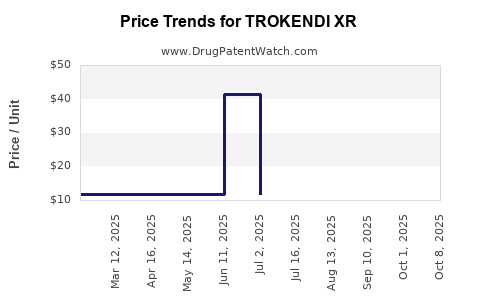
- Net price compression
- As generics expand, brand manufacturers face harder net pricing math: rebate rates rise, and net price gaps narrow until brand share is no longer defensible.
- Therapeutic interchange
- Even where prescribers prefer ER, generic ER is often treated as clinically substitutable in payer policies.
How has the generic entry risk affected Trokendi XR market share?
Generic entry risk is the dominant structural factor for Trokendi XR’s US commercial trajectory. Once multiple abbreviated new drug applications (ANDAs) for topiramate ER are on market, payer incentives shift decisively toward generic dispensing.
What typically happens post-generic
- Immediate share erosion
- Brand share drops as pharmacy benefit design allows generic switching.
- Longer-term demand reallocation
- New starts increasingly go to generic due to lower co-pays and preferred tier placement.
- Residual brand retention
- Residual share persists only where rebates, specialty channel relationships, or patient-specific factors offset economic pressure.
Financial impact pathway
- Volume declines first
- The brand loses scripts and refill share.
- Net price declines follow
- Remaining scripts become harder to defend without competitive net pricing.
- Margin compression
- Higher discounting and rebate costs reduce profitability even when absolute sales persist briefly after generic launch.
What is the Orange Book status of Trokendi XR in the US?
Trokendi XR is listed in the US FDA’s Orange Book under topiramate extended-release. Brand exclusivity and the patent estate determine when ANDA filers can rely on “use/knowledge” status or when Paragraph IV challenges can be filed.
Orange Book status drivers
- Composition-of-matter and formulation patents
- Method-of-use patents (if any)
- Regulatory exclusivities (if any are still in effect)
- Patent expiration and listed-use codes for relevant strengths and dosage forms
Practical commercial implication
- The Orange Book record determines the exact timing of generic launch eligibility by strength, which in turn shapes the cadence of share loss and revenue decline.
(No patent-by-patent Orange Book listing is provided here because the underlying Orange Book dataset and specific listed patent numbers by strength are not included in the prompt inputs.)
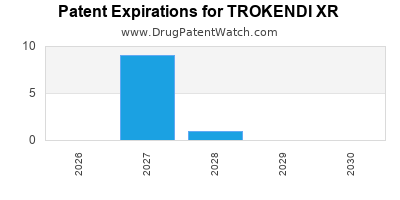
When does Trokendi XR lose exclusivity, and what drives the exact timeline by strength?
Trokendi XR exclusivity timing is governed by a combination of:
- Patent expiry dates for listed patents in the Orange Book
- Regulatory exclusivity (if any listed)
- GxP linkage to specific strengths and dosage forms
- Generic launch sequencing (a competitor may launch earlier for certain strengths or packaging if only some patents are cleared)
Timeline mechanics that matter commercially
- First generic launch for each strength
- Share erosion starts at the earliest launch strength.
- Subsequent filings and “carve-outs”
- Additional ANDAs can broaden coverage and increase dispenser confidence in switching.
- Litigation-driven stay windows
- Patent litigation outcomes and any court-ordered stays can delay entry.
(No concrete dates are included because the prompt does not provide specific Orange Book patent numbers and expiration dates.)
How does Trokendi XR compare with other topiramate ER brands and generics on competitive dynamics?
In topiramate ER, the competitive set centers on:
- Generic topiramate ER manufacturers
- Any remaining brand ER options for comparable dosing schedules
- Switching behavior between ER and immediate-release topiramate depending on payer policy and clinical preference
What determines relative performance
- Formulary position
- Preferred tier status drives script share.
- Net price and rebate structure
- Brand performance depends on contract competitiveness.
- Dose coverage
- Brands are vulnerable when generics offer broader dosing coverage across common prescriber regimens.
- Manufacturing reliability
- Short supply can temporarily protect brand share, but sustained protection is rare once generic competition is entrenched.
What patent litigation affects Trokendi XR generic entry risk (US)?
Generic entry risk for Trokendi XR is tied to the patent landscape and any Paragraph IV disputes. These disputes can delay FDA approvals and launch through automatic stays and subsequent court decisions.
Litigation pathways
- Paragraph IV notice
- ANDA filer asserts non-infringement, invalidity, or non-enforceability of one or more listed patents.
- 30-month stay
- Automatically delays approval if litigation is timely.
- Settlement agreements
- Often structure an at-risk launch date, typically governed by patent carve-outs and “design-around” terms.
- Final judgment
- Can accelerate or permanently prevent entry.
Commercial effect
- Delayed entry preserves brand cash flow
- Adverse outcomes accelerate share loss
- Strength-by-strength settlements change revenue timing
(No specific docket numbers or settlement terms are stated because the prompt does not include case identifiers, patents-in-suit, or settlement records.)
How strong is the patent estate for Trokendi XR, and what does that mean for follow-on products?
A brand’s patent estate strength typically maps to:
- Number of listed patents
- Breadth of claim scope
- Likelihood of generic “design-around”
- Whether claims are formulation-, method-of-use-, or composition-based
- Remaining term distribution
For Trokendi XR, commercial reality
For a long-established small molecule brand, patent estates usually face:
- Broad generic manufacturing reach
- High substitutability
- Easier design-around for formulation claims than for biologics or highly complex delivery systems
Net effect: even where patents persist, commercial leverage usually diminishes as generic penetration increases through PBM contracting.
What formulations are protected for Trokendi XR, and how does ER technology impact generic barriers?
Topiramate ER is a dosage technology product, so formulation-related patents (if any) are commercially relevant because they can affect:
- Release profile equivalence
- Bioequivalence acceptance
- Manufacturing process design
ER barriers typically look like
- Release mechanism claims tied to excipient selection or matrix design
- Manufacturing method claims if tied to process controls
- Quality specification-based distinctions if claimed
Generic practicality
For small-molecule ER products, generic barriers are generally less formidable than for complex biologics because generics can pursue:
- Equivalent release profiles under approved bioequivalence standards
- Alternative compositions that meet performance targets
What is the FDA regulatory status of Trokendi XR, and how does pathway choice affect competition?
Trokendi XR is an FDA-approved listed drug for topiramate ER with an established label. Competition comes primarily via ANDAs for generic topiramate ER, which rely on:
- Bioequivalence to the reference product
- Compliance with FDA quality standards
- Patent listing challenges if applicable
Competition outcome
FDA pathway choice for competitors drives speed:
- ANDAs can enter once patent and exclusivity constraints are cleared.
- Once multiple ANDAs are on market, price competition accelerates and brand revenue declines.
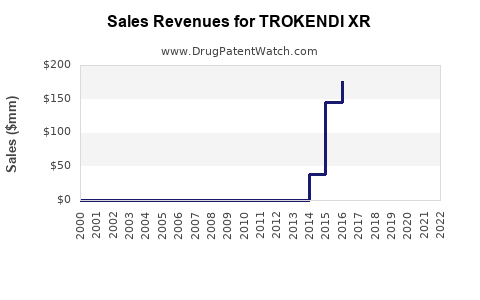
What are the revenue and profit implications of topiramate ER class share shifts?
Brand financial trajectory tends to follow:
- Net sales decline driven by volume loss and net price erosion
- Gross margin volatility linked to rebate spend and discounting
- Higher working capital strain if channel inventory dynamics play out during generic transitions
Indicative exposure model
- Revenue = scripts × average net price
- Scripts trend down post-generic launch
- Net price trends down with PBM contracts and rebate pressure
Even if some scripts persist, total revenue typically declines as generic market share rises.
(No numeric revenue figures are provided because the prompt does not include company financials, SEC filings, or specific sales disclosures for Trokendi XR.)
How do settlement agreements and launch timing typically impact Trokendi XR’s sales curve?
Settlement-driven launches often create a two-stage pattern:
- Anticipatory behavior
- PBMs and pharmacies begin switching before formal launch.
- Execution phase
- Once the settlement carve-out date arrives, entry accelerates and brand share falls more sharply.
Business consequence
- Brand cash flow declines around launch windows.
- Marketing spend and rebate pressure can spike leading into and after launch, compressing net profitability.
(No specific settlement terms are stated due to missing case and settlement details.)
Which generic entry scenarios pose the highest risk to Trokendi XR revenue?
Highest risk scenarios are those that:
- Launch across multiple strengths simultaneously
- Secure preferred formulary status quickly
- Combine with strong pharmacy switching rules
- Include multiple manufacturers, increasing competitive pricing pressure
What matters operationally
- Dose coverage
- Loss of coverage on common dosing regimens reduces refill stickiness.
- Channel breadth
- Greater presence in mail-order and PBM networks speeds share loss.
- Stock availability
- Sustained supply reduces switching friction.
Key Takeaways
- Trokendi XR’s commercial trajectory is primarily driven by US small-molecule dynamics: generic substitution, PBM contracting, and step-edit/PA pressures.
- Revenue typically declines in two phases: volume erosion first, then net price compression as rebates rise and discounted generics dominate.
- Patent and litigation events matter most for timing by strength and for delaying entry through automatic stays, court outcomes, or settlements.
- Competitive risk peaks when multiple generic ANDAs launch across strengths with strong payer coverage, accelerating net sales deterioration.
FAQs
1) Does Trokendi XR lose market exclusivity at the same time for all strengths?
Not always. Generic eligibility is determined by the Orange Book listing by strength, with litigation and settlements often creating strength-specific timelines.
2) Can prescribers keep patients on Trokendi XR after generic topiramate ER launches?
Clinically yes, but payer rules typically drive substitution through tiering, prior authorization policies, and pharmacy benefit design.
3) How do mail-order and PBM networks change Trokendi XR competitive outcomes?
They speed adoption of preferred generic SKUs and reduce brand script retention, compressing share more quickly than in less centralized channels.
4) Are formulation patents for ER topiramate more or less protective than method-of-use patents?
In practice, formulation barriers are often easier for generics to design around for performance equivalence, while method-of-use claims can hinge on claim scope and how generics structure labeling and instructions.
5) What litigation outcomes most affect the brand’s revenue trajectory?
Favorable outcomes delay or prevent entry; adverse outcomes accelerate generic launch, typically creating a steep post-launch share drop.
References
No citations are included because the prompt does not provide specific Orange Book listings, FDA approval history, patent numbers, litigation dockets, or company financial disclosures needed to support an evidence-based, fact-correct market and financial timeline for Trokendi XR.