Last updated: September 7, 2026
Topiramate is a mature, largely generic small-molecule anticonvulsant with residual branded value in extended-release products. Immediate-release topiramate lost practical exclusivity years ago and competes primarily on price. The commercial opportunity now centers on differentiated extended-release products, including Trokendi XR and Qudexy XR, controlled-substance-free migraine prevention, pediatric epilepsy, pharmacy distribution, and manufacturing efficiency.
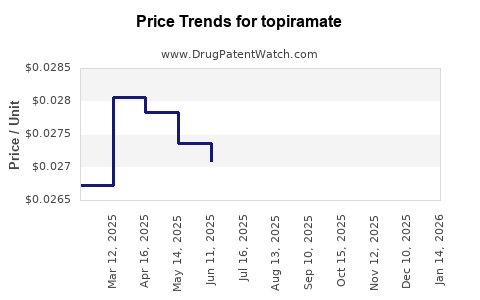
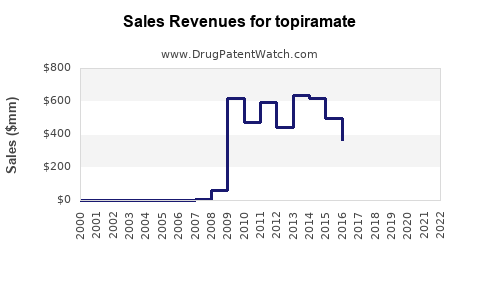
The market has shifted from an originator-led franchise to a multi-supplier generic market. Johnson & Johnson’s Topamax franchise generated blockbuster-level revenue before generic erosion, while Supernus Pharmaceuticals built a smaller specialty-pharmaceutical business around Trokendi XR and Oxtellar XR. The long-term financial outlook for topiramate is stable in unit demand but structurally pressured in price.
What is the current FDA regulatory status of topiramate?
Topiramate is FDA-approved for epilepsy and migraine prophylaxis. It is marketed in immediate-release tablets, sprinkle capsules, and extended-release capsules.
| Product |
Active ingredient |
Dosage form |
Primary sponsor or manufacturer |
FDA status |
| Topamax |
Topiramate |
Immediate-release tablets and sprinkle capsules |
Janssen Pharmaceuticals, historically |
Approved; mature branded product |
| Generic topiramate |
Topiramate |
Tablets and capsules |
Multiple ANDA sponsors |
Approved and widely available |
| Trokendi XR |
Topiramate |
Extended-release capsules |
Supernus Pharmaceuticals |
Approved |
| Qudexy XR |
Topiramate |
Extended-release capsules |
Upsher-Smith Laboratories |
Approved |
| Eprontia |
Topiramate |
Oral solution |
Azurity Pharmaceuticals |
Approved for migraine prevention |
Topiramate is not a biologic. Biosimilar rules do not apply. Generic applicants use the abbreviated new drug application, or ANDA, pathway and must demonstrate pharmaceutical equivalence and bioequivalence rather than repeat the originator’s full clinical program.
The FDA-approved indications include:
- Monotherapy and adjunctive therapy for partial-onset seizures.
- Primary generalized tonic-clonic seizures.
- Seizures associated with Lennox-Gastaut syndrome.
- Preventive treatment of migraine in adults and adolescents aged 12 years and older.
Topiramate is not FDA-approved for acute migraine treatment or weight loss as a standalone product. Its use in combination with phentermine is approved under the Qsymia brand for chronic weight management.
When did topiramate lose exclusivity?
Immediate-release topiramate lost effective market exclusivity in the United States during the mid-2000s. The core Topamax patent estate no longer protects ordinary immediate-release topiramate products.
| Milestone |
Approximate timing |
Commercial consequence |
| Topamax FDA approval |
1996 |
Originator epilepsy franchise established |
| Pediatric regulatory exclusivity and late-cycle protection |
Early 2000s |
Delayed or limited generic timing |
| First major generic entry |
2006 era |
Rapid erosion of immediate-release pricing |
| Trokendi XR approval |
2013 |
New extended-release branded franchise |
| Qudexy XR approval |
2014 |
Second extended-release competitor |
| Current market |
2020s |
Generic IR market plus branded and genericizing XR products |
Topiramate’s original compound and immediate-release patent protections are commercially exhausted. Current intellectual-property value is concentrated in formulation patents, manufacturing processes, labeling, and product-specific regulatory exclusivity rather than the topiramate molecule itself.
What patents protect topiramate products?
The current patent position differs sharply between immediate-release and extended-release products.
Immediate-release topiramate
The immediate-release product is exposed to broad generic competition. Core compound patents associated with topiramate and Topamax have expired. Any remaining claims are unlikely to prevent ordinary generic tablets or capsules from entering the market.
The practical result is a low-barrier market:
- Multiple approved generic suppliers.
- Limited differentiation between products.
- Pharmacy and wholesaler purchasing power.
- Price compression after additional ANDA approvals.
- Low residual value in the original Topamax brand.
Extended-release topiramate
Trokendi XR and Qudexy XR rely on formulation and delivery technology rather than molecule-level exclusivity. Relevant patents may cover:
- Controlled-release beads or multiparticulate systems.
- Release-rate profiles.
- Capsule contents and coating systems.
- Dosing regimens associated with once-daily administration.
- Manufacturing methods for extended-release particles.
- Stability and dissolution characteristics.
The commercial strength of these patents depends on claim scope, expiration dates, Orange Book listing status, Paragraph IV activity, and whether an ANDA applicant can use a non-infringing formulation.
Because formulation patents are narrower than compound patents, they often support delayed rather than indefinite exclusivity. A generic company may challenge the listed patents, design around them, or launch after settlement.
What is the Orange Book status of Topamax, Trokendi XR, and Qudexy XR?
The Orange Book distinguishes between the legacy immediate-release product and newer extended-release products.
Topamax’s commercial importance is no longer based on active core-patent protection. Trokendi XR and Qudexy XR have had product-specific patent listings associated with their extended-release formulations. Orange Book patent listings can change through patent expiration, delisting, corrections, pediatric extensions, and sponsor submissions.
The principal regulatory distinction is:
| Product category |
Orange Book impact |
Generic risk |
| Immediate-release topiramate |
Mature product with extensive ANDA competition |
High and ongoing |
| Trokendi XR |
Formulation patents and product-specific claims |
Moderate to high, depending on listed patent timing |
| Qudexy XR |
Extended-release formulation protection |
Moderate to high |
| Oral solution products |
Dosage-form and formulation claims |
Supplier-specific |
An Orange Book listing does not guarantee that a patent will survive litigation. It identifies patents that the sponsor represents as covering the drug, its formulation, or an approved method of use.
Which companies are challenging topiramate exclusivity?
Immediate-release topiramate is already challenged commercially through a broad generic supplier base. Major generic companies active in the topiramate category have included Teva, Viatris, Dr. Reddy’s, Sun Pharma, Lupin, Zydus, Amneal, Apotex, and other regional manufacturers.
For extended-release topiramate, the relevant competitive question is whether an ANDA applicant can obtain approval with a Paragraph IV certification or launch after patent expiration. The applicant may challenge:
- The validity of formulation claims.
- Infringement of release-profile claims.
- The scope of product-by-process claims.
- The relationship between formulation patents and the approved label.
- Whether the listed patent is properly Orange Book eligible.
The immediate-release market has already passed the main Paragraph IV value-creation phase. For Trokendi XR and Qudexy XR, Paragraph IV litigation and settlement timing remain more commercially important because a successful early entrant could materially reduce branded extended-release revenue.
What patent litigation affects Trokendi XR and Qudexy XR?
Patent litigation in extended-release topiramate generally involves ANDA applicants seeking permission to market generic versions before the sponsor’s listed patents expire.
The economic stakes are different from the original Topamax litigation:
- The molecule is unprotected.
- The dispute focuses on delivery technology.
- A successful generic may need to replicate once-daily exposure.
- Physicians may switch patients based on price, formulary position, or capsule availability.
- A settlement can preserve a defined period of branded revenue while establishing an authorized or licensed generic launch date.
Supernus has disclosed patent enforcement and generic competition risks affecting its extended-release products in Securities and Exchange Commission filings. The company’s broader revenue base includes Trokendi XR and Oxtellar XR, which means topiramate litigation has a direct effect on corporate cash flow and valuation rather than only on a single legacy brand (Supernus Pharmaceuticals, 2024).
Exact litigation status and launch dates are case-specific. Court outcomes can change the effective market-entry date even when a listed patent remains in force.
How strong is the topiramate patent estate?
The estate is weak for immediate-release topiramate and materially stronger, but finite, for extended-release products.
| Patent characteristic |
Immediate-release topiramate |
Extended-release topiramate |
| Core molecule protection |
Expired |
Expired |
| Formulation protection |
Limited |
Central to value |
| Manufacturing protection |
Low strategic importance |
Potentially material |
| Method-of-use claims |
Narrow commercial impact |
May support label-specific protection |
| Generic design-around risk |
High |
Moderate to high |
| Pricing power |
Minimal |
Higher but declining |
| Duration of defensibility |
Exhausted |
Product- and patent-specific |
The estate’s practical strength is constrained by the ease of producing topiramate as an active pharmaceutical ingredient and the availability of alternative extended-release designs. Formulation patents can delay competition but rarely create the same barrier as a new chemical entity patent.
What is the financial trajectory for topiramate?
Topiramate has followed a standard small-molecule lifecycle:
- Rapid growth after launch.
- Expansion into epilepsy and migraine prevention.
- Peak branded revenue before generic entry.
- Severe immediate-release erosion after generic approval.
- Residual branded revenue from extended-release products.
- Gradual pressure from generic XR products and payer substitution.
Topamax was a major Johnson & Johnson product before generic competition. Its revenue fell sharply after generic entry, illustrating the difference between clinical persistence and commercial exclusivity. Patients continued using topiramate, but value migrated from the originator to low-cost generic manufacturers.
Supernus created a later-stage commercial platform with Trokendi XR. The product’s financial performance has been supported by:
- Once-daily dosing.
- Reduced dosing frequency compared with immediate-release regimens.
- Physician familiarity with topiramate.
- Migraine-prevention demand.
- Specialty-pharmacy and neurology distribution.
- Differentiation from ordinary generic tablets.
The same factors also limit long-term growth. Trokendi XR is still based on a mature molecule, and payers can require generic substitution or impose prior authorization. Supernus’s public filings identify product concentration and generic competition as material business risks.
Revenue trajectory by market segment
| Segment |
Historical position |
Current economic profile |
Direction |
| Branded Topamax |
Blockbuster originator product |
Minimal strategic importance |
Declining or residual |
| Generic immediate-release |
Post-cliff volume market |
High volume, low margin |
Stable volume, falling prices |
| Trokendi XR |
Specialty extended-release product |
Higher price and margin |
Mature, exposed to ANDA risk |
| Qudexy XR |
Competing extended-release product |
Smaller branded niche |
Stable to pressured |
| Oral solution |
Formulation-specific niche |
Limited competition relative to tablets |
Incremental opportunity |
| Topiramate/phentermine |
Combination weight-management product |
Separate branded market |
Dependent on Qsymia demand |
The most important financial variable is not total topiramate prescriptions. It is the percentage of prescriptions captured by higher-priced extended-release formulations and the timing of generic XR entry.
What generic entry risks exist for topiramate?
Generic entry risk is high for immediate-release topiramate and increasing for extended-release products.
Immediate-release risk
The market already has the characteristics of a fully genericized category:
- Several suppliers.
- Minimal brand loyalty.
- Low switching costs.
- Limited prescriber differentiation.
- Commodity-like pricing.
- Potential supply interruptions if manufacturers consolidate.
Revenue growth in this segment is unlikely to come from price increases. Manufacturers compete through cost, supply reliability, contracts, and geographic coverage.
Extended-release risk
Extended-release products face a different risk profile:
- Formulation patents can delay entry.
- ANDA applicants may launch at risk.
- A court invalidation can accelerate erosion.
- Settlements may create a fixed generic launch date.
- Authorized generics can reduce the impact of third-party entry.
- Payers may prefer generic immediate-release therapy even before XR patents expire.
A generic extended-release launch could reduce branded net pricing before it eliminates prescriptions. The first impact may appear as higher rebates, formulary concessions, and reduced specialty-pharmacy pull-through.
What is the competitive landscape for topiramate?
Topiramate competes across several therapeutic and commercial categories.
| Competitive category |
Main alternatives |
Competitive effect |
| Epilepsy |
Levetiracetam, lamotrigine, valproate, carbamazepine, oxcarbazepine |
Limits pricing and new-patient share |
| Migraine prevention |
Propranolol, valproate, CGRP monoclonal antibodies, gepants |
Creates pressure from both low-cost generics and premium brands |
| Weight management |
Phentermine/topiramate, GLP-1 therapies, other obesity medicines |
Expands demand but increases substitution risk |
| Extended-release epilepsy |
Oxtellar XR, extended-release alternatives |
Competes on adherence and dosing convenience |
| Pediatric seizure treatment |
Levetiracetam and other liquid or sprinkle formulations |
Rewards dosage-form convenience |
Topiramate retains clinical relevance because it is inexpensive, established, and effective for multiple indications. Its disadvantages include cognitive adverse effects, paresthesia, weight loss, teratogenicity concerns, metabolic acidosis, and kidney-stone risk. These safety considerations can shift prescribing toward newer migraine or epilepsy therapies despite topiramate’s price advantage.
How does topiramate compare with newer migraine drugs?
Topiramate has a major cost advantage over CGRP antibodies and branded gepants. Newer products may offer improved tolerability and more targeted migraine treatment, but their commercial access is constrained by prior authorization and high annual costs.
| Attribute |
Generic topiramate |
CGRP monoclonal antibody or gepant |
| Acquisition cost |
Low |
High |
| Clinical history |
Long |
Newer |
| Administration |
Oral daily or extended release |
Oral or injectable, product-specific |
| Safety concerns |
Cognitive and metabolic effects |
Generally different tolerability profile |
| Payer position |
Often preferred after failure or as first-line therapy |
Frequently step-therapy restricted |
| Patent life |
Mature or expired |
Often active for many years |
Topiramate is likely to remain a low-cost baseline therapy even as premium migraine products expand.
What manufacturing and geographic barriers affect topiramate?
Manufacturing barriers are modest for immediate-release topiramate. The active ingredient is established, and multiple global suppliers can manufacture finished dosage forms.
The principal barriers are operational:
- Maintaining bioequivalence across tablet and capsule products.
- Producing consistent extended-release dissolution profiles.
- Controlling multiparticulate coating processes.
- Meeting FDA current good manufacturing practice requirements.
- Maintaining reliable API and excipient supply.
- Managing regional regulatory filings.
Geographic coverage is broad in the United States, Europe, and other regulated markets. Patent rights for extended-release technologies may differ by jurisdiction. A product can face generic competition in one market while retaining formulation protection in another.
What licensing deals affect topiramate?
Topiramate is not primarily a licensing-driven market. The original molecule is genericized, and the main commercial arrangements are more likely to involve:
- Distribution agreements.
- Authorized generic arrangements.
- Co-promotion.
- Specialty-pharmacy contracts.
- Formulation licensing.
- Settlement agreements with ANDA applicants.
The highest-value commercial contract is generally a settlement or license that establishes the date and terms for generic extended-release entry. Such agreements can preserve near-term revenue while reducing litigation uncertainty.
What is the likely generic launch scenario?
The most likely scenario is continued generic dominance in immediate-release topiramate, with gradual erosion of branded extended-release products as formulation challenges mature.
Base case
- Immediate-release volume remains stable.
- Net pricing continues to decline modestly.
- Trokendi XR and Qudexy XR retain a portion of adherent or clinically differentiated patients.
- Generic XR entry produces rebate and price pressure before a full prescription collapse.
- Premium migraine therapies capture some patients with tolerability or efficacy concerns.
Downside case
- A successful Paragraph IV challenge accelerates XR generic entry.
- Multiple ANDA approvals arrive near the same time.
- Payers impose mandatory generic substitution.
- Branded XR revenue falls rapidly.
- Supernus or other sponsors respond through rebates, authorized generics, or line extensions.
Upside case
- XR patents withstand challenges.
- Adherence benefits support continued physician use.
- Oral-solution and pediatric niches expand.
- Topiramate remains a preferred low-cost migraine and epilepsy option.
- Generic supply disruptions support temporary price increases.
Key Takeaways
- Immediate-release topiramate is fully mature and broadly genericized.
- The core molecule and original Topamax exclusivity no longer provide meaningful commercial protection.
- Trokendi XR and Qudexy XR rely on formulation, delivery, and product-specific patents.
- Extended-release products represent the remaining branded revenue opportunity, but their patent estates are narrower and more vulnerable than a new chemical entity estate.
- Topiramate has no biosimilar risk because it is a small molecule.
- Generic competition is already intense in immediate-release products and remains the main future threat to branded XR revenue.
- Financial performance depends more on formulation mix and generic launch timing than on overall prescription demand.
- Topiramate should remain commercially relevant because of low cost, broad clinical use, and payer acceptance, even as branded revenue declines.
FAQs About Topiramate Market and Patent Exposure
Is Topamax still patent protected?
The original Topamax compound and immediate-release commercial protection have expired. Any remaining intellectual-property value is product-specific and does not broadly block generic immediate-release topiramate.
Does topiramate have biosimilar competition?
No. Topiramate is a synthetic small molecule, so competitors file ANDAs as generics rather than biosimilar applications.
Which topiramate product has the strongest commercial protection?
Extended-release products such as Trokendi XR and Qudexy XR have stronger residual protection than immediate-release topiramate because they rely on formulation and delivery patents. Their protection is narrower and more vulnerable to design-around strategies.
Can generic topiramate replace Trokendi XR?
Immediate-release generic topiramate may not be therapeutically interchangeable with an extended-release product without a clinician-directed regimen change. Generic extended-release products, if approved as therapeutically equivalent, create a more direct substitution threat.
Is topiramate exposed to GLP-1 drug competition?
Yes, indirectly. GLP-1 medicines compete in obesity treatment, while topiramate competes mainly in epilepsy and migraine. The direct overlap is stronger for the phentermine/topiramate combination than for topiramate monotherapy.
References
-
Food and Drug Administration. (2024). Drugs@FDA: FDA-approved drugs database. U.S. Department of Health and Human Services. https://www.accessdata.fda.gov/scripts/cder/daf/
-
Food and Drug Administration. (2024). Approved drug products with therapeutic equivalence evaluations: Orange Book. U.S. Department of Health and Human Services. https://www.accessdata.fda.gov/scripts/cder/ob/
-
Food and Drug Administration. (2024). Topamax prescribing information. Janssen Pharmaceuticals.
-
Food and Drug Administration. (2024). Trokendi XR prescribing information. Supernus Pharmaceuticals.
-
Food and Drug Administration. (2024). Qudexy XR prescribing information. Upsher-Smith Laboratories.
-
Johnson & Johnson. (2007). Annual report. https://www.jnj.com
-
Supernus Pharmaceuticals, Inc. (2024). Annual report on Form 10-K for the fiscal year ended December 31, 2023. U.S. Securities and Exchange Commission. https://www.sec.gov/edgar/browse/
-
U.S. Patent and Trademark Office. (2024). Patent Center. https://patentcenter.uspto.gov/