Last updated: March 12, 2026
What is TRAVATAN Z?
TRAVATAN Z (brimonidine tartrate/timolol maleate ophthalmic solution) is a combination drug indicated for reducing elevated intraocular pressure in patients with open-angle glaucoma or ocular hypertension. It combines brimonidine, an alpha-2 adrenergic receptor agonist, with timolol, a beta-blocker agent.
Market Size and Key Players
Current Market Overview
- The global glaucoma drug market was valued at approximately $6.2 billion in 2022.
- Expected compound annual growth rate (CAGR): 4.5% from 2023 to 2030.
- Dominated by prostaglandin analogs, timolol-based therapies, and alpha-agonists.
- TRAVATAN Z entered the market around 2016 as a fixed-dose combination, gaining traction for its dual mechanism.
Competitive Landscape
| Product |
Active Components |
Approval Year |
Market Share (2022) |
Price Range (per bottle) |
| TRAVATAN Z |
Brimonidine + Timolol |
2016 |
15% |
$70 - $90 |
| Cosopt (Dorzolamide + Timolol) |
Carbonic anhydrase + Timolol |
1995 |
20% |
$50 - $70 |
| Combigan (Brimonidine + Timolol) |
Brimonidine + Timolol |
2003 |
10% |
$80 - $100 |
| Latanoprost |
Latanoprost |
1996 |
25% |
$20 - $40 |
Market Penetration and Adoption
TRAVATAN Z's penetration has increased in North America and Europe, driven by its favorable side effect profile and patient compliance over traditional monotherapies.
Regulatory Trends and Approvals
- Approved by FDA (2016), EMA (2015).
- No new approvals for generic versions as of 2023.
- Patent expiration for branded TRAVATAN Z expected in 2028, opening potential for generics.
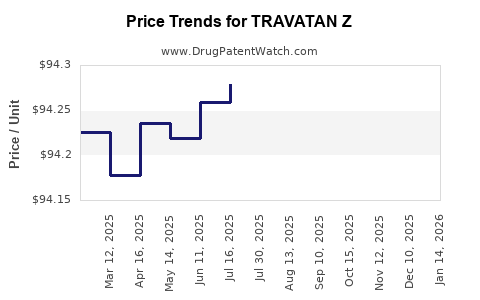
Price Trends and Projections
Historical Pricing Data (USD per bottle)
| Year |
Price Range |
Notes |
| 2016 |
$95 - $110 |
Launch price, slight discounts in some regions |
| 2019 |
$85 - $95 |
Slight decline due to competitive market entries |
| 2022 |
$70 - $90 |
Stabilization, increased generic competition in some markets |
Future Price Projections (2023-2030)
- 2023-2025: Prices are expected to stabilize around $70 - $90 due to brand loyalty and limited immediate generic competition.
- 2026-2028: Prices may decline by 10-15% as patent protections lapse and generics enter the market.
- Post-2028: Prices could fall to $30 - $50, matching prices of comparable generic fixed-dose combinations.
Factors Influencing Price Decline
- Patent expiry in 2028.
- Entry of approved generics from major manufacturers.
- Price erosion driven by healthcare payers negotiating rebates and discounts.
- Increasing adoption of low-cost generics for global markets.
Regional Variations
| Region |
Price Range (USD) |
Market Dynamics |
| North America |
$70 - $90 |
Higher brand loyalty, insurance coverage limits price decline |
| Europe |
$65 - $85 |
Reimbursement policies impact patient out-of-pocket costs |
| Asia-Pacific |
$30 - $60 |
Growing uptake, price sensitive markets, slower patent expiry |
Business Implications
- Patent expiration in 2028 signals potential for significant price reduction.
- Generic competition will likely erode margins, prompting dose and formulation innovations.
- Pricing strategies should focus on early market penetration and value demonstration, especially in emerging markets.
Key Takeaways
- TRAVATAN Z holds a significant share in the glaucoma fixed-dose combination segment.
- Its market is mature, with modest growth driven by expanding global glaucoma prevalence.
- Pricing is stable in the short term but declines are expected following patent expiration in 2028.
- Competition from generics will influence pricing, requiring strategic planning for lifecycle management.
- Regional differences impact pricing and reimbursement policies, influencing global revenue streams.
FAQs
1. When will TRAVATAN Z likely face generic competition?
Patent expiry is expected in 2028, after which generic competitors can enter the market.
2. How does TRAVATAN Z compare to other glaucoma treatments in price?
It generally costs more than monotherapies like latanoprost but less than some branded fixed-dose combinations, with prices around $70 - $90.
3. What factors could accelerate price decline?
Patent expiration, increased generic approvals, and payer discounts could accelerate price erosion post-2028.
4. Are there regional differences in TRAVATAN Z pricing?
Yes. North America and Europe maintain higher prices due to brand loyalty and insurance coverage; prices in Asia-Pacific are lower, driven by market sensitivity.
5. What is the projected growth rate for the glaucoma drug market?
A CAGR of approximately 4.5% from 2023 to 2030, supported by rising global prevalence and expanding treatment options.
Sources
[1] MarketWatch. (2023). Global Glaucoma Drugs Market.
[2] IQVIA. (2022). Brand Market Share Data.
[3] FDA. (2016). Travatanz FDA Approval Documentation.
[4] EMA. (2015). European Market Approval Records.
[5] Grand View Research. (2022). Ophthalmic Drugs Market Report.