You're using a free limited version of DrugPatentWatch: Upgrade for Complete Access

Last Updated: December 31, 2025

TEGRETOL Drug Patent Profile


✉ Email this page to a colleague

« Back to Dashboard


When do Tegretol patents expire, and what generic alternatives are available?

Tegretol is a drug marketed by Novartis and is included in four NDAs.

The generic ingredient in TEGRETOL is carbamazepine. There are twenty-seven drug master file entries for this compound. Forty-nine suppliers are listed for this compound. Additional details are available on the carbamazepine profile page.

DrugPatentWatch® Litigation and Generic Entry Outlook for Tegretol

A generic version of TEGRETOL was approved as carbamazepine by TARO on October 3rd, 1996.

  Get Started Free

AI Deep Research
Questions you can ask:
  • What is the 5 year forecast for TEGRETOL?
  • What are the global sales for TEGRETOL?
  • What is Average Wholesale Price for TEGRETOL?
Summary for TEGRETOL
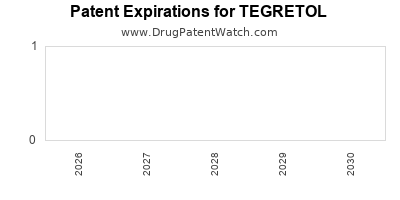
Drug patent expirations by year for TEGRETOL
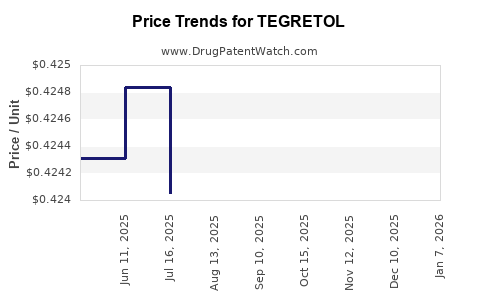
Drug Prices for TEGRETOL

See drug prices for TEGRETOL

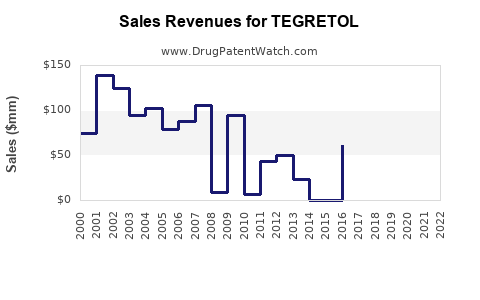
Drug Sales Revenue Trends for TEGRETOL

See drug sales revenues for TEGRETOL

Recent Clinical Trials for TEGRETOL

Identify potential brand extensions & 505(b)(2) entrants

SponsorPhase
PfizerPhase 1
Arvinas Estrogen Receptor, Inc.Phase 1
Dr Cipto Mangunkusumo General HospitalPhase 4

See all TEGRETOL clinical trials

US Patents and Regulatory Information for TEGRETOL

Applicant Tradename Generic Name Dosage NDA Approval Date TE Type RLD RS Patent No. Patent Expiration Product Substance Delist Req. Exclusivity Expiration
Novartis TEGRETOL carbamazepine SUSPENSION;ORAL 018927-001 Dec 18, 1987 AB RX Yes Yes ⤷  Get Started Free ⤷  Get Started Free ⤷  Get Started Free
Novartis TEGRETOL-XR carbamazepine TABLET, EXTENDED RELEASE;ORAL 020234-001 Mar 25, 1996 AB RX Yes No ⤷  Get Started Free ⤷  Get Started Free ⤷  Get Started Free
Novartis TEGRETOL carbamazepine TABLET, CHEWABLE;ORAL 018281-001 Approved Prior to Jan 1, 1982 DISCN Yes No ⤷  Get Started Free ⤷  Get Started Free ⤷  Get Started Free
Novartis TEGRETOL carbamazepine TABLET;ORAL 016608-001 Approved Prior to Jan 1, 1982 AB RX Yes Yes ⤷  Get Started Free ⤷  Get Started Free ⤷  Get Started Free
>Applicant >Tradename >Generic Name >Dosage >NDA >Approval Date >TE >Type >RLD >RS >Patent No. >Patent Expiration >Product >Substance >Delist Req. >Exclusivity Expiration

Expired US Patents for TEGRETOL

Applicant Tradename Generic Name Dosage NDA Approval Date Patent No. Patent Expiration
Novartis TEGRETOL carbamazepine SUSPENSION;ORAL 018927-001 Dec 18, 1987 ⤷  Get Started Free ⤷  Get Started Free
Novartis TEGRETOL carbamazepine TABLET, CHEWABLE;ORAL 018281-001 Approved Prior to Jan 1, 1982 ⤷  Get Started Free ⤷  Get Started Free
Novartis TEGRETOL carbamazepine TABLET;ORAL 016608-001 Approved Prior to Jan 1, 1982 ⤷  Get Started Free ⤷  Get Started Free
>Applicant >Tradename >Generic Name >Dosage >NDA >Approval Date >Patent No. >Patent Expiration

International Patents for TEGRETOL

See the table below for patents covering TEGRETOL around the world.

Country Patent Number Title Estimated Expiration
Italy 1147841 PREPARATI FARMACEUTICI PER LA PROFILASSI ED IL TRATTAMENTO DI INSUFFICIENZA DI RENDIMENTO CEREBRALE ⤷  Get Started Free
Australia 8263382 ⤷  Get Started Free
South Africa 8202568 ⤷  Get Started Free
Italy 8248224 ⤷  Get Started Free
>Country >Patent Number >Title >Estimated Expiration

Market Dynamics and Financial Trajectory for the Pharmaceutical Drug: TEGRETOL (Carbamazepine)

Last updated: July 28, 2025

Introduction

TEGRETOL (carbamazepine) remains a cornerstone in the management of epilepsy, bipolar disorder, and trigeminal neuralgia. Since its US approval in 1968, the drug has held a significant position in neurology and psychiatry markets worldwide. This analysis explores its evolving market landscape, competitive environment, revenue generation trends, regulatory influences, and future growth prospects, providing stakeholders with insight into its financial trajectory.

Market Landscape Overview

TEGRETOL’s primary indications—epilepsy, bipolar disorder, and facial nerve pain—generate considerable demand, especially in regions with aging populations and high prevalence of neurological conditions. According to the World Health Organization, epilepsy affects approximately 50 million individuals globally [1], creating a persistent base of patients reliant on longstanding therapeutic options like carbamazepine.

The drug's market presence is characterized by a combination of branded formulations, generic competition, and emerging biosimilars, particularly following patent expirations. The original patent expiry in 2003 opened the drug to generics, significantly impacting revenue streams. However, branded versions continue to benefit from brand recognition, physician preference, and certain markets with slower adoption of generics.

Competitive Dynamics

Post-patent expiry, generic manufacturers entered the market, leading to substantial price erosion. The global carbamazepine market is now highly competitive, with generics capturing the majority share. Nonetheless, branded formulations maintain premium positioning where clinicians prefer the original drug's quality and consistency, especially in regions where regulatory barriers to generics are higher.

Emerging therapies, including newer anti-epileptics and mood stabilizers such as lamotrigine, levetiracetam, and oxcarbazepine, pose competitive threats. These newer drugs often offer improved safety profiles, fewer drug-drug interactions, or simplified dosing, which influence prescribing patterns.

Regulatory and Patent Landscape

While the original carbamazepine patent expired in 2003 in most jurisdictions, some newer formulations or delivery systems may still be under patent protection, providing niche market opportunities. Regulatory agencies like the US FDA and EMA have approved various generic versions, increasing competition and reducing pricing power for branded TEGRETOL.

In some markets, regulatory barriers or underdeveloped healthcare infrastructure slow generic adoption, allowing branded drugs to maintain higher market shares. Additionally, safety concerns—such as the risk of Stevens-Johnson syndrome linked to HLA-B*1502 allele in certain populations—necessitate genetic screening in some markets, influencing market dynamics and costs.

Market Trends and Revenue Trajectory

The global carbamazepine market was valued at approximately USD 350 million in 2021 and is projected to grow modestly at a CAGR of around 3-4% through 2028 [2]. Growth drivers include rising epilepsy prevalence, expanding indications, and increasing use of carbamazepine in other off-label applications.

However, the sales trajectory is tempered by factors such as the prevalence of generic competition, pricing pressures, and the gradual shift toward newer therapies. In mature markets like North America and Europe, revenue from branded TEGRETOL has declined, giving way to generic products. Conversely, emerging markets with limited access and regulatory hurdles sustain demand for branded formulations.

Pharmaceutical companies are exploring value-added formulations and combination therapies to sustain revenue. For instance, extended-release formulations or combination pills are designed to improve patient adherence and differentiate from generics.

Financial Performance and Forecast

Major pharmaceutical companies that own TEGRETOL rights derive significant revenue, but these figures have stabilized or declined due to patent expirations. For example, Novartis, which historically marketed TEGRETOL, reported a decrease in CNS franchise revenues, including carbamazepine, following patent loss.

Looking ahead, revenue streams depend heavily on market penetration strategies in underdeveloped regions and formulation innovations. Estimated net sales of branded TEGRETOL are projected to decline at a slower pace in markets with delayed generic penetration. Conversely, generic sales continue to dominate revenue in developed regions, exerting downward pressure on average selling prices.

Impact of Biosimilars and New Therapeutics

While biosimilars are not directly applicable to carbamazepine, the entry of next-generation anti-epileptics presents competition for market share. Clinical trials demonstrate that newer agents may offer better tolerability, prompting gradual shifts in prescribing habits. Nonetheless, the cost-effectiveness and long-standing efficacy of carbamazepine support its continued relevance, particularly in cost-sensitive healthcare settings.

Regulatory and Safety Considerations

Recent advances involve genetic screening to mitigate adverse reactions, especially in Asian populations. These safety protocols can influence market dynamics by affecting prescribing behaviors and healthcare costs [3]. Additionally, regulatory authorities' stringent safety warnings impact clinician confidence and patient acceptance.

Future Outlook and Growth Opportunities

The future of TEGRETOL hinges on strategic diversification and innovation:

  • Formulation advancements: Extended-release formulations, fixed-dose combinations, and improved bioavailability can enhance patient compliance and differentiate from generics.
  • Market expansion: Increasing access in emerging markets presents a growth avenue, supported by pricing strategies and educational initiatives.
  • Biomarker-driven personalization: Integration of pharmacogenetic testing can enhance safety profiles, potentially expanding its usage.
  • Off-label and adjunct uses: Exploration of additional indications may open new revenue streams.

Conclusion

TEGRETOL’s market dynamics demonstrate a mature, highly competitive landscape characterized by generics, increasing regulatory complexity, and evolving therapeutic options. While revenue in developed markets declines, strategic engagement in emerging markets, innovation in formulations, and safety-driven personalization present avenues for sustainable growth.

Key Takeaways

  • The global carbamazepine market is experiencing maturity-driven decline in branded sales, offset by growth in generic sales, especially in developed regions.
  • Market competition primarily stems from generic manufacturers and alternative therapies with improved safety and tolerability profiles.
  • Regulatory safety concerns, including genetic screening requirements, influence prescribing practices and penetration strategies.
  • Innovation in formulations and extending indications provide future growth opportunities.
  • Emerging markets and patent strategizing remain critical to maintaining revenue trajectories for branded TEGRETOL formulations.

FAQs

1. How has patent expiration affected TEGRETOL’s market share?
Patent expiration in 2003 led to the entry of generic carbamazepine, significantly reducing branded sales and exerting downward pressure on prices. While generics dominate sales, branded formulations retain market share through physician preference and brand loyalty, especially where regulatory or safety considerations favor original products.

2. What are the main competitors to TEGRETOL in the epilepsy market?
Newer antiepileptic drugs such as levetiracetam, lamotrigine, topiramate, and oxcarbazepine have become primary competitors due to improved side effect profiles and dosing convenience. Their increasing adoption has contributed to the declining dominance of carbamazepine.

3. How do safety concerns influence market dynamics?
Safety issues, including the risk of Stevens-Johnson syndrome in susceptible populations, have prompted genetic testing protocols (e.g., HLA-B*1502 screening in Asians). These measures can affect prescribing patterns and market penetration, favoring drugs with safer profiles.

4. What are the growth prospects for TEGRETOL in emerging markets?
Emerging markets present substantial growth opportunities due to increasing neurological disorder prevalence, limited access to newer drugs, and slower generic adoption. Price sensitivity and healthcare infrastructure challenges influence the pace of growth, often favoring branded formulations.

5. Can innovation restore TEGRETOL’s market prominence?
Yes. Developing extended-release formulations, fixed-dose combinations, and integrating pharmacogenetic testing can differentiate TEGRETOL from generics and competitors, potentially stabilizing or expanding its market share.


References

[1] World Health Organization. Epilepsy Fact Sheet. 2019.
[2] MarketWatch. Carbamazepine Market Size, Share & Trends. 2022.
[3] Chen, P. et al. Genetic Screening and Drug Safety: Impact on Carbamazepine Use. Neurology. 2018.

More… ↓

⤷  Get Started Free

Make Better Decisions: Try a trial or see plans & pricing

Drugs may be covered by multiple patents or regulatory protections. All trademarks and applicant names are the property of their respective owners or licensors. Although great care is taken in the proper and correct provision of this service, thinkBiotech LLC does not accept any responsibility for possible consequences of errors or omissions in the provided data. The data presented herein is for information purposes only. There is no warranty that the data contained herein is error free. We do not provide individual investment advice. This service is not registered with any financial regulatory agency. The information we publish is educational only and based on our opinions plus our models. By using DrugPatentWatch you acknowledge that we do not provide personalized recommendations or advice. thinkBiotech performs no independent verification of facts as provided by public sources nor are attempts made to provide legal or investing advice. Any reliance on data provided herein is done solely at the discretion of the user. Users of this service are advised to seek professional advice and independent confirmation before considering acting on any of the provided information. thinkBiotech LLC reserves the right to amend, extend or withdraw any part or all of the offered service without notice.