TALZENNA Drug Patent Profile
✉ Email this page to a colleague
When do Talzenna patents expire, and when can generic versions of Talzenna launch?
Talzenna is a drug marketed by Pfizer and is included in two NDAs. There are six patents protecting this drug.
This drug has ninety-seven patent family members in thirty-two countries.
The generic ingredient in TALZENNA is talazoparib tosylate. Two suppliers are listed for this compound. Additional details are available on the talazoparib tosylate profile page.
DrugPatentWatch® Generic Entry Outlook for Talzenna
Talzenna was eligible for patent challenges on October 16, 2022.
By analyzing the patents and regulatory protections it appears that the earliest date
for generic entry will be October 20, 2031. This may change due to patent challenges or generic licensing.
Indicators of Generic Entry
AI Deep Research
Questions you can ask:
- What is the 5 year forecast for TALZENNA?
- What are the global sales for TALZENNA?
- What is Average Wholesale Price for TALZENNA?
Summary for TALZENNA
| International Patents: | 97 |
| US Patents: | 6 |
| Applicants: | 1 |
| NDAs: | 2 |
| Finished Product Suppliers / Packagers: | 2 |
| Raw Ingredient (Bulk) Api Vendors: | 44 |
| Clinical Trials: | 23 |
| Patent Applications: | 310 |
| Drug Prices: | Drug price information for TALZENNA |
| What excipients (inactive ingredients) are in TALZENNA? | TALZENNA excipients list |
| DailyMed Link: | TALZENNA at DailyMed |
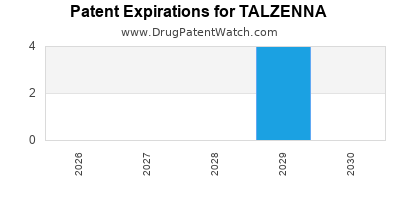

DrugPatentWatch® Estimated Loss of Exclusivity (LOE) Date for TALZENNA
Generic Entry Dates for TALZENNA*:
Constraining patent/regulatory exclusivity:
NDA:
Dosage:
CAPSULE;ORAL |
Generic Entry Dates for TALZENNA*:
Constraining patent/regulatory exclusivity:
NDA:
Dosage:
CAPSULE;ORAL |
*The generic entry opportunity date is the latter of the last compound-claiming patent and the last regulatory exclusivity protection. Many factors can influence early or later generic entry. This date is provided as a rough estimate of generic entry potential and should not be used as an independent source.
Recent Clinical Trials for TALZENNA
Identify potential brand extensions & 505(b)(2) entrants
| Sponsor | Phase |
|---|---|
| German Cancer Research Center | Phase 1/Phase 2 |
| University of Malaya | Phase 2 |
| Cancer Research Malaysia | Phase 2 |
Pharmacology for TALZENNA
| Drug Class | Poly(ADP-Ribose) Polymerase Inhibitor |
| Mechanism of Action | Poly(ADP-Ribose) Polymerase Inhibitors |
US Patents and Regulatory Information for TALZENNA
TALZENNA is protected by six US patents and one FDA Regulatory Exclusivity.
Based on analysis by DrugPatentWatch, the earliest date for a generic version of TALZENNA is ⤷ Start Trial.
This potential generic entry date is based on patent 8,735,392.
Generics may enter earlier, or later, based on new patent filings, patent extensions, patent invalidation, early generic licensing, generic entry preferences, and other factors.
| Applicant | Tradename | Generic Name | Dosage | NDA | Approval Date | TE | Type | RLD | RS | Patent No. | Patent Expiration | Product | Substance | Delist Req. | Exclusivity Expiration |
|---|---|---|---|---|---|---|---|---|---|---|---|---|---|---|---|
| Pfizer | TALZENNA | talazoparib tosylate | CAPSULE;ORAL | 217439-006 | Mar 7, 2024 | RX | Yes | Yes | 9,820,985 | ⤷ Start Trial | ⤷ Start Trial | ||||
| Pfizer | TALZENNA | talazoparib tosylate | CAPSULE;ORAL | 211651-003 | Sep 20, 2021 | DISCN | Yes | No | 9,820,985 | ⤷ Start Trial | ⤷ Start Trial | ||||
| Pfizer | TALZENNA | talazoparib tosylate | CAPSULE;ORAL | 211651-006 | Jun 20, 2023 | DISCN | Yes | No | 8,735,392 | ⤷ Start Trial | Y | Y | ⤷ Start Trial | ||
| Pfizer | TALZENNA | talazoparib tosylate | CAPSULE;ORAL | 217439-004 | Mar 7, 2024 | RX | Yes | No | 9,820,985 | ⤷ Start Trial | ⤷ Start Trial | ||||
| Pfizer | TALZENNA | talazoparib tosylate | CAPSULE;ORAL | 217439-005 | Mar 7, 2024 | RX | Yes | No | 10,780,088 | ⤷ Start Trial | ⤷ Start Trial | ||||
| Pfizer | TALZENNA | talazoparib tosylate | CAPSULE;ORAL | 211651-003 | Sep 20, 2021 | DISCN | Yes | No | 10,189,837 | ⤷ Start Trial | Y | Y | ⤷ Start Trial | ||
| Pfizer | TALZENNA | talazoparib tosylate | CAPSULE;ORAL | 217439-004 | Mar 7, 2024 | RX | Yes | No | 8,420,650 | ⤷ Start Trial | Y | Y | ⤷ Start Trial | ||
| >Applicant | >Tradename | >Generic Name | >Dosage | >NDA | >Approval Date | >TE | >Type | >RLD | >RS | >Patent No. | >Patent Expiration | >Product | >Substance | >Delist Req. | >Exclusivity Expiration |
International Patents for TALZENNA
When does loss-of-exclusivity occur for TALZENNA?
Based on analysis by DrugPatentWatch, the following patents block generic entry in the countries listed below:
Argentina
Patent: 3502
Patent: SAL TOSILADA DE (8S,9R)-5-FLUORO-8-(4-FLUOROFENIL)-9-(1-METIL-1H-1,2,4-TRIAZOL-5-IL)-8,9-DIHIDRO-2H-PIRIDO[4,3,2-DE]FTALAZIN-3(7H)-ONA CRISTALINA
Estimated Expiration: ⤷ Start Trial
Australia
Patent: 11317040
Patent: Crystalline (8S,9R)-5-fluoro-8-(4-fluorophenyl)-9-(1-methyl-1H-1,2,4-triazol-5-yl)-8,9-dihydro-2H-pyrido[4,3,2-de]phthalazin-3(7H)-one tosylate salt
Estimated Expiration: ⤷ Start Trial
Patent: 17201564
Patent: CRYSTALLINE (8S,9R)-5-FLUORO-8-(4-FLUOROPHENYL)-9-(1-METHYL-1H-1,2,4-TRIAZOL-5-YL)-8,9-DIHYDRO-2H-PYRIDO[4,3,2-DE]PHTHALAZIN-3(7H)-ONE TOSYLATE SALT
Estimated Expiration: ⤷ Start Trial
Brazil
Patent: 2013009117
Patent: sal tosilato de (8s,9r)-5-fluor-8-(4-fluorefenil)-9-(1-metil-1h-1,2,4-triazol-5-il)-8,9-diidro-2h-pirido[4,3,2-de]ftalazin-3(7h)-ona, método para preparar uma forma cristalina e uso do mesmo,composição farmacêutica e método para tratar um câncer ou um sintoma do mesmo.
Estimated Expiration: ⤷ Start Trial
Canada
Patent: 14581
Patent: SEL TOSYLATE DE LA (8S,9R)-5-FLUORO-8-(4-FLUOROPHENYL)-9-(1-METHYL-1H- 1,2,4-TRIAZOL-5-YL)-8,9-DIHYDRO-2H-PYRIDO[4,3,2-DE]PHTALAZIN-3(7H)-ONE CRISTALLIN (CRYSTALLINE (8S,9R)-5-FLUORO-8-(4-FLUOROPHENYL)-9-(1-METHYL-1H-1,2,4-TRIAZOL-5-YL)-8,9-DIHYDRO-2H-PYRIDO[4,3,2-DE]PHTHALAZIN-3(7H)-ONE TOSYLATE SALT)
Estimated Expiration: ⤷ Start Trial
China
Patent: 3282365
Patent: 结晶的(8S,9R)‑5‑氟‑8‑(4‑氟苯基)‑9‑(1‑甲基‑1H‑1,2,4‑三唑‑5‑基)‑8,9‑二氢‑2H‑吡啶并[4,3,2‑de]酞嗪‑3(7H)‑酮甲苯磺酸盐 (Crystalline (8S,9R)--fluoro-8-(4-fluorophenyl)-9-(1-methyl-1H-1,2,4-triazol-5-yl)-8,9-dihydro-2H-pyrido[4,3,2-de]phthalazin-3(7H)-one tosylate salt)
Estimated Expiration: ⤷ Start Trial
Cyprus
Patent: 23356
Estimated Expiration: ⤷ Start Trial
Denmark
Patent: 30146
Estimated Expiration: ⤷ Start Trial
European Patent Office
Patent: 30146
Patent: SEL TOSYLATE DE LA (8S,9R)-5-FLUORO-8-(4-FLUOROPHÉNYL)-9-(1-MÉTHYL-1H- 1,2,4-TRIAZOL-5-YL)-8,9-DIHYDRO-2H-PYRIDO[4,3,2-DE]PHTALAZIN-3(7H)-ONE CRISTALLIN (CRYSTALINE (8S,9R)-5-FLUORO-8-(4-FLUOROPHENYL)-9-(1-METHYL-1H-1,2,4-TRIAZOL-5-YL)-8,9-DIHYDRO-2H-PYRIDO[4,3,2-DE]PHTALAZIN-3(7H)-ONE TOSYLATE SALT)
Estimated Expiration: ⤷ Start Trial
Patent: 57106
Patent: SEL TOSYLATE DE LA (8S,9R)-5-FLUORO-8-(4-FLUOROPHÉNYL)-9-(1-MÉTHYL-1H- 1,2,4-TRIAZOL-5-YL)-8,9-DIHYDRO-2H-PYRIDO[4,3,2-DE]PHTALAZIN-3(7H)-ONE CRISTALLIN (CRYSTALINE (8S,9R)-5-FLUORO-8-(4-FLUOROPHENYL)-9-(1-METHYL-1H-1,2,4-TRIAZOL-5-YL)-8,9-DIHYDRO-2H-PYRIDO[4,3,2-DE]PHTALAZIN-3(7H)-ONE TOSYLATE SALT)
Estimated Expiration: ⤷ Start Trial
Hungary
Patent: 51535
Estimated Expiration: ⤷ Start Trial
Israel
Patent: 5789
Patent: מלח טוזילאט של (5–(9r, 8s–פלואורו–8–(4–פלואורופניל)–9–(1–מתיל–4,2,1–1h– טריאזול–5–יל)– 9,8– דיהידרו–2h–פירידו[2,3,4–דה] פתאלאזינ–3(3h)–און גבישי (Crystalline (8s,9r)-5-fluoro-8-(4-fluorophenyl)-9-(1-methyl-1h-1,2,4-triazol-5-yl)-8,9-dihydro-2h-pyrido[4,3,2-de]phthalazin-3(7h)-one tosylate salt)
Estimated Expiration: ⤷ Start Trial
Patent: 1497
Patent: מלח טוזילאט של (s8, r9)–5–פלואורו–8–(4–פלואורופניל)–9–(1–מתיל–h1– 4,2,1–טריאזול–5–יל)–9,8–דיהידרו–h2–פירידו[2,3,4–דה]פתאלאזינ–3(h3)–און גבישי (Crystalline (8s,9r)-5-fluoro-8-(4-fluorophenyl)-9-(1-methyl-1h-1,2,4-triazol-5-yl)-8,9-dihydro-2h-pyrido [4,3,2-de]phthalazin-3(7h)-one tosylate salt)
Estimated Expiration: ⤷ Start Trial
Japan
Patent: 13540158
Estimated Expiration: ⤷ Start Trial
Patent: 17061526
Patent: 結晶性(8S,9R)−5−フルオロ−8−(4−フルオロフェニル)−9−(1−メチル−1H−1,2,4−トリアゾール−5−イル)−8,9−ジヒドロ−2H−ピリド[4,3,2−de]フタラジン−3(7H)−オントシレート塩 (CRYSTALINE (8S,9R)-5-FLUORO-8-(4-FLUOROPHENYL)-9-(1-METHYL-1H-1,2,4-TRIAZOL-5-YL)-8,9-DIHYDRO-2H-PYRIDO[4,3,2-de]PHTHALAZIN-3(7H)-ONE TOSYLATE SALT)
Estimated Expiration: ⤷ Start Trial
Patent: 19034951
Patent: 結晶性(8S,9R)−5−フルオロ−8−(4−フルオロフェニル)−9−(1−メチル−1H−1,2,4−トリアゾール−5−イル)−8,9−ジヒドロ−2H−ピリド[4,3,2−de]フタラジン−3(7H)−オントシレート塩 (CRYSTALLINE (8S,9R)-5-FLUORO-8-(4-FLUOROPHENYL)-9-(1-METHYL-1H-1,2,4-TRIAZOLE-5-YL)-8,9-DIHYDRO-2H-PYRIDO[4,3,2-DE]PHTHALAZINE-3(7H)-ON TOSYLATE)
Estimated Expiration: ⤷ Start Trial
Patent: 20169209
Patent: 結晶性(8S,9R)−5−フルオロ−8−(4−フルオロフェニル)−9−(1−メチル−1H−1,2,4−トリアゾール−5−イル)−8,9−ジヒドロ−2H−ピリド[4,3,2−de]フタラジン−3(7H)−オントシレート塩 (CRYSTALLINE (8S,9R)-5-FLUORO-8-(4-FLUOROPHENYL)-9-(1-METHYL-1H-1,2,4-TRIAZOL-5-YL)-8,9-DIHYDRO-2H-PYRIDO[4,3,2-de]PHTHALAZIN-3(7H)-ONE TOSYLATE SALT)
Estimated Expiration: ⤷ Start Trial
Patent: 22140637
Patent: 結晶性(8S,9R)-5-フルオロ-8-(4-フルオロフェニル)-9-(1-メチル-1H-1,2,4-トリアゾール-5-イル)-8,9-ジヒドロ-2H-ピリド[4,3,2-de]フタラジン-3(7H)-オントシレート塩
Estimated Expiration: ⤷ Start Trial
Patent: 24150772
Patent: 結晶性(8S,9R)-5-フルオロ-8-(4-フルオロフェニル)-9-(1-メチル-1H-1,2,4-トリアゾール-5-イル)-8,9-ジヒドロ-2H-ピリド[4,3,2-de]フタラジン-3(7H)-オントシレート塩 (CRYSTALLINE (8S,9R)-5-FLUORO-8-(4-FLUOROPHENYL)-9-(1-METHYL-1H-1,2,4-TRIAZOL-5-YL)-8,9-DIHYDRO-2H-PYRIDO[4,3,2-de]PHTHALAZIN-3(7H)-ONE TOSYLATE SALT)
Estimated Expiration: ⤷ Start Trial
Mexico
Patent: 2563
Patent: SAL TOSILATO DE (8S, 9R) - 5 - FLUORO -8 - (4 - FLUOROFENIL) - 9 - (1 - METIL - 1H - 1, 2, 4 - TRIAZOL - 5 - IL) - 8, 9 - DIHIDRO - 2H - PIRIDO [4, 3, 2 - DE] FTALAZIN - 3 (7H) - ONA. (CRYSTALLINE (8S,9R)-5-FLUORO-8-(4-FLUOROPHENYL)-9-( 1-METHYL-1H-1,2,4-TRIAZOL-5-YL)-8,9-DIHYDRO-2H-PYRIDO[4,3,2-DE]P HTHALAZIN-3(7H)-ONE TOSYLATE SALT.)
Estimated Expiration: ⤷ Start Trial
Patent: 13004195
Patent: SAL TOSILATO DE (8S, 9R) - 5 - FLUORO -8 - (4 - FLUOROFENIL) - 9 - (1 - METIL - 1H - 1, 2, 4 - TRIAZOL - 5 - IL) - 8, 9 - DIHIDRO - 2H - PIRIDO [4, 3, 2 - DE] FTALAZIN - 3 (7H) - ONA. (CRYSTALLINE (8S,9R)-5-FLUORO-8-(4-FLUOROPHENYL)-9-( 1-METHYL-1H-1,2,4-TRIAZOL-5-YL)-8,9-DIHYDRO-2H-PYRIDO[4,3,2-DE]P HTHALAZIN-3(7H)-ONE TOSYLATE SALT.)
Estimated Expiration: ⤷ Start Trial
New Zealand
Patent: 9490
Patent: Crystalline (8s,9r)-5-fluoro-8-(4-fluorophenyl)-9-(1-methyl-1h-1,2,4-triazol-5-yl)-8,9-dihydro-2h-pyrido[4,3,2-de]phthalazin-3(7h)-one tosylate salt
Estimated Expiration: ⤷ Start Trial
Poland
Patent: 30146
Estimated Expiration: ⤷ Start Trial
Portugal
Patent: 30146
Estimated Expiration: ⤷ Start Trial
Russian Federation
Patent: 98606
Patent: КРИСТАЛЛИЧЕСКАЯ ТОЗИЛАТНАЯ СОЛЬ (8S,9R)-5-ФТОР-8-(4-ФТОРФЕНИЛ)-9-(1-МЕТИЛ-1Н-1,2,4-ТРИАЗОЛ-5-ИЛ)-8-9-ДИГИДРО-2Н-ПИРИДО[4,3,2-de]ФТАЛАЗИН-3(7Н)-ОНА (CRYSTALLINE TOSYLATE SALT (8S,9R)-5-FLUORO-8-(4-FLUOROPHENYL)-9-(1-METHYL-1H-1,2,4-TRIAZOL-5-YL)-8-9-DIHYDRO-2H-PYRIDO[4,3,2-de]PHTHALAZIN-3(7H)-ONE)
Estimated Expiration: ⤷ Start Trial
Patent: 13123036
Patent: КРИСТАЛЛИЧЕСКАЯ ТОЗИЛАТНАЯ СОЛЬ (8S,9R)-5-ФТОР-8-(4-ФТОРФЕНИЛ)-9-(1-МЕТИЛ-1Н-1,2,4-ТРИАЗОЛ-5-ИЛ)-8-9-ДИГИДРО-2Н-ПИРИДО[4,3,2-de]ФТАЛАЗИН-3(7Н)-ОНА (CRYSTALLINE TOSYLATE SALT (8S,9R)-5-FLUORO-8-(4-FLUOROPHENYL)-9-(1-METHYL-1H-1,2,4-TRIAZOL-5-YL)-8-9-DIHYDRO-2H-PYRIDO[4,3,2-de]PHTHALAZIN-3(7H)-ONE)
Estimated Expiration: ⤷ Start Trial
Singapore
Patent: 201710578T
Patent: CRYSTALLINE (8S,9R)-5-FLUORO-8-(4-FLUOROPHENYL)-9-(1-METHYL-1H-1,2,4-TRIAZOL-5-YL)-8,9-DIHYDRO-2H-PYRIDO[4,3,2-DE]PHTHALAZIN-3(7H)-ONE TOSYLATE SALT
Estimated Expiration: ⤷ Start Trial
Patent: 9939
Patent: CRYSTALLINE (8S,9R)-5-FLUORO-8-(4-FLUOROPHENYL)-9-(1-METHYL-1H-1,2,4-TRIAZOL-5-YL)-8,9-DIHYDRO-2H-PYRIDO[4,3,2-DE]PHTHALAZIN-3(7H)-ONE TOSYLATE SALT
Estimated Expiration: ⤷ Start Trial
Slovenia
Patent: 30146
Estimated Expiration: ⤷ Start Trial
South Africa
Patent: 1302810
Patent: CRYSTALLINE(8S,9R)-5-FLUORO-8-(4-FLUOROPHENYL)-9-(1-METHYL-1H11,2,4-TRIAZOL-5-YL)-8,9-DIHYDRO-2H-PYRIDO[4,3,2-DE]PHTHALAZIN-3(7H)-ONE TOSYLATE SALT
Estimated Expiration: ⤷ Start Trial
South Korea
Patent: 140009181
Patent: CRYSTALLINE (8S,9R)-5-FLUORO-8-(4-FLUOROPHENYL)-9-(1-METHYL-1H-1,2,4-TRIAZOL-5-YL)-8,9-DIHYDRO-2H-PYRIDO[4,3,2-DE]PHTHALAZIN-3(7H)-ONE TOSYLATE SALT
Estimated Expiration: ⤷ Start Trial
Patent: 180069132
Patent: 결정질의 (8S,9R)-5-플루오로-8--9-(1-메틸-1H-1,2,4-트리아졸-5-일)-8,9-디하이드로-2H-피리도[4,3,2-DE]프탈라진-3(7H)-온 토실레이트 염 (8S9R-5--8-4--9-1--1H-124--5--89--2H-[432-DE]-37H- CRYSTALLINE 8S9R-5-FLUORO-8-4-FLUOROPHENYL-9-1-METHYL-1H-124-TRIAZOL-5-YL-89-DIHYDRO-2H-PYRIDO[432-DE]PHTHALAZIN-37H-ONE TOSYLATE SALT)
Estimated Expiration: ⤷ Start Trial
Patent: 190120458
Patent: 결정질의 (8S,9R)-5-플루오로-8--9-(1-메틸-1H-1,2,4-트리아졸-5-일)-8,9-디하이드로-2H-피리도[4,3,2-DE]프탈라진-3(7H)-온 토실레이트 염 (8S9R-5--8-4--9-1--1H-124--5--89--2H-[432-DE]-37H- CRYSTALLINE 8S9R-5-FLUORO-8-4-FLUOROPHENYL-9-1-METHYL-1H-124-TRIAZOL-5-YL-89-DIHYDRO-2H-PYRIDO[432-DE]PHTHALAZIN-37H-ONE TOSYLATE SALT)
Estimated Expiration: ⤷ Start Trial
Patent: 210028747
Patent: 결정질의 (8S,9R)-5-플루오로-8--9-(1-메틸-1H-1,2,4-트리아졸-5-일)-8,9-디하이드로-2H-피리도[4,3,2-DE]프탈라진-3(7H)-온 토실레이트 염 (8S9R-5--8-4--9-1--1H-124--5--89--2H-[432-DE]-37H- CRYSTALLINE 8S9R-5-FLUORO-8-4-FLUOROPHENYL-9-1-METHYL-1H-124-TRIAZOL-5-YL-89-DIHYDRO-2H-PYRIDO[432-DE]PHTHALAZIN-37H-ONE TOSYLATE SALT)
Estimated Expiration: ⤷ Start Trial
Spain
Patent: 16600
Estimated Expiration: ⤷ Start Trial
Taiwan
Patent: 1307345
Patent: Crystalline (8S,9R)-5-fluoro-8-(4-fluorophenyl)-9-(1-methyl-1H-1,2,4-triazol-5-yl)-8,9-dihydro-2H-pyrido[4,3,2-de]phthalazin-3(7H)-one tosylate salt
Estimated Expiration: ⤷ Start Trial
Patent: 1713656
Patent: Crystalline (8S,9R)-5-fluoro-8-(4-fluorophenyl)-9-(1-methyl-1H-1,2,4-triazol-5-yl)-8,9-dihydro-2H-pyrido[4,3,2-de]phthalazin-3(7H)-one tosylate salt
Estimated Expiration: ⤷ Start Trial
Patent: 57123
Estimated Expiration: ⤷ Start Trial
Patent: 43858
Estimated Expiration: ⤷ Start Trial
Generics may enter earlier, or later, based on new patent filings, patent extensions, patent invalidation, early generic licensing, generic entry preferences, and other factors.
See the table below for additional patents covering TALZENNA around the world.
| Country | Patent Number | Title | Estimated Expiration |
|---|---|---|---|
| Argentina | 083502 | SAL TOSILADA DE (8S,9R)-5-FLUORO-8-(4-FLUOROFENIL)-9-(1-METIL-1H-1,2,4-TRIAZOL-5-IL)-8,9-DIHIDRO-2H-PIRIDO[4,3,2-DE]FTALAZIN-3(7H)-ONA CRISTALINA | ⤷ Start Trial |
| Australia | 2011317040 | Crystalline (8S,9R)-5-fluoro-8-(4-fluorophenyl)-9-(1-methyl-1H-1,2,4-triazol-5-yl)-8,9-dihydro-2H-pyrido[4,3,2-de]phthalazin-3(7H)-one tosylate salt | ⤷ Start Trial |
| Australia | 2017201564 | CRYSTALLINE (8S,9R)-5-FLUORO-8-(4-FLUOROPHENYL)-9-(1-METHYL-1H-1,2,4-TRIAZOL-5-YL)-8,9-DIHYDRO-2H-PYRIDO[4,3,2-DE]PHTHALAZIN-3(7H)-ONE TOSYLATE SALT | ⤷ Start Trial |
| Brazil | 112013009117 | sal tosilato de (8s,9r)-5-fluor-8-(4-fluorefenil)-9-(1-metil-1h-1,2,4-triazol-5-il)-8,9-diidro-2h-pirido[4,3,2-de]ftalazin-3(7h)-ona, método para preparar uma forma cristalina e uso do mesmo,composição farmacêutica e método para tratar um câncer ou um sintoma do mesmo. | ⤷ Start Trial |
| Canada | 2814581 | SEL TOSYLATE DE LA (8S,9R)-5-FLUORO-8-(4-FLUOROPHENYL)-9-(1-METHYL-1H- 1,2,4-TRIAZOL-5-YL)-8,9-DIHYDRO-2H-PYRIDO[4,3,2-DE]PHTALAZIN-3(7H)-ONE CRISTALLIN (CRYSTALLINE (8S,9R)-5-FLUORO-8-(4-FLUOROPHENYL)-9-(1-METHYL-1H-1,2,4-TRIAZOL-5-YL)-8,9-DIHYDRO-2H-PYRIDO[4,3,2-DE]PHTHALAZIN-3(7H)-ONE TOSYLATE SALT) | ⤷ Start Trial |
| China | 103282365 | 结晶的(8S,9R)‑5‑氟‑8‑(4‑氟苯基)‑9‑(1‑甲基‑1H‑1,2,4‑三唑‑5‑基)‑8,9‑二氢‑2H‑吡啶并[4,3,2‑de]酞嗪‑3(7H)‑酮甲苯磺酸盐 (Crystalline (8S,9R)--fluoro-8-(4-fluorophenyl)-9-(1-methyl-1H-1,2,4-triazol-5-yl)-8,9-dihydro-2H-pyrido[4,3,2-de]phthalazin-3(7H)-one tosylate salt) | ⤷ Start Trial |
| Cyprus | 1123356 | ⤷ Start Trial | |
| >Country | >Patent Number | >Title | >Estimated Expiration |
Supplementary Protection Certificates for TALZENNA
| Patent Number | Supplementary Protection Certificate | SPC Country | SPC Expiration | SPC Description |
|---|---|---|---|---|
| 2767537 | CA 2019 00055 | Denmark | ⤷ Start Trial | PRODUCT NAME: TALAZOPARIB, EVENTUELT I FORM AF ET FARMACEUTISK ACCEPTABELT SALT; REG. NO/DATE: EU/1/19/1377 20190624 |
| 2767537 | 301021 | Netherlands | ⤷ Start Trial | PRODUCT NAME: TALAZOPARIB, DESGEWENST IN DE VORM VAN EEN FARMACEUTISCH AANVAARDBAAR ZOUT; REGISTRATION NO/DATE: EU/1/19/1377 20190624 |
| 2767537 | PA2019522 | Lithuania | ⤷ Start Trial | PRODUCT NAME: TALAZOPARIBAS, PASIRINKTINAI FARMACINIU POZIURIU PRIIMTINOS DRUSKOS PAVIDALU; REGISTRATION NO/DATE: EU/1/19/1377 20190620 |
| 2767537 | LUC00140 | Luxembourg | ⤷ Start Trial | PRODUCT NAME: TALAZOPARIB, EVENTUELLEMENT SOUS LA FORME D'UN SEL PHARMACEUTIQUEMENT ACCEPTABLE; AUTHORISATION NUMBER AND DATE: EU/1/19/1377 20190624 |
| 2767537 | 2019C/551 | Belgium | ⤷ Start Trial | PRODUCT NAME: TALAZOPARIB, OPTIONEEL IN DE VORM VAN EEN FARMACEUTISCH ZOUT; AUTHORISATION NUMBER AND DATE: EU/1/19/1377 20190624 |
| 2767537 | 122019000108 | Germany | ⤷ Start Trial | PRODUCT NAME: TALAZOPARIB ODER PHARMAZEUTISCH VERTRAEGLICHES SALZ DAVON; REGISTRATION NO/DATE: EU/1/19/1377 20190620 |
| 2767537 | 1990055-4 | Sweden | ⤷ Start Trial | PRODUCT NAME: TALAZOPARIB, OPTIONALLY IN THE FORM OF A PHARMACEUTICALLY ACCEPTABLE SALT; FIRST MARKETING AUTHORIZATION NUMBER SE: EG EU/1/19/1377, 2019-06-24; PRV HAR FATTAT BESLUT OM RAETTAD SKYDDSTID FOER FOELJANDE TILLAEGGSSKYDD. 2290042-7 2290031-0 1590027-7 1590062-4 2190040-2 2290010-4 1990014-1 2190030-3 1590011-1 1490013-8 1490014-6 1490015-3 1890033-2 1990042-2 1990055-4 SKYDDSTIDEN FOER SAMTLIGA DESSA TILLAEGGSSKYDD AER FOERLAENGD MED EN DAG, I ENLIGHET MED PATENT- OCH MARKNADSDOMSTOLENS BESLUT I PMAE 7804-24. DEN BESLUTADE SKYDDSTIDEN FRAMGAR AV SVENSK PATENTDATABAS. |
| >Patent Number | >Supplementary Protection Certificate | >SPC Country | >SPC Expiration | >SPC Description |
Make Better Decisions: Try a trial or see plans & pricing
Drugs may be covered by multiple patents or regulatory protections. All trademarks and applicant names are the property of their respective owners or licensors. Although great care is taken in the proper and correct provision of this service, thinkBiotech LLC does not accept any responsibility for possible consequences of errors or omissions in the provided data. The data presented herein is for information purposes only. There is no warranty that the data contained herein is error free. We do not provide individual investment advice. This service is not registered with any financial regulatory agency. The information we publish is educational only and based on our opinions plus our models. By using DrugPatentWatch you acknowledge that we do not provide personalized recommendations or advice. thinkBiotech performs no independent verification of facts as provided by public sources nor are attempts made to provide legal or investing advice. Any reliance on data provided herein is done solely at the discretion of the user. Users of this service are advised to seek professional advice and independent confirmation before considering acting on any of the provided information. thinkBiotech LLC reserves the right to amend, extend or withdraw any part or all of the offered service without notice.
ISSN: 2162-2639

Privacy and Cookies
Terms & Conditions
Site Map
DrugPatentWatch Alternatives
LOE / Major Patent Expirations 2026 - 2027
NCE-1 Patent Challenge Dates 2026 - 2027
Friedman, Yali. "DrugPatentWatch" DrugPatentWatch, thinkBiotech, 2026, www.DrugPatentWatch.com.
See Primary Research Papers Citing DrugPatentWatch