Last updated: September 8, 2026
Tafluprost is a mature prostaglandin analog used to reduce intraocular pressure in patients with open-angle glaucoma or ocular hypertension. Its commercial value is driven by preservative-free delivery, regional brand strength, and ophthalmology distribution rather than regulatory exclusivity. U.S. product-level revenue is not publicly disclosed, while generic and branded competition has materially reduced the drug’s long-term pricing power.
What is tafluprost and how is it used?
Tafluprost is a topical prostaglandin F2α analog administered as an ophthalmic solution. It lowers intraocular pressure by increasing uveoscleral outflow. The main branded products are Zioptan in the United States, Taflotan in Japan and certain Asian markets, and Saflutan in parts of Europe and other international markets.
| Attribute |
Tafluprost |
| Active ingredient |
Tafluprost |
| Drug class |
Prostaglandin analog |
| Primary indications |
Open-angle glaucoma and ocular hypertension |
| Common concentration |
0.0015% ophthalmic solution |
| Key formulation attribute |
Preservative-free single-dose delivery |
| Original developer |
Santen Pharmaceutical |
| U.S. brand |
Zioptan |
| Japan brand |
Taflotan |
| European brand |
Saflutan |
| FDA approval |
2012 |
| Administration |
One drop once daily |
| Biosimilar relevance |
None; tafluprost is a small-molecule drug |
The preservative-free formulation differentiates tafluprost from many older glaucoma products containing benzalkonium chloride. That positioning is commercially relevant for patients with ocular-surface disease, chronic therapy exposure, or intolerance to preserved eye drops.
What is the FDA regulatory status of tafluprost?
The FDA approved Zioptan ophthalmic solution, 0.0015%, in February 2012 for reducing elevated intraocular pressure in patients with open-angle glaucoma or ocular hypertension.[1] The product was approved under a conventional new drug application rather than a biologics pathway.
Tafluprost’s regulatory exclusivity has expired. The five-year new chemical entity period associated with a 2012 approval would have ended in 2017, subject to any applicable pediatric exclusivity or other statutory extensions. There is no current regulatory exclusivity that independently prevents an eligible generic from entering the U.S. market.
FDA market position
The product remains commercially relevant because:
- Glaucoma requires chronic treatment and repeated prescriptions.
- Prostaglandin analogs are commonly used as first-line pressure-lowering therapy.
- Preservative-free products address tolerability and ocular-surface concerns.
- Tafluprost can compete with latanoprost, travoprost, bimatoprost, and preservative-free alternatives.
- The product is a small molecule, so generic substitution is legally and technically feasible.
The principal commercial constraint is that the drug class is established and heavily substituted. Tafluprost therefore competes on tolerability, physician preference, formulary treatment, convenience, and net price rather than on novel mechanism.
What patents protect tafluprost and Zioptan?
The principal U.S. patent protection associated with Zioptan has centered on tafluprost ophthalmic formulations rather than the broad therapeutic concept of using a prostaglandin analog for glaucoma. Publicly reported Orange Book and litigation records have associated Zioptan with patents including U.S. Patent No. 8,871,813.[2]
| Patent or protection category |
Commercial purpose |
Strategic relevance |
| Tafluprost formulation patents |
Protect concentration, excipients, and ophthalmic composition |
Main barrier to an identical generic formulation |
| Method-of-use protection |
Covers treatment of ocular hypertension or glaucoma |
Usually weaker after indication overlap and labeling scrutiny |
| Manufacturing and process know-how |
Supports stability, sterility, filling, and packaging |
Can raise development costs without necessarily blocking approval |
| Single-dose packaging know-how |
Supports preservative-free delivery |
May create design-around and device-development costs |
| Regulatory exclusivity |
Delays certain FDA approvals |
Expired for the original U.S. product |
Patent protection for a topical ophthalmic product can be more commercially important than the active ingredient itself. The molecule is well characterized, but a generic applicant must match or otherwise demonstrate equivalence for formulation performance, sterility, container closure, dose delivery, and stability.
How strong is the tafluprost patent estate?
The estate is moderate rather than dominant.
Its strengths are:
- Formulation complexity in a sterile ophthalmic product.
- Preservative-free packaging requirements.
- Potential patent term extending beyond the original regulatory exclusivity period.
- Manufacturing controls that can increase development and inspection risk.
Its weaknesses are:
- Tafluprost is an established small molecule.
- The disease indication is well known.
- The underlying prostaglandin mechanism is not proprietary.
- Generic applicants can develop alternative excipient systems or packaging configurations.
- U.S. commercial protection depends heavily on the remaining validity and enforceability of formulation patents.
A formulation patent can delay a directly substitutable product, but it does not guarantee long-term market protection. Generic companies may pursue Paragraph IV certifications, challenge patent validity, or develop a non-infringing formulation.
When does tafluprost lose exclusivity?
Tafluprost lost its principal U.S. regulatory exclusivity several years ago. The commercial question is therefore patent timing, not FDA exclusivity.
Exclusivity timeline
| Event |
Timing |
Effect |
| Santen develops tafluprost products |
Before 2012 |
Establishes international commercial base |
| FDA approves Zioptan |
February 2012 |
Starts U.S. branded commercialization |
| Five-year NCE exclusivity |
Approximately 2012-2017 |
Delays certain generic approvals |
| Formulation patent protection |
Extends beyond NCE exclusivity |
Potentially delays or complicates generic entry |
| Mature branded market |
2020s |
Pricing and volume face substitution pressure |
The exact generic-entry date depends on the status of each listed patent, any Paragraph IV litigation, FDA approval timing, and settlement terms. Patent expiration does not automatically produce immediate generic sales. The generic must have an approved ANDA, manufacturing capacity, commercial distribution, and favorable substitution economics.
Are there Paragraph IV challenges to tafluprost?
Paragraph IV litigation is the principal U.S. pathway for challenging listed patents covering Zioptan. A generic applicant can certify that a listed patent is invalid, unenforceable, or not infringed. The patent holder may then file an infringement action, potentially triggering a 30-month stay of FDA approval under the Hatch-Waxman framework.[3]
Publicly available information indicates that tafluprost has faced the same formulation-patent risk profile typical of mature ophthalmic products. The most commercially important question is whether an ANDA applicant has secured a final judgment, settled for a licensed entry date, or proceeded without a blocking patent finding.
A Paragraph IV challenge does not establish that generic entry will occur. Its effects depend on:
- The patents listed for the reference product.
- The timing of the challenge.
- The patent holder’s litigation response.
- The outcome of validity and infringement analysis.
- Any settlement or authorized-generic arrangement.
What formulations are protected by tafluprost patents?
Tafluprost formulation protection generally focuses on the characteristics needed to deliver a stable, sterile, preservative-free ophthalmic dose.
Relevant technical attributes include:
- Tafluprost concentration and chemical stability.
- Buffering agents and pH control.
- Tonicity-adjusting excipients.
- Surfactants or solubilizing systems.
- Container closure and single-dose packaging.
- Protection from light, oxidation, and hydrolysis.
- Sterile filling and shelf-life performance.
The preservative-free format is a commercial differentiator, but it also adds manufacturing complexity. A generic sponsor must produce a product that satisfies FDA chemistry, manufacturing, and controls requirements and demonstrates pharmaceutical equivalence or the applicable bioequivalence standard.
Manufacturing know-how may create practical barriers even when it does not create an absolute legal barrier. Ophthalmic solutions require tight control of particulate matter, microbial contamination, fill volume, container integrity, and dose uniformity.
Which companies compete with tafluprost?
Tafluprost competes primarily with other prostaglandin analogs and preservative-free glaucoma products.
| Product or class |
Active ingredient |
Competitive position |
| Zioptan, Taflotan, Saflutan |
Tafluprost |
Preservative-free tafluprost franchise |
| Xalatan and generics |
Latanoprost |
Large, mature generic base |
| Travatan Z and generics |
Travoprost |
Established prostaglandin alternative |
| Lumigan and generics |
Bimatoprost |
Strong efficacy and branded history |
| Vyzulta |
Latanoprostene bunod |
Newer nitric-oxide-donor prostaglandin product |
| Rocklatan |
Netarsudil plus latanoprost |
Combination therapy |
| Preservative-free latanoprost products |
Latanoprost |
Direct tolerability and price competition |
Latanoprost has the largest structural competitive advantage because of long clinical use, physician familiarity, broad generic availability, and low cost. Tafluprost’s strongest niche is the preservative-free segment, particularly where ocular-surface tolerability influences prescribing.
What is the commercial and financial trajectory for tafluprost?
Tafluprost has moved from branded innovation to mature specialty ophthalmology product. The expected financial trajectory is:
- Initial branded growth after U.S. approval.
- Expansion through specialist prescribing and preservative-free positioning.
- Slower growth as the prostaglandin class becomes more genericized.
- Price pressure from generic or alternative preservative-free products.
- Stable or declining revenue in mature markets unless protected by regional brand strength or licensing.
Santen’s public financial reporting generally aggregates products by regional business, therapeutic area, or broader product category rather than reporting tafluprost revenue as a standalone line item.[4] Zioptan revenue has also been affected by commercial ownership and distribution changes, making historical comparisons difficult.
Revenue exposure
Tafluprost is unlikely to be a major driver of the originating company’s consolidated revenue compared with broader ophthalmology franchises. Its financial importance is more likely to arise from:
- High prescription persistence in chronic glaucoma treatment.
- Low incremental manufacturing cost after scale-up.
- Recurring demand from a large treated population.
- Contribution to a broader ophthalmic sales force.
- Cross-selling and physician-account access.
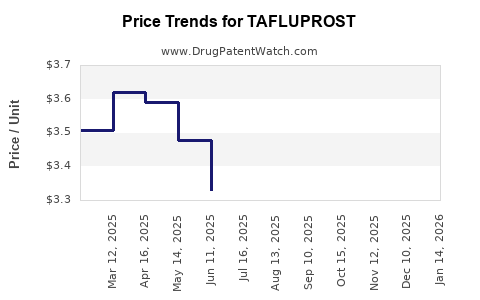
The product’s revenue sensitivity is high to generic substitution. A modest unit decline can be accompanied by a larger net-price decline if payers move prescriptions to low-cost alternatives.
U.S. versus international economics
The United States provides higher nominal pricing but carries greater generic and payer pressure. Japan and selected Asian markets may provide stronger branded persistence where Santen has established physician relationships and local regulatory positioning. Europe is more fragmented because national reimbursement, tendering, and generic policies vary by country.
| Region |
Commercial dynamics |
| United States |
Higher list pricing, strong substitution risk, payer controls |
| Japan |
Santen brand strength and specialist prescribing support |
| Europe |
Country-specific reimbursement and generic pressure |
| Asia-Pacific |
Variable access, growing ophthalmology demand, local competition |
| Latin America and other markets |
Distributor-led access and price sensitivity |
What licensing deals affect tafluprost?
Tafluprost has historically relied on regional commercialization and licensing arrangements rather than a single global commercial model. Santen developed and marketed the product in key markets and used regional partners for selected territories. The U.S. Zioptan franchise has also experienced changes in commercial control and product ownership over time.
Licensing economics can include:
- Upfront payments.
- Milestone payments.
- Territory-based royalties.
- Supply agreements.
- Trademark rights.
- Regulatory responsibilities.
- Minimum purchase obligations.
For a mature product, the value of a licensing deal depends less on expected exclusivity duration and more on territory-level prescription volume, reimbursement, manufacturing cost, and the remaining patent life.
What patent litigation and settlement risks affect tafluprost?
The main litigation risks are:
- Invalidity challenges against formulation patents.
- Non-infringement claims based on alternative excipients.
- Disputes over preservative-free packaging or container systems.
- Patent-term and Orange Book listing disputes.
- Regulatory litigation involving FDA approval timing.
- Commercial disputes between licensees and product owners.
A settlement can delay generic entry to a negotiated date, permit an authorized generic, or establish a royalty-bearing license. Settlement terms are often confidential, and the commercial outcome can differ materially from the public litigation docket.
For investors and business-development teams, the critical diligence issue is not simply whether a patent exists. It is whether the patent is listed, unexpired, enforceable, technically difficult to design around, and supported by a commercially credible injunction strategy.
What generic entry scenarios exist for tafluprost?
Scenario 1: Delayed generic entry
A generic sponsor challenges a listed formulation patent, but litigation or settlement delays approval or launch. Zioptan retains branded volume longer, although discounts may increase before entry.
Scenario 2: Authorized or licensed entry
The brand owner permits a generic launch under negotiated terms. Revenue shifts from product sales toward royalties, supply income, or retained share.
Scenario 3: At-risk launch
A generic launches before final patent resolution. This can produce rapid price erosion and damages exposure if the patent holder later prevails.
Scenario 4: Multiple generic entrants
Several approved products enter after patent expiry or successful challenges. This normally produces the fastest erosion in net price and market share.
Scenario 5: Preservative-free niche defense
Tafluprost maintains a smaller premium segment because physicians prioritize ocular-surface tolerability. Volume declines, but the branded product retains a higher net price than conventional preserved generics.
How does tafluprost compare with latanoprost and bimatoprost?
| Factor |
Tafluprost |
Latanoprost |
Bimatoprost |
| Regulatory maturity |
Mature |
Highly mature |
Mature |
| Preservative-free positioning |
Core differentiator |
Available through selected products |
Available through selected products |
| Generic intensity |
Increasing |
Very high |
High |
| Price protection |
Limited to formulation and brand |
Low in standard formulations |
Moderate in selected branded products |
| Physician familiarity |
Strong in selected markets |
Very strong globally |
Strong |
| Long-term outlook |
Niche recurring revenue |
High-volume, low-price market |
Branded and generic segmentation |
Tafluprost’s commercial defense is product differentiation. Latanoprost’s defense is scale and familiarity. Bimatoprost competes through efficacy perception and brand history. None of the three has meaningful biologic exclusivity risk because all are small-molecule ophthalmic drugs.
Key Takeaways
- Tafluprost is a mature prostaglandin analog for glaucoma and ocular hypertension.
- Zioptan received FDA approval in 2012, and its original regulatory exclusivity has expired.
- The commercial patent question centers on formulation, packaging, and manufacturing protection.
- U.S. generic risk is materially higher than during the initial branded launch period.
- Preservative-free delivery remains tafluprost’s main product differentiator.
- Santen’s public filings do not separately disclose tafluprost revenue, limiting product-level financial attribution.
- The likely long-term trajectory is recurring but pressured revenue, with stronger durability in selected international markets and preservative-free niches.
- Latanoprost is the principal volume and price competitor.
- Paragraph IV litigation, settlement terms, and the design-around strength of formulation patents will determine the timing of U.S. generic erosion.
- Tafluprost has no biosimilar exposure because it is a small-molecule drug.
FAQs
Does tafluprost have orphan-drug exclusivity?
No. Tafluprost is used for common ophthalmic conditions and does not rely on orphan-drug exclusivity.
Is Zioptan still patent protected?
Potentially relevant formulation patents may remain important depending on patent status, expiration, validity, and Orange Book listings. Regulatory exclusivity itself has expired.
Can generic tafluprost be substituted automatically?
Substitution depends on FDA approval, state pharmacy law, payer policy, and whether the generic is therapeutically equivalent and assigned the applicable Orange Book rating.
Is preservative-free tafluprost clinically different from latanoprost?
The primary commercial distinction is formulation and tolerability rather than a different disease mechanism. Clinical selection depends on pressure reduction, ocular-surface status, adherence, and physician judgment.
Does tafluprost have biosimilar competition?
No. Biosimilar regulation applies to biological products. Tafluprost is a chemically synthesized small molecule and competes through the ANDA generic pathway.
References
- U.S. Food and Drug Administration. (2012). Zioptan (tafluprost ophthalmic solution) prescribing information. FDA.
- U.S. Patent and Trademark Office. (2014). U.S. Patent No. 8,871,813: Tafluprost-containing ophthalmic solution.
- U.S. Food and Drug Administration. (2023). Abbreviated new drug application approvals and patent certifications under the Hatch-Waxman Act. FDA.
- Santen Pharmaceutical Co., Ltd. (2024). Integrated report and annual financial disclosures. Santen Pharmaceutical Co., Ltd.