Last updated: September 8, 2026
Sulfasalazine is a mature, low-cost generic anti-inflammatory drug with limited originator economics and minimal current patent protection. Its commercial trajectory is driven by prescription volume, reimbursement, supply reliability, and competition from mesalamine, methotrexate, biologics, and targeted immune therapies rather than by pricing power. No meaningful biosimilar risk exists because sulfasalazine is a small-molecule drug, and no active composition-of-matter exclusivity is central to the U.S. market.
What is the current market position of sulfasalazine?
Sulfasalazine is a legacy small-molecule drug used primarily for ulcerative colitis and inflammatory arthritis. It is sold as immediate-release and delayed-release oral tablets, including generic versions of the former branded products Azulfidine and Azulfidine EN-tabs. The drug is also marketed internationally under names including Salazopyrin.
The U.S. market is mature and fragmented. Multiple manufacturers and labelers compete primarily on price, wholesaler access, pharmacy contracts, and supply continuity. The commercial market has shifted from branded sales to generic volume over several decades.
| Market attribute |
Sulfasalazine position |
| Drug class |
Aminosalicylate and disease-modifying antirheumatic drug |
| Active ingredient |
Sulfasalazine |
| Main U.S. dosage form |
Oral 500 mg tablets, including delayed-release tablets |
| Main indications |
Ulcerative colitis, rheumatoid arthritis, polyarticular-course juvenile rheumatoid arthritis |
| U.S. regulatory status |
FDA-approved small-molecule drug |
| Generic competition |
Established |
| Biosimilar exposure |
None |
| Core patent position |
Expired or commercially irrelevant |
| Pricing power |
Low |
| Primary commercial risks |
Generic price erosion, shortages, low-margin manufacturing, therapeutic substitution |
| Primary commercial opportunity |
Stable chronic-use volume and supply-constrained procurement |
FDA-approved labeling identifies sulfasalazine for the treatment of mild-to-moderate ulcerative colitis and as an adjunct in severe ulcerative colitis. It is also approved for rheumatoid arthritis and polyarticular-course juvenile rheumatoid arthritis when the clinical response to salicylates or other nonsteroidal anti-inflammatory drugs is inadequate (U.S. Food and Drug Administration [FDA], 2023a).
How large is the sulfasalazine market and what is its financial trajectory?
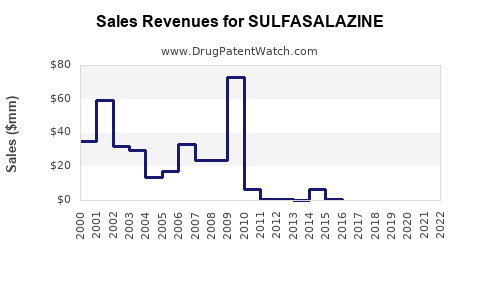
Public companies generally do not report sulfasalazine revenue as a separate product line. The drug is sold as a low-value generic and is usually grouped with broader generic portfolios. Publicly available company filings therefore do not provide a reliable global sulfasalazine revenue series.
The financial trajectory is best characterized as mature, volume-stable, and price-compressed:
- Branded revenue declined after generic entry.
- Generic unit volume remained supported by chronic inflammatory disease treatment.
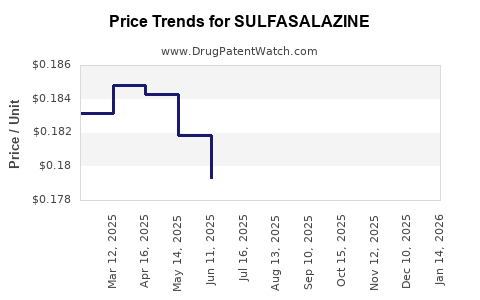
- Average selling prices fell as additional manufacturers entered.
- Margins became sensitive to API costs, manufacturing utilization, and shortages.
- Commercial value migrated from brand ownership to efficient supply and distribution.
Sulfasalazine does not have the revenue profile of newer inflammatory-disease products. Ulcerative colitis treatment has moved toward mesalamine products, corticosteroids for induction, immunomodulators, biologics, and oral targeted therapies. In rheumatoid arthritis, methotrexate and biologic or targeted synthetic DMARDs have reduced the strategic importance of sulfasalazine, although it remains an option in selected patients and combination regimens.
What determines sulfasalazine revenue?
The main revenue variables are prescription volume and net price. Volume is supported by chronic treatment, low acquisition cost, and use in patients for whom clinicians prefer an established conventional therapy. Net price is constrained by generic substitution and payer purchasing.
Manufacturers can improve financial performance through:
- Reliable supply during competitor shortages.
- Efficient API sourcing and manufacturing.
- Delayed-release formulations with stable quality.
- Institutional contracts and wholesaler coverage.
- International distribution under established brand names.
- Portfolio bundling with other generic rheumatology and gastroenterology products.
The principal downside is that a low-priced product can become economically unattractive if API, packaging, quality remediation, or regulatory compliance costs increase. FDA drug-shortage records have historically included sulfasalazine products, demonstrating that low commercial value does not eliminate supply risk (FDA, 2024a).
When does sulfasalazine lose exclusivity?
Sulfasalazine lost meaningful U.S. market exclusivity decades ago. The molecule was introduced in the mid-20th century, and any original composition-of-matter patent protection expired long before the modern generic market.
| Exclusivity category |
Current position |
| Original compound patent |
Expired |
| Original branded product exclusivity |
Expired |
| New chemical entity exclusivity |
Not relevant to the current market |
| Orphan-drug exclusivity |
None identified as commercially relevant |
| Pediatric exclusivity |
No current commercial significance |
| Active formulation exclusivity |
No broad market-blocking protection identified |
| Generic ANDA competition |
Established |
The key commercial issue is not the date on which sulfasalazine first lost exclusivity. It is the absence of a modern patent barrier capable of limiting generic competition. FDA’s Approved Drug Products with Therapeutic Equivalence Evaluations, commonly called the Orange Book, is the principal source for current listed patents and exclusivity information. Sulfasalazine’s market position is consistent with an established generic product rather than a protected branded product (FDA, 2024b).
What patents protect sulfasalazine products?
No active U.S. composition-of-matter patent is central to sulfasalazine commercialization. Historical patents covering the molecule, its synthesis, or early therapeutic use have expired.
Potential intellectual-property rights can still arise around:
- Tablet coatings.
- Delayed-release release profiles.
- Manufacturing processes.
- Impurity controls.
- Packaging.
- Combination products.
- Country-specific formulations.
These rights are narrower than a core molecule patent and generally do not prevent broad generic substitution. A formulation patent would need to claim a commercially meaningful product distinction and survive validity and infringement challenges. For standard 500 mg sulfasalazine tablets, the practical barrier is low.
What formulations are protected by sulfasalazine patents?
The principal formulation distinction is delayed-release oral delivery. Delayed-release tablets are intended to reduce release in the stomach and deliver the drug farther along the gastrointestinal tract. The commercial formulation does not create biologic exclusivity comparable to an extended patent estate around a complex delivery system.
Generic manufacturers must demonstrate pharmaceutical equivalence and bioequivalence or otherwise satisfy FDA approval requirements for the relevant dosage form. Differences in coating, excipients, tablet appearance, or release characteristics do not necessarily create enforceable market exclusivity if the product remains therapeutically equivalent.
What is the Orange Book status of sulfasalazine?
The Orange Book is relevant for identifying approved reference-listed drugs, therapeutic-equivalence ratings, patents, and regulatory exclusivity. Sulfasalazine products are primarily relevant as established small-molecule reference and generic products rather than as products with active patent listings that block ANDA approval.
A practical Orange Book assessment is:
- Generic sulfasalazine products are available.
- The principal 500 mg tablet market is subject to generic competition.
- No active core patent should be assumed to block an ANDA.
- Any listed formulation patent must be evaluated product by product.
- Therapeutic-equivalence codes and approval status may differ by dosage form and manufacturer.
A company assessing a specific launch must review the current FDA Orange Book entry, the applicable reference-listed drug, approved labeling, and any listed patents or exclusivity entries at the time of filing.
Are there Paragraph IV challenges to sulfasalazine?
Paragraph IV litigation is unlikely to be commercially important for standard sulfasalazine products because the core molecule and established tablet formulations have been generic for many years. Paragraph IV certifications are most relevant when an ANDA applicant challenges an unexpired Orange Book patent. Sulfasalazine does not present the typical high-value late-life patent challenge seen with branded specialty drugs.
No material, market-defining sulfasalazine Paragraph IV campaign is publicly associated with the mainstream U.S. product market through June 2024. Any isolated filing would likely concern a specific formulation, manufacturing method, or product presentation rather than the active ingredient itself.
What patent litigation affects sulfasalazine?
Sulfasalazine has no widely recognized active U.S. patent litigation that materially controls market access. The absence of significant litigation reflects the drug’s age, low unit economics, and broad generic availability.
Litigation risk can still arise from:
- ANDA certification disputes involving a particular delayed-release product.
- Manufacturing-process claims.
- Trade-secret disputes concerning API production.
- Contract manufacturing and supply agreements.
- Quality-related recalls or regulatory enforcement.
- Trademark disputes involving historical brand names.
These risks are operational rather than central to the patent value of sulfasalazine.
Which companies are challenging sulfasalazine exclusivity?
No single company is positioned as a high-profile challenger to a current sulfasalazine monopoly. Generic competition is distributed across multiple manufacturers and labelers. The relevant competitive set changes by dosage form, national market, manufacturing site, and supply availability.
In the United States, competition can include:
- Large generic manufacturers.
- Specialty generic companies.
- Authorized generic distributors.
- Contract manufacturers.
- Pharmacy and wholesaler suppliers.
The strategic contest is usually for reliable supply and acceptable gross margin, not for patent invalidation. Manufacturer participation can change when pricing falls below sustainable production levels or when a supplier exits the market.
How does sulfasalazine compare with competing inflammatory-disease drugs?
Sulfasalazine has a lower cost profile but a narrower commercial growth outlook than newer therapies.
| Product class |
Examples |
Relative cost |
Commercial effect on sulfasalazine |
| Conventional aminosalicylates |
Mesalamine |
Low to moderate, depending on formulation |
Direct competition in ulcerative colitis |
| Conventional DMARDs |
Methotrexate, hydroxychloroquine, leflunomide |
Low |
Reduces rheumatology dependence on sulfasalazine |
| Biologics |
Adalimumab, infliximab, vedolizumab, ustekinumab |
High |
Compete in moderate-to-severe disease |
| Targeted oral therapies |
Tofacitinib and other advanced therapies |
High |
Reduce use in treatment-escalation pathways |
| Corticosteroids |
Prednisone and others |
Low |
Compete mainly for short-term induction |
Mesalamine is the closest commercial substitute in ulcerative colitis, especially where clinicians prioritize local gastrointestinal activity and tolerability. Sulfasalazine can remain attractive when cost is decisive or when a patient also has inflammatory arthritis. Guidelines generally position conventional drugs according to disease severity, prior treatment, comorbidities, and treatment goals rather than price alone (American College of Gastroenterology, 2019; Fraenkel et al., 2021).
What FDA regulatory issues affect sulfasalazine?
Sulfasalazine is regulated as an approved small-molecule prescription drug. Manufacturers must maintain compliance with current good manufacturing practice, product specifications, stability requirements, labeling rules, and pharmacovigilance obligations.
The main regulatory risks are manufacturing and quality risks:
- Batch failures.
- Dissolution or delayed-release testing failures.
- API impurity control.
- Nitrogen-containing impurity monitoring.
- Facility inspections.
- Labeling changes.
- Product recalls.
- Manufacturing-site transfers.
Sulfasalazine is metabolized in the intestine to sulfapyridine and 5-aminosalicylic acid. Its labeling includes warnings relating to hypersensitivity, blood dyscrasias, hepatic injury, renal effects, crystalluria, and serious skin reactions. These safety requirements do not create exclusivity, but they can increase post-approval compliance costs (FDA, 2023a).
Does sulfasalazine have biosimilar risk?
No. Biosimilar competition applies to biological products, while sulfasalazine is a chemically synthesized small molecule. Its competitive risk comes from conventional generic competition, therapeutic substitution, and manufacturer exit.
The absence of biosimilar risk does not mean the product is protected. Generic competition is more direct and usually produces greater price pressure than biosimilar competition for a mature product.
Are there licensing deals involving sulfasalazine?
Historical commercialization involved branded products and multinational pharmaceutical companies, including products associated with the Pharmacia and Pfizer commercial lineage. Those historical ownership changes do not establish current exclusivity or meaningful standalone financial value.
No major recent licensing transaction has publicly repositioned sulfasalazine as a growth asset. Current commercial arrangements are more likely to involve generic manufacturing, distribution, private-label supply, or regional brand rights than a high-value global license.
What generic launch scenarios exist for sulfasalazine?
A new entrant would face low legal barriers but challenging economics.
| Launch scenario |
Likely result |
| Standard 500 mg immediate-release tablet |
Rapid price competition and limited differentiation |
| 500 mg delayed-release tablet |
Better product positioning but still exposed to generic substitution |
| Supply-constrained market entry |
Temporary volume and pricing opportunity |
| New manufacturing site |
Potential supply resilience, with significant qualification costs |
| International brand launch |
Depends on local registration, reimbursement, and incumbent strength |
| Reformulated product |
Requires clinical and regulatory justification; commercial upside uncertain |
The strongest entry strategy is usually supply reliability rather than patent litigation. A manufacturer with a qualified API source, robust dissolution performance, and dependable distribution may capture share during competitor shortages. Sustained premium pricing is unlikely without a clinically meaningful formulation advantage.
What geographic markets offer the strongest opportunity?
The United States is a mature generic market with established substitution and low pricing. Europe and other developed markets have similar pressure, although reimbursement and pharmacy substitution rules differ. Emerging markets may offer greater unit growth but lower prices, more variable regulatory enforcement, and greater dependence on local distributors.
Geographic value is determined by:
- Registration requirements.
- Local reference-product rules.
- Government procurement.
- Brand persistence.
- API import controls.
- Domestic manufacturing preferences.
- Availability of competing aminosalicylates and DMARDs.
In markets where sulfasalazine remains a standard low-cost therapy for inflammatory arthritis or ulcerative colitis, volume can remain durable even when per-unit revenue is low.
How strong is the sulfasalazine patent estate?
The patent estate is weak from a blocking-rights perspective and moderate only as an operational asset.
| Dimension |
Assessment |
| Composition-of-matter protection |
Expired |
| Blocking formulation patents |
Limited or not commercially central |
| Method-of-use protection |
Historical use claims are expired or nonblocking |
| Manufacturing know-how |
Potentially useful but difficult to value publicly |
| Regulatory exclusivity |
None of current commercial significance |
| Litigation leverage |
Low |
| Generic entry barrier |
Low |
| Supply-chain barrier |
Moderate |
| Brand value |
Low to moderate, depending on country |
A company should value sulfasalazine based on manufacturing efficiency, procurement access, and supply reliability rather than patent duration.
Key Takeaways
- Sulfasalazine is a mature, low-margin generic drug with durable but limited demand.
- Its original patent and branded exclusivity expired decades ago.
- The U.S. market has established generic competition and no meaningful biosimilar exposure.
- The Orange Book is relevant for product-specific listings, but no broad blocking patent position defines the market.
- Public companies generally do not disclose standalone sulfasalazine revenue.
- Financial performance depends on volume, manufacturing cost, API supply, reimbursement, and shortages.
- Mesalamine is the closest ulcerative-colitis competitor; methotrexate and newer therapies reduce sulfasalazine’s role in rheumatology.
- The strongest commercial opportunity is reliable supply in an otherwise commoditized market.
- Patent litigation and Paragraph IV activity are unlikely to materially affect mainstream sulfasalazine access.
- The product has more operational value than intellectual-property value.
FAQs About Sulfasalazine Market and Patent Exposure
Is sulfasalazine still profitable for generic manufacturers?
It can be profitable when manufacturing costs are low, supply is reliable, and a competitor shortage supports higher utilization. Persistent profitability is limited by generic price competition and low reimbursement.
Does sulfasalazine have an authorized generic?
An authorized generic may exist for a branded product or through a manufacturer-specific distribution arrangement, but status depends on the product, labeler, and market. The commercial market already includes conventional generic alternatives.
Can a new sulfasalazine formulation receive patent protection?
Yes, a genuinely novel formulation or delivery system may be patentable if it satisfies novelty, nonobviousness, written-description, and enablement requirements. A routine change in excipients or tablet appearance is unlikely to create durable market exclusivity.
Why do sulfasalazine shortages occur despite low demand?
Low prices can reduce the number of commercially viable suppliers. A manufacturing interruption, API shortage, quality investigation, or site transfer can then affect the market because remaining suppliers have limited excess capacity.
Is sulfasalazine a growth asset for pharmaceutical licensing?
Generally no. It is more suitable for a generic portfolio, supply-resilience strategy, or regional product bundle than for a high-value licensing transaction based on exclusivity or rapid revenue growth.
References
American College of Gastroenterology. (2019). ACG clinical guideline: Management of ulcerative colitis in adults. The American Journal of Gastroenterology.
Fraenkel, L., Bathon, J. M., England, B. R., St. Clair, E. W., Arayssi, T., Carandang, K., et al. (2021). 2021 American College of Rheumatology guideline for the treatment of rheumatoid arthritis. Arthritis Care & Research, 73(7), 924-939.
U.S. Food and Drug Administration. (2023a). Sulfasalazine delayed-release tablets: Prescribing information. FDA.
U.S. Food and Drug Administration. (2024a). Drug shortages database. FDA.
U.S. Food and Drug Administration. (2024b). Approved drug products with therapeutic equivalence evaluations. FDA.