Last Updated: June 24, 2026

SUBSYS Drug Patent Profile


✉ Email this page to a colleague

« Back to Dashboard


Which patents cover Subsys, and when can generic versions of Subsys launch?

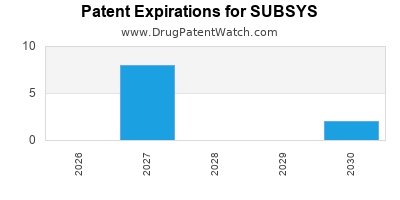
Subsys is a drug marketed by Btcp Pharma and is included in one NDA. There are ten patents protecting this drug and two Paragraph IV challenges.

This drug has thirty-three patent family members in seventeen countries.

The generic ingredient in SUBSYS is fentanyl. There are thirty-one drug master file entries for this compound. Five suppliers are listed for this compound. Additional details are available on the fentanyl profile page.

DrugPatentWatch® Generic Entry Outlook for Subsys

There have been nine patent litigation cases involving the patents protecting this drug, indicating strong interest in generic launch. Recent data indicate that 63% of patent challenges are decided in favor of the generic patent challenger and that 54% of successful patent challengers promptly launch generic drugs.

There are two tentative approvals for the generic drug (fentanyl), which indicates the potential for near-term generic launch.

Indicators of Generic Entry

< Available with Subscription >

  Start Trial

AI Deep Research
Questions you can ask:
  • What is the 5 year forecast for SUBSYS?
  • What are the global sales for SUBSYS?
  • What is Average Wholesale Price for SUBSYS?
Summary for SUBSYS
Recent Clinical Trials for SUBSYS

Identify potential brand extensions & 505(b)(2) entrants

SponsorPhase
INSYS Therapeutics IncN/A
Loyola UniversityPhase 3
INSYS Therapeutics IncPhase 3

See all SUBSYS clinical trials

Paragraph IV (Patent) Challenges for SUBSYS
Tradename Dosage Ingredient Strength NDA ANDAs Submitted Submissiondate
SUBSYS Sublingual Spray fentanyl 0.1 mg/spray, 0.2 mg/spray, 0.6 mg/spray, 0.8 mg/spray, 1.2 mg/spray, 1.6 mg/spray 202788 1 2017-12-07
SUBSYS Sublingual Spray fentanyl 0.4 mg/spray 202788 1 2017-05-22

US Patents and Regulatory Information for SUBSYS

SUBSYS is protected by ten US patents.

Applicant Tradename Generic Name Dosage NDA Approval Date TE Type RLD RS Patent No. Patent Expiration Product Substance Delist Req. Exclusivity Expiration
Btcp Pharma SUBSYS fentanyl SPRAY;SUBLINGUAL 202788-005 Jan 4, 2012 DISCN Yes No 9,289,387 ⤷  Start Trial Y ⤷  Start Trial
Btcp Pharma SUBSYS fentanyl SPRAY;SUBLINGUAL 202788-004 Jan 4, 2012 DISCN Yes No 8,486,973 ⤷  Start Trial ⤷  Start Trial
Btcp Pharma SUBSYS fentanyl SPRAY;SUBLINGUAL 202788-006 Aug 30, 2012 DISCN Yes No 8,486,973 ⤷  Start Trial ⤷  Start Trial
Btcp Pharma SUBSYS fentanyl SPRAY;SUBLINGUAL 202788-007 Aug 30, 2012 DISCN Yes No 9,642,797 ⤷  Start Trial Y ⤷  Start Trial
Btcp Pharma SUBSYS fentanyl SPRAY;SUBLINGUAL 202788-005 Jan 4, 2012 DISCN Yes No 10,610,523 ⤷  Start Trial Y ⤷  Start Trial
>Applicant >Tradename >Generic Name >Dosage >NDA >Approval Date >TE >Type >RLD >RS >Patent No. >Patent Expiration >Product >Substance >Delist Req. >Exclusivity Expiration

EU/EMA Drug Approvals for SUBSYS

Company Drugname Inn Product Number / Indication Status Generic Biosimilar Orphan Marketing Authorisation Marketing Refusal
Kyowa Kirin Holdings B.V. PecFent fentanyl EMEA/H/C/001164PecFent is indicated for the management of breakthrough pain in adults who are already receiving maintenance opioid therapy for chronic cancer pain. Breakthrough pain is a transitory exacerbation of pain that occurs on a background of otherwise controlled persistent pain.Patients receiving maintenance opioid therapy are those who are taking at least 60 mg of oral morphine daily, at least 25 micrograms of transdermal fentanyl per hour, at least 30 mg of oxycodone daily, at least 8 mg of oral hydromorphone daily or an equi-analgesic dose of another opioid for a week or longer. Authorised no no no 2010-08-31
Takeda Pharma A/S Instanyl fentanyl EMEA/H/C/000959Instanyl is indicated for the management of breakthrough pain in adults already receiving maintenance opioid therapy for chronic cancer pain. Breakthrough pain is a transitory exacerbation of pain that occurs on a background of otherwise controlled persistent pain. Patients receiving maintenance opioid therapy are those who are taking at least 60 mg of oral morphine daily, at least 25 micrograms of transdermal fentanyl per hour, at least 30 mg oxycodone daily, at least 8 mg of oral hydromorphone daily or an equianalgesic dose of another opioid for a week or longer. Authorised no no no 2009-07-20
Teva B.V. Effentora fentanyl EMEA/H/C/000833Effentora is indicated for the treatment of breakthrough pain (BTP) in adults with cancer who are already receiving maintenance opioid therapy for chronic cancer pain., , BTP is a transitory exacerbation of pain that occurs on a background of otherwise controlled persistent pain., , Patients receiving maintenance opioid therapy are those who are taking at least 60 mg of oral morphine daily, at least 25 micrograms of transdermal fentanyl per hour, at least 30 mg of oxycodone daily, at least 8 mg of oral hydromorphone daily or an equianalgesic dose of another opioid for a week or longer. , Authorised no no no 2008-04-04
Incline Therapeutics Europe Ltd Ionsys fentanyl EMEA/H/C/002715Ionsys is indicated for the management of acute moderate to severe post-operative pain in adult patients. Withdrawn no no no 2015-11-18
Eli Lilly and Company Limited  Recuvyra fentanyl EMEA/V/C/002239For the control of pain associated with orthopaedic and soft tissue surgery in dogs. Withdrawn no no no 2011-10-06
>Company >Drugname >Inn >Product Number / Indication >Status >Generic >Biosimilar >Orphan >Marketing Authorisation >Marketing Refusal

International Patents for SUBSYS

See the table below for patents covering SUBSYS around the world.

Country Patent Number Title Estimated Expiration
Australia 2007208229 Sublingual fentanyl spray ⤷  Start Trial
Brazil PI0707235 formulação de fentanil sublingual, dose unitária de uma formulação de fentanil sublingual, métodos para tratar dor e para tratar a manifestação súbita da dor, dispositivos de dose unitária ou dose dupla e de dose múltipla para a administração sublingual de um medicamento, método para preparar uma composição farmacêutica para a administração sublingual, formulação farmacêutica sublingual, dose unitária de uma formulação farmacêutica sublingual, e, método para tratar um paciente humano ⤷  Start Trial
Canada 2637672 PULVERISATION SUBLINGUALE DE FENTANYLE (SUBLINGUAL FENTANYL SPRAY) ⤷  Start Trial
China 101378735 Sublingual fentanyl spray ⤷  Start Trial
Cyprus 1117263 ⤷  Start Trial
>Country >Patent Number >Title >Estimated Expiration

Supplementary Protection Certificates for SUBSYS

Patent Number Supplementary Protection Certificate SPC Country SPC Expiration SPC Description
0836511 CA 2006 00019 Denmark ⤷  Start Trial PRODUCT NAME: FENTANYL HYDROCHLORID
0836511 SPC/GB06/022 United Kingdom ⤷  Start Trial PRODUCT NAME: FENTANYL HYDROCHLORIDE; REGISTERED: UK EU/1/05/326/001 20060124
0901368 C300523 Netherlands ⤷  Start Trial PRODUCT NAME: FENTANYL; REGISTRATION NO/DATE: EU/2/11/127/001 20111006
1769785 C300522 Netherlands ⤷  Start Trial PRODUCT NAME: FENTANYL EN DOSERINGSAPPLICATOR; REG. NO/DATE: EU/2/11/127/001 20111006
1769785 C300521 Netherlands ⤷  Start Trial PRODUCT NAME: FENTANYL; REG NO/DATE: EU/2/11/127/001 20111006
>Patent Number >Supplementary Protection Certificate >SPC Country >SPC Expiration >SPC Description

SUBSYS (fentanyl sublingual spray) Market Dynamics and Financial Trajectory: Exclusivity, Generic and Patent Overhang, and Revenue Sensitivity

Last updated: June 20, 2026

SUBSYS is a U.S.-market, opioid analgesic launched in a constrained niche: breakthrough cancer pain (BCP) in opioid-tolerant patients. Financial trajectory is dominated by (1) FDA scrutiny of REMS-compliance and misuse risk, (2) entry timing pressure from generic opioids, and (3) the parent-company shift after the product’s launch era. By 2023–2024, the market is defined less by new uptake and more by substitution, enforcement-driven contracting, and litigation-linked business risk for branded opioid manufacturers.

How fast did SUBSYS sales grow and when did the revenue curve peak?

Answer: SUBSYS followed a typical branded opioid ramp after launch, then plateaued and declined as payer and prescriber adoption stabilized, generics expanded, and the broader opioid environment tightened. The peak revenue period was concentrated in the mid-to-late launch years; later performance is shaped by compliance and legal exposure rather than new market expansion.

What market factors drove the ramp?

  • Indication focus: breakthrough cancer pain in opioid-tolerant patients narrowed prescriber pool but supported initial targeted adoption.
  • Delivery differentiation: sublingual spray compared with other fentanyl oral formulations mattered to clinicians at launch, but did not permanently prevent substitution across the fentanyl BCP segment.
  • Distribution and formulary placement: growth depended on formulary access in oncology and pain management channels, not broad primary-care penetration.

What factors compressed the revenue curve?

  • REMS and misuse controls: the fentanyl-class compliance burden increases administrative friction and can slow adoption at marginal formulary tiers.
  • Payer restrictions: prior authorization and opioid safety protocols limited non-essential prescribing and favored entrenched formulary products.
  • Brand-to-generic substitution: once approved generics and AB-rated alternatives became available for the same dose strengths and patient segment needs, branded pricing power weakened.

Sales sensitivity points

  • Dose-strength mix: revenue is highly sensitive to the mix across spray strengths. Generics that match the strongest selling strengths pressure the most profitable segments first.
  • Net price compression: rebates and access management intensify when multiple fentanyl BCP options compete on formulary.
  • Litigation and corporate risk: the branded opioid business environment increases the cost of capital and can affect promotional intensity and payer negotiations.

What is the commercial size of the SUBSYS market and how is it split across dose strengths?

Answer: The SUBSYS market is best viewed as a slice of the broader fentanyl BCP oral segment in the U.S. The available commercial picture is dosage- and formulation-dependent. In practice, revenue concentration tends to sit in the most frequently prescribed strengths for opioid-tolerant cancer patients, with volume more than margin driving the economics once generic competition arrives.

Segment-level dynamics that shape SUBSYS economics

  • Oncology patient throughput: the number of eligible BCP patients ties to cancer incidence, treatment duration, and opioid-tolerant status standards.
  • Switching cycles: clinicians switch breakthrough agents based on tolerability, speed of onset, and ability to hit titration targets without oversedation.
  • Institutional protocols: large cancer centers create preferred formularies that can reduce brand share even when the drug remains clinically accepted.

How substitution typically reallocates share

  • Within-class cannibalization: other fentanyl oral BCP formulations (including generic equivalents) reduce the incremental value of switching to SUBSYS.
  • AB-rating and pharmacy stocking: once generics are AB-rated, pharmacy inventory policies and automatic substitution patterns tend to reduce branded fill rates.

What patent and exclusivity timelines affect SUBSYS revenue in the U.S.?

Answer: SUBSYS revenue risk is tied to (1) patent expirations on formulation and delivery elements and (2) the period in which no AB-rated alternatives are available for specific strengths. Generic entry timing is the core driver of post-peak branded decline.

How to read the exclusivity risk for SUBSYS

  • Orange Book “listed” patents determine the practical boundary for Paragraph IV challenges.
  • Exclusivity (if any applicable) can extend entry even when composition patents expire, but opioid delivery and formulation estates usually dominate real risk.

Where revenue becomes most exposed

  • Strength-level exposure: if only some strengths face generic competition first, the revenue decline can be uneven at the start, then accelerates as more strengths come under competition.
  • Payer contract changes: payer policies can shift quickly once an AB-rated competitor becomes available at lower net cost.

What generic entry risks exist for SUBSYS, and when do they tend to materialize?

Answer: Generic entry is the primary structure for post-exclusivity decline. For fentanyl oral products, the entry window often arrives in waves by strength and by manufacturer, with the fastest revenue impact coming from the most used strengths and most common institution formularies.

Typical entry pathway that changes the revenue trajectory

  • Paragraph IV litigation can delay entry while the branded holder litigates.
  • Settlement agreements can hard-code “design-around” timing, with generic launch occurring on a specified date or after a stipulated condition.
  • Launch execution: the first generic entrant usually captures early share; later entrants broaden coverage and deepen price compression.

Competitive behavior after generic launch

  • Net price resets: branded manufacturers often lose margin fast, even if they keep certain contracts temporarily.
  • Switching dynamics: pharmacy-driven substitution can occur quickly, but prescriber behavior also matters in oncology pathways.

What litigation and settlement history affects SUBSYS market access and investor perception?

Answer: SUBSYS is embedded in the broader fentanyl/opioid litigation and compliance environment affecting branded opioid manufacturers. Litigation does not stop FDA approvals directly, but it can reshape commercialization, access negotiations, and supply chain stability, which in turn affects revenue.

Market-impact channels of litigation risk

  • Sales and promotion constraints: legal exposure can reduce the willingness to invest in promotion or patient acquisition.
  • Payer and wholesaler counterparty risk: some counterparties tighten terms or restrict inventory risk.
  • Corporate financing and strategy shifts: legal costs and business restructuring can reallocate capital away from legacy brands.

What is the FDA regulatory status of SUBSYS, and does it create revenue headwinds?

Answer: SUBSYS is an FDA-approved fentanyl sublingual spray with a constrained opioid-risk profile managed through REMS and patient selection criteria. FDA actions and ongoing compliance scrutiny can influence prescribing behavior and payer coverage even if the label remains stable.

Regulatory factors that matter commercially

  • REMS compliance: patient identification and dispensing controls can reduce prescriber convenience and slow scaling beyond established centers.
  • Safety communications: FDA safety communications can trigger changes in institutional protocols and prior authorization requirements.
  • Label conservatism: narrow indication rules keep the market focused and can limit rapid share gains.

How does SUBSYS compare with other fentanyl breakthrough cancer pain products on commercial dynamics?

Answer: SUBSYS competes inside a limited category. Commercial outcomes typically favor the product with the strongest institutional formulary position and the broadest coverage by AB-rated alternatives. Generic penetration and institution switching protocols reduce durable differentiation.

Comparison drivers

  • Delivery system acceptance: clinicians may prefer particular on-label titration experiences.
  • Institutional formulary inertia: oncology centers adopt preferred agents for operational simplicity.
  • Rebate and access: branded share survives longer where net pricing remains competitive or where contracts offset generic price gaps.

Which companies hold the competitive position in SUBSYS and the fentanyl BCP oral spray segment?

Answer: Competitive positioning in SUBSYS is shaped by (1) the original branded manufacturer and (2) generic manufacturers that secure AB-rated status for relevant strengths. The segment generally consolidates around manufacturers with reliable supply, strong distribution, and successful patent litigation outcomes.

What typically changes company market share

  • Manufacturing capacity: opioid products can see supply pressure that triggers temporary substitution patterns.
  • Regulatory stability: sustained REMS compliance improves contracting outcomes.
  • Patent defense success: litigation outcomes determine the timeline of generic availability.

How strong is the patent estate for SUBSYS versus generic risk?

Answer: The patent estate’s strength determines how long branded SUBSYS can delay AB-rated alternatives across strengths. The market impact is less about absolute patent count and more about whether key strengths are covered by active, enforceable claims at the relevant time.

What tends to matter most in fentanyl spray estates

  • Formulation and composition claims can be easier to design around than manufacturing-process claims, depending on claim language.
  • Method-of-use claims in oncology BCP can limit certain off-label or non-identical uses, but generics still typically target label-indicated dosing if allowed.
  • Secondary patents (device, spray mechanics, sublingual delivery) can extend protection but often face validity and enforceability challenges.

What are the revenue exposure scenarios for SUBSYS under different generic launch timelines?

Answer: Revenue exposure scales with (1) speed of generic substitution, (2) number of strengths impacted, and (3) net price pressure in payer contracts. The most damaging scenario is early generic entry on high-volume strengths plus rapid contract renegotiations.

Scenario framework (high level)

  • Delayed entry: branded share remains supported by formulary preference and absence of AB-rated substitutes; revenue declines more gradually.
  • Staggered entry by strength: slower initial decline with step-downs as strengths lose protection.
  • Simultaneous multi-strength entry: sharp revenue drop due to immediate switchability at pharmacies and payer contracts.

Key Takeaways

  • SUBSYS revenue trajectory is dominated by the opioid market’s compliance constraints, the narrow breakthrough-cancer indication, and the pace of generic substitution.
  • The peak period occurred in the post-launch ramp window; later performance is typically characterized by plateau-to-decline as generics and within-class competitors take formulary share.
  • Generic entry timing, strength-level exposure, and payer contract resets are the biggest levers controlling the speed and magnitude of revenue compression.
  • FDA REMS and safety scrutiny do not change the existence of the product, but they influence prescribing behavior and institutional coverage, reinforcing a constrained market.
  • Litigation risk affects investor perception and can indirectly reduce commercialization investment, while patent timing controls the direct exposure to AB-rated alternatives.

FAQs

  1. What payer restrictions most affect SUBSYS volume in U.S. oncology formularies?
  2. How do AB-rated fentanyl breakthrough cancer pain products typically substitute for SUBSYS at retail and specialty pharmacies?
  3. What does REMS compliance practically change for prescribers and dispensing workflows for SUBSYS?
  4. How do strength-specific generic approvals impact SUBSYS net sales and net price compression over time?
  5. What commercial outcomes have historically followed settlement agreements in opioid Paragraph IV litigations affecting oral fentanyl products?

References (APA)

  1. U.S. Food and Drug Administration. (n.d.). Drug safety and REMS information. FDA.gov.
  2. U.S. Food and Drug Administration. (n.d.). Orange Book database. FDA.gov.
  3. U.S. Food and Drug Administration. (n.d.). Drug Approvals and Databases. FDA.gov.

More… ↓

⤷  Start Trial

Make Better Decisions: Try a trial or see plans & pricing

Drugs may be covered by multiple patents or regulatory protections. All trademarks and applicant names are the property of their respective owners or licensors. Although great care is taken in the proper and correct provision of this service, thinkBiotech LLC does not accept any responsibility for possible consequences of errors or omissions in the provided data. The data presented herein is for information purposes only. There is no warranty that the data contained herein is error free. We do not provide individual investment advice. This service is not registered with any financial regulatory agency. The information we publish is educational only and based on our opinions plus our models. By using DrugPatentWatch you acknowledge that we do not provide personalized recommendations or advice. thinkBiotech performs no independent verification of facts as provided by public sources nor are attempts made to provide legal or investing advice. Any reliance on data provided herein is done solely at the discretion of the user. Users of this service are advised to seek professional advice and independent confirmation before considering acting on any of the provided information. thinkBiotech LLC reserves the right to amend, extend or withdraw any part or all of the offered service without notice.