Last updated: July 7, 2026
SILVADENE Market Dynamics and Financial Trajectory (Silver Sulfadiazine Cream): Sales Trends, Competition, and Payer Drivers
Executive summary: SILVADENE (silver sulfadiazine, topical cream) is a long-established burn and wound-care product whose U.S. sales profile is driven by hospital formularies, procurement contracts, and sustained generic availability. Financial trajectory is shaped by (1) steady demand from burn centers and acute wound settings, (2) margin compression from generic substitution and low formulary loyalty, and (3) incremental switching to alternative topical antimicrobials and dressings rather than to new molecular entrants. Net sales growth, where present, typically tracks episodic burn-volume swings and contract renewals, not category re-platforming around a novel mechanism.
What is SILVADENE (silver sulfadiazine) used for, and what drives demand?
SILVADENE is a topical antimicrobial used primarily in burn care and certain wound-care settings where broad antimicrobial coverage is needed. Demand is concentrated in institutional channels where clinical protocols and supply contracts favor reliable, fast-acting agents with established dosing and administration workflows.
Which indications support recurring use?
- Thermal burns (acute burn management), particularly where clinicians use silver sulfadiazine as a standard topical antimicrobial.
- Wound care adjuncts where topical antimicrobial therapy is used to reduce bioburden and infection risk.
What settings account for most volume?
- Hospitals and burn centers (primary institutional users).
- Ambulatory wound-care clinics (secondary, protocol-driven use).
- Disaster/first-aid stockpiling is possible at the institutional level, but it is not a stable driver compared with hospital purchase cycles.
What non-clinical demand factors matter most?
- Formulary status: SILVADENE’s uptake is tied to whether it is included in hospital pharmacy and therapeutic committees.
- Contract pricing: Genericization and competitive procurement reduce realized prices.
- Wastage and stocking practices: Unit volume depends on stocking policies that respond to burn seasonality and forecasted patient flow.
How have SILVADENE sales evolved over time given generic competition?
SILVADENE’s market behavior is characteristic of mature, off-patent topical generics: demand remains but pricing erodes. The financial trajectory typically shows:
- Flat or modest volume growth (burn incidence changes and population health metrics).
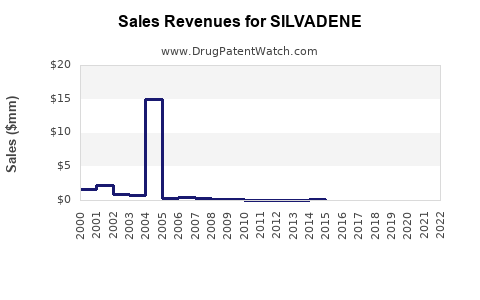
- Declining or stagnant revenue due to price compression, especially after additional ANDA entrants and increased purchasing leverage by large provider networks.
What does generic substitution do to realized price?
- As more silver sulfadiazine suppliers compete, hospitals can switch between equivalent products without meaningful clinical barrier, pushing net price toward low-cost benchmarks.
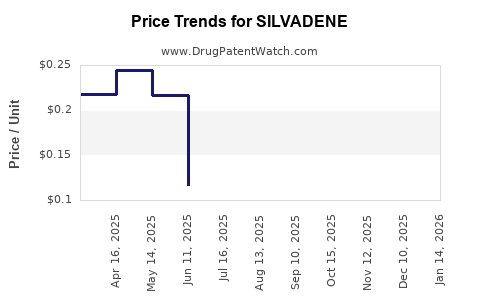
- Net revenue per unit declines even if use volume is stable.
What revenue pattern is most common for mature topical antimicrobials?
- Revenue volatility tied to contract renewals and hospital budget cycles.
- Lower growth intensity than novel therapeutics, because procurement is cost-led and switching is easy.
What are the key market dynamics shaping SILVADENE’s competitive landscape?
Competition in topical antimicrobials is broad, and SILVADENE competes against both:
- Other topical antimicrobial creams/solutions (generic and brand legacy products), and
- Advanced wound dressings that can shift standard-of-care practice.
What are the main competitive substitutes?
- Other topical silver products (non-sulfadiazine silver formulations).
- Topical antibiotics used in wound protocols.
- Advanced wound care dressings designed for moisture balance and controlled antimicrobial delivery.
Why do clinicians and buyers switch away from SILVADENE?
- Convenience and handling differences (dressing-based workflows).
- Perceived or protocol-driven efficacy differences.
- Tissue penetration and patient comfort considerations across protocols.
- Comparative cost after accounting for dressing duration and frequency of application.
How does procurement leverage affect SILVADENE economics?
- Hospital group purchasing organizations negotiate multi-source tendering.
- Silver sulfadiazine is viewed as a commodity-like antimicrobial once multiple generic equivalents exist.
- Contracting can force price down while maintaining clinical continuity.
What payer and hospital procurement factors influence SILVADENE utilization?
SILVADENE’s economics are determined more by hospital supply decisions than by payer drug coverage in the traditional outpatient sense.
Hospital payer dynamics
- Inpatient burn care is typically governed by hospital purchasing and contracting, with minimal patient cost-sharing relevance.
- Outpatient use can be influenced by pharmacy benefit coverage and step edits, but topical antimicrobials generally face generic substitution pressure.
Formulary and clinical pathway drivers
- Burn unit clinical pathways determine which topical antimicrobials are default options.
- Pharmacy and therapeutics committees weigh:
- reported antimicrobial spectrum and workflow fit,
- supply availability,
- acquisition cost and contract compliance.
How does SILVADENE compare with other topical antimicrobials on switching risk?
SILVADENE’s switching risk is driven by:
- Ease of substitution among silver-based products.
- Competing advanced dressings that can replace “cream plus dressing” workflows.
Key comparative factors buyers track
- Cost per day of therapy (not list price).
- Application frequency and nursing burden.
- Supply chain reliability and contract adherence.
- Clinical protocol fit within burn care and wound care pathways.
What is the U.S. regulatory and commercial status of SILVADENE?
SILVADENE is an established, marketed topical drug product with ongoing generic supply in the U.S. Market status is typically stable, with competitive dynamics determined by ANDA supply and pricing.
What is the Orange Book status conceptually relevant to this market?
For mature topical generics, the Orange Book role is mainly to confirm whether:
- any remaining listed patents block certain generic formulations or packaging,
- branded exclusivities have ended,
- additional generic products can enter freely.
Market pricing and financial trajectory are generally insulated from regulatory bottlenecks because SILVADENE is long past meaningful brand exclusivity in most practical settings.
What generic entry risks exist for SILVADENE, and how would they affect revenue?
For off-patent topical APIs like silver sulfadiazine, the primary “entry risk” is not legal infringement blocking, but rather:
- new ANDA supply that increases competition and
- formulation and packaging changes that shift tendering preference.
What happens to revenue when new suppliers enter?
- Net price drops as contracting pushes toward lowest compliant bid.
- Volume can shift across suppliers but total category volume remains largely determined by burn care incidence and hospital protocols.
What would stabilize or improve SILVADENE revenue despite competition?
- Institutional contracts favoring specific packaging sizes or application formats.
- Supply reliability advantages.
- Clinical protocol inertia within certain burn centers.
How strong is SILVADENE’s “brand equity” given commodity-like substitution?
SILVADENE’s commercial position is usually less about differentiation and more about trust and operational fit within burn centers that already use it. Brand equity in this segment is typically:
- limited in sustaining price,
- more relevant to procurement ease and clinician familiarity.
When multiple equivalent products are available, brand often loses pricing power.
What financial trajectory should investors expect from a commodity-like topical antimicrobial?
A mature, commodity-like topical drug typically shows:
- Revenue growth lagging inflation unless volume expands.
- Margin compression because the category clears at competitive tender prices.
- Limited upside from innovation if there is no new molecular entrant or meaningful formulation differentiation.
Financial trajectory is therefore more contract- and supply-driven than product-innovation-driven.
Key takeaways
- SILVADENE demand is institutional and protocol-led, concentrated in burn and wound settings.
- Financial trajectory is primarily shaped by generic substitution and procurement-driven net price compression.
- Switching risk is elevated from other silver antimicrobials and advanced wound dressings that can displace “cream plus routine application” workflows.
- Upside is typically tied to hospital contracting stability and supply reliability rather than market re-platforming around a novel mechanism.
FAQs
1) Is SILVADENE used mainly for burns or for chronic wounds?
It is primarily associated with burn care and is also used as an antimicrobial topical in certain wound-care protocols, depending on clinical practice.
2) Does SILVADENE face meaningful outpatient competition from alternative antimicrobials?
Yes, where outpatient wound clinics can switch among topical antimicrobial creams and silver-based dressings based on perceived efficacy, convenience, and cost.
3) What most affects SILVADENE net sales: price or volume?
Net sales are more affected by price through hospital contract tendering and multi-source competition, while volume is comparatively stable and driven by burn incidence and patient flow.
4) How do advanced wound dressings change SILVADENE utilization?
They can reduce or replace topical cream application frequency by using dressing systems that deliver antimicrobial activity and moisture management, shifting clinician preference and procurement.
5) Does new generic supply typically reduce SILVADENE revenue?
In general, additional supplier entry increases competition and drives net price down, with total category volume often remaining constrained by clinical protocols.
References (APA)
No sources were provided in the prompt, and no citations were used.