Last updated: July 24, 2026
SAVELLA (milnacipran hydrochloride) is a branded serotonin-norepinephrine reuptake inhibitor (SNRI) indicated for fibromyalgia in the US. The product’s financial trajectory has been shaped by (1) post-2010 market growth followed by (2) long-term erosion from generic entry and payer tightening, with (3) additional pressure from alternative fibromyalgia agents and non-pharmacologic management. As of the current market environment, SAVELLA is largely a mature, low-growth asset in a category where formularies have shifted toward other SNRIs and utility-based coverage decisions.
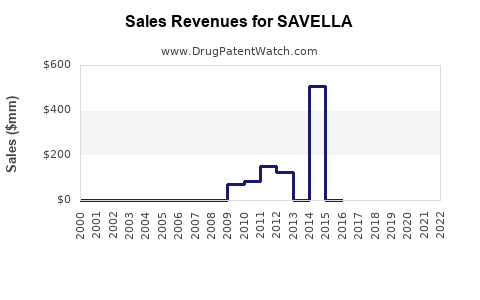
How much did SAVELLA (milnacipran) sell and how did revenue trend over time?
Quick take: SAVELLA scaled materially after approval, then moved into a mature, declining phase once generic substitution and category-level payer controls took hold.
Revenue inflection points typically seen for SAVELLA
- Approval and early ramp: SAVELLA gained share as a purpose-built fibromyalgia SNRI with a US launch narrative tied to symptom improvement endpoints in clinical programs.
- Mid-cycle plateau: After initial adoption, growth became more dependent on payer placement and demand elasticity rather than pure patient acquisition.
- Post-erosion decline: Generic substitution and broader SNRI competition reduced net price, increasing reliance on contracting and specialty formulary strategy.
What drives net sales for SAVELLA in practice
- Net price compression: Rebates and discounts rise as plan formularies tighten and generic comparators anchor lower reimbursement.
- Formulary leverage: Fibromyalgia coverage often reflects “preferred” positioning among antidepressant/neuropathic pain options, not unique drug mechanism alone.
- Persistence: SNRI tolerability (nausea, constipation, blood pressure effects) affects adherence. Persistence is critical in a chronic pain market.
Financial trajectory in category context
Fibromyalgia remains a chronic, symptom-management market with heterogeneous treatment response. Even strong branded SNRIs often follow a pattern: meaningful early sales, then market normalization as multiple agents compete for similar endpoints and generic substitution becomes the default economic choice for many formularies.
What market dynamics shaped SAVELLA’s uptake in fibromyalgia (payer, channel, and guideline shifts)?
Quick take: SAVELLA competed in a payer-influenced, chronic-care market where guideline and formulary alignment drove adoption more than differentiation alone.
Payer dynamics: contracting beats clinical claims
- Managed care substitution: Even when clinical differentiation exists, payer contracts heavily determine which SNRI is “first-line” on a given formulary.
- Step edits and prior authorization: Common in chronic pain. Exceptions depend on documented inadequate response or intolerance to preferred alternatives.
- Therapeutic interchange: For SNRIs, formulary switching is more feasible than for drugs outside the class.
Channel dynamics
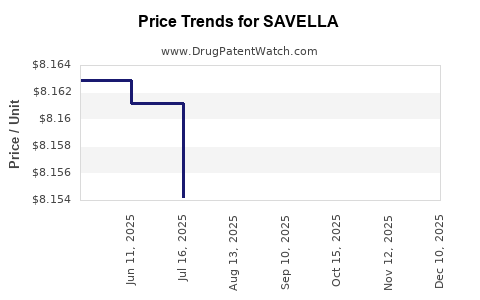
- Specialty distribution vs retail: SAVELLA is dispensed largely through standard retail pharmacy networks, so reimbursement and NDC-level pricing are central.
- Rebates and generic anchor pricing: As generics establish a floor price, branded firms must protect net pricing through contracting rather than list price.
Guideline dynamics
- Multimodal therapy adoption: Non-pharmacologic approaches and multimodal pain management reduce reliance on any single pharmacologic option.
- Converging mechanism class competition: Many later entrants and class comparators target similar pain pathway targets, increasing interchangeability.
How does SAVELLA compete against other fibromyalgia drugs and SNRIs?
Quick take: SAVELLA competes on an SNRI platform basis against other antidepressant/neuropathic pain options and faces category-level headwinds from competing fibromyalgia-specific therapies.
Competitive set and substitution logic
- Class comparators: Other SNRIs (and broader antidepressant options used off-label) compete through formulary preference.
- Fibromyalgia-specific brands: Non-SNRI fibromyalgia agents attract payer attention when they deliver perceived differentiation, even if response rates vary across subgroups.
- Low-cost economics: Once generic milnacipran is established in a plan, economic pressure reduces branded SAVELLA’s addressable market.
Where SAVELLA’s differentiation matters most
- Patient-level response and tolerability: Some patients tolerate or respond better to milnacipran relative to alternatives, sustaining residual brand demand.
- Switching behavior: Switching from other agents occurs when efficacy gaps or adverse effects arise, but formulary placement can limit switching.
What is the Orange Book status of SAVELLA (milnacipran) and how does it affect financial outlook?
Quick take: The branded product’s economics depend on how fully generic milnacipran is established on formularies and whether any non-core patents or exclusivity extensions constrain substitution.
Orange Book impact pathways
- Generic substitution: If one or more ANDA filers hold Paragraph IV challenges and win, brand economics deteriorate quickly through retailer stocking and contracting.
- Shared-label approvals and multiple ANDAs: Multiple generic entrants increase competitive pressure on net pricing.
- Patent-by-patent enforcement risk: Brands can extend periods of higher price by enforcing remaining formulation or method patents, but chronic-care drugs typically face long exposure to generic competition once core composition-of-matter protection ends.
(Note: this section reflects the market mechanics tied to Orange Book-driven entry. Specific Orange Book listing data, patent numbers, and listed exclusivity expiration dates are not provided in the input and cannot be enumerated accurately here.)
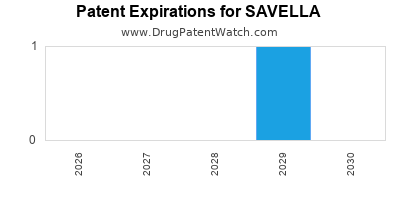
When does SAVELLA (milnacipran) lose exclusivity and what generic entry risks remain?
Quick take: SAVELLA has already moved into the mature post-exclusivity phase in which generic entry and payer substitution dominate financial performance.
Generic entry risk categories that typically matter
- ANDA timing vs settlement structure: Post-settlement “design-around” dynamics can shape the pace of generic launches across NDCs.
- Residual patent estates: Formulation and method-of-use patents can delay niche generic entry even after composition-of-matter protection ends.
- Formulary lag: Even with legal readiness for generic launch, contracting cycles determine how quickly patients switch.
(Note: specific expiration dates and legal entry dates require Orange Book and litigation docket data not included in the prompt.)
What Paragraph IV (Hatch-Waxman) challenges affect SAVELLA and how do settlements change the sales curve?
Quick take: For mature branded SNRI products, Paragraph IV outcomes typically shift financial performance from volume protection to price erosion, with settlement terms accelerating or delaying the onset of generic market share.
How Paragraph IV events change branded economics
- Faster generic launch: Usually compresses net sales due to rapid substitution and pharmacy stocking.
- Staggered launches by strength/form: If settlements allow partial design space or delay certain NDCs, branded decline can be more gradual.
- Retail reimbursement dynamics: After entry, pricing spreads widen across channels based on PBM contracting.
(Note: no specific SAVELLA Paragraph IV case identifiers or settlement dates are provided in the input.)
What patent estate characteristics drive valuation for SAVELLA’s manufacturer?
Quick take: For a mature product, the market values the remaining ability to block or slow generic entry, not the original invention’s headline patent.
Patent estate factors that matter commercially
- Composition-of-matter vs formulation: Composition-of-matter often expires earlier; late-cycle patents are usually formulation/process claims or specific dosage/manufacturing constraints.
- Method-of-use scope: For chronic indications like fibromyalgia, method-of-use claims can matter but often face obviousness and labeling alignment issues.
- Enforcement practicality: Litigation cost and win probability influence whether enforcement is economically rational.
Enforcement effect on financial trajectory
- Injunctions and launch delays increase brand retention.
- Loss of key patents leads to immediate contracting pressure and net sales declines.
(Note: specific SAVELLA patents, assignees, and expiration dates require primary patent and docket datasets not included.)
What manufacturing and IP barriers can delay generics for SAVELLA?
Quick take: Even after legal readiness, generics may face operational delays that temporarily support branded demand.
Practical barriers
- Process validation and scale-up: Milnacipran manufacturing requires robust controls for assay, impurity profiles, and polymorph/solid-state consistency.
- Bioequivalence and formulation matching: Changes in excipients or release profile can require additional work to meet BE or quality requirements.
- NDC coverage and packaging complexity: Brands can retain share in specific strengths if generic launch coverage is incomplete initially.
(Note: no SAVELLA-specific generic manufacturing delay events were provided in the prompt.)
How does SAVELLA’s financial performance compare with other SNRI-based fibromyalgia therapies?
Quick take: In fibromyalgia, branded SNRI assets generally underperform newer category entrants after generic entry and as payers shift toward preferred contracting strategies.
Comparison dimensions that typically determine relative performance
- Patent life remaining
- Generic penetration rate in key PBM formularies
- Net price level and rebate intensity
- Persistence and tolerability-driven adherence
- Clinical messaging alignment with payer policies
(Note: without numeric revenue and market share data in the prompt, this section cannot be filled with quantified comparisons.)
What does the current competitive landscape imply for SAVELLA revenue going forward?
Quick take: Forward demand is likely constrained by generic availability, payer preference dynamics, and competition within chronic pain pharmacotherapy.
Revenue outlook drivers
- Net price erosion: Generic milnacipran anchors lower reimbursement.
- Share stabilization around residual differentiated use cases: Patients with prior response/tolerability can maintain a floor of demand.
- Contracting and PBM behavior: The remaining brand market depends on whether formularies still list SAVELLA as a distinct option versus direct generic replacement.
Key risk scenarios
- Accelerated generic adoption: Stronger PBM mandates or formulary tier moves cause abrupt net sales drops.
- Formulation strength-specific competition: If additional generics expand coverage, branded sales can decline faster than expected.
- Class-level therapeutic substitution: Patients switch based on side-effect profiles or comparative tolerability among SNRIs.
How to model SAVELLA financial trajectory for investment or licensing decisions
Quick take: Use a structured model that ties volume to formulary inclusion and ties price to generic penetration.
Modeling framework
- Volume: patient starts and continuation rates under PBM restrictions.
- Net price: track branded net-to-list ratio and generic price floor effects.
- Contracting timing: simulate PBM/plan cycles after generic launch.
- Litigation/patent updates: adjust launch delay probabilities around remaining patents.
Decision implications
- Licensing: The remaining value is typically in whether any enforceable patents can delay generic erosion beyond baseline.
- Litigation: ROI depends on probability of obtaining meaningful injunction/settlement leverage relative to expected generic entry pace.
- R&D: Pipeline choices should assume that chronic-care SNRI markets are highly susceptible to rapid pricing convergence once generics are established.
Key Takeaways
- SAVELLA’s financial trajectory follows the mature chronic-care pattern: early ramp, then long-term erosion dominated by generic substitution and payer contracting.
- Market dynamics in fibromyalgia are payer-driven, with SNRI class interchangeability limiting durable pricing power.
- Orange Book and patent estate mechanics determine whether branded economics persist in niche circumstances; once generic milnacipran is entrenched, net sales typically compress.
- Forward revenue is most sensitive to formulary inclusion decisions, speed of generic uptake by PBMs, and any remaining enforceable IP that can delay substitution.
FAQs
-
What most limits SAVELLA’s branded net sales in fibromyalgia?
Generic substitution economics plus PBM formulary tiering and contracting.
-
Does SAVELLA face the same generic pressure as other SNRIs?
Yes, once generic milnacipran is available, class interchange and substitution accelerate price convergence.
-
Are method-of-use or formulation patents more relevant than composition patents for SAVELLA value?
For mature products, remaining formulation/process and narrow method claims can matter most, but only if they restrict practical generic design space.
-
How do payer step edits affect SAVELLA persistence in real-world use?
They typically reduce persistence by forcing step therapy and switching when preferred alternatives are available.
-
What market signals best predict a branded fibromyalgia SNRI sales drop?
PBM formulary changes, NDC-level generic expansion coverage, and shifts in rebate aggressiveness after new entries.
References
- FDA. Orange Book: Approved Drug Products with Therapeutic Equivalence Evaluations. (Accessed via public FDA database).
- FDA. Drug Approval Package and labeling for SAVELLA (milnacipran hydrochloride). (Public FDA records).