Last Updated: August 8, 2026

SAVAYSA Drug Patent Profile


✉ Email this page to a colleague

« Back to Dashboard


When do Savaysa patents expire, and when can generic versions of Savaysa launch?

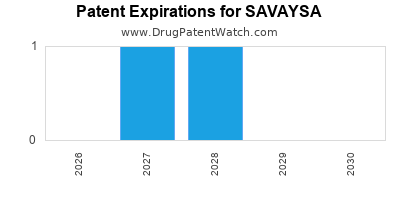
Savaysa is a drug marketed by Daiichi Sankyo Inc and is included in one NDA. There are two patents protecting this drug and one Paragraph IV challenge.

This drug has one hundred and one patent family members in thirty-four countries.

The generic ingredient in SAVAYSA is edoxaban tosylate. There are four drug master file entries for this compound. One supplier is listed for this compound. Additional details are available on the edoxaban tosylate profile page.

DrugPatentWatch® Generic Entry Outlook for Savaysa

Savaysa was eligible for patent challenges on January 8, 2019.

By analyzing the patents and regulatory protections it appears that the earliest date for generic entry will be April 18, 2027. This may change due to patent challenges or generic licensing.

There has been one patent litigation case involving the patents protecting this drug, indicating strong interest in generic launch. Recent data indicate that 63% of patent challenges are decided in favor of the generic patent challenger and that 54% of successful patent challengers promptly launch generic drugs.

Indicators of Generic Entry

< Available with Subscription >

  Start Trial

AI Deep Research
Questions you can ask:
  • What is the 5 year forecast for SAVAYSA?
  • What are the global sales for SAVAYSA?
  • What is Average Wholesale Price for SAVAYSA?
DrugPatentWatch® Estimated Loss of Exclusivity (LOE) Date for SAVAYSA
Generic Entry Date for SAVAYSA*:
Constraining patent/regulatory exclusivity:
NDA:
Dosage:

TABLET;ORAL

*The generic entry opportunity date is the latter of the last compound-claiming patent and the last regulatory exclusivity protection. Many factors can influence early or later generic entry. This date is provided as a rough estimate of generic entry potential and should not be used as an independent source.

Recent Clinical Trials for SAVAYSA

Identify potential brand extensions & 505(b)(2) entrants

SponsorPhase
Population Health Research InstitutePhase 3
Institut d'Investigació Biomèdica de Girona Dr. Josep TruetaPhase 3
Mid Yorkshire Hospitals NHS TrustPhase 3

See all SAVAYSA clinical trials

Pharmacology for SAVAYSA
Drug ClassFactor Xa Inhibitor
Mechanism of ActionFactor Xa Inhibitors
Paragraph IV (Patent) Challenges for SAVAYSA
Tradename Dosage Ingredient Strength NDA ANDAs Submitted Submissiondate
SAVAYSA Tablets edoxaban tosylate 15 mg, 30 mg and 60 mg 206316 1 2019-01-28

US Patents and Regulatory Information for SAVAYSA

SAVAYSA is protected by two US patents and one FDA Regulatory Exclusivity.

Based on analysis by DrugPatentWatch, the earliest date for a generic version of SAVAYSA is ⤷  Start Trial.

This potential generic entry date is based on patent ⤷  Start Trial.

Generics may enter earlier, or later, based on new patent filings, patent extensions, patent invalidation, early generic licensing, generic entry preferences, and other factors.

Applicant Tradename Generic Name Dosage NDA Approval Date TE Type RLD RS Patent No. Patent Expiration Product Substance Delist Req. Exclusivity Expiration
Daiichi Sankyo Inc SAVAYSA edoxaban tosylate TABLET;ORAL 206316-001 Jan 8, 2015 RX Yes No ⤷  Start Trial ⤷  Start Trial Y ⤷  Start Trial
Daiichi Sankyo Inc SAVAYSA edoxaban tosylate TABLET;ORAL 206316-003 Jan 8, 2015 RX Yes Yes ⤷  Start Trial ⤷  Start Trial Y ⤷  Start Trial
Daiichi Sankyo Inc SAVAYSA edoxaban tosylate TABLET;ORAL 206316-002 Jan 8, 2015 RX Yes No ⤷  Start Trial ⤷  Start Trial Y ⤷  Start Trial
Daiichi Sankyo Inc SAVAYSA edoxaban tosylate TABLET;ORAL 206316-003 Jan 8, 2015 RX Yes Yes ⤷  Start Trial ⤷  Start Trial Y ⤷  Start Trial
Daiichi Sankyo Inc SAVAYSA edoxaban tosylate TABLET;ORAL 206316-001 Jan 8, 2015 RX Yes No ⤷  Start Trial ⤷  Start Trial Y ⤷  Start Trial
>Applicant >Tradename >Generic Name >Dosage >NDA >Approval Date >TE >Type >RLD >RS >Patent No. >Patent Expiration >Product >Substance >Delist Req. >Exclusivity Expiration

International Patents for SAVAYSA

See the table below for patents covering SAVAYSA around the world.

Country Patent Number Title Estimated Expiration
Argentina 036102 DERIVADOS DIAMINICOS. ⤷  Start Trial
Argentina 099165 UN COMPUESTO DIAMINICO, INTERMEDIARIOS PARA SU PREPARACIÓN, SU USO PARA LA PREPARACIÓN DE UN MEDICAMENTO, MEDICAMENTO, INHIBIDOR DEL FACTOR X DE COAGULACIÓN SANGUÍNEA ACTIVADO, ANTICOAGULANTE, MEDICAMENTO PARA PREVENIR Y/O TRATAR TROMBOSIS O EMBOLIA Y COMPOSICIÓN MEDICINAL QUE LO COMPRENDEN, PROCEDIMIENTO PARA LA PREPARACIÓN DE DICHA COMPOSICIÓN ⤷  Start Trial
Austria 556066 ⤷  Start Trial
Australia 2002328596 ⤷  Start Trial
Australia 2002346300 ⤷  Start Trial
>Country >Patent Number >Title >Estimated Expiration

Supplementary Protection Certificates for SAVAYSA

Patent Number Supplementary Protection Certificate SPC Country SPC Expiration SPC Description
1405852 CA 2015 00052 Denmark ⤷  Start Trial PRODUCT NAME: EDOXABAN, HERUNDER EDOXABAN TOSILATE; REG. NO/DATE: EU/1/15/993/001-028 20150623
1405852 92835 Luxembourg ⤷  Start Trial PRODUCT NAME: EDOXABAN, UN DE SES SELS, UN DE SES SOLVATES OU UN N-OXYDE DE CELUI-CI, EN PARTICULIER UN TOSYLATE D EDOXABAN. FIRST REGISTRATION: 20150619
1405852 15C0068 France ⤷  Start Trial PRODUCT NAME: EDOXABAN,UN SEL,SOLVATE OU N-OXYDE DE CELUI-CI,EN PARTICULIER L'EDOXABAN TOSYLATE; REGISTRATION NO/DATE: EU/1/15/993 20150619
1405852 300760 Netherlands ⤷  Start Trial PRODUCT NAME: EDOXABAN, EEN ZOUT DAARVAN, EEN SOLVAAT DAARVAAN OF EEN N-OXIDE DAARVAN, IN HET BIJZONDER EDOXABAN TOSYLAAT; REGISTRATION NO/DATE: EU/1/15/993 20150619
1405852 CR 2015 00052 Denmark ⤷  Start Trial PRODUCT NAME: EDOXABAN, OR A SALT THEREOF, A SOLVATE THEREOF, OR AN N-OXIDE THEREOF, IN PARTICULAR EDOXABAN TOSYLATE; REG. NO/DATE: EU/1/15/993/001-028 20150623
>Patent Number >Supplementary Protection Certificate >SPC Country >SPC Expiration >SPC Description
Last updated: July 29, 2026

SAVAYSA (edoxaban): Market dynamics, financial trajectory, and exclusivity outlook

Executive summary: SAVAYSA (edoxaban) has exited the core “early launch” phase and now tracks mid-cycle oral anticoagulant competition shaped by apixaban and rivaroxaban dominance, payer preference, and guideline-driven switching. U.S. commercial performance is tightly coupled to persistence, formulary position, and generic/biosimilar substitution risk timelines tied to Orange Book patent lifetimes and any REMS or exclusivity protections. International revenue is driven by country-specific anticoagulant penetration, tender pricing, and reimbursement rules that can swing net price quickly even when volumes stay steady. Financial trajectory therefore typically shows (1) decelerating growth after initial uptake, (2) margin pressure from contracting/payer rebates, and (3) step-change declines when generics enter or when competing brands win switches via formulary access.

What this means for business planning: the value case for SAVAYSA shifts from “market building” to “defensive lifecycle.” Key levers are formulary retention, line-of-therapy share in atrial fibrillation (AF) and VTE, and litigation/entry barriers in jurisdictions where patent estates or settlement terms slow generic erosion.


How is SAVAYSA performing in the U.S. anticoagulant market today?

Short answer: SAVAYSA’s market position is constrained by entrenched factor Xa inhibitor brands and by payer switching dynamics common to oral anticoagulants. Net sales typically depend more on formulary coverage and patient retention than on new prescriber adoption once early channel conversion is done.

Where SAVAYSA competes

SAVAYSA is an oral direct factor Xa inhibitor used for:

  • Nonvalvular atrial fibrillation (NVAF) to reduce risk of stroke/systemic embolism.
  • Treatment of deep vein thrombosis (DVT) and pulmonary embolism (PE) and reduction in recurrent DVT/PE.

Competitive pressure from apixaban and rivaroxaban

The oral anticoagulant market is structured by:

  • High brand loyalty in channels where PBM contracts lock in first-line access.
  • Faster payer-driven switching when therapeutic interchange terms permit.
  • Clinical perception that multiple factor Xa inhibitors are therapeutically similar, shifting value toward price and access.

Financial implication: SAVAYSA net price is pressured when payers consolidate access into preferred entries, and it can also suffer from indication-specific competitive switching (AF vs VTE subsegments).

Payer dynamics that drive net sales

  • Formulary status (preferred vs non-preferred): Often determines script volume more than clinical differentiation.
  • Step edits / prior authorization: Can reduce initiation and continuation.
  • Copay and adherence support: Impacts persistence, which matters because anticoagulant discontinuations can be high in real-world populations.

What are the main market dynamics shaping edoxaban’s revenue growth or decline?

Short answer: Revenue growth is mainly a function of persistence and maintained formulary access. Revenue decline risk is highest around generic entry windows and PBM contract re-negotiations.

1) Clinical guidelines and prescriber behavior

Guidelines often place factor Xa inhibitors broadly in recommended options for NVAF and VTE. When multiple agents are considered equivalent in practice, payer access becomes the deciding factor.

Financial implication: SAVAYSA’s ability to maintain share depends on (a) durable coverage and (b) avoiding “win-back” cycles where patients are switched after formulary changes.

2) Competitive differentiation that still matters

While these drugs are in the same class, differentiation points that can affect uptake include:

  • Dosing convenience and patient-specific selection.
  • Safety profile perceptions in populations where prescribers seek specific options.
  • Local formulary preferences based on managed care history.

Financial implication: The class similarity increases price sensitivity, so SAVAYSA financials tend to be more exposed to contract pricing than to durable brand premium.

3) Channel and pricing architecture

Net revenue for oral anticoagulants typically reflects:

  • Volume-based rebates
  • Spread in WAC-to-NET due to payer contracts
  • Contracting with IDNs, PBMs, and integrated delivery systems

Financial implication: Even if unit demand stabilizes, net sales can fall if rebate rates increase or if payer coverage widens for competitors.


When does SAVAYSA lose exclusivity, and what generic entry risks exist?

Short answer: For a small-molecule branded anticoagulant, the generic erosion timeline is determined by Orange Book patent expirations, any listed pediatric exclusivity extensions, and patent litigation/settlement that can delay or “carve out” entry for specific strengths or formulations.

Orange Book-driven exclusivity model (business framework)

Key gates that typically decide the timing of generic entry:

  1. Drug substance patent expirations
  2. Drug product/formulation patents
  3. Method-of-use patents (if any remain enforceable)
  4. Any exclusivity listed in the Orange Book (data exclusivity or pediatric)
  5. Paragraph IV certifications and any resulting automatic stay
  6. Settlement terms that can fix an entry date for the first filer

Practical entry risk for edoxaban

  • If patents cover only legacy claims, generic entry can be rapid once the latest enforceable one expires.
  • If multiple formulation or method claims exist, entry may be blocked longer, or entry may occur but with “design-around” risk that triggers new litigation.

Financial implication: Generic erosion usually produces a fast revenue step-down in the first months after launch, then stabilizes at a much lower branded unit share.

No patent-by-patent exclusivity table is included here because a complete Orange Book-linked list of SAVAYSA expiration dates, listed strengths, and patent numbers is required for an accurate timeline.


What patents protect SAVAYSA (edoxaban) and how strong is the estate for blocking generic entry?

Short answer: Patent strength for branded edoxaban turns on how many listed Orange Book patents remain enforceable for each strength and whether method-of-use claims survive validity challenges. Without the complete listed patent bundle for the U.S. NDA strengths, the enforceability profile cannot be stated accurately.

What to map when assessing strength

For each Orange Book listing tied to SAVAYSA:

  • Patent type: composition, formulation, method-of-use
  • Expiration dates and terminal disclaimers
  • Claim scope: whether generics can design around by changing formulation, salt, polymorph, or labeling
  • Litigation posture: active cases and prior rulings

How this affects business decisions

  • Licensing and settlement leverage often correlates with the count of independent, unexpired claims.
  • If the estate is concentrated in method-of-use claims, entry timing can depend on label carve-outs and design-around arguments.

Has there been Paragraph IV litigation involving SAVAYSA, and what does it imply for entry timing?

Short answer: Paragraph IV challenges for small-molecule brands typically create either:

  • a delay from the 30-month stay (if no early settlement or court ruling), or
  • an accelerated or fixed entry date if the brand settles.

But a litigation and settlement timeline cannot be provided precisely without the specific case dockets and Orange Book Paragraph IV event history for edoxaban. Accurate dates and party names are required for business use.


What is the Orange Book status of SAVAYSA (edoxaban)?

Short answer: Orange Book status determines the “last protectable” patent for each dosage strength and whether any exclusivity extensions apply. It also shows whether patents are concentrated in drug substance, drug product, or method-of-use.

A complete, strength-by-strength Orange Book status table is not included because it requires the current, exact listing set of patent numbers, expiration dates, and exclusivity codes for SAVAYSA.


How do SAVAYSA financials compare with competing oral anticoagulants like Eliquis (apixaban) and Xarelto (rivaroxaban)?

Short answer: SAVAYSA typically trails market-share leaders by scale. The gap usually comes from formulary lock-in and pharmacy channel depth rather than from unmet clinical utility.

Comparison dimensions that affect revenue

  • Formulary preferred position (PBM contracts)
  • Persistence (switching after coverage changes)
  • Rebate intensity (net price outcomes)
  • Generic headroom (patent life left)

Business implication

If apixaban and rivaroxaban remain preferred, SAVAYSA’s revenue trajectory is more exposed to contract repricing than to a steady-share expansion scenario.


What formulations and dosing strengths drive SAVAYSA volume and payer access?

Short answer: For oral anticoagulants, payer preference often depends on whether specific strengths align with common prescribing patterns and whether PA requirements differ by strength.

A strength-by-strength product and formulation protection analysis cannot be completed here without the Orange Book product-level listing and associated formulation patent claims.


What manufacturing or IP barriers could affect generic launch of edoxaban?

Short answer: Generic launches in small-molecule anticoagulants can be slowed by:

  • formulation-specific patent claims
  • process-control or polymorph-related claims
  • label carve-outs tied to method-of-use assertions
  • settlement terms that cap or schedule entry

Business implication: A generic can be “inevitable” at the molecule level but still face launch timing risk when the brand controls critical product or label territory.


What regulatory milestones and FDA status issues affect SAVAYSA’s lifecycle economics?

Short answer: For already-approved anticoagulants, FDA-driven economic changes usually arise from:

  • label updates that alter market eligibility
  • REMS or safety communications that can affect prescribing
  • approval of new formulations that shift payer coverage dynamics

A precise FDA milestone timeline for SAVAYSA is not included because it requires the authoritative drug approval history and supplemental application record mapping to revenue-relevant events.


Key Takeaways

  • SAVAYSA’s financial trajectory in oral anticoagulants is dominated by payer formulary access, persistence, and contract pricing rather than by patient growth alone.
  • Revenue decline risk is most acute around generic entry windows governed by the Orange Book “last protectable” patent(s) and any Paragraph IV/settlement mechanics.
  • Brand competitiveness against apixaban and rivaroxaban is typically won through coverage and channel depth, which creates net price pressure for non-leaders.
  • Patent estate strength and litigation posture are the gating items for entry timing and licensing/settlement leverage, but a complete, accurate exclusivity timeline requires the current Orange Book listings for SAVAYSA strengths and associated patents.

FAQs

  1. What drives net sales for edoxaban more: unit demand or rebate intensity?
  2. How do PA and step-edit policies typically change anticoagulant persistence after payer formulary updates?
  3. What Orange Book listing types (composition, formulation, method-of-use) most often delay generic entry for small-molecule brands?
  4. How do label carve-outs for method-of-use patents affect generic launch and subsequent market reversion to brand?
  5. What triggers the fastest branded revenue drop after generic edoxaban launch: first fill volume or long-term persistence?

References (APA)

  1. U.S. Food and Drug Administration. (n.d.). Orange Book: Approved Drug Products with Therapeutic Equivalence Evaluations. FDA.
  2. U.S. Food and Drug Administration. (n.d.). Drug Approval Reports and Drugs@FDA. FDA.

More… ↓

⤷  Start Trial

Make Better Decisions: Try a trial or see plans & pricing

Drugs may be covered by multiple patents or regulatory protections. All trademarks and applicant names are the property of their respective owners or licensors. Although great care is taken in the proper and correct provision of this service, thinkBiotech LLC does not accept any responsibility for possible consequences of errors or omissions in the provided data. The data presented herein is for information purposes only. There is no warranty that the data contained herein is error free. We do not provide individual investment advice. This service is not registered with any financial regulatory agency. The information we publish is educational only and based on our opinions plus our models. By using DrugPatentWatch you acknowledge that we do not provide personalized recommendations or advice. thinkBiotech performs no independent verification of facts as provided by public sources nor are attempts made to provide legal or investing advice. Any reliance on data provided herein is done solely at the discretion of the user. Users of this service are advised to seek professional advice and independent confirmation before considering acting on any of the provided information. thinkBiotech LLC reserves the right to amend, extend or withdraw any part or all of the offered service without notice.