Last updated: September 24, 2026
Saphris, the branded form of asenapine maleate, is a sublingual atypical antipsychotic developed for schizophrenia and bipolar I disorder. Its commercial profile has shifted from branded-growth therapy to mature product under generic pressure. The U.S. market is now driven by generic asenapine availability, payer substitution, limited differentiation of the sublingual route, and the absence of separately reported post-acquisition sales.
The asset has residual commercial value in patients who need an orally disintegrating sublingual antipsychotic, but its peak-growth period has ended. Generic entry materially reduced the value of the U.S. brand, while the product’s formulation and administration requirements limit broad substitution into the entire antipsychotic market.
What is Saphris and how does it work?
Saphris contains asenapine maleate, an atypical antipsychotic administered under the tongue. The dosage form is designed for sublingual absorption and is not intended to be swallowed. Saphris is available in 5 mg and 10 mg sublingual tablets in the United States.
The FDA-approved indications are:
| Indication |
Approved population |
| Schizophrenia |
Adults |
| Bipolar I disorder, manic or mixed episodes |
Adults as monotherapy or adjunctive therapy |
| Bipolar I disorder, manic or mixed episodes |
Pediatric patients ages 10 to 17, depending on labeling and formulation |
Asenapine has activity at multiple dopamine and serotonin receptors. Its sublingual delivery can be relevant for patients who have difficulty swallowing conventional tablets, but the administration procedure creates practical disadvantages. Patients must avoid eating or drinking for a defined period after administration, and oral hypoesthesia or unpleasant taste can reduce adherence.[1]
When did Saphris receive FDA approval?
The FDA approved Saphris in August 2009 for acute treatment of schizophrenia in adults and acute treatment of manic or mixed episodes associated with bipolar I disorder in adults.[2]
The approval history established Saphris as a branded alternative within a crowded atypical antipsychotic market that already included risperidone, olanzapine, quetiapine, aripiprazole, ziprasidone, and several long-acting injectable products.
The principal commercial challenge was not clinical entry into an untreated category. Saphris entered a mature market with extensive generic competition and multiple established prescribing patterns.
What was Saphris’s commercial trajectory?
Saphris experienced an initial period of commercial expansion after launch, followed by plateauing demand and decline as competing antipsychotics gained broader formulary access and generic asenapine approached the market.
AbbVie and Allergan did not maintain a consistently transparent, standalone Saphris revenue line in later public reporting. Earlier Allergan filings reported product-level sales or discussed Saphris within neuroscience and central nervous system portfolios, while post-acquisition AbbVie reporting grouped products into broader therapeutic categories.[3,4]
A practical revenue trajectory is:
| Period |
Commercial phase |
Main market driver |
| 2009-2012 |
Launch and uptake |
New branded atypical antipsychotic positioning |
| 2013-2016 |
Maturity |
Competition from established oral and injectable antipsychotics |
| 2017-2019 |
Late branded phase |
Payer pressure and limited differentiation |
| 2020 onward |
Generic erosion |
FDA-approved generic asenapine and substitution |
| Current phase |
Mature or residual brand |
Narrow patient segments, contracting, and legacy prescriptions |
The product did not achieve the scale of leading antipsychotics such as Abilify, Seroquel, Latuda, or Rexulti. Its commercial ceiling was constrained by the size of the sublingual niche and by the lack of a long-acting injectable version.
How large was the Saphris market?
Saphris was a mid-tier branded CNS product rather than a blockbuster. Historical sales reached the low hundreds of millions of dollars annually at peak, based on company disclosures and industry reporting, but the product did not become a multibillion-dollar franchise.[3,5]
The addressable market was broad in diagnosis but narrower in practical use:
- Schizophrenia patients requiring maintenance or acute therapy
- Bipolar I patients with manic or mixed episodes
- Patients with swallowing difficulties
- Patients who had inadequate response or tolerability issues with other atypical antipsychotics
- Prescribers seeking a non-tablet oral delivery option without an injection
The commercial market was reduced by:
- Generic alternatives across most competing atypical antipsychotic classes.
- Strong formulary preferences for lower-cost agents.
- Availability of long-acting injectable antipsychotics for adherence problems.
- The requirement to administer Saphris sublingually.
- Taste, oral numbness, and post-dose eating and drinking restrictions.
- Limited evidence that the sublingual route produces broad outcome advantages over competing products.
What companies market Saphris and generic asenapine?
Saphris originated with Schering-Plough and was later associated with Merck, Forest Laboratories, Actavis, Allergan, and AbbVie through successive transactions. AbbVie acquired Allergan in 2020.[6]
The branded commercial chain was:
| Company |
Role |
| Schering-Plough |
Original development and commercialization history |
| Merck |
Successor corporate owner after merger |
| Forest Laboratories |
Commercial rights and CNS portfolio involvement |
| Actavis |
Acquired Forest Laboratories |
| Allergan |
Successor owner before AbbVie transaction |
| AbbVie |
Current corporate successor to Allergan’s portfolio |
Generic asenapine has been developed and marketed by multiple generic-drug companies following FDA approval of abbreviated new drug applications. Generic competition is generally supplied through retail and institutional channels, with market share depending on state substitution rules, payer contracts, wholesaler availability, and the number of approved manufacturers.
What is the Orange Book status of Saphris?
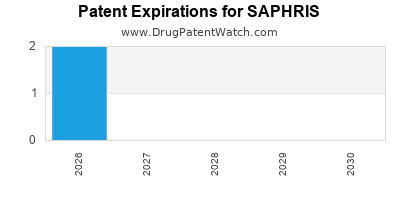
Saphris is an FDA-approved small-molecule drug listed in the Orange Book. Its principal regulatory protection came from composition, formulation, and use patents rather than biologic exclusivity.
The Orange Book is the controlling source for listed patents, pediatric exclusivity, patent-use codes, and approved generic status.[7] Saphris does not have biosimilar exposure because asenapine is a synthetic small molecule, not a biologic.
Relevant exclusivity categories include:
| Protection |
Relevance to Saphris |
| New chemical entity exclusivity |
Applied to the original FDA approval period |
| Pediatric exclusivity |
May have extended certain listed protection periods |
| Formulation patents |
Covered the sublingual dosage form and excipient or delivery characteristics |
| Method-of-use patents |
Potentially covered approved psychiatric indications or dosing |
| FDA approval exclusivity |
Did not prevent later generic entry once statutory and patent barriers expired or were resolved |
The core commercial exclusivity period has ended. Generic asenapine is available in the United States, which confirms that the principal barriers to abbreviated approval no longer prevent market entry.
What patents protect Saphris?
Saphris protection centered on the active ingredient’s pharmaceutical formulation and sublingual delivery rather than on a complex manufacturing platform.
The relevant patent categories were:
Asenapine compound patents
The earliest patent estate protected the asenapine molecule and related pharmaceutical compositions. Compound protection is generally the strongest form of small-molecule protection, but it expires earliest relative to later-filed formulation and use patents.
Sublingual formulation patents
Later patents addressed the sublingual tablet, dissolution behavior, excipients, stability, and administration characteristics. These patents were commercially important because the marketed product depends on sublingual delivery rather than a conventional swallowed tablet.
Method-of-use patents
Use patents could cover treatment of schizophrenia, bipolar disorder, manic episodes, mixed episodes, or specific dosing regimens. Their practical value depended on the FDA-approved labeling and the ability to enforce patents against generic products under the Hatch-Waxman framework.
Pediatric protection
FDA pediatric studies may have provided six months of additional exclusivity for qualifying listed patents or regulatory protections. Pediatric exclusivity is time-limited and does not create a new long-term patent estate.[8]
The patent estate was commercially weaker than the estates around complex injectables or extended-release delivery systems because generic manufacturers could compete with a relatively conventional sublingual tablet once the principal formulation barriers expired.
When did Saphris lose exclusivity?
Saphris lost effective U.S. market exclusivity in stages rather than on a single date. The original regulatory exclusivity period expired before generic approval, while patent protections and litigation timing influenced the date on which generic products could enter.
Generic asenapine reached the U.S. market around 2020. That entry date is the most relevant commercial breakpoint because it converted Saphris from a protected branded product into a product facing direct substitutable competition.
The distinction matters:
- Patent expiration determines whether a generic can lawfully launch.
- FDA approval determines whether a generic can legally market.
- Commercial launch depends on settlement terms, supply readiness, litigation risk, and payer substitution.
- Revenue erosion often begins before full generic availability because payers and wholesalers anticipate entry.
Were there Paragraph IV challenges to Saphris?
Generic manufacturers seeking approval before expiration of listed patents could submit Paragraph IV certifications under the Hatch-Waxman Act. Such certifications can trigger patent litigation and a potential 30-month stay of FDA approval under statutory conditions.[9]
Saphris faced the standard generic challenge environment applicable to branded small-molecule products. The commercial significance of Paragraph IV activity was greatest for sublingual formulation patents and any remaining listed method-of-use patents.
The principal outcome was eventual generic availability rather than durable exclusion of generic competition. Once multiple generic manufacturers entered, the brand’s ability to sustain premium pricing declined sharply.
What patent litigation affected Saphris?
Patent litigation involving Saphris was principally associated with generic challenges to listed patents covering asenapine or its sublingual formulation. These cases were relevant to launch timing, but Saphris did not develop the prolonged, high-value litigation profile associated with major oncology, immunology, or complex injectable products.
The litigation pattern was typical for a mature oral product:
- Generic applicant files an ANDA with a Paragraph IV certification.
- Brand owner sues for patent infringement.
- FDA approval may be delayed by statutory stay provisions.
- The parties may settle or continue to judgment.
- Generic entry occurs after patent expiry, settlement authorization, or successful invalidity or noninfringement proceedings.
Public litigation databases and FDA records should be read together because court resolution does not necessarily establish the date of commercial launch. A settlement can permit entry before nominal patent expiration, while supply and contracting conditions may postpone actual distribution.
What is the generic launch risk for Saphris?
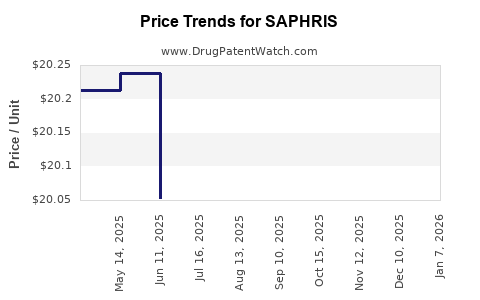
Generic launch risk is high and realized. Generic asenapine is available, and the branded product no longer has the economic protection associated with an exclusive market.
The likely market effects are:
| Risk |
Effect on Saphris |
| Multiple generic suppliers |
Lower average selling price |
| Automatic substitution |
Reduced branded prescription retention |
| Payer exclusion or nonpreferred status |
Higher patient cost share and lower demand |
| Institutional purchasing |
Greater price sensitivity |
| Brand-only contracting |
Limited unless supported by rebates or access guarantees |
| Generic supply disruption |
Temporary opportunity for brand or alternate suppliers |
A branded product can retain a small share after generic entry through physician familiarity, patient stability, prior authorization exceptions, and supply shortages. That residual share does not generally support the earlier branded revenue base.
How does Saphris compare with competing antipsychotics?
| Product |
Active ingredient |
Delivery |
Generic status |
Competitive position |
| Saphris |
Asenapine |
Sublingual tablet |
Generic available |
Niche oral option |
| Abilify |
Aripiprazole |
Oral and long-acting injectable |
Generic available |
Broad class reach and injectable franchise |
| Seroquel |
Quetiapine |
Immediate- and extended-release oral |
Generic available |
Large historical prescriber base |
| Latuda |
Lurasidone |
Oral tablet |
Generic available after loss of exclusivity |
Strong bipolar depression positioning |
| Rexulti |
Brexpiprazole |
Oral tablet |
Branded |
Newer branded alternative |
| Invega products |
Paliperidone |
Oral and long-acting injectable |
Mixed by product |
Adherence and depot advantages |
| Zyprexa |
Olanzapine |
Oral and injectable |
Generic available |
Established efficacy but metabolic concerns |
Saphris’s main differentiator is its sublingual route. It lacks the long-acting delivery, device complexity, or indication breadth that can support stronger post-patent barriers.
What manufacturing and intellectual-property barriers remain?
Manufacturing barriers are moderate. Asenapine itself is a conventional small-molecule active pharmaceutical ingredient, and the dosage form is less technically demanding than a long-acting injectable, inhaled product, or sterile biologic.
The remaining barriers include:
- Control of sublingual dissolution and dose uniformity
- Taste masking and patient acceptability
- Tablet stability and packaging
- Demonstration of bioequivalence for the sublingual dosage form
- Reliable active-ingredient sourcing
- FDA compliance for manufacturing and quality systems
These barriers can limit the number of successful suppliers, but they do not create a durable moat comparable to a complex drug-device combination or biologic manufacturing process.
Are there licensing deals or strategic transactions involving Saphris?
Saphris passed through several corporate transactions rather than a single highly visible late-stage licensing deal. The major strategic events were portfolio transfers and acquisitions involving Schering-Plough, Merck, Forest Laboratories, Actavis, Allergan, and AbbVie.[3,6]
The financial implication is that Saphris became part of broader CNS portfolio management. Its value was linked to portfolio scale, sales infrastructure, and lifecycle management rather than to a standalone platform or partnership ecosystem.
No biosimilar licensing structure applies. The relevant commercial arrangements are generic supply, wholesaler distribution, payer contracting, and any residual brand access agreements.
What is Saphris’s current financial outlook?
Saphris has limited standalone growth potential. Its revenue trajectory is likely characterized by low or declining branded sales, with value concentrated in residual prescriptions and any temporary supply or contracting advantages.
The main financial variables are:
- Generic price discounting
- Number of active generic manufacturers
- Brand reimbursement status
- Patient switching rates
- Prescriber retention in treatment-resistant or swallowing-limited patients
- Manufacturing continuity
- Costs of maintaining the brand and regulatory infrastructure
The product’s current value is therefore defensive rather than expansionary. A buyer would likely underwrite Saphris as a mature branded asset with residual cash flow, not as a growth product.
Key Takeaways
- Saphris is asenapine maleate, a sublingual atypical antipsychotic for schizophrenia and bipolar I disorder.
- FDA approval occurred in 2009.
- The product entered a crowded market dominated by established oral and injectable antipsychotics.
- Historical revenue reached the low hundreds of millions of dollars annually at peak, but later standalone sales disclosure became limited.
- Generic asenapine became available in the United States around 2020.
- The Orange Book and Hatch-Waxman framework governed the relevant patent and generic-entry process.
- The strongest residual intellectual-property value was associated with sublingual formulation and use claims.
- Saphris has no biosimilar risk because it is a synthetic small molecule.
- Current commercial value is limited by automatic substitution, payer pressure, and the availability of generic competitors.
- The main remaining market opportunity is a narrow patient population that values the sublingual route or has limited tolerance for competing antipsychotics.
FAQs About Saphris Market and Patent Outlook
Is Saphris still sold in the United States?
Yes. Saphris remains an FDA-approved branded product, but generic asenapine is also available and has materially reduced the brand’s commercial position.
Is asenapine the same drug as Saphris?
Asenapine is the active ingredient in Saphris. Generic asenapine products are intended to be therapeutically equivalent to the corresponding branded dosage form when approved by the FDA.
Does Saphris have a long-acting injectable version?
No. Saphris is administered as a sublingual tablet. The absence of a long-acting injectable version limits its competitive position in adherence-focused antipsychotic treatment.
Can a generic manufacturer launch a swallowed asenapine tablet?
A swallowed tablet would require its own FDA approval and would need to satisfy applicable pharmaceutical equivalence, bioequivalence, safety, and efficacy requirements. Approval of sublingual asenapine does not automatically authorize a different route of administration.
Is Saphris attractive for pharmaceutical licensing?
Saphris is more suitable for a mature-products or specialty-generic strategy than for a growth-oriented branded licensing strategy. Its residual value depends on manufacturing efficiency, supply reliability, payer access, and the ability to retain a narrow branded patient segment.
References
- U.S. Food and Drug Administration. (2024). Saphris (asenapine) prescribing information.
- U.S. Food and Drug Administration. (2009). FDA approves Saphris for schizophrenia and bipolar disorder.
- Allergan plc. (2019). Annual report for the year ended December 31, 2019.
- AbbVie Inc. (2020). Annual report for the year ended December 31, 2020.
- Evaluate Pharma. (Various years). Pharmaceutical sales and market data.
- AbbVie Inc. (2020). AbbVie completes acquisition of Allergan.
- U.S. Food and Drug Administration. (2024). Approved drug products with therapeutic equivalence evaluations, Orange Book.
- U.S. Food and Drug Administration. (2024). Regulatory information on pediatric exclusivity.
- U.S. Code, 21 U.S.C. § 355(j). Abbreviated new drug applications and patent certifications.