Last updated: August 22, 2026
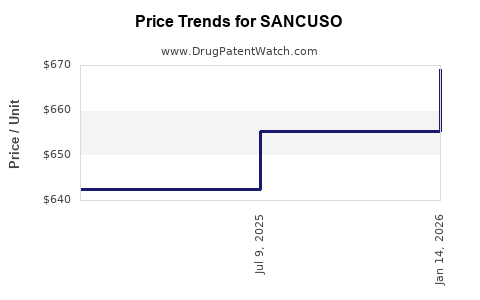
Sancuso, the granisetron transdermal system, occupies a narrow oncology-supportive-care market defined by convenience rather than pharmacologic differentiation. Its seven-day transdermal delivery can reduce dosing burden during multi-day chemotherapy, but oral and intravenous 5-HT3 antagonists are widely available at lower cost. The commercial outlook therefore depends on oncology-center adoption, reimbursement, supply continuity, and the timing of generic or alternative transdermal entry.
The product has no publicly disclosed standalone revenue line from its commercial owners. Public filings support directional analysis, but not a verified product-level sales history. Sancuso's core U.S. patent protection has been associated with a 2026 expiration date in FDA patent records, creating a finite window for premium pricing and lifecycle management. [1][2]
What is Sancuso and how does the product work?
Sancuso is a transdermal patch containing granisetron, a selective serotonin 5-HT3 receptor antagonist. The U.S. Food and Drug Administration approved it in 2008 under New Drug Application 022198. It is indicated for adults receiving moderately emetogenic or highly emetogenic chemotherapy regimens that are scheduled to continue for up to five consecutive days. [1][3]
| Attribute |
Sancuso profile |
| Active ingredient |
Granisetron |
| Dosage form |
Transdermal patch |
| Delivery rate |
3.1 mg per 24 hours |
| Application |
One patch applied to the upper outer arm |
| Wear period |
Up to seven days |
| U.S. approval |
2008 |
| NDA |
022198 |
| Primary use |
Chemotherapy-induced nausea and vomiting |
| Main commercial rationale |
Multi-day antiemetic coverage and reduced oral dosing |
The patch is generally applied 24 to 48 hours before chemotherapy and remains in place during treatment and afterward, subject to the label's seven-day limit. It is not positioned as a superior antiemetic on efficacy alone. Its value proposition is sustained delivery for patients who may have difficulty taking oral medication during chemotherapy.
How does Sancuso compare with competing antiemetics?
Sancuso competes against both branded and generic products. Its closest pharmacologic competitors are granisetron tablets and injections, ondansetron products, and palonosetron. Broader antiemetic regimens also include neurokinin-1 antagonists, dexamethasone, and olanzapine.
| Product or class |
Form |
Commercial position versus Sancuso |
| Generic granisetron |
Oral and injectable |
Lower-cost, established alternative |
| Generic ondansetron |
Oral, orally disintegrating, injectable |
Broad availability and strong price competition |
| Palonosetron |
Injectable and selected oral combinations |
Longer activity and common chemotherapy use |
| Aprepitant/fosaprepitant |
Oral and injectable |
Used in combination for higher-risk regimens |
| Rolapitant |
Oral |
Combination-based antiemetic option |
| Olanzapine |
Oral |
Increasingly used in guideline-based combination regimens |
| Sancuso |
Transdermal patch |
Convenience and adherence proposition |
Sancuso's commercial advantage is strongest when patients face several consecutive chemotherapy days, have swallowing difficulties, or need a delivery system that does not require repeated oral administration. The advantage is weaker in single-day regimens and in formularies that prioritize generic acquisition cost.
Generic granisetron and ondansetron create a structural ceiling on Sancuso pricing. Physicians may prescribe the patch for operational or patient-specific reasons, but payers can treat it as a premium formulation of an established active ingredient.
What is the FDA regulatory status of Sancuso?
Sancuso is an FDA-approved prescription product marketed under NDA 022198. It is a small-molecule drug-device combination rather than a biologic, so biosimilar regulation does not apply. Any competitive product would generally pursue an abbreviated new drug application or another applicable pathway for a transdermal product, with formulation, delivery, bioequivalence, and device-performance requirements.
The FDA label identifies the following principal risks:
- Serotonin syndrome, particularly with serotonergic medicines.
- QT interval prolongation.
- Skin irritation and application-site reactions.
- Reduced absorption or altered delivery if the patch is exposed to heat.
- Constipation and headache, consistent with the 5-HT3 antagonist class.
The patch is not interchangeable with oral granisetron solely because both products contain the same active ingredient. The delivery system, pharmacokinetic profile, application instructions, and regulatory evidence differ.
What patents protect Sancuso?
The principal U.S. patent historically associated with Sancuso is U.S. Patent No. 7,718,188. FDA Orange Book records have associated the patent with a June 2026 expiration date. The patent covers aspects of transdermal delivery of granisetron and is directed to the product's delivery technology rather than the basic granisetron molecule, which was developed and marketed long before Sancuso. [2]
| Patent issue |
Sancuso assessment |
| Active ingredient patent |
Expired; granisetron is an established generic molecule |
| Product-specific protection |
Transdermal delivery and formulation claims |
| Key U.S. patent |
U.S. 7,718,188 |
| Reported U.S. expiration |
June 2026 |
| Orange Book relevance |
Central to ANDA patent certification and launch timing |
| Biosimilar protection |
Not applicable |
| Primary residual barrier |
Patch formulation, adhesive, release profile, and manufacturing know-how |
The economic value of the patent estate is narrower than the value of an active-ingredient patent. A competitor can avoid infringement by developing a materially different patch architecture or delivery approach. Conversely, a technically close transdermal copy may face formulation and device-related patent claims even after the active ingredient is unprotected.
Patent strength depends on claim scope, prosecution history, validity, and the design of a competing patch. The expiration of the main listed patent does not automatically eliminate all trade-secret, manufacturing, trademark, regulatory, or contractual barriers. It does, however, reduce the legal basis for maintaining a premium price.
When does Sancuso lose exclusivity?
Sancuso's principal U.S. product-patent protection is scheduled to expire in June 2026 based on the Orange Book-listed patent record. FDA regulatory exclusivity and patent exclusivity are separate concepts.
| Exclusivity category |
Sancuso status |
| New chemical entity exclusivity |
Long expired |
| Orphan-drug exclusivity |
Not the principal basis of protection |
| Pediatric exclusivity |
No material current protection identified |
| Listed product patent |
Reported expiration in June 2026 |
| Regulatory exclusivity after patent expiry |
No broad barrier apparent from the original approval date |
| Generic entry risk |
Increases materially after patent expiry or successful challenge |
A generic applicant could potentially enter before the listed patent expiration through a Paragraph IV certification, a non-infringement or invalidity position, or an alternative product design that avoids the relevant claims. A patent challenge would not guarantee commercial entry. Litigation, a 30-month stay, regulatory review, manufacturing readiness, and settlement terms would determine the actual timing.
Which companies are challenging Sancuso patent protection?
No widely reported, high-profile Paragraph IV litigation against the principal Sancuso patent is identified in the core public regulatory record used for this analysis. That does not establish that no ANDA has been filed or that no confidential patent certification exists. Public litigation exposure has been limited compared with heavily litigated blockbuster drugs.
The competitive threat is more likely to emerge from:
- A generic transdermal granisetron applicant.
- A reformulated patch with a different adhesive or release mechanism.
- A low-cost oral or injectable antiemetic regimen.
- A competing long-acting antiemetic combination.
The absence of visible litigation can indicate limited expected market value, technical difficulty, uncertain reimbursement, or an applicant's decision to wait for patent expiry. It does not itself establish strong patent validity.
What formulation patents and manufacturing barriers affect Sancuso?
Sancuso's principal technical barrier is the patch, not granisetron. A transdermal product must control drug release, adhesion, skin tolerability, stability, and dose delivery over several days. The manufacturer must also demonstrate consistent performance across different skin conditions and application environments.
Relevant barriers include:
- Drug loading and uniformity across the patch.
- Adhesive performance during prolonged wear.
- Control of crystallization and drug migration.
- Release kinetics over the intended treatment period.
- Skin permeation and interpatient variability.
- Packaging and stability.
- Manufacturing scale-up and batch consistency.
- Device and container-closure requirements.
These factors can slow generic development. They do not create permanent protection. Once the main patent expires, a technically adequate competitor could still pressure price even if it has higher manufacturing costs than an oral generic.
Who owns or markets Sancuso?
Sancuso originated within the ProStrakan commercial portfolio. Kyowa Kirin acquired ProStrakan in 2011, bringing Sancuso into Kyowa Kirin's commercial organization. Cumberland Pharmaceuticals later became associated with U.S. commercial rights through a transaction with Kyowa Kirin. [4][5]
The product's ownership and commercialization history matters because Sancuso is a specialty product rather than a large-scale primary-care medicine. Commercial performance depends on the resources devoted to oncology account coverage, hospital contracting, specialty distribution, reimbursement support, and supply management.
| Commercial phase |
Strategic implication |
| ProStrakan launch period |
Specialty oncology positioning |
| Kyowa Kirin ownership |
Broader multinational infrastructure |
| Cumberland commercial involvement |
Portfolio-based U.S. specialty commercialization |
| Post-patent period |
Greater exposure to price erosion and formulation competition |
Licensing and acquisition transactions involving Sancuso indicate that the asset has strategic value as a niche product, but public corporate disclosures do not establish a separately reported, consistently growing revenue stream.
What is Sancuso's financial trajectory?
Sancuso's standalone revenue trajectory cannot be calculated from public financial statements because its commercial owners have generally reported revenue at company or portfolio level rather than as a separate product line. The defensible financial conclusion is directional:
- Initial commercialization benefited from the novelty of a seven-day transdermal antiemetic.
- Growth was constrained by the availability of inexpensive generic 5-HT3 antagonists.
- Revenue likely depends on a small oncology-supportive-care segment rather than broad prescribing.
- Product transfers and portfolio ownership changes can alter reported sales without changing underlying demand.
- Patent expiry creates a clear risk of gross-to-net deterioration and declining net sales.
- The asset's value is more likely to be measured by durable specialty cash flow than by blockbuster growth.
Sancuso's financial model is therefore sensitive to five variables:
| Driver |
Effect on revenue |
| Multi-day chemotherapy volume |
Expands the addressable patient pool |
| Patch adoption rate |
Determines conversion from oral and injectable products |
| Payer coverage |
Controls access and rebate burden |
| Generic competition |
Pressures price and volume |
| Supply reliability |
Affects treatment-center confidence and repeat use |
A premium patch can maintain revenue after patent expiry if it retains strong formulary placement and patient preference. In practice, transdermal products face rapid price pressure when payers can substitute inexpensive oral or injectable therapies and when the generic entrant has adequate supply.
What generic launch scenarios exist for Sancuso?
Scenario 1: No early Paragraph IV challenge
A generic entrant waits for the listed patent to expire and launches after regulatory approval. This is the lowest litigation-risk scenario but may attract multiple applicants at the same time. Price erosion would depend on the number of approved products and the extent to which pharmacies, hospitals, and payers treat them as substitutes.
Scenario 2: Paragraph IV challenge
An ANDA applicant certifies that the listed patent is invalid, unenforceable, or not infringed. The patent holder may file an infringement action, potentially triggering the statutory 30-month stay under the Hatch-Waxman framework. The commercial launch date would then depend on litigation outcome, settlement, or expiration of the stay. [6]
Scenario 3: Design-around transdermal product
A competitor develops a patch with a different formulation, adhesive, or delivery architecture. This could avoid infringement of narrow claims but would increase development and regulatory complexity.
Scenario 4: Non-patch substitution
Payers and treatment centers expand use of oral granisetron, ondansetron, palonosetron, or combination therapy. This scenario does not require a direct Sancuso generic and can reduce demand before formal patent expiry.
What is the Orange Book status of Sancuso?
Sancuso is listed in FDA's Orange Book under NDA 022198. The relevant patent listing has historically been associated with the product's transdermal formulation and delivery system, with an expiration date reported in June 2026. Orange Book status is important because it informs ANDA patent certifications and the timing of possible generic entry. [2]
The Orange Book does not determine whether the patent is valid or infringed. It also does not guarantee that an ANDA applicant will receive approval, launch, or secure commercial supply.
How strong is the Sancuso patent estate?
The estate is moderate for the specific patch technology but weak for the underlying active ingredient. Its strengths are technical specificity and the difficulty of reproducing a reliable seven-day transdermal system. Its weaknesses are the narrow commercial market, generic availability of granisetron, the approaching expiration date, and the possibility of alternative delivery designs.
| Strength factor |
Assessment |
| Active-ingredient protection |
Weak; expired |
| Product differentiation |
Moderate; seven-day transdermal delivery |
| Formulation complexity |
Moderate to high |
| Remaining patent term |
Limited |
| Litigation deterrence |
Unclear and likely dependent on expected market size |
| Substitution risk |
High from oral, injectable, and other long-acting antiemetics |
| Long-term pricing power |
Limited |
What patent litigation and settlement risks affect Sancuso?
There is no prominent publicly reported Sancuso patent settlement comparable with major pharmaceutical Paragraph IV disputes in high-revenue therapeutic categories. The principal legal risks are:
- A generic applicant's Paragraph IV challenge.
- A claim-construction dispute over transdermal delivery limitations.
- Invalidity challenges based on prior art involving granisetron patches or related delivery systems.
- Regulatory disputes over bioequivalence and product-device comparability.
- Contractual disputes involving territorial commercialization rights.
A settlement could establish an agreed generic entry date before patent expiration, but no major public settlement date is established in the cited record.
What is the geographic coverage and international outlook?
Sancuso has been commercialized through international specialty-pharmaceutical organizations, but its economic importance varies by market. Patent terms, regulatory approvals, reimbursement, and commercial rights are country-specific. U.S. Orange Book protection does not establish equivalent protection in Europe, Japan, Canada, or other jurisdictions.
International demand is shaped by:
- Access to transdermal oncology products.
- National reimbursement rules.
- Hospital procurement practices.
- Local generic granisetron pricing.
- Country-specific patent and supplementary protection certificate status.
- Regional licensing arrangements.
The United States remains the most relevant market for Orange Book-driven generic timing. International revenue can decline independently if local patents expire earlier, reimbursement narrows, or commercial rights change hands.
What is the investment and commercial outlook for Sancuso?
Sancuso is best viewed as a niche, mature specialty asset with a defined patent cliff rather than a growth-stage oncology platform. Its near-term value is based on maintaining premium formulation economics and protecting prescriber loyalty before generic entry. Its post-expiry value depends on brand persistence, supply quality, payer coverage, and the absence of a technically credible patch competitor.
The product has commercial durability where chemotherapy schedules are prolonged and adherence is a clinical concern. Its downside is structural: the active ingredient is generic, alternative antiemetic regimens are established, and the main product-specific patent has a finite remaining term.
Key Takeaways
- Sancuso is a seven-day granisetron transdermal patch approved by the FDA in 2008.
- Its value proposition is dosing convenience during multi-day chemotherapy, not a new mechanism of action.
- Generic oral and injectable 5-HT3 antagonists create persistent pricing pressure.
- U.S. Patent No. 7,718,188 has been associated with Sancuso and a June 2026 expiration date.
- No major publicly reported Paragraph IV litigation or settlement is established in the cited record.
- Sancuso is a small-molecule drug-device product, so biosimilar risk does not apply.
- Public company filings do not provide a reliable standalone revenue history.
- The commercial outlook is mature and cash-flow oriented, with material post-2026 generic-entry risk.
FAQs
Does Sancuso have a generic equivalent?
A direct generic equivalent would need to reproduce the relevant transdermal product characteristics and satisfy FDA requirements. Oral and injectable granisetron products are generic alternatives but are not direct formulation equivalents.
Is Sancuso more effective than ondansetron?
Sancuso's principal differentiation is sustained transdermal delivery. It should not be treated as broadly superior to ondansetron based solely on formulation or route of administration.
Can Sancuso be substituted automatically at the pharmacy?
Automatic substitution depends on the approved product, state law, payer policy, and whether a competing product is rated therapeutically equivalent. Shared active ingredients do not by themselves establish substitutability.
Will Sancuso lose all revenue after patent expiry?
No. Patent expiry increases generic and price-competition risk, but a branded product can retain revenue through patient preference, physician familiarity, supply reliability, and payer coverage.
Is Sancuso protected by orphan-drug exclusivity?
Sancuso's principal commercial protection is associated with its product-specific transdermal patent and regulatory approval history, not a current orphan-drug exclusivity period.
References
- U.S. Food and Drug Administration. (2008). Sancuso (granisetron transdermal system) prescribing information.
- U.S. Food and Drug Administration. (n.d.). Approved drug products with therapeutic equivalence evaluations: Orange Book, NDA 022198.
- U.S. Food and Drug Administration. (2008). FDA approves Sancuso for chemotherapy-induced nausea and vomiting.
- Kyowa Kirin Co., Ltd. (2011). Acquisition of ProStrakan Group plc.
- Cumberland Pharmaceuticals Inc. (n.d.). Corporate product portfolio and Sancuso commercial information.
- U.S. Food and Drug Administration. (2017). ANDA submissions: Amendments and supplements under GDUFA.