You're using a free limited version of DrugPatentWatch: Upgrade for Complete Access

Last Updated: December 12, 2025

ROZEREM Drug Patent Profile


✉ Email this page to a colleague

« Back to Dashboard


When do Rozerem patents expire, and what generic alternatives are available?

Rozerem is a drug marketed by Takeda Pharms Usa and is included in one NDA.

The generic ingredient in ROZEREM is ramelteon. There are three drug master file entries for this compound. Twenty-six suppliers are listed for this compound. Additional details are available on the ramelteon profile page.

DrugPatentWatch® Litigation and Generic Entry Outlook for Rozerem

A generic version of ROZEREM was approved as ramelteon by DR REDDYS LABS SA on July 26th, 2013.

  Get Started Free

AI Deep Research
Questions you can ask:
  • What is the 5 year forecast for ROZEREM?
  • What are the global sales for ROZEREM?
  • What is Average Wholesale Price for ROZEREM?
Summary for ROZEREM
Drug patent expirations by year for ROZEREM
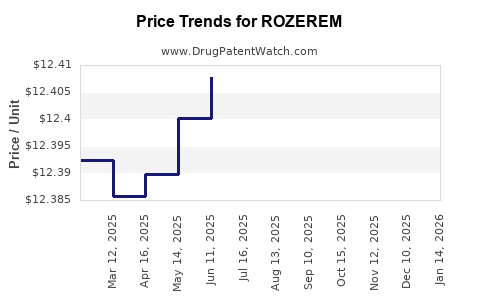
Drug Prices for ROZEREM

See drug prices for ROZEREM

Recent Clinical Trials for ROZEREM

Identify potential brand extensions & 505(b)(2) entrants

SponsorPhase
Beijing CTSmed Co. LtdPHASE1
Overseas Pharmaceuticals, Ltd.PHASE1
Brigham and Women's HospitalPhase 4

See all ROZEREM clinical trials

Pharmacology for ROZEREM
Paragraph IV (Patent) Challenges for ROZEREM
Tradename Dosage Ingredient Strength NDA ANDAs Submitted Submissiondate
ROZEREM Tablets ramelteon 8 mg 021782 2 2009-07-22

US Patents and Regulatory Information for ROZEREM

Applicant Tradename Generic Name Dosage NDA Approval Date TE Type RLD RS Patent No. Patent Expiration Product Substance Delist Req. Exclusivity Expiration
Takeda Pharms Usa ROZEREM ramelteon TABLET;ORAL 021782-001 Jul 22, 2005 AB RX Yes Yes ⤷  Get Started Free ⤷  Get Started Free ⤷  Get Started Free
>Applicant >Tradename >Generic Name >Dosage >NDA >Approval Date >TE >Type >RLD >RS >Patent No. >Patent Expiration >Product >Substance >Delist Req. >Exclusivity Expiration

Expired US Patents for ROZEREM

Applicant Tradename Generic Name Dosage NDA Approval Date Patent No. Patent Expiration
Takeda Pharms Usa ROZEREM ramelteon TABLET;ORAL 021782-001 Jul 22, 2005 ⤷  Get Started Free ⤷  Get Started Free
>Applicant >Tradename >Generic Name >Dosage >NDA >Approval Date >Patent No. >Patent Expiration

International Patents for ROZEREM

See the table below for patents covering ROZEREM around the world.

Country Patent Number Title Estimated Expiration
Norway 983970 ⤷  Get Started Free
China 100443480 ⤷  Get Started Free
Japan 2884153 ⤷  Get Started Free
Poland 328726 ⤷  Get Started Free
Australia 1430502 ⤷  Get Started Free
Hungary 9900616 ⤷  Get Started Free
Czech Republic 9802775 ⤷  Get Started Free
>Country >Patent Number >Title >Estimated Expiration

Market Dynamics and Financial Trajectory for ROZEREM (Ramelteon)

Last updated: July 31, 2025

Introduction

ROZEREM (ramelteon) is a prescription hypnotic marketed primarily for the treatment of insomnia characterized by difficulty with sleep onset. Launched by Takeda Pharmaceutical Company in 2005, ROZEREM is recognized for its unique mechanism of action, targeting melatonin receptors rather than gamma-aminobutyric acid (GABA) receptors common in traditional sleep aids. Its market performance, influenced by evolving regulatory, competitive, and consumer factors, demonstrates a nuanced pathway for its financial trajectory over the coming years.

Pharmacological Profile and Market Position

Ramelteon functions as a selective melatonin receptor agonist, specifically targeting MT1 and MT2 receptors in the suprachiasmatic nucleus, effectively regulating the sleep-wake cycle (1). This mechanism offers purported advantages over benzodiazepine receptor agonists, including a lower risk of dependence and abuse potential, aligning with increasing regulatory and consumer preferences for safer sleep therapeutics.

Despite initial enthusiasm, ROZEREM’s market penetration has remained moderate. It generated approximately $250 million globally in revenues by 2020, with the majority of sales in the United States, where it maintains a distinct segment in the insomnia drug market (2). Amidst mounting concerns over long-term safety and dependence, ROZEREM has positioned itself as a safer alternative; however, its clinical efficacy is sometimes viewed as modest compared to traditional hypnotics.

Market Dynamics Impacting ROZEREM

Regulatory Environment

The FDA approved ramelteon with specific stipulations, emphasizing its safety profile. Regulatory agencies have generally maintained a cautious stance toward sleep aids due to concerns related to dependence, next-day impairment, and misuse. While ROZEREM's non-habit-forming profile is favorable, its modest efficacy compared to benzodiazepines limits prescribing enthusiasm (3).

International regulatory landscapes vary, with some countries adopting restrictive classifications, which impacts global market expansion. Regulatory challenges have thus constrained the drug's growth potential outside the highly regulated US landscape.

Competitive Landscape

The market for sleep medications is highly competitive, dominated by benzodiazepines, Z-drugs like zolpidem and eszopiclone, and newer agents such as suvorexant. These drugs often offer more potent hypnotic effects but carry higher dependence risks, which has created a niche for ramelteon—particularly among patients seeking safer alternatives (4).

In recent years, the advent of orexin receptor antagonists, such as suvorexant (Belsomra), has further intensified competition. These newer agents often demonstrate superior efficacy in inducing and maintaining sleep, which has pressured ROZEREM's market share. Nonetheless, its favorable safety profile ensures a dedicated patient subset, especially among elderly or comorbid populations.

Consumer Preferences and Prescriber Attitudes

The increasing emphasis on safety and minimal dependence has cultivated a favorable environment for drugs like ROZEREM. Healthcare providers and patients often prefer safer sleep medications, particularly in light of the opioid and benzodiazepine crisis in the US.

However, perceptions of limited efficacy and the availability of more efficacious but potentially riskier drugs have limited prescriber enthusiasm. Moreover, insurance coverage and pharmacoeconomic factors influence prescription patterns.

Intellectual Property and Patent Landscape

ROZEREM enjoyed patent exclusivity until around 2012, when generic versions entered the market. The entry of generics significantly impacted its pricing, leading to substantial revenue erosion (5). Patent expiries and generic competition remain key determinants of its financial trajectory. No recent patent extensions have been awarded, limiting opportunities for price premiums.

Market Trends and Future Outlook

The insomnia therapeutic market is experiencing key shifts:

  • Growth in Aging Population: Older adults, more prone to chronic insomnia, represent a core demographic for safety-focused agents like ramelteon. This demographic expansion supports ongoing demand, provided safety perceptions persist.

  • Shift Toward Non-Pharmacologic Interventions: Cognitive-behavioral therapy for insomnia (CBT-I) increasingly replaces pharmacotherapy as the first-line treatment, constraining prescription volumes.

  • Emerging Pharmacological Alternatives: Development of dual orexin receptor antagonists and melatonin-based formulations pose both opportunities and threats to ROZEREM's market share.

The combined effect of these factors suggests a modest but steady revenue outlook for ramelteon, primarily driven by niche prescribing and specific patient populations seeking safe sleep solutions.

Financial Trajectory Analysis

Revenue Projections

Initially launched as a blockbusters drug, ROZEREM’s revenues have declined post-generic entry. For instance, Takeda reported a revenue downturn from approximately $250 million in 2015 to less than $100 million in 2020 (2). Future revenue streams are projected to stabilize or slightly increase, contingent upon:

  • Expansion into emerging markets with less generic competition.
  • Continued awareness of its safety profile among prescribers.
  • Efficacy improvements via combination therapies or formulation innovations.

Cost and Margins

Drug development expenses for ramelteon were recovered rapidly after launch. However, ongoing costs related to marketing, regulatory compliance, and patent litigation diminish net margins. The shift to generics reduces pricing power, exerting downward pressure on revenue and profit margins.

Strategic Opportunities

Potential avenues for improving its financial course include:

  • Formulation Innovations: Developing long-acting or alternative delivery systems.
  • New Indications: Investigating ramelteon’s role in circadian rhythm disorders beyond insomnia.
  • Combination Therapies: Combining ramelteon with other agents for enhanced efficacy.

Currently, these remain speculative; the primary financial trajectory revolves around maintaining its niche status in a competitive market.

Regulatory and Market Challenges

Regulatory agencies’ cautious stance on sleep medications necessitates ongoing post-marketing surveillance to solidify safety claims. Moreover, insurance reimbursement policies favor cost-effective treatments, thus constraining pricing strategies and revenue potential.

Global expansion faces hurdles such as regulatory approvals, cultural perceptions of sleep drugs, and patent landscapes. Additionally, the global trend favoring non-drug interventions diminishes prescription volumes.

Key Takeaways

  • Niche Market Position: ROZEREM occupies a specialized segment focusing on safety, with a consistent but limited revenue stream influenced heavily by generic competition.

  • Competitive Pressures: Evolving pharmacotherapies, especially orexin receptor antagonists, challenge ramelteon’s market share, urging strategic innovation.

  • Regulatory and Consumer Trends: Increasing emphasis on safety, alongside a preference for non-pharmacologic treatments, shape prescribing behaviors that favor ramelteon’s profile but limit growth.

  • Patent and Pricing Dynamics: Patent expiry and generic competition have significantly compressed margins; future revenue depends on maintaining niche relevance and potential formulation innovations.

  • Market Opportunities: Aging populations and specific patient groups remain viable markets, provided safety perceptions sustain demand.

Conclusion

Ramelteon’s market dynamics are rooted in its unique safety profile and targeted mechanism, yet its financial trajectory faces headwinds from intense competition, patent expirations, and shifting treatment paradigms. While current demand persists among safety-conscious prescribers and patients, its growth outlook remains moderate. Strategic innovation and targeted market expansion could sustain or enhance its financial performance in a transforming sleep medication landscape.


FAQs

1. Is ROZEREM (ramelteon) more effective than traditional sleep aids?
Ramelteon offers a favorable safety profile but generally exhibits modest efficacy compared to benzodiazepines or Z-drugs, primarily aiding sleep initiation rather than maintenance.

2. What factors most influence the market performance of ramelteon?
Regulatory decisions, generic competition, prescriber and patient preferences, and emergence of new pharmacotherapies primarily shape its market performance.

3. Can ramelteon be used for conditions other than insomnia?
Research indicates potential in circadian rhythm disorders, jet lag, and delayed sleep phase syndrome; ongoing studies may expand its indications.

4. How does the loss of patent protection impact ramelteon’s revenue?
Patent expirations allow generics to enter the market, significantly reducing drug prices and revenue, pushing sales toward niche markets.

5. What are future prospects for ramelteon in the evolving sleep therapy market?
Future prospects depend on formulation innovations, expanded indications, and strategic positioning amid competition and non-pharmacologic treatment growth.


References

  1. Dijk DJ. Regulation of sleep and circadian rhythms by melatonin. Sleep Med Rev. 2003;7(4):291-300.
  2. Takeda Pharmaceutical Company. Annual Reports 2015-2020.
  3. US Food and Drug Administration. Ramelteon Label. 2005.
  4. Herring WJ, et al. The clinical utility of ramelteon: a review. Clin Ther. 2008;30(5):769-779.
  5. U.S. Patent and Trademark Office. Patent status of ramelteon.

More… ↓

⤷  Get Started Free

Make Better Decisions: Try a trial or see plans & pricing

Drugs may be covered by multiple patents or regulatory protections. All trademarks and applicant names are the property of their respective owners or licensors. Although great care is taken in the proper and correct provision of this service, thinkBiotech LLC does not accept any responsibility for possible consequences of errors or omissions in the provided data. The data presented herein is for information purposes only. There is no warranty that the data contained herein is error free. We do not provide individual investment advice. This service is not registered with any financial regulatory agency. The information we publish is educational only and based on our opinions plus our models. By using DrugPatentWatch you acknowledge that we do not provide personalized recommendations or advice. thinkBiotech performs no independent verification of facts as provided by public sources nor are attempts made to provide legal or investing advice. Any reliance on data provided herein is done solely at the discretion of the user. Users of this service are advised to seek professional advice and independent confirmation before considering acting on any of the provided information. thinkBiotech LLC reserves the right to amend, extend or withdraw any part or all of the offered service without notice.