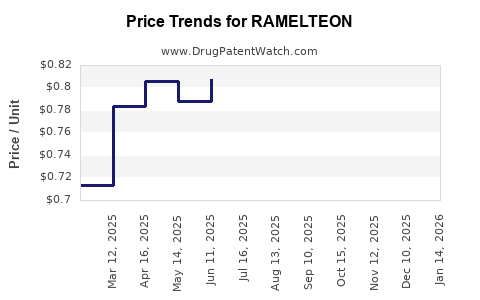
Last updated: September 8, 2026
Ramelteon is a U.S.-approved melatonin-receptor agonist for insomnia with low dependence risk and no controlled-substance classification. Its commercial trajectory shifted from branded Rozerem growth after the 2005 launch to price erosion after generic entry. The product has limited current revenue visibility because Takeda does not separately report Rozerem sales, while generic competition has made ramelteon a low-cost, mature prescription product.
What is ramelteon and how does it compete in insomnia treatment?
Ramelteon is an oral selective agonist of the MT1 and MT2 melatonin receptors. The FDA approved Rozerem, ramelteon tablets, on July 22, 2005, for the treatment of insomnia characterized by difficulty with sleep onset. The approved adult dose is 8 mg taken within 30 minutes of bedtime. Ramelteon is not classified as a controlled substance in the United States [1].
Its commercial positioning differs from benzodiazepines and nonbenzodiazepine sedative-hypnotics such as zolpidem. Ramelteon does not act through the GABA-A receptor and has not shown the same abuse, dependence, or withdrawal profile associated with many traditional hypnotics. Its main clinical limitation is narrower efficacy: it primarily addresses sleep initiation rather than broad sleep-maintenance problems.
| Attribute |
Ramelteon |
Zolpidem |
Eszopiclone |
Suvorexant |
| Primary mechanism |
MT1/MT2 melatonin agonist |
GABA-A receptor modulator |
GABA-A receptor modulator |
Orexin receptor antagonist |
| Controlled substance in U.S. |
No |
Schedule IV |
Schedule IV |
Schedule IV |
| Main approved use |
Sleep-onset insomnia |
Insomnia |
Insomnia |
Insomnia |
| Generic competition |
Yes |
Yes |
Yes |
Yes |
| Dependence positioning |
Low relative to sedative-hypnotics |
Higher concern |
Higher concern |
Controlled-substance restrictions |
| Commercial maturity |
Mature generic |
Mature generic |
Mature generic |
Branded and generic competition emerging |
The principal market opportunity for ramelteon is in patients who need a non-controlled prescription sleep medicine. The principal commercial constraint is that clinicians and payers have numerous low-cost generic alternatives.
What is the FDA regulatory status of ramelteon?
Ramelteon remains an FDA-approved active ingredient in immediate-release oral tablets. The original reference product is Rozerem, developed and commercialized by Takeda Pharmaceuticals.
The FDA-approved product has several important regulatory characteristics:
- Dosage form: immediate-release tablets.
- Strength: 8 mg.
- Indication: insomnia characterized by difficulty with sleep onset.
- Administration: within 30 minutes before bedtime.
- Schedule: not controlled under the federal Controlled Substances Act.
- Regulatory pathway for competitors: abbreviated new drug applications, or ANDAs, demonstrating pharmaceutical equivalence and bioequivalence to the reference product.
Ramelteon is not a biologic. Biosimilar competition is therefore not relevant. Competitive products enter through the generic drug pathway rather than the abbreviated biologics license application pathway.
FDA labeling also identifies clinically relevant interaction issues. Ramelteon exposure can increase with strong CYP1A2 inhibitors such as fluvoxamine. Alcohol is not recommended with ramelteon because of additive central nervous system effects. The label also identifies cautions involving severe hepatic impairment and concomitant use with certain medications [1].
When did ramelteon lose market exclusivity?
Ramelteon lost practical branded exclusivity after the expiration of key patents and the entry of FDA-approved generic versions. The original U.S. composition patent, U.S. Patent No. 6,034,239, was issued in 2000 and covered ramelteon-related melatonin receptor agonist compounds. Its ordinary patent term extended into the late 2010s, subject to patent-term adjustment and any applicable regulatory extension [2].
The principal commercial timeline is:
| Event |
Date or period |
| U.S. patent No. 6,034,239 issued |
March 7, 2000 |
| FDA approved Rozerem |
July 22, 2005 |
| Branded commercial expansion |
2005-2010s |
| Key composition-patent term reached expiration period |
Late 2010s |
| FDA generic approvals and commercial generic availability |
2017 onward |
| Current market structure |
Generic-dominated |
Publicly available FDA and patent records support the conclusion that ramelteon is now a mature generic market. The commercial loss of exclusivity did not result from a biosimilar transition or a complex-device substitution. It resulted from ordinary small-molecule generic entry after the relevant patent barriers weakened or expired.
What patents protect ramelteon and Rozerem?
The core ramelteon patent estate centered on composition-of-matter protection for melatonin receptor agonists, with additional protection potentially covering therapeutic use and pharmaceutical formulations.
Core composition patents
U.S. Patent No. 6,034,239 is the most commercially important publicly identifiable patent associated with ramelteon. It covers chemical compounds with melatonin receptor activity, including the ramelteon molecule and related structures [2].
Composition patents generally provide the strongest exclusionary protection because they can block use of the active ingredient across multiple formulations and indications. Once the core composition patent expires, formulation and method-of-use patents typically have less value unless they cover clinically necessary or commercially differentiated products.
Method-of-use patents
Ramelteon’s patent estate also included claims directed to the use of melatonin receptor agonists for sleep disorders and related therapeutic purposes. Method-of-use patents can remain relevant after composition-patent expiration, but their practical value depends on:
- The scope of the approved indication.
- Whether generic labels include or carve out the patented use.
- Whether physicians prescribe the generic for the patented indication.
- The ability of the patent holder to prove induced infringement.
For a broadly prescribed insomnia medicine, method-of-use enforcement can be difficult if the generic product has a label that supports non-infringing uses or if the claimed use overlaps substantially with the FDA-approved indication.
Formulation patents
Immediate-release ramelteon tablets are relatively simple dosage forms. Public commercial information does not indicate a major extended-release, injectable, implantable, or device-based formulation franchise comparable to products protected by complex drug-delivery systems.
Formulation patents may cover excipients, tablet manufacture, dissolution characteristics, or specific compositions. These patents generally create weaker barriers than a composition patent unless the formulation provides a clinically important advantage and is difficult to design around.
How many patents cover ramelteon, and how strong is the patent estate?
The estate was commercially meaningful during the branded period but is now weak as a barrier to standard generic ramelteon tablets. The core molecule is a small-molecule compound with a conventional oral tablet presentation, and the product has no biological manufacturing process or delivery device that would create a substantial technical barrier.
| Patent category |
Strategic value during exclusivity |
Current barrier strength |
| Composition of matter |
High |
Low after expiry |
| Method of use |
Moderate |
Low to moderate, depending on claim scope |
| Tablet formulation |
Moderate |
Low for ordinary 8 mg tablets |
| Manufacturing process |
Low to moderate |
Low unless process-specific |
| Device or delivery technology |
Not a major feature |
Minimal |
| Biologic comparability protection |
Not applicable |
Not applicable |
The overall estate should be rated as low-strength for protecting U.S. sales of standard ramelteon tablets. Any remaining patent value is more likely to relate to narrow claims than to blocking generic access to the active ingredient.
What Paragraph IV challenges affected ramelteon?
Generic applicants commonly use Paragraph IV certifications when they contend that listed patents are invalid, unenforceable, or not infringed. Ramelteon faced the standard small-molecule generic challenge pattern as ANDA applicants sought approval before or around the expiration of branded patents.
The commercial consequences of Paragraph IV activity included:
- Earlier litigation risk for Takeda.
- Potential 30-month FDA approval stays if a listed-patent suit was filed within the statutory period.
- Negotiation leverage for generic applicants.
- Earlier market access once patent barriers expired, were defeated, or were otherwise resolved.
The public record does not support treating ramelteon as a product with a major continuing Paragraph IV litigation program. The central issue is historical patent expiry and generic entry, not an active late-stage litigation fight over a protected formulation.
What is the Orange Book status of ramelteon?
The FDA Orange Book identifies approved drug products and relevant patents or exclusivity information for reference-listed drugs. Rozerem and generic ramelteon tablets are associated with the small-molecule reference-product framework rather than the biologics framework [3].
The commercial Orange Book implications are:
- The reference product is Rozerem.
- Generic applicants can rely on the Rozerem NDA through ANDA procedures.
- Listed patents were relevant to approval timing and Paragraph IV certifications.
- Patent expiry has allowed multiple generic products to enter.
- No biosimilar interchangeability analysis applies.
Orange Book listing status should be evaluated by product strength, dosage form, patent listing, and current marketing status. A historical Orange Book listing does not itself establish that a patent remains an effective commercial barrier after expiration or litigation resolution.
What patent litigation affects ramelteon?
Ramelteon’s major legal risk occurred during the transition from branded exclusivity to generic entry. Takeda’s primary litigation exposure came from ANDA applicants attempting to market generic ramelteon before full expiration of listed patents.
The litigation profile differs from high-value oncology or biologic disputes:
- No major biologic patent thicket.
- No biosimilar interchangeability dispute.
- No known device-patent dispute controlling market access.
- No durable formulation barrier comparable to long-acting injectables.
- The central legal questions concerned validity, infringement, and timing of generic approval.
Publicly available information does not establish a current, material U.S. patent case likely to alter the mature generic market structure.
What licensing deals commercialized ramelteon?
Takeda developed Rozerem and retained the central commercial and regulatory role. Takeda entered into a U.S. co-promotion agreement with Abbott Laboratories around the product’s launch, giving Abbott a role in promoting Rozerem to physicians [4].
The deal had strategic value during the launch period because it expanded sales-force reach for a product entering a competitive insomnia market. It did not create a durable post-exclusivity moat. After generic entry, the economic importance of co-promotion declined sharply because branded price premiums and market share were pressured by lower-cost substitutes.
No major current licensing transaction is known to control generic ramelteon supply or to create a separate high-growth commercial platform.
What is the financial trajectory of ramelteon?
Ramelteon’s financial trajectory follows a conventional branded-to-generic curve:
- Pre-launch investment in clinical development and regulatory approval.
- Initial branded growth after the 2005 FDA approval.
- Commercial stabilization as a differentiated non-controlled insomnia treatment.
- Revenue pressure from generic competition and therapeutic alternatives.
- Low-margin mature-product economics after loss of exclusivity.
Takeda does not currently report Rozerem revenue as a separate material line item in its public financial reporting. The company reports results at broader business-unit and geographic levels, so product-specific revenue estimates require third-party prescription, channel, or IQVIA data rather than public audited company disclosures [5].
Revenue exposure
The current revenue exposure is likely limited relative to Takeda’s major products. The company’s post-acquisition portfolio has been concentrated in gastrointestinal, rare disease, oncology, neuroscience, and plasma-derived products. Rozerem is not identified as a leading growth product in recent corporate reporting.
The principal financial effects of generic entry were:
- Lower average selling price.
- Reduced branded prescription volume.
- Loss of formulary preference.
- Reduced return on promotional spending.
- Declining value of the brand’s sales infrastructure.
- Lower probability of meaningful incremental revenue from the original tablet product.
Generic suppliers can still generate sales because insomnia is a large chronic-treatment market, but ramelteon tablets have limited pricing power. Pharmacy benefit managers can substitute among therapeutically similar generic sleep products, and physicians have low switching costs.
What drives current ramelteon market demand?
Demand is shaped by four factors.
Non-controlled status
Ramelteon remains attractive for patients and prescribers seeking to avoid controlled hypnotics. This is particularly relevant where abuse potential, diversion, substance-use history, or regulatory scrutiny affects treatment selection.
Clinical differentiation
Ramelteon’s receptor selectivity and sleep-onset indication distinguish it from GABAergic hypnotics. The differentiation is clinically meaningful but narrow. It does not automatically produce premium pricing after generic entry.
Generic pricing
Generic ramelteon prices are generally far below the historical branded price. Once several suppliers are active, pharmacy benefit managers can place the product in low-cost formulary tiers.
Alternatives
The competitive set includes generic zolpidem, eszopiclone, zaleplon, doxepin, trazodone used off-label, suvorexant, lemborexant, daridorexant, melatonin products, and cognitive behavioral therapy for insomnia. Ramelteon competes most directly on safety and controlled-substance avoidance rather than on broad efficacy or price.
How does ramelteon compare with newer insomnia drugs?
Ramelteon has a lower-risk regulatory profile than controlled orexin antagonists and GABAergic hypnotics, but newer branded products can offer stronger differentiation in sleep maintenance.
| Product class |
Main advantage |
Main commercial weakness |
| Ramelteon |
Non-controlled; sleep-onset treatment |
Generic price pressure; limited indication |
| Zolpidem and zaleplon |
Low cost; established prescribing |
Controlled-substance and dependence concerns |
| Doxepin |
Generic; sleep-maintenance use |
Anticholinergic and tolerability considerations at higher doses |
| Orexin antagonists |
Sleep-onset and sleep-maintenance utility |
Higher branded cost; controlled-substance status for several products |
| Melatonin supplements |
Easy access; low cost |
Variable quality and less predictable clinical effect |
| CBT-I |
Durable behavioral benefit |
Access, adherence, and provider-capacity limitations |
Ramelteon’s best commercial position is as a generic non-controlled prescription option for sleep-onset insomnia. It is less likely to regain premium branded economics without a new formulation, new indication, or strong outcomes evidence.
What generic launch scenarios exist for ramelteon?
The most likely market scenario is continued generic availability with stable demand and low price growth. A generic supplier can gain share through wholesaler contracts, pharmacy benefit manager placement, reliable supply, and low acquisition cost.
Potential scenarios include:
| Scenario |
Market effect |
Probability assessment |
| Stable multi-source generic market |
Persistent low prices and broad access |
Highest |
| Supplier consolidation |
Temporary price increases if shortages occur |
Moderate |
| New branded formulation |
Limited premium opportunity if clinically differentiated |
Low |
| Patent-based relaunch |
Unlikely for standard 8 mg tablets |
Low |
| Demand expansion from non-controlled prescribing |
Gradual volume growth |
Moderate |
| Generic supply disruption |
Short-term price and share volatility |
Possible |
The main supply-chain risk is not patent exclusion. It is manufacturing concentration, active pharmaceutical ingredient availability, quality remediation, or a temporary shortage among a small number of suppliers.
What manufacturing and geographic IP barriers exist for ramelteon?
Ramelteon is a chemically synthesized small molecule. Its manufacturing pathway is less technically complex than biologics, antibody-drug conjugates, or sterile injectables. Generic manufacturers still must establish:
- API identity, purity, and impurity controls.
- Reproducible tablet manufacturing.
- Bioequivalence to the reference product.
- Stability through the labeled shelf life.
- Compliance with current good manufacturing practices.
- A reliable supply chain for API and finished dosage forms.
Geographic patent risk is highest in jurisdictions where composition or use patents had longer effective terms. In the United States, the core commercial barrier has expired. Patent status must be assessed country by country because filing dates, patent-term adjustments, supplementary protection certificates, national-phase prosecution, and litigation outcomes differ.
The United States remains the most commercially important regulatory reference market, but generic ramelteon availability and reimbursement vary across Europe, Japan, Canada, and emerging markets.
Key Takeaways
- Ramelteon is an FDA-approved, non-controlled MT1/MT2 melatonin-receptor agonist for sleep-onset insomnia.
- Rozerem launched in 2005 and moved from branded growth to mature generic economics after patent expiry and generic entry.
- U.S. Patent No. 6,034,239 was the core composition patent associated with ramelteon.
- The current patent estate is weak as a barrier to standard 8 mg tablets.
- Biosimilar risk does not apply because ramelteon is a small molecule.
- Paragraph IV and ANDA litigation were relevant during the branded-to-generic transition, but no major active patent dispute is known to control current U.S. access.
- Takeda does not separately report current Rozerem revenue, preventing a reliable product-level financial estimate from public company filings.
- Current demand depends on non-controlled status, generic affordability, and use in patients who need an alternative to GABAergic or controlled hypnotics.
- A new formulation or differentiated indication would be required to create material premium economics.
FAQs About Ramelteon Market Dynamics and Exclusivity
Is ramelteon still profitable for pharmaceutical manufacturers?
Generic ramelteon can remain commercially viable through volume, manufacturing efficiency, and pharmacy-channel contracts. The product is unlikely to deliver branded-style margins without a differentiated formulation or new intellectual-property position.
Does ramelteon have an orphan-drug or pediatric exclusivity opportunity?
Ramelteon is not primarily associated with an orphan-drug franchise. Any pediatric exclusivity would depend on a specific FDA request and completed pediatric studies rather than the original adult approval.
Can a company launch an authorized generic of Rozerem?
An authorized generic could be marketed under a drug-labeling and supply arrangement with the NDA holder, but the commercial value is limited when multiple independent generic suppliers already compete on price.
Is ramelteon vulnerable to over-the-counter melatonin products?
Yes. Melatonin supplements compete directly for consumers seeking a non-controlled sleep-onset product. Prescription ramelteon retains advantages in standardized dose, FDA-approved labeling, and physician oversight.
What would increase the value of the ramelteon franchise?
The strongest value drivers would be a sustained-release formulation, a validated sleep-maintenance indication, evidence supporting use in high-risk populations, or a commercial arrangement that improves reimbursement and prescribing without triggering new safety concerns.
References
-
U.S. Food and Drug Administration. (2005). Rozerem (ramelteon) prescribing information. FDA.
-
United States Patent and Trademark Office. (2000). U.S. Patent No. 6,034,239, melatonin receptor agonists. USPTO.
-
U.S. Food and Drug Administration. (2024). Approved drug products with therapeutic equivalence evaluations. FDA.
-
Abbott Laboratories. (2005). Annual report 2005. Abbott Laboratories.
-
Takeda Pharmaceutical Company Limited. (2024). Annual report and integrated report. Takeda Pharmaceutical Company Limited.