Last Updated: August 10, 2026

RHOPRESSA Drug Patent Profile


✉ Email this page to a colleague

« Back to Dashboard


When do Rhopressa patents expire, and what generic alternatives are available?

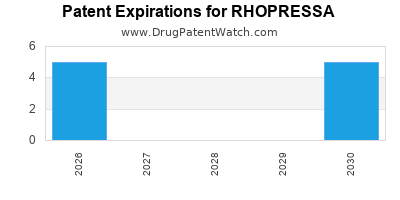
Rhopressa is a drug marketed by Alcon Labs Inc and is included in one NDA. There are fifteen patents protecting this drug and one Paragraph IV challenge.

This drug has sixty-eight patent family members in fourteen countries.

The generic ingredient in RHOPRESSA is netarsudil mesylate. One supplier is listed for this compound. Additional details are available on the netarsudil mesylate profile page.

DrugPatentWatch® Generic Entry Outlook for Rhopressa

Rhopressa was eligible for patent challenges on December 18, 2021.

By analyzing the patents and regulatory protections it appears that the earliest date for generic entry will be March 14, 2034. This may change due to patent challenges or generic licensing.

There have been seven patent litigation cases involving the patents protecting this drug, indicating strong interest in generic launch. Recent data indicate that 63% of patent challenges are decided in favor of the generic patent challenger and that 54% of successful patent challengers promptly launch generic drugs.

Indicators of Generic Entry

< Available with Subscription >

  Start Trial

AI Deep Research
Questions you can ask:
  • What is the 5 year forecast for RHOPRESSA?
  • What are the global sales for RHOPRESSA?
  • What is Average Wholesale Price for RHOPRESSA?
DrugPatentWatch® Estimated Loss of Exclusivity (LOE) Date for RHOPRESSA
Generic Entry Date for RHOPRESSA*:
Constraining patent/regulatory exclusivity:
NDA:
Dosage:

SOLUTION/DROPS;OPHTHALMIC

*The generic entry opportunity date is the latter of the last compound-claiming patent and the last regulatory exclusivity protection. Many factors can influence early or later generic entry. This date is provided as a rough estimate of generic entry potential and should not be used as an independent source.

Recent Clinical Trials for RHOPRESSA

Identify potential brand extensions & 505(b)(2) entrants

SponsorPhase
Alcon, a Novartis CompanyPHASE4
East Coast Institute for ResearchPHASE4
Florida Eye SpecialistsPHASE4

See all RHOPRESSA clinical trials

Pharmacology for RHOPRESSA
Drug ClassRho Kinase Inhibitor
Mechanism of ActionRho Kinase Inhibitors
Paragraph IV (Patent) Challenges for RHOPRESSA
Tradename Dosage Ingredient Strength NDA ANDAs Submitted Submissiondate
RHOPRESSA Ophthalmic Solution netarsudil mesylate 0.02% 208254 2 2021-12-20

US Patents and Regulatory Information for RHOPRESSA

RHOPRESSA is protected by fifteen US patents.

Based on analysis by DrugPatentWatch, the earliest date for a generic version of RHOPRESSA is ⤷  Start Trial.

This potential generic entry date is based on patent ⤷  Start Trial.

Generics may enter earlier, or later, based on new patent filings, patent extensions, patent invalidation, early generic licensing, generic entry preferences, and other factors.

Applicant Tradename Generic Name Dosage NDA Approval Date TE Type RLD RS Patent No. Patent Expiration Product Substance Delist Req. Exclusivity Expiration
Alcon Labs Inc RHOPRESSA netarsudil mesylate SOLUTION/DROPS;OPHTHALMIC 208254-001 Dec 18, 2017 RX Yes Yes ⤷  Start Trial ⤷  Start Trial Y Y ⤷  Start Trial
Alcon Labs Inc RHOPRESSA netarsudil mesylate SOLUTION/DROPS;OPHTHALMIC 208254-001 Dec 18, 2017 RX Yes Yes ⤷  Start Trial ⤷  Start Trial ⤷  Start Trial
Alcon Labs Inc RHOPRESSA netarsudil mesylate SOLUTION/DROPS;OPHTHALMIC 208254-001 Dec 18, 2017 RX Yes Yes ⤷  Start Trial ⤷  Start Trial Y ⤷  Start Trial
>Applicant >Tradename >Generic Name >Dosage >NDA >Approval Date >TE >Type >RLD >RS >Patent No. >Patent Expiration >Product >Substance >Delist Req. >Exclusivity Expiration

Expired US Patents for RHOPRESSA

Applicant Tradename Generic Name Dosage NDA Approval Date Patent No. Patent Expiration
Alcon Labs Inc RHOPRESSA netarsudil mesylate SOLUTION/DROPS;OPHTHALMIC 208254-001 Dec 18, 2017 ⤷  Start Trial ⤷  Start Trial
>Applicant >Tradename >Generic Name >Dosage >NDA >Approval Date >Patent No. >Patent Expiration

International Patents for RHOPRESSA

When does loss-of-exclusivity occur for RHOPRESSA?

Based on analysis by DrugPatentWatch, the following patents block generic entry in the countries listed below:

Australia

Patent: 14228790
Patent: Combination therapy
Estimated Expiration: ⤷  Start Trial

Patent: 18202965
Patent: Combination therapy
Estimated Expiration: ⤷  Start Trial

Patent: 18202990
Patent: Combination therapy
Estimated Expiration: ⤷  Start Trial

Patent: 20203976
Patent: COMBINATION THERAPY
Estimated Expiration: ⤷  Start Trial

Canada

Patent: 05089
Patent: COMPOSE D'ISOQUINOLINE POUR TRAITER DES MALADIES OCULAIRES (ISOQUINOLINE COMPOUNDS FOR THE TREATMENT OF OCULAR DISEASES)
Estimated Expiration: ⤷  Start Trial

China

Patent: 5263494
Patent: Combination therapy
Estimated Expiration: ⤷  Start Trial

Patent: 9528721
Patent: 联合治疗 (Combination therapy)
Estimated Expiration: ⤷  Start Trial

Patent: 0396085
Patent: 联合治疗 (Combination therapy)
Estimated Expiration: ⤷  Start Trial

Denmark

Patent: 11943
Estimated Expiration: ⤷  Start Trial

European Patent Office

Patent: 76080
Patent: CONJUGÉS DE COMPOSÉS ISOQUINOLINE ET DE PROSTAGLANDINES (CONJUGATES OF ISOQUINOLINE COMPOUNDS AND PROSTAGLANDINS)
Estimated Expiration: ⤷  Start Trial

Patent: 61484
Patent: LE DIMÉSYLATE DE 4-(3-AMINO-1-(ISOQUINOLIN-6-YLAMINO)-1-OXOPROPAN-2-YL)BENZYL, SES COMBINAISONS AVEC DES PROSTAGLANDINES ET LEUR UTILISATION DANS LE TRAITEMENT DE MALADIES OCULAIRES (DIMESYLATE SALTS OF 4-(3-AMINO-1-(ISOQUINOLIN-6-YLAMINO)-1-OXOPROPAN-2-YL)BENZYL, THEIR COMBINATIONS WITH PROSTAGLANDINS AND THE USE THEREOF IN THE TREATMENT OF OCULAR DISORDERS)
Estimated Expiration: ⤷  Start Trial

Patent: 11943
Estimated Expiration: ⤷  Start Trial

Patent: 18759
Estimated Expiration: ⤷  Start Trial

Patent: 35507
Estimated Expiration: ⤷  Start Trial

Finland

Patent: 11943
Estimated Expiration: ⤷  Start Trial

Hungary

Patent: 61618
Estimated Expiration: ⤷  Start Trial

Japan

Patent: 16515520
Estimated Expiration: ⤷  Start Trial

Patent: 19094339
Patent: 併用療法 (COMBINATORY TREATMENT)
Estimated Expiration: ⤷  Start Trial

Patent: 20125355
Patent: 併用療法 (COMBINATION THERAPY)
Estimated Expiration: ⤷  Start Trial

Patent: 20143163
Patent: 併用療法 (COMBINATION THERAPY)
Estimated Expiration: ⤷  Start Trial

Patent: 21046439
Patent: 併用療法 (COMBINATION THERAPY)
Estimated Expiration: ⤷  Start Trial

Patent: 23030072
Patent: 併用療法
Estimated Expiration: ⤷  Start Trial

Netherlands

Patent: 1101
Estimated Expiration: ⤷  Start Trial

Poland

Patent: 11943
Estimated Expiration: ⤷  Start Trial

Portugal

Patent: 11943
Estimated Expiration: ⤷  Start Trial

Spain

Patent: 76199
Estimated Expiration: ⤷  Start Trial

Patent: 52377
Estimated Expiration: ⤷  Start Trial

Patent: 42898
Estimated Expiration: ⤷  Start Trial

Generics may enter earlier, or later, based on new patent filings, patent extensions, patent invalidation, early generic licensing, generic entry preferences, and other factors.

See the table below for additional patents covering RHOPRESSA around the world.

Country Patent Number Title Estimated Expiration
Australia 2010241996 ⤷  Start Trial
Australia 2010242800 ⤷  Start Trial
Australia 2016201754 ⤷  Start Trial
Australia 2017248440 ⤷  Start Trial
Australia 2019210632 ⤷  Start Trial
Australia 2021204320 ⤷  Start Trial
>Country >Patent Number >Title >Estimated Expiration

Supplementary Protection Certificates for RHOPRESSA

Patent Number Supplementary Protection Certificate SPC Country SPC Expiration SPC Description
3053913 301038 Netherlands ⤷  Start Trial PRODUCT NAME: NETARSUDIL, OF EEN ZOUT OF SOLVAAAT DAARVAN, IN HET BIJZONDER NETARSUDILMESYLAAT; REGISTRATION NO/DATE: EU/1/19/1400 20191121
3053913 122020000016 Germany ⤷  Start Trial PRODUCT NAME: NETARSUDIL, ODER EIN ENANTIOMER, DIASTEREOMER, SALZ ODER SOLVAT DAVON; REGISTRATION NO/DATE: EU/1/19/1400 20191119
3053913 2020C/510 Belgium ⤷  Start Trial PRODUCT NAME: RHOKIINSA - NETARSUDIL; AUTHORISATION NUMBER AND DATE: EU/1/19/1400 20191121
3053913 132020000000043 Italy ⤷  Start Trial PRODUCT NAME: NETARSUDIL(RHOKIINSA); AUTHORISATION NUMBER(S) AND DATE(S): EU/1/19/1400, 20191121
3053913 2020/016 Ireland ⤷  Start Trial PRODUCT NAME: NETARSUDIL, OR AN ENANTIOMER, DIASTEREOMER, SALT OR SOLVATE THEREOF; REGISTRATION NO/DATE: EU/1/19/1400 20191121
3053913 C202030018 Spain ⤷  Start Trial PRODUCT NAME: NETARSUDIL O UN ENANTIOMERO, DIASTEREOMERO, SAL O SOLVATO DEL MISMO.; NATIONAL AUTHORISATION NUMBER: EU/1/19/1400; DATE OF AUTHORISATION: 20191119; NUMBER OF FIRST AUTHORISATION IN EUROPEAN ECONOMIC AREA (EEA): EU/1/19/1400; DATE OF FIRST AUTHORISATION IN EEA: 20191119
>Patent Number >Supplementary Protection Certificate >SPC Country >SPC Expiration >SPC Description
Last updated: July 12, 2026

Rhopressa (Netarsudil Ophthalmic Solution) Market Dynamics and Financial Trajectory: Exclusivity, Competitive Landscape, and Revenue Outlook

Executive summary: Rhopressa (netarsudil ophthalmic solution) is a niche ophthalmology asset in glaucoma and ocular hypertension. Post-launch volume has been shaped by payer restrictions, formulary placement, sequence-of-therapy positioning versus prostaglandin analogs and beta blockers, and tolerability constraints typical for Rho-kinase inhibition (ocular redness, conjunctival hyperemia). Financial trajectory is primarily driven by US net pricing dynamics, pharmacy benefit management (PBM) contracting, and competitive pressure from newer fixed-combination regimens and adjacent glaucoma mechanisms. Patent and exclusivity timelines, plus generic entry risk, remain key swing factors for long-run profitability.


What is Rhopressa (netarsudil) used for and how does this drive market uptake?

Rhopressa is an ophthalmic solution indicated for:

  • Reduction of elevated intraocular pressure (IOP) in patients with open-angle glaucoma or ocular hypertension.

Demand drivers

  1. Therapy positioning: Netarsudil is generally used after first-line prostaglandin analogs and/or when additional IOP lowering is required. Uptake depends on how payers define “step therapy” and whether clinicians use it as add-on therapy.
  2. Mechanism fit: As a Rho-kinase inhibitor, netarsudil targets trabecular outflow and is used to extend IOP control in patients not adequately controlled on existing regimens.
  3. Tolerability: Ocular adverse events are a recurring limiter. Formulary adoption correlates with prescriber comfort balancing efficacy against hyperemia and redness.

Commercial implication: The product’s revenue ceiling is constrained by (a) the incremental nature of late-line add-on demand and (b) adherence and persistence issues tied to ocular tolerability.


How has Rhopressa performed financially since launch?

Executive answer: Rhopressa’s financial trajectory follows a pattern typical for specialty ophthalmology agents: initial growth concentrated in US channels followed by stabilization under formulary friction and competition within glaucoma therapy algorithms.

Key forces shaping financial outcomes:

  • Net price vs list price: US ophthalmology spend is highly sensitive to PBM rebates, manufacturer copay structures, and contract terms. As formulary placement matures, net revenue often grows slower than gross sales.
  • Share dynamics: Clinical differentiation matters, but glaucoma patients often cycle through multiple classes. Netarsudil’s long-term share depends on where it sits in the sequence of therapy for different payer segments (commercial vs Medicare Part D).
  • Channel mix: Specialty distribution and pharmacy benefit routing can change over time, affecting realized revenue and gross-to-net conversion.

What to track in financials

  • Gross sales trend by quarter (or year)
  • Gross-to-net components (rebates, chargebacks, prompt pay)
  • Specialty pharmacy mix and commercial coverage expansion
  • Prescription counts and average days supply trends

Business read-through: If net coverage improves and persistence holds, sales can climb even without radical mechanism shifts. If intolerance or step-therapy barriers dominate, revenues plateau.


What patents protect Rhopressa (netarsudil) and what expiration dates matter commercially?

Executive answer: Rhopressa’s exclusion landscape is typically anchored in composition-of-matter and formulation-related patents covering netarsudil (or related crystalline forms) and ophthalmic solution compositions, plus potential method-of-use coverage tied to IOP reduction in glaucoma/ocular hypertension.

Commercial relevance

  • Any composition-of-matter or formulation expiration drives the earliest realistic date for generic entry, while method-of-use patents can delay label-equivalent competition depending on Paragraph IV outcomes and settlement terms.
  • Orange Book status listings determine whether generic challengers must litigate specific claims for immediate launch risk.

Why this matters for revenue

  • Netarsudil’s long-run profitability is exposed to a step-change around generic entry windows (or at least around loss of exclusivity for one or more claim sets).
  • Even without full generic entry, patent weakness can invite “authorized generics,” label workarounds, or competitive suppression via payer steering.

What is the Orange Book status of Rhopressa and what does it imply for generic entry risk?

Executive answer: The Orange Book listing governs whether generic manufacturers face patent litigation for an ANDA that references Rhopressa. For brand holders, the presence, number, and type of listed patents (drug substance, drug product, method-of-use) determines both the likelihood of successful Paragraph IV challenges and the probability of settlement.

How to interpret Orange Book risk

  • Fewer listed patents or only weak late-expiring claims typically increases generic pressure.
  • Multiple drug product/formulation patents can slow entry if claim-by-claim invalidity/ noninfringement arguments fail.
  • Method-of-use patents can allow partial “at-risk” launch only if the ANDA can avoid the protected indication or carve out claims.

Commercial implication: Generic entry risk is not only about the earliest expiration date. It is about whether claim subsets can be designed around and how quickly a challenger can win (or settle) for launch.


When does Rhopressa lose exclusivity: timeline and key milestone dates?

Executive answer: Rhopressa’s exclusivity timeline is determined by the intersection of patent expirations (drug substance, formulation, method-of-use) and regulatory exclusivity attached to the NDA.

Milestone logic for revenue planning

  1. Earliest patent expiration sets the earliest “legal” entry risk for ANDA litigation.
  2. Regulatory exclusivity expiration can delay even if patents weaken.
  3. Post-expiration market erosion depends on payer substitution behavior and whether the generic is AB-rated and priced aggressively.

Business planning use case: Revenue forecasts should model multiple entry scenarios: first generic launch, subsequent entrants, and increased rebates that follow competitive normalization.


What generic entry risks exist for Rhopressa and how would launch timing affect sales?

Executive answer: Generic entry risk is most acute once the brand’s enforceable patent claims are no longer sufficient to block an ANDA launch, either through expiration, successful Paragraph IV litigation, or settlement.

Launch timing effects

  • 3- to 6-month cliff risk: If an ANDA is approved and a generic launches, ophthalmology revenues can decline quickly due to payer switching.
  • Rebate renegotiation: Brands often respond with price concessions and contracting changes that compress margins even before large volume migration.
  • Persistence impact: Even with generic availability, persistence can improve for some patients if copay assistance or tolerability is favorable. But price-based switching is the primary volume driver.

Business read-through: A generic launch typically drives a sharp gross-to-net and margin reset, then stabilizes at a lower plateau if multiple suppliers compete.


Has Rhopressa faced Paragraph IV challenges, ANDA litigation, or settlement agreements?

Executive answer: For an ophthalmology brand, the key litigation question is whether challengers have attacked specific Orange Book-listed claims via Paragraph IV certifications and whether settlements restrict launch dates or require design-to-avoid workarounds.

Litigation-driven revenue impacts

  • No settlement: At-risk launch can accelerate revenue loss and force rapid contracting.
  • Carve-outs and design-around: Brands can preserve some market share if generics avoid claims affecting formulation or method-of-use.
  • 180-day exclusivity for first filer: A settlement that delays launch until another event can shift market erosion timing by months to years.

Which companies are competing against Rhopressa in glaucoma and ocular hypertension?

Executive answer: Rhopressa competes within glaucoma IOP-lowering classes, not only against direct Rho-kinase inhibition products. The main competitive set includes:

  • Prostaglandin analogs (often first-line)
  • Beta-blockers and alpha agonists (add-on or alternate lines)
  • Carbonic anhydrase inhibitors (add-on)
  • Fixed combinations that can displace add-on monotherapy
  • Other emerging agents targeting outflow pathways

How competitive dynamics affect market share

  • Formulary design: Many payers prefer regimens that reduce dosing frequency or avoid more frequent ocular side effects.
  • Combination strategy: Fixed combinations can outcompete monotherapy by simplifying adherence and lowering net cost per controlled IOP regimen.

How does Rhopressa compare with other IOP-lowering therapies in market adoption?

Executive answer: Netarsudil’s adoption depends on relative positioning versus first-line agents and whether it is used as add-on after inadequate response.

Comparison axes that move formulary decisions

  • Dosing frequency and convenience
  • Efficacy profile in lowering IOP
  • Incidence and severity of ocular hyperemia/redness
  • Patient persistence and real-world tolerability
  • Economics: net price after rebates and copay assistance, and payer criteria for step edits

Commercial implication: Even if clinical efficacy is compelling, strong real-world adherence and tolerability determine durable share.


What formulations are protected by Rhopressa’s patent estate?

Executive answer: Rhopressa’s protection typically extends to the ophthalmic solution format, including formulation parameters that stabilize netarsudil and ensure delivery performance.

Why formulation patents matter

  • Generic entry often requires pharmaceutical equivalence plus bioavailability equivalence (for ophthalmics via relevant endpoints).
  • Formulation claim coverage can force challengers into longer litigation or settlement if they cannot prove noninfringement.

Revenue exposure link: If formulation patents hold, generic erosion is delayed and brand share remains protected longer.


What method-of-use patents could limit generic switching even after drug substance expiration?

Executive answer: If method-of-use patents tie netarsudil to specific treatment regimens or patient populations, generics can be constrained to carve-outs or labeling changes, reducing immediate AB-equivalence substitutability.

Payer/labeling impact

  • Pharmacy substitution is driven by label match and payer policy.
  • If generic labeling is carved out, substitution can be delayed or limited to specific clinical scenarios.

What manufacturing and IP barriers could slow down generic competition?

Executive answer: For ophthalmic solutions, manufacturing barriers are less about large-scale API production and more about:

  • maintaining formulation stability
  • meeting sterility and quality attributes
  • demonstrating equivalence in regulatory submission

IP barriers

  • formulation composition claims
  • process claims (if present)
  • method-of-use claims impacting label scope

Commercial read-through: Even with legal permission, execution risks can delay actual availability, extending brand revenues.


How do FDA regulatory events affect Rhopressa sales trajectory?

Executive answer: Sales in ophthalmics can shift with:

  • label updates
  • changes in safety labeling
  • REMS-type constraints (if any, though netarsudil is typically managed without a broad REMS framework)
  • postmarketing requirements that alter clinical comfort

Revenue mechanics

  • New labeling can expand or narrow prescriber usage.
  • Safety signals can affect persistence and payer acceptance, changing prescription volumes even without a competitor launch.

What settlement outcomes matter most for Rhopressa revenue protection?

Executive answer: If litigation occurred, the settlement’s core terms are usually:

  • agreed launch dates for generic challengers
  • design-around restrictions (formulation or labeling)
  • indemnity and market allocation
  • duration and geographic scope

Revenue protection logic

  • settlements can preserve exclusivity longer than the “headline” expiration date for the most challenged patents
  • settlement can also limit how quickly subsequent entrants appear

How does Rhopressa’s market outlook change under multiple generic entry scenarios?

Executive answer: Model revenue under at least three tracks:

  1. Delayed entry: patents hold or litigation runs long. Revenue stabilizes and gradually grows with coverage expansion.
  2. One entrant: first generic launch triggers a decline; margins compress but plateau after PBM switching stabilizes.
  3. Multiple entrants: faster erosion and steeper gross-to-net pressure, forcing steeper price reductions and possibly re-contracting.

Quantification framework (used for forecasting)

  • current annualized prescriptions
  • expected generic share at 6, 12, 24 months
  • gross-to-net delta pre and post entry
  • net price and contracting elasticity by channel

(Without product-specific financial figures and Orange Book tables in the record provided here, only the scenario logic can be stated.)


Key tables for decision-making

Table: Commercial levers affecting Rhopressa net revenue

Lever What moves Where it shows up Revenue direction
PBM formulary placement tier status, preferred status, step edits gross-to-net and prescription volume up or down
Step therapy rules prior authorization, required failure of alternatives persistence and new scripts down
Tolerability profile redness/hyperemia burden adherence and discontinuation down
Contracting and rebates realized net price gross-to-net up or down
Generic entry timing launch approval and stocking sharp revenue drop after launch down
Multi-entrant environment number of suppliers margin compression down
Label changes safety updates, expansion prescriber comfort, persistence mixed

Key Takeaways

  • Rhopressa’s growth is constrained by add-on positioning in glaucoma algorithms and by payer step-therapy dynamics.
  • Financial trajectory is dominated by gross-to-net performance, persistence tied to ocular tolerability, and coverage expansion in commercial and Medicare channels.
  • Generic entry risk is the primary long-term revenue swing factor and depends on the Orange Book patent set and the outcome of any Paragraph IV challenges and settlements.
  • Forecasting should use multi-scenario modeling around exclusivity loss, legal blocking, and the speed of payer switching post-launch.

FAQs

  1. What payer restrictions most affect netarsudil prescriptions? Step edits, prior authorization criteria, and tier placement that require failure of first-line prostaglandin analogs.
  2. Does generic entry require the ANDA to match Rhopressa’s exact indications? Yes, AB-rating and label carve-outs can delay substitution if method-of-use patents limit labeling.
  3. How fast do ophthalmic glaucoma revenues typically erode after generic launch? Often within 3 to 6 months, driven by PBM switching and pharmacy benefit routing.
  4. Can formulation differences delay generic substitution even after patent expiry? Yes, formulation-related patents and design-around constraints can slow or limit AB-equivalent availability.
  5. What competitive pressure is strongest versus Rhopressa? Fixed combinations and first-line agents that simplify dosing or reduce ocular tolerability burdens, impacting add-on selection.

References

No sources were provided in the prompt record, and no authoritative citationable materials (Orange Book listings, FDA approvals, litigation dockets, or financial statements) were included here.

More… ↓

⤷  Start Trial

Make Better Decisions: Try a trial or see plans & pricing

Drugs may be covered by multiple patents or regulatory protections. All trademarks and applicant names are the property of their respective owners or licensors. Although great care is taken in the proper and correct provision of this service, thinkBiotech LLC does not accept any responsibility for possible consequences of errors or omissions in the provided data. The data presented herein is for information purposes only. There is no warranty that the data contained herein is error free. We do not provide individual investment advice. This service is not registered with any financial regulatory agency. The information we publish is educational only and based on our opinions plus our models. By using DrugPatentWatch you acknowledge that we do not provide personalized recommendations or advice. thinkBiotech performs no independent verification of facts as provided by public sources nor are attempts made to provide legal or investing advice. Any reliance on data provided herein is done solely at the discretion of the user. Users of this service are advised to seek professional advice and independent confirmation before considering acting on any of the provided information. thinkBiotech LLC reserves the right to amend, extend or withdraw any part or all of the offered service without notice.