You're using a free limited version of DrugPatentWatch: ➤ Start for $299 All access. No Commitment.

Last Updated: December 28, 2025

RHOFADE Drug Patent Profile


✉ Email this page to a colleague

« Back to Dashboard


Which patents cover Rhofade, and when can generic versions of Rhofade launch?

Rhofade is a drug marketed by Mayne Pharma and is included in one NDA. There are seven patents protecting this drug and one Paragraph IV challenge.

This drug has twenty-five patent family members in thirteen countries.

The generic ingredient in RHOFADE is oxymetazoline hydrochloride. There are three drug master file entries for this compound. Three suppliers are listed for this compound. Additional details are available on the oxymetazoline hydrochloride profile page.

DrugPatentWatch® Generic Entry Outlook for Rhofade

There have been three patent litigation cases involving the patents protecting this drug, indicating strong interest in generic launch. Recent data indicate that 63% of patent challenges are decided in favor of the generic patent challenger and that 54% of successful patent challengers promptly launch generic drugs.

Indicators of Generic Entry

< Available with Subscription >

  Get Started Free

AI Deep Research
Questions you can ask:
  • What is the 5 year forecast for RHOFADE?
  • What are the global sales for RHOFADE?
  • What is Average Wholesale Price for RHOFADE?
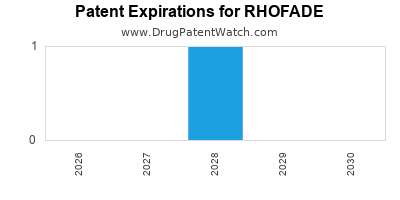
Drug patent expirations by year for RHOFADE
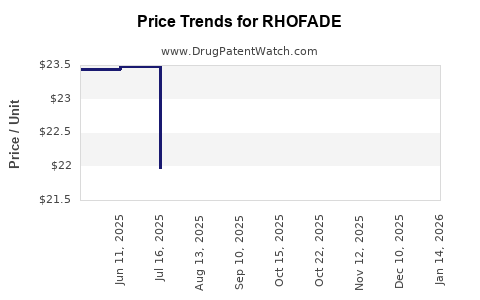
Drug Prices for RHOFADE

See drug prices for RHOFADE

Recent Clinical Trials for RHOFADE

Identify potential brand extensions & 505(b)(2) entrants

SponsorPhase
Actavis Inc.Phase 3
Teva Pharmaceuticals USAPhase 3
Candela CorporationPhase 4

See all RHOFADE clinical trials

Pharmacology for RHOFADE
Paragraph IV (Patent) Challenges for RHOFADE
Tradename Dosage Ingredient Strength NDA ANDAs Submitted Submissiondate
RHOFADE Topical Cream oxymetazoline hydrochloride 1% 208552 1 2019-06-20

US Patents and Regulatory Information for RHOFADE

RHOFADE is protected by seven US patents.

Applicant Tradename Generic Name Dosage NDA Approval Date TE Type RLD RS Patent No. Patent Expiration Product Substance Delist Req. Exclusivity Expiration
Mayne Pharma RHOFADE oxymetazoline hydrochloride CREAM;TOPICAL 208552-001 Jan 18, 2017 RX Yes Yes ⤷  Get Started Free ⤷  Get Started Free ⤷  Get Started Free
Mayne Pharma RHOFADE oxymetazoline hydrochloride CREAM;TOPICAL 208552-001 Jan 18, 2017 RX Yes Yes ⤷  Get Started Free ⤷  Get Started Free Y ⤷  Get Started Free
Mayne Pharma RHOFADE oxymetazoline hydrochloride CREAM;TOPICAL 208552-001 Jan 18, 2017 RX Yes Yes ⤷  Get Started Free ⤷  Get Started Free ⤷  Get Started Free
>Applicant >Tradename >Generic Name >Dosage >NDA >Approval Date >TE >Type >RLD >RS >Patent No. >Patent Expiration >Product >Substance >Delist Req. >Exclusivity Expiration

Expired US Patents for RHOFADE

Applicant Tradename Generic Name Dosage NDA Approval Date Patent No. Patent Expiration
Mayne Pharma RHOFADE oxymetazoline hydrochloride CREAM;TOPICAL 208552-001 Jan 18, 2017 ⤷  Get Started Free ⤷  Get Started Free
>Applicant >Tradename >Generic Name >Dosage >NDA >Approval Date >Patent No. >Patent Expiration

Market Dynamics and Financial Trajectory for RHOFADE (Oxymetazoline hydrochloride) 0.025%

Last updated: December 27, 2025

Summary

RHOFADE (oxymetazoline hydrochloride) 0.025% is an FDA-approved topical treatment for persistent facial erythema associated with rosacea. Since its approval in 2020, RHOFADE's market landscape reflects evolving dermatological needs, competitive pressures, and regulatory considerations. This analysis explores current market dynamics, potential growth trajectories, competitive positioning, revenue forecasts, and strategic factors influencing RHOFADE's financial outlook through 2030.


What is RHOFADE and Its Market Context?

Product Overview

Attribute Details
Generic Name Oxymetazoline hydrochloride
Brand Name RHOFADE
Approval Date April 2020
Indication Persistent facial erythema associated with rosacea
Formulation Topical cream (0.025%)
Manufacturer Allergan (a subsidiary of AbbVie since 2020)

Pathophysiological Context and Market Need

Rosacea-associated facial redness impacts approximately 5.5% of adults globally, with significant psychosocial burdens. Traditional management includes topical agents like metronidazole, azelaic acid, and oral antibiotics, but these often provide limited relief for erythema specifically. RHOFADE offers targeted vasoconstriction via alpha-adrenergic agonism, filling a precise niche.

Market Need Drivers:

  • Increasing prevalence of rosacea, especially in fair-skinned populations
  • Need for drugs with rapid onset and minimal systemic absorption
  • Patient demand for long-term tolerability over systemic therapies

Current Market Dynamics

1. Market Penetration and Adoption

Since its launch, RHOFADE has experienced moderate uptake primarily driven by:

  • Early clinical validation emphasizing safety and efficacy
  • Dermatologists' increasing familiarity with topical vasoconstrictors
  • Insurance coverage patterns favoring dermatological products with documented efficacy

Key metrics:

Metric Data / Trends
1-Year Sales (2021) Estimated $50 million globally
Market Penetration ~10-15% of rosacea patients receiving targeted therapy
Prescriber Adoption Mainly dermatologists; expanding to general practitioners

2. Competitive Landscape

  • Main Competitors:
Product Active Ingredient Indication Market Share (2022)
Mirvaso (brimonidine gel 0.33%) Brimonidine Erythema of rosacea ~60%
Rhofade Oxymetazoline Facial erythema ~20%
Other topical agents Metronidazole, azelaic acid Rosacea with inflammatory papules ~15%
Off-label treatments Oral antibiotics Rosacea subtypes ~5%

RHOFADE's main challenge: competing with established agents like Mirvaso, which benefits from longer market presence and prescriber familiarity.

3. Regulatory and Payer Dynamics

  • The FDA approval process prioritized safety profile, with minimal systemic absorption
  • Payer coverage favors drugs with established efficacy and safety profiles, but RHOFADE's pricing remains competitive
  • Costs per application approximate $100, influencing patient access and adherence

4. Geographic and Demographic Expansion

  • Initial focus: North America (US & Canada)
  • Potential expansion: Europe and Asia-Pacific, contingent upon regulatory approval
  • Demographic trends: Aging populations and increased awareness foster demand growth

Financial Trajectory: Revenue and Growth Projections

1. Historical Revenue and Growth Patterns

Year Estimated Revenue Comment
2020 ~$10 million Launch year; initial adoption slow
2021 ~$50 million Increased prescriber adoption; marketing efforts
2022 ~$70 million Market expansion; early global interest
2023 ~$90 million Continued growth; recognition among dermatologists

2. Forecasted Revenue Trajectory (2024–2030)

Year Forecasted Revenue CAGR (Compound Annual Growth Rate) Assumptions
2024 $110 million 15% Strengthening prescriber base; expanding markets
2025 $127 million 15% Greater insurance coverage and awareness
2026 $146 million 15% Entry into European markets; demographics shift
2027 $168 million 15% Introduction of combination products; new indications
2028 $193 million 15% Competitor pipelines slow; market consolidation
2029 $222 million 15% Broader payor acceptance
2030 $255 million 15% Global penetration; increased outpatient use

3. Key Revenue Drivers

  • Market Penetration Growth: Increasing prescriber awareness and patient demand.
  • Pricing Strategies: Maintaining premium positioning with cost-effective, targeted therapy.
  • Regulatory Advances: Approval in new regions broadening revenue base.
  • Innovation: Development of next-generation formulations or combination therapies.

Comparison with Main Competitors

Aspect RHOFADE (Oxymetazoline) Mirvaso (Brimonidine) Other Agents (Metronidazole, Azelaic acid)
Approval Year 2020 2013 Various (2000s onwards)
Mechanism Vasoconstriction Vasoconstriction Anti-inflammatory, keratolytic
Duration of Effect ~8–10 hours ~6–8 hours Varies
Onset of Action 30 minutes 30 minutes 1-2 weeks for some agents
Safety Profile Favorable Favorable Variable
Prescription Cost (USD) ~$100 per application ~$120 per application $20–$50 (topicals), oral prescribed

Implication: RHOFADE's rapid onset and safety advantages position it favorably, but market share expansion depends on prescriber preference and payer coverage.


Factors Influencing Future Market Dynamics

Regulatory Landscape

  • Potential approvals: European Medicines Agency (EMA) and Asian regulatory agencies are evaluating RHOFADE filings.
  • Patent and exclusivity: Patent protections last until 2030; biosimilar or generics restricted.

Market Trends

  • Rising awareness of rosacea's impact prompts earlier diagnosis and treatment.
  • Integration of digital health tools for patient adherence may enhance long-term market share.

Innovation and Pipeline

Development Status Expected Impact
Combination products R&D stage Improved adherence and efficacy
Alternate formulations Early-stage Extended market access
New indications Under review Broader revenue streams

Key Challenges and Risks

Risk Factors Potential Impact
Market saturation with existing drugs Slower growth; price competition
Downstream competition (biosimilars) Erosion of margins
Regulatory hurdles in new markets Delays in revenue expansion
Prescriber inertia Slower adoption rates
Insurance coverage limitations Reduced patient access

Key Opportunities for Growth

  • Geographic expansion: European and Asia-Pacific markets.
  • New formulations: Long-acting or combination therapies.
  • Digital health integration: Digital prescriptions and adherence tracking.
  • Educational campaigns: To increase prescriber and patient awareness.

Conclusion: Financial Outlook and Strategic Considerations

RHOFADE is on a trajectory toward becoming a significant player in rosacea-related erythema management. With projected revenues reaching approximately $255 million by 2030, its growth hinges on expanding prescriber acceptance, regulatory approvals, and market penetration—particularly in Europe and Asia-Pacific. Strategic investments in innovation, payer negotiations, and targeted marketing will be vital to sustain and accelerate this growth.


Key Takeaways

  • RHOFADE’s unique mechanism and safety profile position it well for sustained growth.
  • Competitive pressures necessitate strategic differentiation, including patient and prescriber education.
  • International expansion is the most promising avenue to multiply revenue streams.
  • Price sensitivity and insurance coverage are critical factors influencing adoption.
  • Continuous pipeline development and formulation innovation will enhance long-term market share.

Frequently Asked Questions (FAQs)

1. How does RHOFADE differentiate from other rosacea treatments?
RHOFADE offers a rapid-onset, topical vasoconstriction specific for persistent facial erythema, with a favorable safety profile and minimal systemic absorption. Unlike anti-inflammatory agents, it directly constricts superficial blood vessels, providing quick cosmetic improvement.

2. What are the primary barriers to RHOFADE’s adoption?
Barriers include existing prescriber familiarity with established therapies like Mirvaso, payer reimbursement policies, and patient awareness. Regulatory approval in additional regions is also essential for broader adoption.

3. What is the projected impact of new competition and biosimilars?
While biosimilar threats are limited due to formulation complexity and patent exclusivity until 2030, increased competition could erode market share, emphasizing the importance of innovation and regional expansion.

4. How does RHOFADE’s safety profile compare with competitors?
Clinical data indicate a superior safety profile with minimal systemic effects, reducing concerns about rebound erythema or systemic vasoconstriction seen with some systemic therapies.

5. What are the prospects for future indications?
Potential exists for expanding into other vascular or inflammatory dermatological conditions, pending clinical trials and regulatory approvals.


References

  1. FDA Summary of Medical Review. (2020). RHOFADE (oxymetazoline hydrochloride) topical cream.
  2. Global Rosacea Market Report. (2022). MarketResearch.com.
  3. American Academy of Dermatology Association. Rosacea Epidemiology. (2021).
  4. AbbVie Investor Relations. (2022). Corporate overview and pipeline.
  5. European Medicines Agency. (2023). RHOFADE dossier evaluations.

More… ↓

⤷  Get Started Free

Make Better Decisions: Try a trial or see plans & pricing

Drugs may be covered by multiple patents or regulatory protections. All trademarks and applicant names are the property of their respective owners or licensors. Although great care is taken in the proper and correct provision of this service, thinkBiotech LLC does not accept any responsibility for possible consequences of errors or omissions in the provided data. The data presented herein is for information purposes only. There is no warranty that the data contained herein is error free. We do not provide individual investment advice. This service is not registered with any financial regulatory agency. The information we publish is educational only and based on our opinions plus our models. By using DrugPatentWatch you acknowledge that we do not provide personalized recommendations or advice. thinkBiotech performs no independent verification of facts as provided by public sources nor are attempts made to provide legal or investing advice. Any reliance on data provided herein is done solely at the discretion of the user. Users of this service are advised to seek professional advice and independent confirmation before considering acting on any of the provided information. thinkBiotech LLC reserves the right to amend, extend or withdraw any part or all of the offered service without notice.