Last updated: September 23, 2026
Rhofade, the brand name for oxymetazoline hydrochloride cream 1%, is a prescription topical treatment for persistent facial erythema associated with rosacea. The U.S. Food and Drug Administration approved Rhofade in January 2017. Journey Medical Corporation holds the U.S. commercial rights and markets the product through dermatology channels.
Rhofade remains commercially relevant because it addresses a visible symptom that is poorly served by older generic therapies. Its financial trajectory is constrained by the size of the rosacea market, high patient copay exposure, payer controls, and potential Hatch-Waxman generic competition. Public filings do not provide a standalone Rhofade revenue figure, so product performance must be assessed through prescription trends, company disclosures, market access, competitive positioning, and exclusivity risk.
What is Rhofade and how does it work?
Rhofade is a topical alpha-1 adrenergic receptor agonist. Its active ingredient, oxymetazoline hydrochloride, causes vasoconstriction in cutaneous blood vessels and reduces persistent facial redness associated with rosacea.
The product is applied once daily as a thin layer to the affected areas of the face. The FDA label covers adults with persistent facial erythema associated with rosacea. Rhofade is not approved to treat all rosacea symptoms, including papules, pustules, ocular disease, or intermittent flushing as a standalone indication. [1]
Rhofade product profile
| Attribute |
Rhofade |
| Active ingredient |
Oxymetazoline hydrochloride |
| Strength |
1% cream |
| Dosage form |
Topical cream |
| FDA indication |
Persistent facial erythema associated with rosacea |
| Route |
Cutaneous |
| Dosing |
Once daily |
| Original FDA approval |
January 2017 |
| Regulatory pathway |
New drug application |
| Commercial rights |
Journey Medical Corporation |
| Principal competitors |
Mirvaso, generic metronidazole, ivermectin, azelaic acid, laser and light procedures |
Rhofade differs from oral alpha-adrenergic therapies because it is designed for localized facial treatment. Its main clinical value is rapid reduction of visible redness without requiring systemic dosing.
What is the market position of Rhofade?
Rhofade occupies the persistent-erythema segment of the broader rosacea market. The product competes with topical brimonidine tartrate gel, marketed as Mirvaso, and with low-cost generic therapies used for inflammatory lesions or broader rosacea management.
The competitive distinction is symptom-specific:
| Product or therapy |
Primary role in rosacea |
Commercial advantage |
Commercial limitation |
| Rhofade |
Persistent facial erythema |
Once-daily topical alpha agonist; differentiated cream formulation |
High branded cost and payer restrictions |
| Mirvaso |
Persistent facial erythema |
Established market presence and physician familiarity |
Similar class and rebound-flushing concerns |
| Metronidazole |
Papules and pustules |
Broad generic availability and low cost |
Does not directly target persistent erythema |
| Ivermectin |
Inflammatory rosacea lesions |
Strong efficacy for papulopustular disease |
Limited direct effect on fixed redness |
| Azelaic acid |
Inflammatory lesions and redness |
Generic availability |
Less targeted for persistent erythema |
| Laser and intense pulsed light |
Vascular redness |
Procedural efficacy |
High out-of-pocket cost and limited insurance coverage |
Rhofade benefits from a large diagnosed and treated rosacea population. The commercial opportunity is narrower than the total rosacea population because the product is most relevant to patients whose primary complaint is persistent redness.
How large is the addressable Rhofade market?
Rosacea affects an estimated 14 million people in the United States, although prevalence estimates vary by diagnostic method and underdiagnosis is common. [2] The relevant Rhofade population is smaller because treatment requires a diagnosis, a persistent erythema presentation, a prescribing physician, and access to a branded topical product.
The addressable market has four commercial filters:
- Dermatologist or primary-care diagnosis.
- Persistent facial erythema as a clinically meaningful symptom.
- Prescriber preference for an alpha-agonist cream.
- Patient ability to obtain and continue treatment.
Rhofade's market is therefore a specialty branded market rather than a mass dermatology market. Its strongest commercial channels are dermatologists, high-volume rosacea practices, specialty pharmacies, and digital patient-support programs.
What is the financial trajectory of Rhofade?
Journey Medical has not publicly reported a standalone Rhofade revenue series in the manner of a large publicly traded pharmaceutical company. Product-level sales, gross-to-net adjustments, refill rates, and contribution margins are therefore not independently verifiable from public company disclosures.
The financial trajectory can be characterized in three stages.
Launch and market education: 2017 to 2019
Rhofade entered a market already familiar with topical alpha-agonist treatment through Mirvaso. The product required physician education around patient selection, daily administration, expectations for redness reduction, and potential rebound or worsening erythema.
Early commercial investment likely centered on dermatology sales coverage, samples, copay assistance, and patient acquisition. The product's value proposition was strongest for patients who considered facial redness more burdensome than inflammatory lesions.
Commercial expansion: 2020 to 2022
The product's commercial profile benefited from continued demand for non-procedural, at-home treatment. Dermatology prescriptions shifted during the COVID-19 period, but facial appearance became a more visible concern for many patients using video communication.
The product also benefited from Journey Medical's focused dermatology portfolio. A focused commercial infrastructure can reduce the incremental cost of promoting Rhofade compared with a standalone sales organization.
Maturity and exclusivity pressure: 2023 onward
Rhofade is now a mature branded topical product. Growth depends less on initial physician awareness and more on:
- Refill persistence.
- Payer coverage.
- Copay support.
- Switching from Mirvaso.
- New patient diagnosis.
- Protection against generic substitution.
- Expansion of prescriber use beyond dermatologists.
A mature branded topical typically faces revenue pressure before complete generic substitution because payers can impose prior authorization, preferred-product rules, and higher patient cost sharing. The timing of actual generic entry is more important than the nominal expiration date of a single patent.
What patents protect Rhofade?
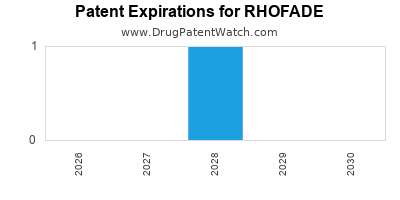
Rhofade is protected through a combination of formulation, composition, and regulatory exclusivity rights rather than biologic exclusivity. Its relevant U.S. protection must be analyzed through FDA Orange Book listings, issued patents, patent-term adjustments, patent-term extensions, and any litigation involving ANDA applicants. [3]
The product's intellectual-property value is concentrated in the topical cream formulation and its use for persistent facial erythema. Oxymetazoline itself is an old active pharmaceutical ingredient, which limits the value of basic molecule protection. The commercial defense therefore depends on formulation and use claims.
Formulation patent exposure
Formulation claims may cover:
- Oxymetazoline hydrochloride concentration.
- Cream vehicle composition.
- pH and excipient selection.
- Stability characteristics.
- Delivery of oxymetazoline to facial skin.
- Reduction of persistent facial erythema.
A generic applicant can challenge listed patents through an ANDA Paragraph IV certification, arguing that a patent is invalid, unenforceable, or not infringed. The applicant may also wait for expiration, certify against patents that do not block approval, or develop a product that avoids asserted claims.
Method-of-use patent exposure
Method-of-use protection is commercially relevant because Rhofade is approved for persistent facial erythema associated with rosacea. A narrow use patent may be difficult to enforce against a generic if the generic label omits the patented use. A broader method claim can increase litigation risk, but its validity depends on claim scope, prior art, written description, and obviousness.
What is the Orange Book status of Rhofade?
Rhofade is an FDA-approved prescription drug regulated under the NDA framework. Its generic competition risk is therefore governed by the Hatch-Waxman system, not the biosimilar pathway.
The FDA Orange Book is the controlling public source for listed patents, patent-use codes, therapeutic equivalence evaluations, and exclusivity information. [3] Orange Book status can change as patents are added, delisted, corrected, expire, or become subject to litigation.
The key commercial distinction is between:
- Patent expiration, which removes a listed patent barrier.
- FDA approval eligibility, which may be affected by other listed patents or exclusivity.
- Actual generic launch, which depends on litigation outcomes, settlement terms, manufacturing readiness, and commercial economics.
Have generic manufacturers filed Paragraph IV challenges to Rhofade?
Paragraph IV risk is the central generic-entry issue for Rhofade. A first applicant that submits a valid Paragraph IV certification and meets statutory requirements may obtain 180 days of generic exclusivity. That period can delay additional generic competition while creating a high-value launch opportunity.
Publicly available information does not establish a confirmed commercial generic launch that has displaced Rhofade in the U.S. market. The absence of a visible generic launch does not eliminate risk. ANDA litigation, tentative approval, settlement agreements, or nonpublic commercial decisions can precede market entry.
Generic launch scenarios
| Scenario |
Likely impact on Rhofade |
| No approved generic |
Brand retains pricing and prescription control, subject to payer pressure |
| One authorized or Paragraph IV generic |
Faster payer substitution and reduced net pricing |
| First-to-market generic |
Material share loss, particularly in cash-pay and high-deductible patients |
| Multiple generics |
Rapid price compression and significant prescription migration |
| At-risk launch |
Immediate litigation exposure and potential damages or injunction risk |
For a topical product, substitution may be less automatic than for a conventional oral tablet if the generic's vehicle, packaging, patient experience, or pharmacy availability differs. That can slow switching, but payers can still create strong substitution incentives.
Does Rhofade face biosimilar risk?
No. Rhofade is a chemically synthesized small-molecule topical drug, not a biologic. It is subject to ANDA generic competition rather than biosimilar competition under the Public Health Service Act.
The principal competitive risks are:
- Generic oxymetazoline cream.
- Competing branded topical alpha agonists.
- Generic rosacea therapies used in combination.
- Laser and intense pulsed light procedures.
- New topical or oral agents with broader rosacea claims.
What licensing deals affect Rhofade?
Rhofade was originally developed and commercialized under Allergan ownership. Journey Medical acquired U.S. rights and has since positioned the product within its dermatology portfolio. The transaction transferred commercial responsibility from a large diversified pharmaceutical company to a specialty dermatology company.
The strategic effect is significant:
- Journey can prioritize dermatology prescribers.
- Rhofade can share sales infrastructure with other dermatology products.
- The product receives greater portfolio importance than it would inside a large multinational company.
- Journey assumes greater exposure to payer changes, generic entry, and single-product performance.
Public information does not provide enough detail to calculate royalty rates, milestone obligations, transfer prices, or the precise economic allocation between the parties.
What patent litigation affects Rhofade?
Rhofade's litigation exposure is tied to ANDA filings and any Paragraph IV challenges against listed patents. The most important litigation variables are:
- The number of ANDA filers.
- The patents asserted.
- Whether a 30-month stay applies.
- Whether the dispute ends in settlement.
- Whether a settlement permits an agreed generic entry date.
- Whether the first filer retains 180-day exclusivity.
- Whether the generic launches at risk.
A settlement can preserve branded revenue longer than an adverse judgment but still create a defined future erosion date. The economic value of a settlement depends on the permitted launch date, launch restrictions, supply arrangements, authorized-generic provisions, and whether the agreement attracts Federal Trade Commission scrutiny.
How strong is the Rhofade patent estate?
Rhofade's patent estate is strategically useful but structurally narrower than a new chemical entity estate. The active ingredient is not novel, so the strongest protection must come from the formulation and approved-use combination.
Patent-strength indicators include:
| Factor |
Assessment |
| New molecular entity protection |
Weak or unavailable because oxymetazoline is an established compound |
| Formulation protection |
Important and potentially valuable |
| Method-of-use protection |
Relevant to rosacea erythema, but claim scope matters |
| Regulatory exclusivity |
Limited compared with biologics and newly approved chemical entities |
| Generic design-around risk |
Meaningful for topical formulations |
| Manufacturing complexity |
Moderate; cream manufacture is more accessible than sterile biologic production |
| Enforcement leverage |
Dependent on Orange Book claims and ANDA product details |
The principal weakness is substitutability. A generic manufacturer may not need to reproduce every commercial attribute of Rhofade if it can obtain approval with a therapeutically equivalent topical product and win payer preference.
What manufacturing and intellectual-property barriers protect Rhofade?
Rhofade does not have the manufacturing barrier associated with monoclonal antibodies, vaccines, or complex injectables. A topical cream still requires control of particle distribution, homogeneity, stability, microbiological quality, packaging, and preservative performance.
Potential barriers include:
- Consistent incorporation of oxymetazoline in the cream base.
- Stability across the labeled shelf life.
- Container-closure compatibility.
- Scale-up reproducibility.
- Comparative bioequivalence or product-performance requirements.
- FDA review of inactive ingredients and formulation differences.
These barriers can delay generic development, but they are unlikely to provide durable protection once multiple manufacturers commit resources.
How does Rhofade compare with Mirvaso?
Rhofade and Mirvaso are the closest branded competitors because both target persistent facial erythema through topical alpha-adrenergic vasoconstriction.
| Factor |
Rhofade |
Mirvaso |
| Active ingredient |
Oxymetazoline |
Brimonidine |
| Formulation |
Cream |
Gel |
| Approved use |
Persistent facial erythema of rosacea |
Persistent facial erythema of rosacea |
| Dosing |
Once daily |
Once daily |
| Strategic positioning |
Cream vehicle and oxymetazoline differentiation |
Earlier market entry and physician familiarity |
| Generic risk |
Oxymetazoline cream competition |
Brimonidine gel competition |
| Switching driver |
Vehicle preference, tolerability, payer coverage |
Brand familiarity, clinical response, coverage |
Neither product has an unlimited market because persistent redness is only one rosacea treatment need. Clinical experience, insurance coverage, patient tolerability, and refill behavior determine share.
What generic entry risks exist for Rhofade?
The highest-risk launch scenario is a first approved generic with favorable payer placement and a low wholesale acquisition cost. Rhofade's net sales could fall before full generic penetration through formulary exclusions, higher patient copays, and mandatory step therapy.
The most likely erosion sequence is:
- Payers tighten coverage.
- New prescriptions shift to the generic.
- Existing patients receive substitution or face higher copays.
- Brand discounts increase.
- Gross-to-net deductions rise.
- Prescriber promotion becomes less efficient.
- Brand revenue declines faster than prescription volume.
The commercial defense is limited to clinical differentiation, patient persistence, formulation preference, supply reliability, brand support, and any enforceable patent or settlement position.
Key Takeaways
- Rhofade is a branded oxymetazoline hydrochloride 1% cream approved for persistent facial erythema associated with rosacea.
- Journey Medical owns the principal U.S. commercial position after acquiring rights from Allergan.
- The product addresses a meaningful but narrower segment of the total rosacea market.
- Public disclosures do not provide a reliable standalone Rhofade revenue history.
- Financial performance depends on refills, payer coverage, copay support, and dermatologist adoption.
- Rhofade faces generic, not biosimilar, competition.
- Formulation and method-of-use patents are more important than active-ingredient novelty.
- Actual generic launch timing depends on Orange Book patents, ANDA challenges, litigation, settlements, and commercial readiness.
- Topical manufacturing creates moderate development barriers but not the high barriers associated with biologics.
- Mirvaso is the closest branded competitor, while generic rosacea therapies constrain pricing and prescribing.
FAQs
When did Rhofade receive FDA approval?
The FDA approved Rhofade in January 2017 for persistent facial erythema associated with rosacea in adults. [1]
Is Rhofade the same as Afrin?
No. Both products contain oxymetazoline-related active ingredients, but Rhofade is a prescription 1% topical cream approved for facial erythema, while Afrin is an over-the-counter nasal decongestant product.
Can a generic pharmacy automatically substitute for Rhofade?
Automatic substitution depends on FDA therapeutic-equivalence status, state pharmacy law, payer policy, and the specific generic product. A generic may receive an AB rating only after satisfying applicable FDA requirements.
Does Rhofade treat rosacea bumps and pustules?
Rhofade is approved for persistent facial erythema. It is not approved specifically as a treatment for papules and pustules, which may require metronidazole, ivermectin, azelaic acid, doxycycline, or other therapies.
What is the main investment risk associated with Rhofade?
The principal risk is branded revenue erosion from generic oxymetazoline cream, amplified by payer substitution, patient out-of-pocket costs, and the limited ability to differentiate an established active ingredient.
References
- U.S. Food and Drug Administration. (2017). Rhofade (oxymetazoline hydrochloride) cream, 1% prescribing information.
- National Rosacea Society. (n.d.). Rosacea prevalence and disease characteristics.
- U.S. Food and Drug Administration. (n.d.). Approved drug products with therapeutic equivalence evaluations, Orange Book.
- U.S. Food and Drug Administration. (n.d.). Hatch-Waxman amendments and abbreviated new drug applications.
- U.S. Food and Drug Administration. (n.d.). Drugs@FDA: FDA-approved drugs database.