Last Updated: June 27, 2026

QTERN Drug Patent Profile


✉ Email this page to a colleague

« Back to Dashboard


Which patents cover Qtern, and what generic alternatives are available?

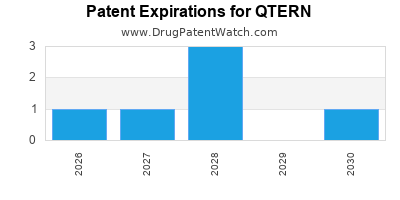
Qtern is a drug marketed by Astrazeneca Ab and is included in two NDAs. There are seven patents protecting this drug and two Paragraph IV challenges.

This drug has two hundred and fifty-six patent family members in forty-eight countries.

The generic ingredient in QTERN is dapagliflozin; metformin hydrochloride; saxagliptin hydrochloride. There are twenty-six drug master file entries for this compound. Additional details are available on the dapagliflozin; metformin hydrochloride; saxagliptin hydrochloride profile page.

DrugPatentWatch® Generic Entry Outlook for Qtern

Qtern was eligible for patent challenges on January 8, 2018.

There have been eighteen patent litigation cases involving the patents protecting this drug, indicating strong interest in generic launch. Recent data indicate that 63% of patent challenges are decided in favor of the generic patent challenger and that 54% of successful patent challengers promptly launch generic drugs.

Indicators of Generic Entry

< Available with Subscription >

  Start Trial

AI Deep Research
Questions you can ask:
  • What is the 5 year forecast for QTERN?
  • What are the global sales for QTERN?
  • What is Average Wholesale Price for QTERN?
Summary for QTERN
Paragraph IV (Patent) Challenges for QTERN
Tradename Dosage Ingredient Strength NDA ANDAs Submitted Submissiondate
QTERN Tablets dapagliflozin; saxagliptin hydrochloride 5 mg/5 mg 209091 1 2020-07-29
QTERN Tablets dapagliflozin; saxagliptin hydrochloride 10 mg/5 mg 209091 5 2018-01-08

US Patents and Regulatory Information for QTERN

QTERN is protected by six US patents.

Applicant Tradename Generic Name Dosage NDA Approval Date TE Type RLD RS Patent No. Patent Expiration Product Substance Delist Req. Exclusivity Expiration
Astrazeneca Ab QTERNMET XR dapagliflozin; metformin hydrochloride; saxagliptin hydrochloride TABLET, EXTENDED RELEASE;ORAL 210874-004 May 2, 2019 DISCN Yes No 9,616,028*PED ⤷  Start Trial Y ⤷  Start Trial
Astrazeneca Ab QTERNMET XR dapagliflozin; metformin hydrochloride; saxagliptin hydrochloride TABLET, EXTENDED RELEASE;ORAL 210874-004 May 2, 2019 DISCN Yes No 6,515,117*PED ⤷  Start Trial Y ⤷  Start Trial
Astrazeneca Ab QTERNMET XR dapagliflozin; metformin hydrochloride; saxagliptin hydrochloride TABLET, EXTENDED RELEASE;ORAL 210874-004 May 2, 2019 DISCN Yes No 7,919,598*PED ⤷  Start Trial Y ⤷  Start Trial
Astrazeneca Ab QTERN dapagliflozin; saxagliptin hydrochloride TABLET;ORAL 209091-002 May 2, 2019 DISCN Yes No 8,501,698*PED ⤷  Start Trial Y ⤷  Start Trial
Astrazeneca Ab QTERNMET XR dapagliflozin; metformin hydrochloride; saxagliptin hydrochloride TABLET, EXTENDED RELEASE;ORAL 210874-002 May 2, 2019 DISCN Yes No 8,716,251*PED ⤷  Start Trial Y ⤷  Start Trial
>Applicant >Tradename >Generic Name >Dosage >NDA >Approval Date >TE >Type >RLD >RS >Patent No. >Patent Expiration >Product >Substance >Delist Req. >Exclusivity Expiration

Expired US Patents for QTERN

International Patents for QTERN

When does loss-of-exclusivity occur for QTERN?

Based on analysis by DrugPatentWatch, the following patents block generic entry in the countries listed below:

Argentina

Patent: 1730
Estimated Expiration: ⤷  Start Trial

Australia

Patent: 07265246
Estimated Expiration: ⤷  Start Trial

Brazil

Patent: 2017015106
Estimated Expiration: ⤷  Start Trial

Patent: 2017021516
Estimated Expiration: ⤷  Start Trial

Patent: 0713544
Estimated Expiration: ⤷  Start Trial

Canada

Patent: 53344
Estimated Expiration: ⤷  Start Trial

Patent: 24318
Estimated Expiration: ⤷  Start Trial

Patent: 85797
Estimated Expiration: ⤷  Start Trial

Chile

Patent: 07001915
Estimated Expiration: ⤷  Start Trial

China

Patent: 1479287
Estimated Expiration: ⤷  Start Trial

Patent: 3145773
Estimated Expiration: ⤷  Start Trial

Colombia

Patent: 60299
Estimated Expiration: ⤷  Start Trial

Croatia

Patent: 0141007
Estimated Expiration: ⤷  Start Trial

Cyprus

Patent: 15738
Estimated Expiration: ⤷  Start Trial

Denmark

Patent: 69374
Estimated Expiration: ⤷  Start Trial

Eurasian Patent Organization

Patent: 8229
Estimated Expiration: ⤷  Start Trial

Patent: 0428
Estimated Expiration: ⤷  Start Trial

Patent: 8259
Estimated Expiration: ⤷  Start Trial

Patent: 5999
Estimated Expiration: ⤷  Start Trial

Patent: 0900066
Estimated Expiration: ⤷  Start Trial

Patent: 1171333
Estimated Expiration: ⤷  Start Trial

Patent: 1490902
Estimated Expiration: ⤷  Start Trial

Patent: 1791254
Estimated Expiration: ⤷  Start Trial

Patent: 2091391
Estimated Expiration: ⤷  Start Trial

European Patent Office

Patent: 69374
Estimated Expiration: ⤷  Start Trial

Patent: 57918
Estimated Expiration: ⤷  Start Trial

Patent: 45466
Estimated Expiration: ⤷  Start Trial

Patent: 63807
Estimated Expiration: ⤷  Start Trial

Hong Kong

Patent: 27359
Estimated Expiration: ⤷  Start Trial

Israel

Patent: 5882
Estimated Expiration: ⤷  Start Trial

Patent: 4180
Estimated Expiration: ⤷  Start Trial

Patent: 4181
Estimated Expiration: ⤷  Start Trial

Patent: 4182
Estimated Expiration: ⤷  Start Trial

Japan

Patent: 13889
Estimated Expiration: ⤷  Start Trial

Patent: 66651
Estimated Expiration: ⤷  Start Trial

Patent: 37187
Estimated Expiration: ⤷  Start Trial

Patent: 09545525
Estimated Expiration: ⤷  Start Trial

Patent: 13209394
Estimated Expiration: ⤷  Start Trial

Patent: 15071636
Estimated Expiration: ⤷  Start Trial

Patent: 16172758
Estimated Expiration: ⤷  Start Trial

Patent: 17222681
Estimated Expiration: ⤷  Start Trial

Patent: 19059779
Estimated Expiration: ⤷  Start Trial

Malaysia

Patent: 8566
Estimated Expiration: ⤷  Start Trial

Patent: 3930
Estimated Expiration: ⤷  Start Trial

Mexico

Patent: 9143
Estimated Expiration: ⤷  Start Trial

Patent: 7155
Estimated Expiration: ⤷  Start Trial

Patent: 08015377
Estimated Expiration: ⤷  Start Trial

New Zealand

Patent: 4346
Estimated Expiration: ⤷  Start Trial

Patent: 9190
Estimated Expiration: ⤷  Start Trial

Patent: 9195
Estimated Expiration: ⤷  Start Trial

Patent: 9202
Estimated Expiration: ⤷  Start Trial

Norway

Patent: 6828
Estimated Expiration: ⤷  Start Trial

Patent: 7770
Estimated Expiration: ⤷  Start Trial

Patent: 085169
Estimated Expiration: ⤷  Start Trial

Patent: 221233
Estimated Expiration: ⤷  Start Trial

Peru

Patent: 080349
Estimated Expiration: ⤷  Start Trial

Patent: 120776
Estimated Expiration: ⤷  Start Trial

Philippines

Patent: 012500168
Patent: CRYSTALLINE SOLVATES AND COMPLEXES OF (IS)-1,5-ANHYDRO-L-C-(3-((PHENYL)METHYL)PHENYL)-D-GLUCITOL DERIVATIVES WITH AMINO ACIDS AS SGLT2 INHIBITORS FOR THE TREATMENT OF DIABETES
Estimated Expiration: ⤷  Start Trial

Poland

Patent: 69374
Estimated Expiration: ⤷  Start Trial

Portugal

Patent: 69374
Estimated Expiration: ⤷  Start Trial

Serbia

Patent: 638
Patent: KRISTALNI SOLVATI DERIVATA (1S)-1,5-ANHIDRO-1-C-(3-((FENIL) METIL) FENIL)-D-GLUCITOLA SA ALKOHOLIMA KAO INHIBITORI SGLT2 ZA TRETMAN DIJABETESA (CRYSTALLINE SOLVATES OF (1S)-1,5-ANHYDRO-1-C-(3-((PHENYL) METHYL) PHENYL)-D-GLUCITOL DERIVATIVES WITH ALCOHOLS AS SGLT2 INHIBITORS FOR THE TREATMENT OF DIABETES)
Estimated Expiration: ⤷  Start Trial

Singapore

Patent: 201402181S
Patent: CRYSTALLINE SOLVATES AND COMPLEXES OF (1S) -1, 5-ANHYDRO-1-C- (3- ( (PHENYL) METHYL) PHENYL) -D-GLUCITOL DERIVATIVES WITH AMINO ACIDS AS SGLT2 INHIBITORS FOR THE TREATMENT OF DIABETES
Estimated Expiration: ⤷  Start Trial

Patent: 2741
Patent: CRYSTALLINE SOLVATES AND COMPLEXES OF (1S) -1, 5-ANHYDRO-1-C- (3- ( (PHENYL) METHYL) PHENYL) -D-GLUCITOL DERIVATIVES WITH AMINO ACIDS AS SGLT2 INHIBITORS FOR THE TREATMENT OF DIABETES
Estimated Expiration: ⤷  Start Trial

Slovenia

Patent: 69374
Estimated Expiration: ⤷  Start Trial

South Africa

Patent: 0810475
Patent: CRYSTALLINE SOLVATES AND COMPLEXES OF (IS)-1,5-ANHYDRO-L-C-(3-((PHENYL)METHYL)PHENYL)-D-GLUCITOL DERIVATIVES WITH AMINO ACIDS AS SGLT2 INHIBITORS FOR THE TREATMENT OF DIABETES
Estimated Expiration: ⤷  Start Trial

South Korea

Patent: 1493102
Estimated Expiration: ⤷  Start Trial

Patent: 090023643
Estimated Expiration: ⤷  Start Trial

Spain

Patent: 21665
Estimated Expiration: ⤷  Start Trial

Patent: 59862
Estimated Expiration: ⤷  Start Trial

Patent: 69130
Estimated Expiration: ⤷  Start Trial

Taiwan

Patent: 0811127
Patent: Crystal structures of SGLT2 inhibitors and processes for preparing same
Estimated Expiration: ⤷  Start Trial

Patent: 1406743
Patent: Crystal structures of SGLT2 inhibitors and processes for preparing same
Estimated Expiration: ⤷  Start Trial

Patent: 1509927
Patent: Crystal structures of SGLT2 inhibitors and processes for preparing same
Estimated Expiration: ⤷  Start Trial

Patent: 1546054
Patent: Crystal structures of SGLT2 inhibitors and processes for preparing same
Estimated Expiration: ⤷  Start Trial

Patent: 21245
Estimated Expiration: ⤷  Start Trial

Patent: 66876
Estimated Expiration: ⤷  Start Trial

Patent: 19528
Estimated Expiration: ⤷  Start Trial

Ukraine

Patent: 765
Patent: КРИСТАЛЛИЧЕСКИЕ СОЛЬВАТЫ И КОМПЛЕКСЫ ПРОИЗВОДНЫХ (IS)-1,5-АНГИДРО-L-C-(3-((ФЕНИЛ)МЕТИЛ)ФЕНИЛ)-D-ГЛЮЦИТОЛА С АМИНОКИСЛОТАМИ КАК ИНГИБИТОРЫ БЕЛКА SGLT2, ПРИГОДНЫЕ В ЛЕЧЕНИИ ДИАБЕТА (CRYSTALLINE SOLVATES AND COMPLEXES OF (IS) -1, 5-ANHYDRO-L-C- (3- ((PHENYL) METHYL) PHENYL) -D-GLUCITOL DERIVATIVES WITH AMINO ACIDS AS SGLT2 INHIBITORS FOR THE TREATMENT OF DIABETES)
Estimated Expiration: ⤷  Start Trial

Generics may enter earlier, or later, based on new patent filings, patent extensions, patent invalidation, early generic licensing, generic entry preferences, and other factors.

See the table below for additional patents covering QTERN around the world.

Country Patent Number Title Estimated Expiration
Argentina 026024 COMPUESTOS INHIBIDORES SGLT2 DE GLUCOSIDOS DE C-ARILO Y METODO, LAS COMPOSICIONES FARAMCEUTICAS QUE LOS CONTIENEN Y LOS INTERMEDIARIOS DE SINTESIS DEDICHOS COMPUESTOS ⤷  Start Trial
Argentina 040032 C-ARIL-GLUCOSIDOS COMO INHIBIDORES DE SGLT2 Y METODO ⤷  Start Trial
Austria 295848 ⤷  Start Trial
Austria 353334 ⤷  Start Trial
Australia 2003237886 C-ARYL GLUCOSIDE SGLT2 INHIBITORS AND METHOD ⤷  Start Trial
>Country >Patent Number >Title >Estimated Expiration

Supplementary Protection Certificates for QTERN

Patent Number Supplementary Protection Certificate SPC Country SPC Expiration SPC Description
1506211 C300585 Netherlands ⤷  Start Trial PRODUCT NAME: DAPAGLIFLOZINE, DESGEWENST IN DE VORM VAN EEN FARMACEUTISCH AANVAARDBAAR ZOUT; REGISTRATION NO/DATE: EU/1/12/795/001-010 20121112
1506211 PA2013008 Lithuania ⤷  Start Trial PRODUCT NAME: DAPAGLIFLOZINUM; REGISTRATION NO/DATE: EU/1/12/795/001 - EU/1/12/795/010 20121112
1506211 122013000033 Germany ⤷  Start Trial PRODUCT NAME: DAPAGLIFLOZIN UND PHARMAZEUTISCH VERTRAEGLICHE SALZE DAVON; REGISTRATION NO/DATE: EU/1/12/795/001-010 20121112
1506211 C20130006 00074 Estonia ⤷  Start Trial PRODUCT NAME: DAPAGLIFLOZIN;REG NO/DATE: K(2012)8378 12.11.2012
1506211 92182 Luxembourg ⤷  Start Trial PRODUCT NAME: DAPAGLIFLOZINE ET SES SELS PHARMACEUTIQUEMENT ACCEPTABLES
>Patent Number >Supplementary Protection Certificate >SPC Country >SPC Expiration >SPC Description
Last updated: May 27, 2026

QTERN (dapagliflozin/metformin extended-release) market dynamics and financial trajectory

QTERN, the fixed-dose combination of dapagliflozin and metformin extended-release (XR), is a U.S.-market product inside the broader SGLT2 inhibitor and metformin class competitive set. Its financial trajectory is driven by (1) SGLT2 demand growth and share shifts among dapagliflozin, empagliflozin, and ertugliflozin ecosystems; (2) formulary placement and payer steering based on A1c and cardiorenal indications; (3) generic and label-expansion timing for metformin XR and SGLT2 molecules; and (4) managed-entry dynamics for branded SGLT2 products and combination fixed-dose tablets.

This analysis maps the commercial mechanics that typically govern U.S. revenue for a late-stage branded combination and highlights the key IP and competitive pressure points that determine whether QTERN maintains share, declines, or is absorbed into payer-favored generics and alternative brand combinations.


What is QTERN’s commercial positioning in the SGLT2 + metformin XR class?

QTERN’s role: fixed-dose adherence-focused product that pairs an SGLT2 inhibitor (dapagliflozin) with metformin XR, targeting type 2 diabetes patients needing both glucose lowering and a simplified regimen.

Where QTERN competes

QTERN competes against:

  • Other dapagliflozin-based regimens (single-ingredient dapagliflozin + metformin XR, and other combination formats if present in-market).
  • Competing SGLT2 + metformin combinations (different fixed-dose pairings within the same therapeutic adjacency).
  • SGLT2 branded monotherapies/combos that win formulary preference based on payer contracting.
  • Metformin generics plus branded SGLT2s once metformin XR is economically favorable on formularies.

Why fixed-dose combinations matter financially

Fixed-dose products typically win when payers and providers value:

  • Reduced dosing complexity, which improves persistence
  • Lower total copays vs separate prescriptions
  • Clinical differentiation only when supported by guideline alignment and payer messaging

In practice, QTERN’s pricing power depends less on incremental pharmacology and more on formulary access relative to competing combos and the “branded SGLT2 + generic metformin” cost equation.


How do formulary design and payer policies shape QTERN revenue?

Core mechanism: QTERN revenue is highly sensitive to payer step therapy and preferred drug lists (PDLs) across the SGLT2 class.

Payer levers that move demand

  • Class-wide step therapy that makes SGLT2 eligibility contingent on metformin history or specific A1c thresholds.
  • Prior authorization for combination products, especially if the plan allows inexpensive metformin generics plus a preferred SGLT2.
  • Copay design that steers patients toward preferred SGLT2 molecules and away from non-preferred combinations.
  • Network contracting that sets effective net prices via rebates tied to formulary tiering.

Featured snippet answer

QTERN financial performance tends to track payer favorability for dapagliflozin-based regimens and combination access. Revenue growth or stability usually requires maintaining preferred tier status versus the branded monotherapy and combination competitors.


When does QTERN face generic erosion or brand substitution risk?

Generic erosion risk for the combination is driven by two lanes:

  1. Metformin XR economics (metformin is largely generic; fixed-dose combo value erodes when payers prefer generic metformin).
  2. SGLT2 ingredient exclusivity and derivative lifecycle (dapagliflozin brand protection determines the durability of the combination’s branded premium).

What typically accelerates substitution

  • Expiration or weakening of protections specific to the fixed-dose combination product.
  • Payer re-tiering that increases out-of-pocket costs for the combination tablet.
  • Expansion of preferred SGLT2 options through contracting that narrows the net-price gap.

Commercial timing pattern

For fixed-dose combinations like QTERN, the most damaging demand shock is usually not a single patent expiry, but the combination of:

  • SGLT2 molecule loss of market protection (when applicable)
  • Contracting changes that favor generics or other preferred branded alternatives
  • Switching by prescribers once cost barriers rise

(Determining exact launch and loss-of-exclusivity dates requires the Orange Book and patent docket for QTERN.)


What patents protect QTERN and how does the patent estate affect financial durability?

Key point: A combination’s financial life depends on whether its protections cover the specific dose form, fixed-dose combination claims, and any method-of-use or formulation improvements.

Patent estate drivers for combination products

  • Composition-of-matter coverage for the active ingredients (often long-lived but ingredient-specific).
  • Combination-specific claims tied to fixed-dose ratios and dosage regimens.
  • Formulation and manufacturing claims for XR release characteristics.
  • Method-of-use claims for clinical indications (if pursued as drug-device or drug-benefit claims).

Featured snippet answer

QTERN’s financial durability depends on whether it retains enforceable claims specific to the fixed-dose combination and XR formulation, or whether exclusivity weakens into ingredient-level competition where payers steer patients to generic metformin plus the preferred SGLT2.


What is the Orange Book status of QTERN and which filings create generic entry risk?

Orange Book status governs whether generic challengers can leverage FDA-described drug product patents and listing-driven Paragraph IV strategies.

What to check for entry risk

  • Orange Book patent listings for QTERN: active ingredient, formulation, and method-of-use.
  • Any generic ANDA submissions referencing QTERN with Paragraph IV certifications.
  • Triggering events: court outcomes, settlement dates, and regulatory approvals.

Why this matters for the revenue trajectory

Generic entry risk converts into:

  • Slower demand for branded QTERN ahead of launch
  • Price competition after approvals
  • Additional payer switching and channel inventory dynamics

(Exact status, listed patents, and any ANDA/Paragraph IV activity must be verified in Orange Book and related litigation dockets.)


How strong is QTERN’s competitive position versus other SGLT2 + metformin products?

Competition outcome variables:

  • Net price after rebates vs branded monotherapy options
  • Formulary tier and patient access
  • Prescriber familiarity and switching inertia
  • Indication coverage and evidence used in payer policy

Comparison framework

Factor QTERN impact mechanism What it determines
Formulary tier Preferred vs non-preferred Volume growth or decline
Net price Rebates and contracting Margin and competitive ability
Fixed-dose adherence value Reduced pill burden Persistence and adherence-linked conversion
SGLT2 preferred molecule dynamics Payer contracting within class Share shift among dapagliflozin/alternatives
Combination vs “generic metformin + branded SGLT2” Total cost to plan Whether combination stays economically rational

Featured snippet answer

QTERN’s share is most threatened when payers conclude that cost minimization favors generic metformin plus the preferred SGLT2 monotherapy, shrinking the economic advantage of fixed-dose combinations.


What litigation and settlements affect QTERN market exclusivity?

Financial relevance: settlements and court outcomes can accelerate or delay generic launch timelines and affect pre-launch contracting behavior.

Litigation categories to map

  • Patent infringement suits involving QTERN Orange Book-listed patents
  • Counterclaims tied to invalidity or non-infringement
  • Settlement agreements that include launch date covenants

Commercial effect

  • If courts or settlements reduce enforceable patent time, expect earlier payer switching and pharmacy stocking changes.
  • If patent protection holds, brand makers often defend through contracting and patient-support programs.

(Actual QTERN litigation timelines require a patent and court docket review.)


How do FDA labeling updates for dapagliflozin/metformin combinations shift QTERN demand?

Demand is influenced by:

  • Label expansion into cardiorenal risk reduction categories
  • Changes in guideline adoption for earlier use
  • Safety communications that affect class prescribing patterns

What label changes typically do

  • Increase “eligible patient” counts, expanding the addressable market
  • Improve payer confidence to cover earlier-line therapy
  • Trigger sequencing rule changes (e.g., SGLT2 earlier in treatment ladders)

Featured snippet answer

For SGLT2-based combinations, FDA label updates that broaden cardiorenal utility generally lift market demand for the whole class, but the incremental benefit to QTERN depends on whether payers prefer dapagliflozin-based fixed-dose options.


Biosimilar risk: does it apply to QTERN?

QTERN is a small-molecule combination tablet, not a biologic. Biosimilar pathways and related exclusivity constraints do not apply.


What generic entry scenarios threaten QTERN, and how quickly does share erode?

Entry scenario depends on whether generic or AB-rated versions can be marketed as fixed-dose combinations and whether the market permits substitution at the pharmacy level.

Typical post-launch share shape

  • Early period: modest substitution if prescriber authorizations or PA requirements remain
  • Mid period: stronger substitution as pharmacy and payer policies normalize
  • Late period: additional switching once competing options gain tiering and inventory scale

Featured snippet answer

QTERN’s most material financial threat is fixed-dose combination competition or payer switching away from combination tablets toward “generic metformin + preferred SGLT2.”


How does manufacturing and supply constrain QTERN growth?

Fixed-dose combinations can face:

  • Scale and cost-of-goods headwinds
  • Batch-release constraints for XR formulation
  • Contract manufacturing switching costs

In mature markets, supply issues can cause short-term volume volatility, but long-run trajectory usually tracks formulary and competitive pricing.


Market dynamics summary for QTERN: what moves revenue week-to-week and quarter-to-quarter

Quarterly revenue drivers typically include:

  • Payer formulary updates and pharmacy channel tiering
  • Net-price changes tied to contracting, rebates, and performance-based agreements
  • Inventory buying patterns ahead of anticipated competitive entries
  • Prescriber shift dynamics between fixed-dose combinations and monotherapy + metformin

Class-level tailwinds and headwinds are driven by:

  • SGLT2 category growth trends
  • Safety and tolerability perceptions (class-wide)
  • Cardiorenal evidence adoption
  • Competitor contracting intensity

Key Takeaways

  • QTERN is a branded SGLT2 + metformin XR fixed-dose tablet whose financial trajectory is driven mainly by payer contracting, formulary placement, and the economics of “combination vs generic metformin + preferred SGLT2.”
  • The biggest revenue risk is structural brand-to-generic substitution once combination-specific protections weaken or payer strategies favor less expensive regimens.
  • Exact exclusivity timing, generic entry triggers, and litigation-driven launch windows must be confirmed through Orange Book listings and Paragraph IV and litigation dockets tied to QTERN.
  • Label expansions that expand eligible patients can lift the whole SGLT2 market, but QTERN share gains depend on whether payers prefer dapagliflozin-based combination products.

FAQs

  1. How does QTERN’s net price depend on SGLT2 formulary contracting and rebate structures?
  2. What are the most common payer reasons for prior authorization denial for fixed-dose dapagliflozin/metformin XR products?
  3. Does switching from separate prescriptions to QTERN improve adherence enough to affect payer coverage decisions?
  4. Which SGLT2 competitor combination regimens most directly displace fixed-dose dapagliflozin/metformin XR on PDLs?
  5. What Orange Book patent types (formulation vs method-of-use) most often determine QTERN generic launch timing?

References

  1. FDA. Orange Book: Approved Drug Products with Therapeutic Equivalence Evaluations. U.S. Food and Drug Administration.
  2. FDA. ANDA (Abbreviated New Drug Application) and Paragraph IV certification information and related resources. U.S. Food and Drug Administration.

More… ↓

⤷  Start Trial

Make Better Decisions: Try a trial or see plans & pricing

Drugs may be covered by multiple patents or regulatory protections. All trademarks and applicant names are the property of their respective owners or licensors. Although great care is taken in the proper and correct provision of this service, thinkBiotech LLC does not accept any responsibility for possible consequences of errors or omissions in the provided data. The data presented herein is for information purposes only. There is no warranty that the data contained herein is error free. We do not provide individual investment advice. This service is not registered with any financial regulatory agency. The information we publish is educational only and based on our opinions plus our models. By using DrugPatentWatch you acknowledge that we do not provide personalized recommendations or advice. thinkBiotech performs no independent verification of facts as provided by public sources nor are attempts made to provide legal or investing advice. Any reliance on data provided herein is done solely at the discretion of the user. Users of this service are advised to seek professional advice and independent confirmation before considering acting on any of the provided information. thinkBiotech LLC reserves the right to amend, extend or withdraw any part or all of the offered service without notice.