Last Updated: November 8, 2026

QTERNMET XR Drug Patent Profile

« Back to Dashboard


DrugPatentWatch® Generic Entry Outlook for Qternmet Xr

By analyzing the patents and regulatory protections it appears that the earliest date for generic entry will be May 12, 2031. This may change due to patent challenges or generic licensing.

There have been thirty patent litigation cases involving the patents protecting this drug, indicating strong interest in generic launch. Recent data indicate that 63% of patent challenges are decided in favor of the generic patent challenger and that 54% of successful patent challengers promptly launch generic drugs.

Indicators of Generic Entry

< Available with Subscription >

  Start Trial

AI Deep Research
Questions you can ask:
  • What is the 5 year forecast for QTERNMET XR?
  • What are the global sales for QTERNMET XR?
  • What is Average Wholesale Price for QTERNMET XR?
Summary for QTERNMET XR
DrugPatentWatch® Estimated Loss of Exclusivity (LOE) Date for QTERNMET XR
Generic Entry Date for QTERNMET XR*:
Constraining patent/regulatory exclusivity:
NDA:
Dosage:

TABLET, EXTENDED RELEASE;ORAL

*The generic entry opportunity date is the latter of the last compound-claiming patent and the last regulatory exclusivity protection. Many factors can influence early or later generic entry. This date is provided as a rough estimate of generic entry potential and should not be used as an independent source.

US Patents and Regulatory Information for QTERNMET XR

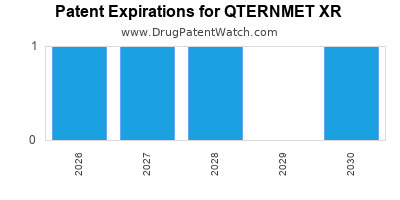
QTERNMET XR is protected by five US patents.

Based on analysis by DrugPatentWatch, the earliest date for a generic version of QTERNMET XR is ⤷  Start Trial.

This potential generic entry date is based on patent 9,616,028.

Generics may enter earlier, or later, based on new patent filings, patent extensions, patent invalidation, early generic licensing, generic entry preferences, and other factors.

Applicant Tradename Generic Name Dosage NDA Approval Date TE Type RLD RS Patent No. Patent Expiration Product Substance Delist Req. Exclusivity Expiration
Astrazeneca Ab QTERNMET XR dapagliflozin; metformin hydrochloride; saxagliptin hydrochloride TABLET, EXTENDED RELEASE;ORAL 210874-001 May 2, 2019 DISCN Yes No 9,616,028*PED ⤷  Start Trial Y ⤷  Start Trial
Astrazeneca Ab QTERNMET XR dapagliflozin; metformin hydrochloride; saxagliptin hydrochloride TABLET, EXTENDED RELEASE;ORAL 210874-004 May 2, 2019 DISCN Yes No 8,716,251*PED ⤷  Start Trial Y ⤷  Start Trial
Astrazeneca Ab QTERNMET XR dapagliflozin; metformin hydrochloride; saxagliptin hydrochloride TABLET, EXTENDED RELEASE;ORAL 210874-002 May 2, 2019 DISCN Yes No 7,919,598*PED ⤷  Start Trial Y ⤷  Start Trial
Astrazeneca Ab QTERNMET XR dapagliflozin; metformin hydrochloride; saxagliptin hydrochloride TABLET, EXTENDED RELEASE;ORAL 210874-001 May 2, 2019 DISCN Yes No 8,716,251*PED ⤷  Start Trial Y ⤷  Start Trial
>Applicant >Tradename >Generic Name >Dosage >NDA >Approval Date >TE >Type >RLD >RS >Patent No. >Patent Expiration >Product >Substance >Delist Req. >Exclusivity Expiration

Expired US Patents for QTERNMET XR

Applicant Tradename Generic Name Dosage NDA Approval Date Patent No. Patent Expiration
Astrazeneca Ab QTERNMET XR dapagliflozin; metformin hydrochloride; saxagliptin hydrochloride TABLET, EXTENDED RELEASE;ORAL 210874-004 May 2, 2019 6,936,590 ⤷  Start Trial
Astrazeneca Ab QTERNMET XR dapagliflozin; metformin hydrochloride; saxagliptin hydrochloride TABLET, EXTENDED RELEASE;ORAL 210874-002 May 2, 2019 6,414,126 ⤷  Start Trial
Astrazeneca Ab QTERNMET XR dapagliflozin; metformin hydrochloride; saxagliptin hydrochloride TABLET, EXTENDED RELEASE;ORAL 210874-004 May 2, 2019 RE44186 ⤷  Start Trial
Astrazeneca Ab QTERNMET XR dapagliflozin; metformin hydrochloride; saxagliptin hydrochloride TABLET, EXTENDED RELEASE;ORAL 210874-003 May 2, 2019 6,936,590 ⤷  Start Trial
>Applicant >Tradename >Generic Name >Dosage >NDA >Approval Date >Patent No. >Patent Expiration

International Patents for QTERNMET XR

When does loss-of-exclusivity occur for QTERNMET XR?

Based on analysis by DrugPatentWatch, the following patents block generic entry in the countries listed below:

Australia

Patent: 10319343
Patent: Bilayer tablet formulations
Estimated Expiration: ⤷  Start Trial

Brazil

Patent: 2012011726
Patent: comprimidos de duas camadas, seu uso, e suas combinações farmacêuticas
Estimated Expiration: ⤷  Start Trial

Canada

Patent: 80939
Patent: FORMULATIONS DE COMPRIME BICOUCHE (BILAYER TABLET FORMULATIONS)
Estimated Expiration: ⤷  Start Trial

Patent: 87757
Patent: FORMULATIONS DE COMPRIME BICOUCHE (BILAYER TABLET FORMULATIONS)
Estimated Expiration: ⤷  Start Trial

China

Patent: 2711739
Patent: Bilayer tablet formulations
Estimated Expiration: ⤷  Start Trial

Patent: 5193761
Patent: BILAYER TABLET FORMULATIONS
Estimated Expiration: ⤷  Start Trial

Croatia

Patent: 0181347
Estimated Expiration: ⤷  Start Trial

Denmark

Patent: 98758
Estimated Expiration: ⤷  Start Trial

European Patent Office

Patent: 98758
Patent: FORMULATIONS DE COMPRIMÉ BICOUCHE (BILAYER TABLET FORMULATIONS)
Estimated Expiration: ⤷  Start Trial

Patent: 15124
Patent: FORMULATIONS DE COMPRIMÉS BICOUCHES (BILAYER TABLET FORMULATIONS)
Estimated Expiration: ⤷  Start Trial

Hungary

Patent: 40486
Estimated Expiration: ⤷  Start Trial

Patent: 000009
Estimated Expiration: ⤷  Start Trial

Japan

Patent: 75522
Estimated Expiration: ⤷  Start Trial

Patent: 67299
Estimated Expiration: ⤷  Start Trial

Patent: 22862
Estimated Expiration: ⤷  Start Trial

Patent: 13510873
Estimated Expiration: ⤷  Start Trial

Patent: 15110630
Patent: 二層錠製剤 (BILAYER TABLET FORMULATIONS)
Estimated Expiration: ⤷  Start Trial

Patent: 17081943
Patent: 二層錠製剤 (BILAYER TABLET FORMULATIONS)
Estimated Expiration: ⤷  Start Trial

Patent: 18172418
Patent: 二層錠製剤 (BILAYER TABLET FORMULATIONS)
Estimated Expiration: ⤷  Start Trial

Lithuania

Patent: 98758
Estimated Expiration: ⤷  Start Trial

Patent: 498758
Estimated Expiration: ⤷  Start Trial

Patent: 2020003
Estimated Expiration: ⤷  Start Trial

Mexico

Patent: 5777
Patent: FORMULACIONES DE TABLETAS BICAPA. (BILAYER TABLET FORMULATIONS.)
Estimated Expiration: ⤷  Start Trial

Patent: 12005416
Patent: FORMULACIONES DE TABLETAS BICAPA. (BILAYER TABLET FORMULATIONS.)
Estimated Expiration: ⤷  Start Trial

Norway

Patent: 20009
Estimated Expiration: ⤷  Start Trial

Poland

Patent: 98758
Estimated Expiration: ⤷  Start Trial

Portugal

Patent: 98758
Estimated Expiration: ⤷  Start Trial

Russian Federation

Patent: 83920
Patent: КОМПОЗИЦИЯ ДВУХСЛОЙНОЙ ТАБЛЕТКИ (BI-LAYER TABLET COMPOSITION)
Estimated Expiration: ⤷  Start Trial

Patent: 12757
Patent: КОМПОЗИЦИЯ ДВУХСЛОЙНОЙ ТАБЛЕТКИ (DOUBLE-LAYER TABLET COMPOSITION)
Estimated Expiration: ⤷  Start Trial

Patent: 12123947
Patent: КОМПОЗИЦИЯ ДВУХСЛОЙНОЙ ТАБЛЕТКИ
Estimated Expiration: ⤷  Start Trial

Patent: 16112599
Patent: КОМПОЗИЦИЯ ДВУХСЛОЙНОЙ ТАБЛЕТКИ
Estimated Expiration: ⤷  Start Trial

Serbia

Patent: 756
Patent: FORMULACIJE TABLETA SA DVA SLOJA (BILAYER TABLET FORMULATIONS)
Estimated Expiration: ⤷  Start Trial

Slovenia

Patent: 98758
Estimated Expiration: ⤷  Start Trial

Spain

Patent: 89107
Estimated Expiration: ⤷  Start Trial

Patent: 56888
Estimated Expiration: ⤷  Start Trial

Generics may enter earlier, or later, based on new patent filings, patent extensions, patent invalidation, early generic licensing, generic entry preferences, and other factors.

See the table below for additional patents covering QTERNMET XR around the world.

Country Patent Number Title Estimated Expiration
Argentina 026024 COMPUESTOS INHIBIDORES SGLT2 DE GLUCOSIDOS DE C-ARILO Y METODO, LAS COMPOSICIONES FARAMCEUTICAS QUE LOS CONTIENEN Y LOS INTERMEDIARIOS DE SINTESIS DEDICHOS COMPUESTOS ⤷  Start Trial
Argentina 040032 C-ARIL-GLUCOSIDOS COMO INHIBIDORES DE SGLT2 Y METODO ⤷  Start Trial
Austria 295848 ⤷  Start Trial
Austria 353334 ⤷  Start Trial
>Country >Patent Number >Title >Estimated Expiration

Supplementary Protection Certificates for QTERNMET XR

Patent Number Supplementary Protection Certificate SPC Country SPC Expiration SPC Description
1506211 C300585 Netherlands ⤷  Start Trial PRODUCT NAME: DAPAGLIFLOZINE, DESGEWENST IN DE VORM VAN EEN FARMACEUTISCH AANVAARDBAAR ZOUT; REGISTRATION NO/DATE: EU/1/12/795/001-010 20121112
1506211 PA2013008 Lithuania ⤷  Start Trial PRODUCT NAME: DAPAGLIFLOZINUM; REGISTRATION NO/DATE: EU/1/12/795/001 - EU/1/12/795/010 20121112
1506211 122013000033 Germany ⤷  Start Trial PRODUCT NAME: DAPAGLIFLOZIN UND PHARMAZEUTISCH VERTRAEGLICHE SALZE DAVON; REGISTRATION NO/DATE: EU/1/12/795/001-010 20121112
1506211 C20130006 00074 Estonia ⤷  Start Trial PRODUCT NAME: DAPAGLIFLOZIN;REG NO/DATE: K(2012)8378 12.11.2012
>Patent Number >Supplementary Protection Certificate >SPC Country >SPC Expiration >SPC Description

QTERNMET XR Market Dynamics, Patent Exposure, and Financial Trajectory

Last updated: November 8, 2026

Qternmet XR is AstraZeneca’s fixed-dose combination of dapagliflozin, saxagliptin, and extended-release metformin for adults with type 2 diabetes. The product received FDA approval in May 2019 but occupies a narrow commercial position relative to AstraZeneca’s Farxiga franchise and competing SGLT2, DPP-4, and GLP-1 products. AstraZeneca does not separately report Qternmet XR revenue, prescription volume, or profitability. Its financial trajectory is therefore best assessed through the performance of the underlying diabetes franchise, formulary dynamics, and generic exposure for each active ingredient.

What is Qternmet XR and how does it work?

Qternmet XR combines three established diabetes mechanisms in one extended-release tablet:

Component Drug class Primary role
Dapagliflozin SGLT2 inhibitor Increases urinary glucose excretion; also provides cardiovascular and renal outcome benefits through the broader dapagliflozin evidence base
Saxagliptin DPP-4 inhibitor Enhances glucose-dependent insulin secretion and suppresses glucagon
Metformin extended release Biguanide Reduces hepatic glucose production and improves insulin sensitivity

The FDA-approved strengths are based on dapagliflozin 5 mg or 10 mg, saxagliptin 5 mg, and metformin extended-release 1,000 mg or 2,000 mg daily. The product is used with diet and exercise in adults whose glycemic control is inadequate on metformin or who already require the three component medicines. It is not indicated for type 1 diabetes. The FDA label also contains warnings relating to ketoacidosis, volume depletion, genital mycotic infections, lactic acidosis, pancreatitis, heart failure risk associated with saxagliptin, and renal limitations.[1]

Qternmet XR differs from Qtern, which contains dapagliflozin and saxagliptin but does not contain metformin. It also differs from Xigduo XR, which combines dapagliflozin and metformin without saxagliptin.

When did Qternmet XR receive FDA approval?

The FDA approved Qternmet XR in May 2019 under New Drug Application 210110. The approval followed earlier U.S. approvals for the individual agents and for the two-drug combination Qtern.[1]

Milestone Date
Dapagliflozin U.S. approval 2014
Saxagliptin U.S. approval 2009
Qtern U.S. approval 2017
Qternmet XR U.S. approval May 2019
Primary commercial setting Type 2 diabetes
Regulatory pathway New drug application for a fixed-dose combination

The approval timing was commercially unfavorable. By 2019, physicians and payers already had access to separate dapagliflozin, saxagliptin, and metformin products, as well as competing fixed-dose combinations. The product therefore entered a market where convenience was its main differentiator rather than novel pharmacology.

How large is the Qternmet XR market?

Qternmet XR is a niche product rather than a separately material revenue contributor for AstraZeneca. The company reports Farxiga revenue as part of its cardiovascular, renal, and metabolic portfolio, but does not break out Qternmet XR or Qtern revenue in its annual reports.[2]

The principal commercial value sits in dapagliflozin, not in the Qternmet XR brand.

AstraZeneca’s diabetes franchise

Farxiga has become one of AstraZeneca’s largest products because its use expanded beyond glycemic control into heart failure and chronic kidney disease. Those broader indications have materially increased the value of dapagliflozin. Qternmet XR does not capture the full benefit of that expansion because its approved positioning is primarily diabetes treatment and because the combination contains saxagliptin, which is associated with a heart-failure warning in the FDA label.[1]

AstraZeneca reported Farxiga sales of approximately $5.5 billion in 2023, making the product a major growth driver for the company.[2] Qternmet XR sales are not separately disclosed and are likely immaterial relative to Farxiga. The product’s contribution is more likely to be reflected in broader diabetes-product reporting or bundled commercial activity than in a distinct revenue line.

What are the main market dynamics affecting Qternmet XR?

SGLT2 growth supports dapagliflozin but not necessarily Qternmet XR

Dapagliflozin benefits from clinical adoption in heart failure and chronic kidney disease. Those indications have expanded prescriber awareness and payer focus on the molecule. Qternmet XR gains indirect recognition from that growth, but the combination does not automatically inherit all of Farxiga’s cardiovascular and renal commercial momentum.

The product is constrained by its inclusion of saxagliptin. DPP-4 inhibitors remain widely used, but their growth is weaker than that of SGLT2 inhibitors and GLP-1 receptor agonists. Saxagliptin also competes with sitagliptin, linagliptin, and generic DPP-4 options.

Fixed-dose convenience has limited economic power

Qternmet XR reduces pill burden for patients who need all three ingredients. That advantage can support adherence and physician convenience. Payers, however, frequently prefer lower-cost generic metformin plus a preferred SGLT2 inhibitor or DPP-4 inhibitor prescribed separately.

A fixed-dose combination can also create formulary problems if a payer covers one component but not the full combination. Physicians may then prescribe separate tablets to preserve access or reduce patient cost.

GLP-1 competition weakens the category

GLP-1 receptor agonists and dual incretin products have changed treatment sequencing for patients requiring substantial glucose lowering or weight reduction. Products such as semaglutide and tirzepatide compete for patients who might otherwise receive escalating oral therapy.

Qternmet XR remains relevant for patients who prefer oral treatment, cannot tolerate injectable therapy, or require a multi-agent regimen without a GLP-1 product. Its growth ceiling is lower because weight loss is not a central value proposition.

How does Qternmet XR compare with competing diabetes drugs?

Product Active ingredients Strategic position
Qternmet XR Dapagliflozin, saxagliptin, metformin ER Triple oral therapy with SGLT2 and DPP-4 mechanisms
Qtern Dapagliflozin, saxagliptin Dual oral therapy without metformin
Xigduo XR Dapagliflozin, metformin ER Directly aligned with the dapagliflozin-plus-metformin need
Janumet XR Sitagliptin, metformin ER Established DPP-4 combination competitor
Synjardy XR Empagliflozin, metformin ER SGLT2-plus-metformin competitor from Boehringer Ingelheim and Eli Lilly
Trijardy XR Empagliflozin, linagliptin, metformin ER Closest major triple-combination competitor
GLP-1 products Semaglutide, tirzepatide and others Higher-value alternatives for weight and glucose control

Trijardy XR is the most direct branded comparison because it also provides triple oral therapy. Its SGLT2 component is empagliflozin, while its DPP-4 component is linagliptin. The broader SGLT2 class has strong clinical demand, but brand-level competition depends on formulary preference, rebates, renal labeling, and negotiated net price.

What patents protect Qternmet XR?

Qternmet XR has several potential layers of intellectual-property protection:

  1. Patents covering dapagliflozin.
  2. Patents covering saxagliptin.
  3. Patents covering extended-release metformin technology.
  4. Patents covering the fixed-dose combination, formulation, or manufacturing process.
  5. Regulatory exclusivity associated with the approved combination product.

The commercial significance of these layers differs. Component patents do not necessarily prevent a generic manufacturer from marketing the other components separately. A combination patent can be more relevant to an ANDA directed to the exact Qternmet XR formulation, while formulation and process patents may be challenged or designed around.

The FDA Orange Book is the controlling public source for patent listings associated with approved products. Qternmet XR’s patent position must be evaluated separately from Farxiga’s broader dapagliflozin patent estate and from patents covering Qtern. AstraZeneca’s protection for dapagliflozin as a molecule does not necessarily provide equivalent protection for the full Qternmet XR product.[3]

When does Qternmet XR lose exclusivity?

Qternmet XR does not have a single commercially decisive expiry date. Its exclusivity profile depends on the patent claims asserted against a generic product and on whether an ANDA applicant challenges the listed patents under Paragraph IV.

The most important distinction is between:

  • The expiration of dapagliflozin patents.
  • The expiration of saxagliptin patents.
  • The expiration of combination and formulation patents.
  • The date on which a generic applicant can obtain approval.
  • The date on which a generic applicant can commercially launch.

Dapagliflozin and saxagliptin are small molecules, so Qternmet XR faces generic rather than biosimilar risk. Metformin has long been generic. Once a viable ANDA is approved and litigation barriers are resolved, generic substitution can materially reduce net price.

Publicly reported AstraZeneca filings identify Farxiga as a major product exposed to eventual generic competition, but they do not provide a separate Qternmet XR revenue forecast or a product-specific loss-of-exclusivity forecast.[2] No prominent Qternmet XR-specific Paragraph IV litigation materially affecting the product’s reported financial trajectory is identified in the cited public sources.

What is the Orange Book status of Qternmet XR?

Qternmet XR is an FDA-approved prescription drug listed in the FDA’s Orange Book framework. Orange Book analysis should distinguish the NDA from the separate NDAs for Qtern, Farxiga, Onglyza, and metformin products.[3]

The practical questions for generic entry are:

  • Whether Qternmet XR has active listed patents.
  • Whether those patents cover the full strength and dosage form.
  • Whether an ANDA applicant submits a Paragraph IV certification.
  • Whether AstraZeneca files infringement litigation within the statutory period.
  • Whether a settlement permits an earlier generic launch.

A generic manufacturer may also pursue a product that substitutes the individual components rather than replicating the branded fixed-dose tablet. That approach can erode Qternmet XR demand even before a fully substitutable three-drug generic becomes available.

Which companies are competing with or challenging Qternmet XR?

The main competitive pressure comes from manufacturers with products in adjacent combinations rather than from a single direct challenger.

  • Boehringer Ingelheim and Eli Lilly compete through Jardiance, Synjardy XR, and Trijardy XR.
  • Merck and its partners compete through Januvia and Janumet XR.
  • Novo Nordisk competes through GLP-1 products, including semaglutide.
  • Eli Lilly competes through tirzepatide.
  • Generic manufacturers compete through dapagliflozin, saxagliptin, metformin, and separate-tablet regimens as patents and regulatory barriers expire.

The competitive threat is therefore broader than a Qternmet XR-specific ANDA. Prescribers can bypass the product through therapeutic substitution, formulary-driven switching, or use of component medicines.

What is the financial trajectory for Qternmet XR?

Qternmet XR’s financial trajectory is likely characterized by initial launch uptake, limited scale, and eventual price pressure rather than sustained high growth.

Period Financial interpretation
2019-2020 Launch phase with limited differentiation and established component competition
2021-2023 Indirect benefit from growing dapagliflozin awareness, offset by strong competition and limited standalone reporting
2024 onward Greater exposure to generic component pricing, formulary pressure, and substitution by GLP-1 or other SGLT2 regimens
Long term Low strategic importance as a standalone product compared with Farxiga

The main value driver is AstraZeneca’s dapagliflozin franchise. Qternmet XR is unlikely to be a meaningful independent contributor to group revenue because its sales are not reported separately and because the product competes against lower-cost component therapy.

Its residual value may persist in markets where fixed-dose combinations are preferred, adherence is a concern, or reimbursement favors a single prescription. Those factors can support a small but durable base of demand. They are unlikely to offset broad generic erosion once relevant combination or component protections lapse.

How strong is the Qternmet XR patent estate?

The estate is commercially moderate rather than highly defensive.

Its strengths are the complexity of a triple fixed-dose formulation and the possibility that generic applicants must address multiple active ingredients and formulation claims. Its weaknesses are the availability of all three components from established generic sources, the ability of physicians to prescribe separate tablets, and the absence of a novel active pharmaceutical ingredient.

The product’s strongest asset is commercial association with dapagliflozin. Its weakest asset is the lack of a unique mechanism or indication that cannot be replicated through separate products.

Key Takeaways

  • Qternmet XR is AstraZeneca’s triple oral combination of dapagliflozin, saxagliptin, and metformin ER.
  • FDA approval occurred in May 2019.
  • AstraZeneca does not separately disclose Qternmet XR revenue, prescriptions, or profitability.
  • Farxiga’s cardiovascular and renal growth supports dapagliflozin demand but does not translate directly into equivalent Qternmet XR growth.
  • The product competes with Trijardy XR, Synjardy XR, Janumet XR, separate-tablet regimens, and GLP-1 therapies.
  • Generic risk is more important than biosimilar risk because all three ingredients are small molecules.
  • Patent analysis must separate Qternmet XR combination claims from the broader Farxiga and saxagliptin estates.
  • The likely commercial trajectory is niche persistence followed by increasing price and substitution pressure.

FAQs

Is Qternmet XR the same as Qtern?

No. Qtern contains dapagliflozin and saxagliptin. Qternmet XR adds extended-release metformin.

Does Qternmet XR provide the same heart-failure benefit as Farxiga?

The product contains dapagliflozin, but Qternmet XR should not be treated as interchangeable with Farxiga for every cardiovascular or renal indication. Approved indications and labeling must be evaluated product by product.

Is Qternmet XR exposed to biosimilar competition?

No. Dapagliflozin, saxagliptin, and metformin are small-molecule drugs. The relevant threat is generic competition through ANDAs and separate-tablet substitution.

What is the closest branded competitor to Qternmet XR?

Trijardy XR is the closest major branded triple oral competitor because it combines an SGLT2 inhibitor, a DPP-4 inhibitor, and metformin ER.

Is Qternmet XR financially material to AstraZeneca?

AstraZeneca does not report Qternmet XR separately. The product is not identified as a material standalone revenue driver in the company’s public financial reporting. Its economic relevance is substantially lower than that of Farxiga.

References

  1. U.S. Food and Drug Administration. (2019). Qternmet XR prescribing information.
  2. AstraZeneca PLC. (2024). Annual report and Form 20-F 2023.
  3. U.S. Food and Drug Administration. (2024). Approved drug products with therapeutic equivalence evaluations: Orange Book.

More… ↓

⤷  Start Trial

Make Better Decisions: Try a trial or see plans & pricing

Drugs may be covered by multiple patents or regulatory protections. All trademarks and applicant names are the property of their respective owners or licensors. Although great care is taken in the proper and correct provision of this service, thinkBiotech LLC does not accept any responsibility for possible consequences of errors or omissions in the provided data. The data presented herein is for information purposes only. There is no warranty that the data contained herein is error free. We do not provide individual investment advice. This service is not registered with any financial regulatory agency. The information we publish is educational only and based on our opinions plus our models. By using DrugPatentWatch you acknowledge that we do not provide personalized recommendations or advice. thinkBiotech performs no independent verification of facts as provided by public sources nor are attempts made to provide legal or investing advice. Any reliance on data provided herein is done solely at the discretion of the user. Users of this service are advised to seek professional advice and independent confirmation before considering acting on any of the provided information. thinkBiotech LLC reserves the right to amend, extend or withdraw any part or all of the offered service without notice.