Last Updated: June 27, 2026

PYLARIFY Drug Patent Profile


✉ Email this page to a colleague

« Back to Dashboard


DrugPatentWatch® Generic Entry Outlook for Pylarify

Pylarify was eligible for patent challenges on May 26, 2025.

By analyzing the patents and regulatory protections it appears that the earliest date for generic entry will be November 7, 2027. This may change due to patent challenges or generic licensing.

Indicators of Generic Entry

< Available with Subscription >

  Start Trial

AI Deep Research
Questions you can ask:
  • What is the 5 year forecast for PYLARIFY?
  • What are the global sales for PYLARIFY?
  • What is Average Wholesale Price for PYLARIFY?
Summary for PYLARIFY
International Patents:116
US Patents:6
Applicants:2
NDAs:2
Finished Product Suppliers / Packagers: 1
Raw Ingredient (Bulk) Api Vendors: 3
Clinical Trials: 5
Patent Applications: 112
Drug Prices: Drug price information for PYLARIFY
What excipients (inactive ingredients) are in PYLARIFY?PYLARIFY excipients list
DailyMed Link:PYLARIFY at DailyMed
DrugPatentWatch® Estimated Loss of Exclusivity (LOE) Date for PYLARIFY
Generic Entry Date for PYLARIFY*:
Constraining patent/regulatory exclusivity:
NDA:
Dosage:

SOLUTION;INTRAVENOUS

*The generic entry opportunity date is the latter of the last compound-claiming patent and the last regulatory exclusivity protection. Many factors can influence early or later generic entry. This date is provided as a rough estimate of generic entry potential and should not be used as an independent source.

Recent Clinical Trials for PYLARIFY

Identify potential brand extensions & 505(b)(2) entrants

SponsorPhase
Oregon Health and Science UniversityPhase 4
OHSU Knight Cancer InstitutePhase 4
Progenics Pharmaceuticals, Inc.Phase 4

See all PYLARIFY clinical trials

Pharmacology for PYLARIFY

US Patents and Regulatory Information for PYLARIFY

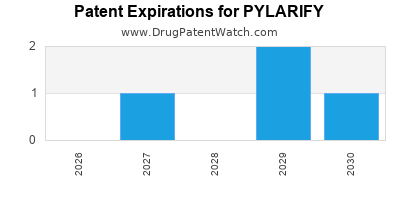
PYLARIFY is protected by six US patents and one FDA Regulatory Exclusivity.

Based on analysis by DrugPatentWatch, the earliest date for a generic version of PYLARIFY is ⤷  Start Trial.

This potential generic entry date is based on patent 8,487,129.

Generics may enter earlier, or later, based on new patent filings, patent extensions, patent invalidation, early generic licensing, generic entry preferences, and other factors.

Applicant Tradename Generic Name Dosage NDA Approval Date TE Type RLD RS Patent No. Patent Expiration Product Substance Delist Req. Exclusivity Expiration
Progenics Pharms Inc PYLARIFY piflufolastat f-18 SOLUTION;INTRAVENOUS 214793-001 May 26, 2021 RX Yes Yes 8,778,305 ⤷  Start Trial Y Y ⤷  Start Trial
Progenics Pharms Inc PYLARIFY piflufolastat f-18 SOLUTION;INTRAVENOUS 214793-001 May 26, 2021 RX Yes Yes ⤷  Start Trial ⤷  Start Trial ⤷  Start Trial
Progenics Pharms Inc PYLARIFY piflufolastat f-18 SOLUTION;INTRAVENOUS 214793-001 May 26, 2021 RX Yes Yes 11,851,407 ⤷  Start Trial Y Y ⤷  Start Trial
Aphelion PYLARIFY TRUVU piflufolastat f-18 SOLUTION;INTRAVENOUS 220089-001 Mar 6, 2026 RX Yes Yes 8,778,305 ⤷  Start Trial Y Y ⤷  Start Trial
>Applicant >Tradename >Generic Name >Dosage >NDA >Approval Date >TE >Type >RLD >RS >Patent No. >Patent Expiration >Product >Substance >Delist Req. >Exclusivity Expiration

International Patents for PYLARIFY

When does loss-of-exclusivity occur for PYLARIFY?

Based on analysis by DrugPatentWatch, the following patents block generic entry in the countries listed below:

Australia

Patent: 07316391
Estimated Expiration: ⤷  Start Trial

Brazil

Patent: 0718700
Estimated Expiration: ⤷  Start Trial

Canada

Patent: 69127
Estimated Expiration: ⤷  Start Trial

China

Patent: 1778910
Estimated Expiration: ⤷  Start Trial

Patent: 3922998
Estimated Expiration: ⤷  Start Trial

Cyprus

Patent: 16610
Estimated Expiration: ⤷  Start Trial

Denmark

Patent: 97111
Estimated Expiration: ⤷  Start Trial

European Patent Office

Patent: 97111
Estimated Expiration: ⤷  Start Trial

Patent: 42065
Estimated Expiration: ⤷  Start Trial

Patent: 35736
Estimated Expiration: ⤷  Start Trial

Patent: 99162
Estimated Expiration: ⤷  Start Trial

Patent: 23624
Estimated Expiration: ⤷  Start Trial

Hong Kong

Patent: 00164
Patent: 谷氨酸的異質二聚體 (HETERODIMERS OF GLUTAMIC ACID)
Estimated Expiration: ⤷  Start Trial

Patent: 57260
Patent: 谷氨酸的異質二聚體 (HETERODIMERS OF GLUTAMIC ACID)
Estimated Expiration: ⤷  Start Trial

Hungary

Patent: 26216
Estimated Expiration: ⤷  Start Trial

Patent: 39199
Estimated Expiration: ⤷  Start Trial

Patent: 59645
Estimated Expiration: ⤷  Start Trial

Japan

Patent: 06737
Estimated Expiration: ⤷  Start Trial

Patent: 36659
Estimated Expiration: ⤷  Start Trial

Patent: 10509358
Estimated Expiration: ⤷  Start Trial

Patent: 15044807
Patent: グルタミン酸のヘテロダイマー (HETERODIMERS OF GLUTAMIC ACID)
Estimated Expiration: ⤷  Start Trial

Poland

Patent: 97111
Estimated Expiration: ⤷  Start Trial

Patent: 42065
Estimated Expiration: ⤷  Start Trial

Patent: 99162
Estimated Expiration: ⤷  Start Trial

Portugal

Patent: 97111
Estimated Expiration: ⤷  Start Trial

Patent: 99162
Estimated Expiration: ⤷  Start Trial

Slovenia

Patent: 97111
Estimated Expiration: ⤷  Start Trial

Spain

Patent: 47481
Estimated Expiration: ⤷  Start Trial

Patent: 84322
Estimated Expiration: ⤷  Start Trial

Patent: 47275
Estimated Expiration: ⤷  Start Trial

Patent: 26912
Estimated Expiration: ⤷  Start Trial

Taiwan

Patent: 0836765
Patent: Heterodimers of glutamic acid
Estimated Expiration: ⤷  Start Trial

Patent: 92761
Estimated Expiration: ⤷  Start Trial

Generics may enter earlier, or later, based on new patent filings, patent extensions, patent invalidation, early generic licensing, generic entry preferences, and other factors.

See the table below for additional patents covering PYLARIFY around the world.

Country Patent Number Title Estimated Expiration
Canada 3026889 ⤷  Start Trial
Canada 3240630 ⤷  Start Trial
China 109563038 ⤷  Start Trial
Denmark 3481804 ⤷  Start Trial
>Country >Patent Number >Title >Estimated Expiration

Supplementary Protection Certificates for PYLARIFY

Patent Number Supplementary Protection Certificate SPC Country SPC Expiration SPC Description
2318366 301250 Netherlands ⤷  Start Trial PRODUCT NAME: PIFLUFOLASTAT (18F) OF EEN FARMACEUTISCH AANVAARDBAAR ZOUT DAARVAN; REGISTRATION NO/DATE: EU/1/23/1746 20230725
2318366 CR 2023 00032 Denmark ⤷  Start Trial PRODUCT NAME: PIFLUFOLASTAT (18F) ELLER ET FARMACEUTISK ACCEPTABELT SALT DERAF; REG. NO/DATE: EU/1/23/1746 20230725
2318366 PA2023534 Lithuania ⤷  Start Trial PRODUCT NAME: PIFLUFOLASTATAS (18F) ARBA JO FARMACINIU POZIURIU PRIIMTINA DRUSKA; REGISTRATION NO/DATE: EU/1/23/1746 20230724
2318366 2023C/540 Belgium ⤷  Start Trial PRODUCT NAME: PIFLUFOLASTAT (18F) OF EEN FARMACEUTISCH AANVAARDBAAR ZOUT DAARVAN; AUTHORISATION NUMBER AND DATE: EU/1/23/1746 20230725
>Patent Number >Supplementary Protection Certificate >SPC Country >SPC Expiration >SPC Description
Last updated: June 26, 2026

PYLARIFY Market Dynamics and Financial Trajectory (2024–2029): Uptake, Pricing, Competition, and Revenue Risk

PYLARIFY (piflufolastat F 18) is an FDA-approved radiopharmaceutical for PET imaging in prostate cancer. Commercial trajectory is shaped by (1) demand tied to prostate cancer patient volume and referral patterns into nuclear medicine, (2) reimbursement and bundled payment dynamics for PET workflows, (3) supply-chain constraints for short-lived radionuclides, and (4) competitive pressure from other PSMA-targeted imaging agents and facility-level conversion costs. Near-term sales hinge on site adoption, scan utilization per patient, and payer coverage stability; downside risk is concentrated in coverage variability, utilization underperformance, and competition that accelerates after multiple approvals or labeling expansions.

This report frames market dynamics by demand drivers, access and payer mechanics, competitive landscape and substitution, operational supply limitations, and financial trajectory scenarios tied to typical radiopharmaceutical commercialization constraints.


What is PYLARIFY (piflufolastat F 18) and how does it map to prostate cancer imaging demand?

PYLARIFY is used for PSMA-targeted PET imaging in prostate cancer, replacing older PSMA PET agents in workflows where it is selected by clinicians and reimbursed by payers. Because it is an imaging product, revenue is driven by scan volume (exams), not chronic dosing, and the installed base is the dominant predictor of growth.

Which patient journeys drive scan volume?

High-intent utilization generally clusters into:

  • Initial staging workflows for patients with newly diagnosed or high-risk disease
  • Biochemical recurrence (rising PSA after definitive therapy)
  • Restaging to localize metastases and guide therapy selection
  • Treatment response assessment in settings where PSMA PET is adopted

What limits volume growth for PSMA PET in general?

  • Referral and ordering inertia: clinicians must switch imaging orders
  • Coverage and prior authorization: payer policies can slow utilization
  • Site capability: PET infrastructure and radiopharmacy workflow readiness
  • Volume per site: growth depends on scan throughput and scheduling stability

How do pricing and reimbursement dynamics affect PYLARIFY revenue growth?

Radiopharmaceutical revenue sensitivity is high to payer reimbursement levels, coverage breadth, and claims processing behavior. Unlike small-molecule drugs, imaging products monetize per administration, and payer behavior changes utilization quickly.

What reimbursement mechanics matter most?

  • National and local coverage determinations for PSMA PET indications
  • Medicare/Commercial reimbursement rates for PET imaging plus radiotracer reimbursement
  • Denial rates and documentation requirements for eligibility
  • Contracting terms tied to scan volume and hospital network participation

What does “sticker price” miss?

Net revenue depends on:

  • Discounting tied to group purchasing or hospital contracts
  • Mix shift across outpatient imaging centers vs hospitals
  • Denials and charge capture performance
  • Patient scheduling capacity and scan throughput

Financial implication for trajectory

  • Early phase: revenue is constrained by adoption and coverage friction.
  • Expansion phase: revenue scales with site count and exam volume as payer policies stabilize.
  • Plateau risk: if reimbursement lags behind competitor products or if coverage narrows, utilization can stall even as sites remain installed.

Which competitors pressure PYLARIFY in PSMA PET imaging, and how does substitution work?

Competitive dynamics in PSMA PET are “site-level switching,” driven by:

  • ordering preferences (radiologists and nuclear medicine physicians)
  • supply reliability
  • reimbursement and patient access
  • perceived image quality and clinical confidence

Key substitution patterns

  • Facilities may standardize on a preferred tracer due to protocol alignment and staff familiarity.
  • Switching tends to occur when clinical leadership or payer policies favor an alternative, or when supply reliability issues change.

What matters competitively for a radiopharmaceutical

  • Supply chain reliability for a short-lived isotope
  • Delivered product consistency and on-time scheduling
  • Distribution footprint relative to facility demand centers
  • Labeling fit for payer-approved indications

How does the short-lived isotope supply chain shape PYLARIFY market share?

For F-18-based tracers, timing and distribution logistics determine whether facilities can reliably deliver scans. Even where demand exists, operational capability can cap utilization.

Operational bottlenecks that cap growth

  • Radiopharmacy production scheduling and capacity
  • Transportation time windows
  • Scheduling constraints at high-throughput PET centers
  • Cold-chain and chain-of-custody requirements
  • Variability in patient scheduling that degrades scan utilization

What drives adoption speed at new sites?

  • Demonstrated operational performance in local distribution
  • Training and workflow integration for technologists and ordering clinicians
  • Stable reimbursement that avoids repeated prior authorizations

When does PYLARIFY face exclusivity and competitive entry risks, including generic or radiotracer substitution?

Radiopharmaceuticals do not face “generic” substitution like oral small molecules. Competitive pressure comes from:

  • alternative PSMA PET radiotracers with overlapping indication labeling
  • manufacturing scale-up by competitors
  • potential biosimilar-like pathways are generally not applicable for small-molecule imaging agents, but regulatory competition still arises through approved products and labeling changes

What “exclusivity” means for imaging products

  • Regulatory exclusivity periods for the approved product and manufacturing processes (where applicable)
  • Patent estate controlling formulation, synthesis, or use, where it exists and is enforceable
  • Practical dominance through supply reliability and payer alignment

Financial implication

A tracer can face rapid share loss if competing agents are:

  • equally or better reimbursed
  • more available operationally
  • supported by payer policy updates

What does the near-term financial trajectory likely look like given radiopharmaceutical commercialization constraints?

A realistic financial trajectory for a PET imaging tracer is typically characterized by:

  • a staged ramp (new site onboarding)
  • utilization scaling as ordering confidence builds
  • volatility tied to supply and payer handling

Trajectory framework (site-first, exam-volume second)

  • Adoption phase: revenue grows with initial conversion of PET sites and early scan orders
  • Scale phase: revenue expands as scan throughput increases and more ordering clinicians adopt the product
  • Maturity phase: growth rate slows as the market saturates and substitution compresses pricing or utilization

Key levers that determine whether revenue accelerates or stalls

  • Net reimbursement stability across commercial and Medicare
  • Facility retention and repeat ordering
  • Denial rates and authorization turnaround time
  • Competitive tracer substitution and protocol standardization

How strong is PYLARIFY’s patent and regulatory positioning, and what does that mean for revenue defense?

Revenue defense for a radiopharmaceutical is mostly about:

  • controlling protected uses, synthesis methods, and manufacturing know-how
  • sustaining market access against competing imaging agents

What investors and licensors typically underwrite

  • Freedom-to-operate versus competing tracer manufacturing and distribution
  • Duration of enforceable protections that deter substitution
  • Likelihood of labeling expansions that extend addressable indications

What is the FDA and payer status risk profile for PYLARIFY, and how can it affect sales?

Regulatory posture impacts market access through:

  • label breadth that matches payer coverage criteria
  • timing of updates or clarifications that expand eligible patient populations

Why payer status can matter more than label

Even with strong label coverage, denials for documentation can delay utilization. For imaging products, “policy fit” often drives faster revenue conversion than clinical differentiation alone.


How do licensing and channel strategy choices influence PYLARIFY revenue?

Imaging product commercialization often depends on:

  • distribution partners and radiopharm relationships
  • hospital systems contracting and formulary decisions
  • contracting terms that influence net price and scan adoption

Channel structure that drives adoption

  • Agreements that reduce operational burden on facilities
  • Local distribution coverage matching scan demand centers
  • Contracting that prevents net reimbursement from eroding during growth

What generic entry risks exist for PYLARIFY, and how do radiopharmaceutical pathways differ from classic generics?

Classic “generic entry” is usually not the primary risk model for an imaging radiotracer product. The more relevant competitive risks are:

  • alternative approved PSMA PET imaging agents
  • supply bottlenecks that indirectly shift usage
  • payer-led formulary preference that accelerates substitution

Risk concentration

  • If a competitor enters with better reimbursement or broader coverage, utilization can shift faster than patents can be litigated.
  • If supply reliability for PYLARIFY underperforms at peak demand, sites may qualify alternatives.

PYLARIFY vs competing PSMA PET imaging agents: what drives winner-take-more dynamics?

In PSMA PET, “winner” dynamics are often decided by:

  • delivered reliability and logistics
  • reimbursement stability
  • clinician trust and workflow integration

Comparison drivers (how to evaluate competitors)

  • Indication overlap
  • Imaging protocol fit and scan timing requirements
  • Distribution coverage
  • Contracting leverage and payer inclusion
  • Evidence quality and published clinical adoption patterns

Key financial drivers and KPIs to model PYLARIFY performance

For an imaging tracer, the most predictive KPIs map directly to revenue mechanics:

KPI What it signals Why it moves revenue
Active scan sites (count) Installed base penetration Determines ceiling for exam volume
Exams per site per month Utilization intensity Drives revenue per distribution effort
Net price per scan Contracted reimbursement and discounts Directly impacts revenue per unit
Denial/authorization rate Payer access friction Converts demand into billable utilization
On-time delivery rate Operational reliability Prevents missed scan slots and switching
Mix of outpatient vs hospital Contracting and reimbursement differences Changes net revenue realization
Inventory availability and production yields Supply stability Avoids service interruptions

Revenue scenario map (base, upside, downside) for PYLARIFY 2024–2029

Because the revenue model for radiotracers is driven by scan volume and net price, the scenario ranges should be interpreted as directionally grounded by adoption and access risks.

Base case (adoption-driven ramp)

  • Gradual site onboarding with stable scan ordering
  • Net pricing holds while competitive substitution remains limited
  • Growth slows as market matures and coverage becomes saturated

Upside case (faster-than-expected adoption)

  • Faster payer acceptance and higher authorization approval rates
  • Better than expected on-time delivery expands utilization
  • Protocol standardization increases repeat scans per site

Downside case (coverage or supply headwinds)

  • Denials increase or reimbursement compresses
  • Supply constraints reduce scan scheduling consistency
  • Competitive tracer substitution reduces share per facility

Key Takeaways

  • PYLARIFY revenue is fundamentally exam-volume driven, with adoption of PET sites and payer-approved utilization as the core determinants.
  • Pricing is secondary to net reimbursement realization after discounts and denials; authorization friction can cap growth even when clinical demand exists.
  • Competitive pressure is exerted through substitute PSMA PET tracers via payer preference, operational reliability, and protocol standardization.
  • The supply chain for a short-lived isotope is a gating factor for market share; consistent on-time delivery supports utilization expansion.
  • The principal revenue risks are payer access variability, reimbursement compression, and faster substitution by competing PSMA PET imaging agents rather than “generic” entry in the classic sense.

FAQs

  1. How many PET sites typically adopt a new PSMA radiotracer like PYLARIFY in the first year?
  2. What payer factors most often drive denials for PSMA PET imaging claims?
  3. How does on-time delivery of an F-18 radiotracer affect utilization and facility switching?
  4. Does PYLARIFY’s labeling breadth change reimbursement policy and scan volume?
  5. What commercial KPIs best predict whether a PSMA PET tracer will plateau early?

References

  1. FDA. “Drug Approval Package: PYLARIFY (piflufolastat F 18).” U.S. Food and Drug Administration.
  2. FDA. “Orange Book: Approved Drug Products with Therapeutic Equivalence Evaluations.” U.S. Food and Drug Administration.
  3. Centers for Medicare & Medicaid Services. “Medicare Coverage Policies and reimbursement context for imaging services.” CMS.
  4. ASNC (American Society of Nuclear Cardiology). “PSMA PET imaging practice and utilization considerations” (published materials and guidance where available).
  5. NCCN (National Comprehensive Cancer Network). “Prostate Cancer Guidelines” (PSMA PET-related recommendation updates).

More… ↓

⤷  Start Trial

Make Better Decisions: Try a trial or see plans & pricing

Drugs may be covered by multiple patents or regulatory protections. All trademarks and applicant names are the property of their respective owners or licensors. Although great care is taken in the proper and correct provision of this service, thinkBiotech LLC does not accept any responsibility for possible consequences of errors or omissions in the provided data. The data presented herein is for information purposes only. There is no warranty that the data contained herein is error free. We do not provide individual investment advice. This service is not registered with any financial regulatory agency. The information we publish is educational only and based on our opinions plus our models. By using DrugPatentWatch you acknowledge that we do not provide personalized recommendations or advice. thinkBiotech performs no independent verification of facts as provided by public sources nor are attempts made to provide legal or investing advice. Any reliance on data provided herein is done solely at the discretion of the user. Users of this service are advised to seek professional advice and independent confirmation before considering acting on any of the provided information. thinkBiotech LLC reserves the right to amend, extend or withdraw any part or all of the offered service without notice.