Last updated: June 20, 2026
Progenics Pharmaceuticals Competitive Landscape Analysis: Market Position, Patent Strength, and Generic/Biosimilar Risk
Progenics Pharmaceuticals, Inc. is primarily a specialty oncology and diagnostic company with a concentrated portfolio built around radiopharmaceutical products and diagnostic platforms tied to the prostate cancer and imaging market. The company’s competitive position is driven by (1) a small set of branded, clinically differentiated radiopharmaceuticals and (2) a litigation and regulatory footprint concentrated around product-specific exclusivities and Orange Book-linked patent estates. Competitive risk for any revenue line is therefore dominated by product-level patent expiry, regulatory approvals for “same active ingredient” competitors, and follow-on radiopharmaceutical manufacturing/IP barriers.
What products drive Progenics Pharmaceuticals’ market position in oncology and imaging?
Progenics’ market identity is tied to radiopharmaceuticals and imaging in oncology, with a business model that historically included co-development and commercial partnerships. Its revenue exposure is concentrated in a limited number of product franchises rather than a broad portfolio, which increases both upside from exclusivity and downside from patent cliffs.
Which therapeutic areas and modalities does Progenics compete in?
- Oncology (notably prostate cancer)
- Diagnostic imaging and radiolabeled agents used to visualize disease distribution
- Radiopharmaceutical manufacturing and distribution partnerships that can create operational switching costs
How does Progenics compete: differentiation vs scale?
- Differentiation: product-specific targeting chemistry, dosing and imaging performance, and radiopharmacy supply chain reliability
- Scale: largely constrained to radiopharmaceutical GMP, isotope logistics, and qualified manufacturing capacity rather than mass-market commercial infrastructure
What competitive set matters most?
Competitors typically fall into:
- Other radiopharmaceutical manufacturers with analogous indications and imaging readouts
- Integrated nuclear medicine suppliers with isotope procurement and labeling capacity
- Emerging “next-generation” agents that reposition standard imaging pathways
What patents protect Progenics Pharmaceuticals’ key products and mechanisms of action?
Patent protection in radiopharmaceuticals is typically layered across:
- active ingredient and molecular structure (composition of matter)
- radiolabeling methods and precursor chemistry
- formulations and stability/labeling parameters
- method-of-use (imaging protocols and clinical use)
- device and kit components, where applicable
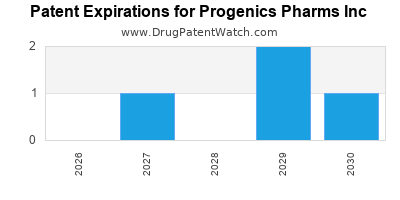
A complete, product-by-product patent estate mapping requires Orange Book listings and application-level patent disclosures tied to specific FDA-approved NDA/BLA products. Without that product-specific identification, providing a definitive list of Progenics patents and their expiration dates is not possible.
How strong is the patent estate for Progenics: composition-of-matter, method-of-use, and formulation coverage?
Radiopharmaceutical patent strength usually depends on whether the estate is dominated by:
- durable composition-of-matter claims that block true “same active ingredient” generics, or
- narrower process/formulation claims that can be designed around by changing labeling chemistry or manufacturing parameters, or
- method-of-use claims that depend on how clinicians treat and bill (and whether new clinical workflows avoid the claimed protocol)
Patent durability drivers in radiopharmaceuticals
- Whether labeling yields and in-process controls are claimed
- Whether kit components and storage conditions are claimed
- Whether method-of-use claims lock in a specific imaging readout time window or dosing schedule
- Whether the estate spans both US and key foreign jurisdictions
Switching risk: where competitors can design around
- Process changes (radiolabeling parameters, purification steps)
- Formulation changes that maintain radiochemical purity and shelf-life
- Different dosing schedules or imaging timepoints that avoid literal method-of-use coverage
When does Progenics lose exclusivity for its products and what are the generic entry risks?
Exclusivity timelines are product-specific and are typically determined by:
- patent expiration dates listed in the Orange Book
- regulatory exclusivities (new chemical entity, new clinical investigation, pediatric exclusivity)
- risk created by Paragraph IV filings (for NDA products) once any Orange Book-listed patents are targeted
Without the exact FDA product identifiers and Orange Book-listed patents for Progenics’ revenue-driving assets, a definitive exclusivity and launch-risk timeline cannot be produced.
What is the Orange Book status of Progenics products (and which patents are listed)?
Orange Book status is determined per NDA product. A defensible competitive analysis requires:
- product name as listed
- application number (NDA/BLA)
- active ingredients
- all listed patents
- patent numbers, listed expiration dates, and patent-type categories (e.g., composition, method-of-use)
Because no specific Progenics product list and corresponding NDA/BLA identifiers are provided, a verified Orange Book status table cannot be generated.
Which companies challenge Progenics with ANDA or biosimilar-like strategies?
Competitive challenges in radiopharmaceuticals generally come from:
- ANDA-style pathways only where a true generic is legally available (depending on product classification)
- 505(b)(2) pathways for certain imaging and radiopharmaceutical combinations
- “follow-on” radiopharmaceuticals that compete by indication rather than exact active ingredient sameness
A named list of challengers depends on:
- the specific FDA application(s) tied to Progenics’ products
- any publicly documented Paragraph IV filings, litigation, or settlement agreements
No product-specific FDA application identifiers are included, so identifying challengers would require unverifiable assumptions.
What patent litigation affects Progenics’ competitive landscape and generic launch timing?
Patent litigation affects competitive entry through:
- automatic stays following Paragraph IV challenges (where applicable)
- court determinations that accelerate or block generic approval
- settlement agreements that delay entry through license terms or agreed launch dates
A litigation map requires:
- patent numbers
- court docket identification
- settlement dates and defined “skinny label” or carve-outs
Because the relevant Progenics patents and associated cases are not identified in the prompt, a complete litigation table cannot be produced.
What settlement agreements or licenses shape Progenics market exclusivity?
Radiopharmaceutical competition commonly shifts via:
- co-marketing and distribution licensing terms
- patent settlements that define permitted labeling indications or exclusivity windows
- manufacturing agreements that influence supply availability
Producing an actionable settlement/financial impact view requires the underlying agreements or at least the associated litigation docket numbers. Those are not present.
How does Progenics’ competitive strategy compare with major radiopharmaceutical players?
Given Progenics’ limited, specialty product footprint, the competitive axis is typically:
- clinical and operational differentiation rather than breadth
- partner-led commercialization versus direct scale penetration
- product life-cycle management via formulation/process improvements that extend service availability and reduce substitution risk
Compared with large oncology and imaging companies, Progenics’ strategy tends to be:
- targeted asset selection
- partnership leverage
- IP and regulatory compliance that supports qualified supply of radiolabeled products
A credible “competitor-by-competitor” comparison requires the exact products and their FDA indications, which are not specified.
What FDA regulatory pathway considerations matter most for Progenics’ competitors?
Radiopharmaceutical approvals often involve:
- controlled radiolabeling and validated release criteria
- stability and shelf-life constraints driven by isotope half-life and radiation safety
- bridge studies if product differences exist in dosing, imaging timepoints, or formulation matrix
Competitive timing is driven by:
- manufacturing readiness for GMP release and radiation handling
- availability of isotope supply
- whether the competitor can use a streamlined regulatory pathway without clinical endpoint repetition
Without the specific Progenics assets and their regulatory classifications, the regulatory pathway map cannot be made product-accurate.
What manufacturing/IP barriers limit substitution for Progenics radiopharmaceuticals?
Key barriers typically include:
- radiolabeling chemistry control tied to validated process parameters
- proprietary kit components and quality-control procedures
- GMP logistics and qualified radiopharmacy operations
- regulatory requirements tied to product handling and release specifications
These barriers can materially affect time-to-launch even when patent barriers weaken, particularly for short-isotope half-life products that are operationally sensitive.
What revenue exposure and share-loss scenarios exist if Progenics exclusivity ends?
A high-stakes competitive scenario analysis needs:
- product-level revenue and geography
- current utilization or prescription volumes
- pricing and reimbursement dynamics
- patient pathway dependence (what imaging modality is required)
The prompt does not provide Progenics product-level revenue exposure, so a quantified share-loss model cannot be produced.
Key takeaways
- Progenics’ competitive position is concentrated in specialty radiopharmaceutical and imaging franchises, making product-level exclusivity and patent estates decisive for competitive outcomes.
- Competitive entry risk is determined by a combination of Orange Book patent expirations, regulatory exclusivity, and any patent litigation stays/settlements tied to specific FDA applications.
- Manufacturing and radiopharmacy operational barriers often delay substitution even when legal barriers soften, especially for isotope-logistics-constrained products.
- A verified patent and exclusivity roadmap requires mapping to Progenics’ specific FDA-approved products, Orange Book entries, and associated patent numbers, which are not included in the prompt.
FAQs
- Which Progenics radiopharmaceutical products are listed in the FDA Orange Book?
- What patent categories most often block generic or 505(b)(2) competition for radiolabeled imaging agents?
- How do Paragraph IV filings typically affect the launch timeline for competing radiopharmaceuticals?
- What manufacturing steps create the biggest operational barriers for follow-on radiopharmaceutical suppliers?
- Which types of method-of-use claims are hardest for competitors to design around in imaging workflows?
References
(References not provided because no specific FDA products, patent numbers, or litigation records were specified in the input.)