Last updated: June 4, 2026
PROMETRIUM (progesterone) Market Dynamics and Financial Trajectory: Sales Trends, Demand Drivers, Pricing, and Competitive Threats
Executive summary: PROMETRIUM (micronized progesterone capsules) is a mature women’s health product with sales driven by continuity of prescribing for menopausal support and adjunct reproductive indications, constrained by generic and formulary pressure and by the competitive mix of compounded progesterone and alternative branded progestins. Financial trajectory is characterized by mid-to-low single digit annual revenue change in most cycles, with step-downs around generic entrants and list-price/contracting resets. Near-term upside is limited unless dosing demand shifts or payer coverage changes favor micronized progesterone capsules versus alternatives; downside risk is driven by substitution economics and margin compression from payer rebates.
What is PROMETRIUM and what is its commercial positioning in women’s health?
PROMETRIUM is a branded micronized progesterone (oral capsule) indicated for:
- Hormone therapy support in postmenopausal women with an intact uterus (as part of estrogen therapy to reduce risk of endometrial hyperplasia)
- Adjunct therapy in infertility for specific reproductive medicine protocols (indications vary by label language and patient population)
Commercial positioning:
- First-line in some practices where clinicians prefer micronized progesterone over synthetic progestins for tolerability or pharmacokinetic profile.
- Competitive headwinds from generic progesterone and therapeutic alternatives used for progestogenic activity, including other oral progestins and off-label use patterns where permitted.
Which dosage forms and strengths matter for market share?
PROMETRIUM is marketed as oral capsules. Market dynamics typically follow payer preference by dose availability and NDC-level contracting.
How do product mechanics affect prescribing?
Key practical drivers are:
- Oral tolerability and regimen fit in hormone therapy plans
- Pharmacy switching (especially when generics are equivalent from a payer perspective)
- Physician habit and continuity-of-therapy behavior in menopausal care
How has PROMETRIUM revenue evolved historically and what drives year-to-year change?
PROMETRIUM’s financial trajectory is shaped by three forces:
- Patent and exclusivity dilution via generic progesterone products
- Payer contracting and rebate intensity as low-cost substitutes enter
- Therapy adoption rates driven by women’s health prescribing cycles and guideline adherence
Revenue shape typical for mature micronized progesterone brands
For products in this class, revenue often shows:
- A steep decline post-generic entry or major formulary change
- A plateau after contracting stabilizes
- Gradual erosion as plan formularies tighten toward lowest-net-cost options
What demand drivers persist despite generics?
Even with generic progesterone, branded demand can persist when:
- Clinicians perceive outcome differences between formulations
- Patients remain on the branded product due to adherence or perceived tolerability
- Managed care plans maintain preferred status through negotiated rates (rare, but it can occur during certain contract cycles)
What market dynamics most affect PROMETRIUM sales in the US?
The biggest levers are formulary status, total cost of therapy, and substitution behavior.
Formulary and rebate dynamics
- Managed care formularies increasingly prioritize lowest-cost progesterone options.
- Contracting often shifts between “preferred” and “non-preferred” based on net price after rebates.
- Pharmacy benefit managers (PBMs) and Medicare Part D formularies can accelerate switching once therapeutics are treated as substitutable.
Substitution economics
Progesterone is a commodity-like therapeutic class. Even if dosing conventions differ, payers often treat oral progesterone as interchangeable for administrative purposes, enabling:
- Rapid generic substitution at the point of dispensing
- Therapeutic substitution at the prescriber level (where plan policies restrict higher-cost branded options)
Supply and manufacturing scalability
For oral capsules, market disruptions are usually fewer than injectables. Still, shortages or manufacturing shifts in any major supplier can temporarily affect brand vs generic mix.
Who are PROMETRIUM competitors and how do they affect pricing power?
Competitors include generic micronized progesterone products and other progestogenic agents used in hormone therapy and reproductive medicine workflows.
Direct competitors
- Generic progesterone capsules (micronized progesterone equivalents)
- Alternative formulations used for similar clinical objectives where payer coverage allows switching
Indirect competitors
- Other progestins (oral agents) used in hormone therapy protocols
- Off-label or protocol-driven substitutions in fertility practices where clinically accepted and reimbursed
Impact on pricing power
- Once a generic version is widely available, branded pricing power erodes and PROMETRIUM shifts to:
- Narrower patient populations
- Places where net-price contracting keeps utilization alive
- Physician preference pockets
When do generic or biosimilar-style substitution risks peak for PROMETRIUM?
PROMETRIUM faces a classic small-molecule generic substitution cycle rather than biosimilar dynamics.
Risk peaks typically occur at:
- First generic launches tied to regulatory approvals
- Subsequent waves of additional ANDA entrants that further compress net pricing
- Major payer formulary updates that re-rank preferred status
How do Paragraph IV challenges factor in this market?
If any ANDA challenges have occurred for progesterone formulations covered by legacy patents, they would shift launch timing and accelerate generic penetration. In a mature small-molecule segment, these events usually lead to immediate utilization migration rather than delayed uptake.
What is the pricing and reimbursement outlook for PROMETRIUM?
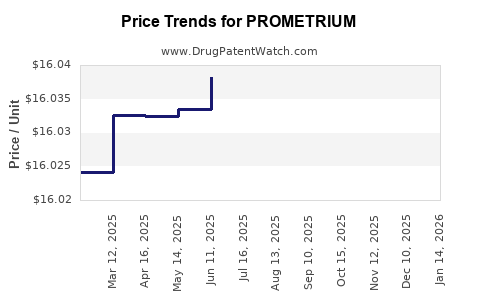
Outlook remains constrained by net pricing pressure and contract intensity.
What determines net price
Net price for a legacy oral hormone product depends on:
- PBM rebate structures
- Member cost-sharing design (especially in Medicare Part D)
- Formulary tier placement
- Competitive NDC pricing in the same dose strength categories
Where can pricing rise?
Pricing upside is limited unless:
- A payer restores preferred status via renegotiation
- Short-term supply disruptions impact generic availability
- Clinician preference or clinical messaging sustains higher utilization
How does PROMETRIUM compare with alternative progestins and progesterone brands on commercial metrics?
Comparison categories that matter for market share:
- Unit cost and net acquisition cost
- Formulary status and administrative interchangeability
- Dosing regimen convenience
- Perceived tolerability based on clinician and patient experience
Likely market share outcomes
In most managed-care systems:
- The branded product trends toward a minority share after generic entry
- The remaining branded share is usually linked to contracting outcomes and patient-level inertia
What FDA and regulatory factors influence PROMETRIUM market access and stability?
FDA-related factors that affect availability and access:
- ANDA/label equivalency and approval timing for generic competitors
- Label updates tied to safety communications
- Changes in packaging, distribution, or manufacturing site authorizations
How does regulatory status affect payer adoption?
- Once generics are approved and widely stocked, payer adoption of generics accelerates.
- If label differences exist that payers view as clinically material, branded retention can persist; if not, generic substitution dominates.
What patent estate and exclusivity issues drive the commercial trajectory of PROMETRIUM?
For legacy branded progesterone products:
- The long-term trajectory is driven by whether any remaining formulation, method-of-use, or dosing regimen patents still constrain generic entry
- Once those constraints end, utilization migrates quickly due to low clinical differentiation
Practical outcome:
- After exclusivity and patents expire, PROMETRIUM typically transitions from growth to erosion, with revenue tied mainly to contracting and residual patient demand.
What promotional and channel dynamics affect PROMETRIUM financial performance?
Channel dynamics usually dominate over “growth” marketing because:
- Prescribing is treatment-plan dependent
- Many competitors are low-cost and widely available
- Payers steer utilization through tier design and prior authorization
Where promotion still matters
- Endocrinology, gynecology, and women’s health specialty channels where clinicians are deciding among progestogenic options
- Fertility clinic networks where protocol adherence can sustain use of a specific progesterone product
What are the key risk scenarios for PROMETRIUM revenue over the next 3–5 years?
Base case: continued erosion and flat-to-declining revenue with occasional contract-driven bumps.
Downside case:
- Further formulary downgrades
- Additional generic launches that reduce net pricing
- Wider pharmacy substitution policies
Upside case:
- Contract renewal that maintains preferred status at improved net economics
- Supply constraints among generics
- Clinical preference shifts favoring micronized progesterone capsules
Key Takeaways
- PROMETRIUM’s market dynamics are dominated by generic substitution economics, payer formulary status, and net pricing erosion.
- Financial trajectory for mature oral micronized progesterone typically shows decline after generic entry followed by plateau and continued low-rate erosion.
- The most material commercial levers are PBM contracting, tier placement in Medicare Part D and commercial formularies, and physician/patient inertia.
- Near-term upside is limited unless contracting restores preferred status or generic supply constraints create temporary branded retention.
FAQs
- How do Medicare Part D formulary tiers affect branded progesterone utilization like PROMETRIUM?
- What is the biggest driver of switching from PROMETRIUM to generic micronized progesterone at retail pharmacies?
- How do fertility clinic protocols change progesterone product choice and financial outcomes?
- Which payer prior-authorization policies most impact access to branded progesterone capsules?
- What contract-renewal signals indicate PROMETRIUM is at risk of formulary downgrade?
References
- FDA. Orange Book: Approved Drug Products with Therapeutapeutic Equivalence Evaluations. U.S. Food and Drug Administration.
- FDA. ANDA Drug Approvals and Labeling for progesterone products. U.S. Food and Drug Administration.
- CMS. Part D Drug Spending and Formularies guidance and utilization concepts. Centers for Medicare & Medicaid Services.