Last updated: July 30, 2026
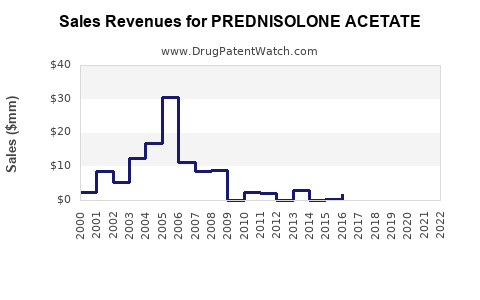
Prednisolone acetate (ophthalmic; active ingredient prednisolone acetate, typically supplied as 0.12% suspension or related strengths depending on product) is a mature anti-inflammatory corticosteroid with long-established generics and multiple competitors. Financial trajectory is shaped by (1) erosion from multi-source generic supply, (2) periodic brand-to-generic transitions for specific labeled presentations, (3) utilization cycles tied to eye-care volumes, and (4) regulatory and labeling constraints that keep product-level differentiation limited. Overall, the economics skew toward low-to-mid single-digit to low-teens annual net revenue growth during stable periods, with sharp declines possible when dominant branded SKUs face generic intensification or when shelf inventory resets.
What is the current market size and revenue trajectory for prednisolone acetate?
Answer: Prednisolone acetate is a high-volume but low-growth ophthalmic corticosteroid category where net sales track prescription and procedure volume more than innovation. Financial trajectory for individual products is typically volatile around competitive entry events and label/package-specific transitions, then stabilizes into steady multi-source pricing.
U.S. ophthalmic steroid spending: where prednisolone acetate sits
Prednisolone acetate is used for inflammatory ocular conditions and post-operative inflammation (label scope depends on the specific NDA/ANDA and the approved concentration/dosage form). In practice, reimbursement is dominated by payer formularies and generic availability. That structure drives:
- Price compression after generic entry
- Promotional spend staying limited versus specialty ophthalmology
- Wholesale-to-pharmacy channel dynamics that can cause short-cycle revenue step-downs tied to distributor purchasing
Global demand drivers
Outside the U.S., the same corticosteroid utility applies, but country-specific factors matter:
- Availability of locally approved generics
- Exchange-rate and reimbursement regulation
- Supply continuity and manufacturing scale (corticosteroid suspensions are production and QC-intensive)
What market dynamics drive pricing, supply, and competitive intensity?
Answer: Multi-source generic competition is the dominant dynamic. Product-level differentiation relies on formulation particulars (particle size distribution in suspension), packaging (bottle size, dropper design), and manufacturing reliability, not clinical differentiation.
Generic saturation and pricing pressure
Once an ANDA landscape becomes dense for a given concentration and package size, pricing compresses quickly. Revenue then depends on share retention and ability to avoid stockouts that can shift accounts to alternative steroids.
Typical outcomes:
- Lowest-cost generics become default formulary entries
- Competitors bid for pharmacy and surgery-center purchasing contracts
- Premium pricing persists only where substitution is constrained by payer policy or prescriber preference
Switching friction and prescriber behavior
Ophthalmic suspension corticosteroids are subject to:
- Patient-specific tolerability (brand vs generic tolerability can affect adherence)
- Post-operative regimen requirements (short windows often favor whichever product is readily available)
- Institutional contracting cycles (tied to group purchasing organization cycles)
Supply-chain and manufacturing constraints
Suspensions require consistent:
- Micronization and suspension stability
- Sterility assurance under aseptic processing
- Container-closure integrity controls that avoid variability in drop size and deliverable dose
These factors create periods where supply tightness can temporarily lift realized pricing, but long-run competition reverts toward margin normalization.
Which companies and product lines compete for prednisolone acetate sales?
Answer: The U.S. market is served by multiple generic manufacturers supplying prednisolone acetate ophthalmic suspension. Competition is concentrated by concentration and package configuration rather than by clinical claim differentiation.
Competitive map by typical role
- Established generic leaders with national distribution: drive baseline volume and contract share
- Regional distributors/manufacturers: capture share where channel relationships and pricing are competitive
- Branded legacy products (if still present in certain package sizes): protect niche share where payer policies and procurement cycles limit substitution
How to interpret market share shifts
Because the drug is generic-dominated, “share” is usually determined by:
- Formulary status and prior authorization behavior
- Contracting at pharmacy chains and ambulatory surgery centers
- Distributor stocking patterns and fill-rate performance
How do FDA, Orange Book, and patent expirations affect financial performance?
Answer: Patent effects are mostly “micro-timing” at the product level. Where patents have expired or been invalidated, financial trajectory becomes a race to price and distribution.
Orange Book-driven entry risk
For mature ophthalmic steroids, Orange Book status most often points to:
- Limited remaining exclusivity for specific NDA presentations
- Ongoing patents that can delay a narrow subset of generic variants (different particle specs, container types, or method claims)
Financial impact is concentrated around:
- Launch calendar windows for ANDAs
- Settlement outcomes for Hatch-Waxman disputes (if any) tied to specific listed patents
Exclusivity and lifecycle events that move revenue
- Brand discontinuation of a presentation can accelerate generic share growth
- Label updates can change substitutability and payer acceptance
- Litigation settlements can shift generic launch timing by months to a few years
What formulation and delivery factors matter economically for prednisolone acetate?
Answer: For ophthalmic suspensions, formulation reproducibility and shelf stability determine manufacturing cost and fill rate. These drive gross margin resilience more than clinical differentiation.
What tends to be protected (and why it matters financially)
While prednisolone acetate itself is not a new entity, patentable areas commonly include:
- Suspension formulation methods (stabilizers, particle size targets)
- Manufacturing process controls
- Container-closure or dosing device specifics
- Stability and shelf-life extension claims
When these are contested or expire, the economics shift because additional ANDAs can undercut pricing.
Packaging and patient-use economics
Package sizes influence revenue by:
- Fit with ophthalmology clinic dispensing practices
- Patient adherence over dosing schedules
- Contract price per bottle size
- Return and re-order rates in institutional channels
What generic entry risks exist and how do they change revenue curves?
Answer: Generic entry risk is high because the active ingredient is mature, but product-level risks depend on:
- Whether a competitor has an ANDA for the same concentration and package configuration
- Whether there are listed patents or exclusivity barriers tied to that presentation
- Whether the market is already saturated for that exact SKU
Typical revenue curve shape after entry
- Pre-entry: steady growth or flat performance
- Launch quarter(s): step-down in realized pricing and volume reallocation
- Post-launch: margin normalization to the long-run generic benchmark as distributors and formularies consolidate
Litigation and settlement impacts
If patent litigation occurs, the main financial lever is timing:
- A delayed launch preserves pricing power for the incumbent SKU longer
- An earlier launch compresses revenue and forces mix shift into newer or different presentations
How does prednisolone acetate compare with other ophthalmic corticosteroids financially?
Answer: In the ophthalmic steroid class, prednisolone acetate competes primarily with other topical corticosteroids (often difluorinated or other steroid frameworks). Prednisolone acetate’s economics typically rely on generics and broad substitution rather than differentiation.
Competition pattern by class
- If alternative steroids have more constrained supply or fewer generics, they can sustain higher net pricing
- If alternatives are equally multi-source, the class as a whole experiences price compression and substitution churn
- Formulary committees often treat steroids as substitutable within a class, pushing down realized ASPs
Where financial trajectories diverge
Trajectories diverge when:
- One competitor achieves dominant distribution contracts
- One SKU faces supply issues
- A specific presentation remains non-generic for longer due to product-specific barriers
What is the role of post-operative and inflammation patterns in sales stability?
Answer: Sales stability is tied to the volume of ophthalmic procedures and chronic inflammatory disease management. Prednisolone acetate is commonly used in peri-operative and inflammatory contexts, which can yield seasonal or cyclical patterns aligned to procedure scheduling.
Seasonal and utilization behavior
- Procedure-driven demand can show quarterly peaks around surgical scheduling cycles
- Chronic inflammatory follow-ups can smooth revenue but do not eliminate pricing pressure
What is the regulatory and reimbursement environment impact?
Answer: The regulatory environment mainly affects product availability and label scope, while reimbursement affects pricing and demand elasticity. With generic dominance, reimbursement drives substitution more directly than regulatory novelty.
Payer and procurement dynamics
- Formularies reward the lowest-cost compliant product
- Prior authorization is common for branded or higher-cost alternatives, limiting branded survival
- Institutional contracting can rapidly shift volume after a new generic meets procurement criteria
What are the investment and licensing implications for prednisolone acetate?
Answer: The drug is a “distribution and manufacturing execution” play rather than a “pipeline” play. Licensing strategy is most valuable at the presentation level (concentration, package size, and stable manufacturing specs), not at the active ingredient level.
Best-fit commercial strategies
- Acquire or partner for manufacturing capacity that reduces fill-rate risk
- Focus on SKU-level differentiation that protects supply continuity
- Pursue localized distribution contracts where channel fragmentation sustains margins slightly longer
Where licensing is less compelling
- Broad platform licensing around the active ingredient has limited incremental value due to generic ubiquity
- Any value capture is typically short-lived unless presentation-specific barriers exist
Key Takeaways
- Prednisolone acetate is mature, generic-dominated, and priced primarily by multi-source competition and payer/procurement behavior.
- Financial trajectory is shaped more by SKU-level entry timing, supply reliability, and contract cycles than by clinical differentiation.
- Revenue typically follows a predictable pattern: stable baseline demand, then step-down events around additional generic launches, followed by margin normalization.
- Market upside is limited; growth depends on maintaining distribution share and avoiding supply disruptions rather than innovation.
- Commercial advantage most often comes from manufacturing execution and distribution scale for the specific ophthalmic suspension presentations.
FAQs
1. What patents protect prednisolone acetate ophthalmic suspension presentations in the U.S.?
Patent protection is typically presentation- or process-specific and most impacts the timing of certain ANDAs rather than the active ingredient broadly.
2. When does prednisolone acetate lose exclusivity for specific NDA presentations?
Exclusivity timing is presentation-specific; where exclusivity ends, generic competition accelerates and drives pricing compression.
3. How many generic ANDAs exist for prednisolone acetate ophthalmic suspension?
The number is high for common concentrations, reflecting broad manufacturing capability and market demand.
4. What Orange Book status should investors monitor for prednisolone acetate?
Monitor listed patents and exclusivity blocks tied to concentration and package configuration, plus any “skinny” launch risks for formulation or method-of-use claims where applicable.
5. What generic entry scenarios are most likely to cut prednisolone acetate pricing?
Launches for identical concentration and package SKUs, especially when they arrive ahead of or during distributor inventory resets, are the most likely to create step-down realized pricing.
References
- U.S. Food and Drug Administration. Orange Book: Approved Drug Products with Therapeutic Equivalence Evaluations. https://www.accessdata.fda.gov/scripts/cder/daf/
- FDA. Drugs@FDA (labeling and regulatory history). https://www.accessdata.fda.gov/scripts/cder/daf/index.cfm