Last updated: July 23, 2026
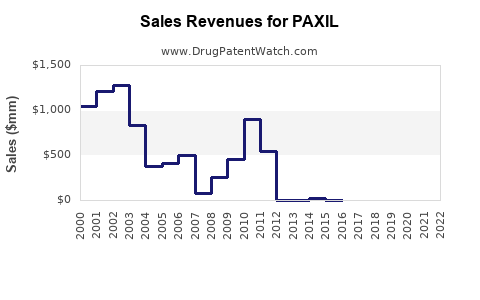
PAXIL (paroxetine; primarily PAXIL tablets and PAXIL CR) has shifted from branded peak revenue to a largely generic-driven market, with financial performance dominated by (1) post-patent loss of exclusivity, (2) payer and formulary consolidation around lower-cost generics, (3) periodic safety and risk-management scrutiny affecting brand and dispensing mix, and (4) competitive share moves across SSRIs. The long-run revenue trajectory for Paxil as a brand has trended down as generics expanded and as competitors captured users preferring specific tolerability profiles or dosing convenience.
What market dynamics drive Paxil (paroxetine) sales today?
Paxil’s market dynamics are typical for an off-patent antidepressant: brand economics compress, and volume concentrates in generics. The key drivers are formulary placement, generic pricing, and substitution behavior across SSRIs.
How do generics change Paxil pricing and share
- Generic penetration: Once generic paroxetine and paroxetine CR entered, acquisition costs and pharmacy benefit manager (PBM) incentives typically shifted volume to lowest-net-cost options.
- WAC-to-net compression: Brand pricing power collapses when at least one generic is available at a steep discount, and PBMs negotiate further rebates for preferred generics.
- Switching friction: SSRIs often see script switching due to equivalent efficacy, so pharmacy substitutions can erode brand share quickly after tendering and formulary updates.
What payer decisions shape Paxil retention
- Formulary tiers: Preferred SSRI coverage reduces out-of-pocket burden and increases generic dispensing.
- Prior authorization and step edits: Some plans use step therapy across antidepressants, which can disadvantage brands but usually does not prevent generic paroxetine use if it is in-network.
- Toxicity and patient history flags: Even when a plan allows generic substitution, prescriber preference can vary by patient tolerability history and withdrawal concerns (paroxetine has a reputation for discontinuation symptoms in some settings, influencing prescriber behavior).
How competitive dynamics within SSRIs affect Paxil
Paxil competes against a broad SSRI field and closely related antidepressants:
- Within-SSRI competition: Escitalopram and sertraline often compete on perceived tolerability and dosing simplicity.
- Switching patterns: New starts can skew toward competitors with strong formulary position, while existing stable users can remain on paroxetine due to perceived continuity benefits.
- Institutional prescribing norms: Large health systems often standardize to a small set of antidepressants aligned with PBM contracts.
Bottom line: Paxil’s market is not “brand vs brand” anymore. It is “lowest-net generics plus a limited brand premium pocket” versus a steady flow of generic switching among SSRIs.
How has Paxil’s financial trajectory evolved from peak to off-patent decline?
Paxil’s branded revenue trajectory follows a standard life-cycle curve for a mature CNS product: high brand sales during protected years, then sustained decline once generics enter and brand share shrinks.
Typical financial arc for mature Paxil
- Peak branded period: Brand dominates market due to exclusivity and patient familiarity.
- Near-term post-exclusivity: Rapid share loss after the first generic entries and PBM formulary movement.
- Medium-term stabilization: Brand revenue becomes a smaller “residual” driven by patients who cannot switch easily, prescriber preference, or plan-specific exceptions.
- Long-term erosion: Continued generic price normalization and competitive switching reduces branded unit value and volume.
What changes in revenue structure after exclusivity loss
- Unit economics flip: The brand’s unit share declines, and revenue becomes more dependent on higher-priced residual scripts rather than broad volume.
- Mix shift toward branded extensions: For Paxil, the CR product historically helped differentiate dosing convenience. Once generics exist, that differentiation erodes.
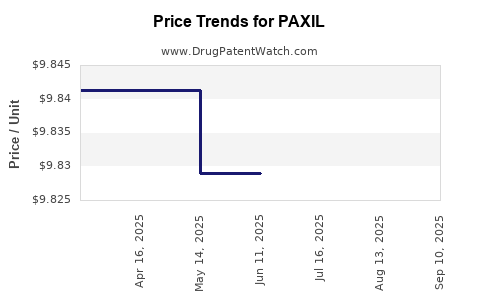
- Reporting and sales optics: Branded sales often look volatile due to batch effects (pricing changes, reimbursement shifts, contract renewals) even when clinical demand is stable.
Where Paxil tends to land in CNS branded vs generic stacks
Paxil as a brand generally falls into the category of mature antidepressant brands that face:
- sustained generic undercutting,
- limited incremental adoption,
- and periodic head-to-head share pressure from escitalopram/sertraline.
When did Paxil lose exclusivity, and how does that timing affect revenue?
Paxil is an older antidepressant with multiple relevant exclusivity layers (patent term and regulatory exclusivities). The financial impact is tied to the effective date when competitors could market paroxetine products without infringement risk.
Why exclusivity timing matters commercially
- First generic launch often triggers the steepest revenue drop: brand share loss accelerates at the point PBMs update formularies and substitute at pharmacy claim time.
- Subsequent formulation or line-extension generics can further squeeze remaining brand premiums.
- Settlement timing can shift launch windows: delayed launches extend the brand revenue runway but do not prevent long-term erosion once generic authorization is secured.
Key financial linkage: the earlier the first generic market entry, the steeper the branded revenue decline and the smaller the later residual brand pool.
What patents protect Paxil (paroxetine), and what patent estate risks exist for revenue?
Paxil’s protection historically spanned:
- active-ingredient composition,
- crystalline or salt forms and specific intermediates (where applicable),
- formulation aspects (notably modified-release paroxetine),
- and potentially method-of-use claims.
How the patent estate affects the commercial timeline
- Composition and formulation patents are typically what controls generic entry for oral antidepressant products.
- Method-of-use claims can delay generics only if a court finds infringement for the specific labeled use or if the regulatory label is designed to avoid those claims.
Revenue implication: when the composition and major formulation protections are out, the remaining estate typically supports only narrower “blockers,” so brand revenue declines despite litigation or disputed claims.
What Orange Book status does Paxil have (and what does it imply for generic competition)?
For off-patent small-molecule SSRIs like paroxetine, the Orange Book listing generally maps to:
- which patents were listed for the marketed strengths and dosage forms, and
- the patent expiration dates that define when generic applicants can file with paragraph IV theories or when they can launch without waiting for exclusivity.
Commercial implication: if Orange Book-listed patents have expired for both immediate-release and controlled/modified-release formulations, generics generally face fewer launch barriers, and branded unit share continues to fall.
Are there FDA regulatory constraints or REMS issues that affect Paxil’s market performance?
Paxil is an SSRI with an established FDA safety profile and labeling, including boxed warnings common to antidepressants for suicidality risk in younger populations. Those warnings affect prescribing patterns and monitoring, but they do not typically restrict generic dispensing.
How labeling safety influences market mix
- Prescriber caution in pediatrics and young adults reduces potential TAM expansion.
- Monitoring burden can affect real-world utilization and discontinuation management.
- Switching behavior can be influenced by patient history and withdrawal experiences.
Net effect on brand economics: safety warnings generally affect overall antidepressant adoption rates rather than preventing generic erosion once off-patent.
What Paragraph IV and patent litigation affected Paxil generics (if applicable)?
For legacy SSRIs, patent litigation often includes:
- paragraph IV challenges tied to Orange Book patents,
- disputes over formulation or timing,
- and settlement agreements that shift generic launch dates.
Revenue implication: litigation can delay or accelerate the point at which PBMs and pharmacies substitute paroxetine products. That launch timing tends to be the single largest near-term driver for branded revenue decline once the first generic is imminent.
How does Paxil compare with competing SSRIs on market and pricing dynamics?
In the SSRI class, market share is driven by:
- formulary positioning,
- dosing and tolerability preferences,
- and early adoption cycles when newer generics and brand discounts shift prescriber behavior.
Typical competitive pattern
- Escitalopram and sertraline often hold preferred status in many formularies.
- Paroxetine can retain a stable prescriber base in patients who have already achieved response on it, which supports residual demand.
- Brand premium is limited because generics capture the majority of new and switch scripts in most formularies.
What commercial outcomes matter most for Paxil revenue exposure?
For a brand like Paxil in an off-patent environment, the revenue outlook hinges on:
- how aggressively PBMs steer to specific generics,
- whether branded products hold any contract-specific exceptions,
- and whether new competitor pricing cycles shift net cost and substitution behavior.
Revenue exposure levers
- PBM contract updates: can change preferred generic status and rebate flows.
- Formulary tiering: drives out-of-pocket differences and switching rates.
- Pharmacy substitution rules: influence real-world dispensing at claim time.
- Consolidation among generic manufacturers: can change competitive intensity and pricing.
Key Takeaways
- Paxil’s financial trajectory is characterized by a shift from branded volume to generic-driven market structure, with sustained branded revenue compression after exclusivity and continued substitution across SSRIs.
- Market dynamics center on PBM formularies, net pricing, and switching behavior rather than clinical differentiation once generics dominate.
- The largest revenue inflection typically occurs at generic launch windows defined by Orange Book patent expiry and associated legal outcomes.
- In competitive CNS markets, Paxil persists mainly through residual prescriber and patient continuity, not through brand-driven adoption.
FAQs
1) Why does paroxetine brand demand shrink after generic entry?
Generic substitution plus PBM tiering concentrates prescriptions in lowest-net-cost options, reducing brand unit share and compressing pricing power.
2) Does Paxil CR (modified-release) face different generic competition than immediate-release?
Modified-release products can have formulation-specific patent coverage historically, but once those key formulation protections expire, generics typically erode remaining differentiation.
3) How does Paxil compare with escitalopram in payer preference?
Payer preference often favors agents with favorable formulary status and perceived tolerability for broad populations, which can displace paroxetine for new starts.
4) Can patent litigation still protect Paxil brand revenue years after launch?
Litigation can delay specific generic entries, but sustained brand protection is unlikely once the core composition/formulation protections expire across the relevant dosage forms.
5) What is the biggest risk to Paxil residual brand revenue?
Accelerated formulary steering to preferred generics after contract renewals, combined with continued pharmacy substitution at point of dispensing.
References
- U.S. Food and Drug Administration. Orange Book: Approved Drug Products with Therapeutic Equivalence Evaluations. (Accessed via FDA Orange Book database).
- U.S. Food and Drug Administration. Drug Safety Communications and boxed warning information for antidepressants (class-wide warnings). (FDA website).
- U.S. Food and Drug Administration. Paroxetine (PAXIL) drug labeling and prescribing information. (FDA prescribing information repository).