ORKAMBI Drug Patent Profile
✉ Email this page to a colleague
Which patents cover Orkambi, and when can generic versions of Orkambi launch?
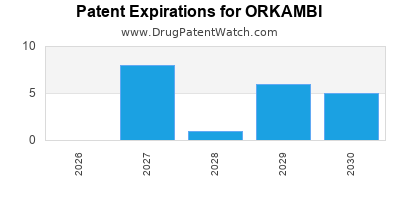
Orkambi is a drug marketed by Vertex Pharms Inc and is included in two NDAs. There are twenty-three patents protecting this drug.
The generic ingredient in ORKAMBI is ivacaftor; lumacaftor. There is one drug master file entry for this compound. One supplier is listed for this compound. Additional details are available on the ivacaftor; lumacaftor profile page.
DrugPatentWatch® Generic Entry Outlook for Orkambi
Orkambi was eligible for patent challenges on July 2, 2019.
By analyzing the patents and regulatory protections it appears that the earliest date
for generic entry will be March 20, 2031. This may change due to patent challenges or generic licensing.
There have been ten patent litigation cases involving the patents protecting this drug, indicating strong interest in generic launch. Recent data indicate that 63% of patent challenges are decided in favor of the generic patent challenger and that 54% of successful patent challengers promptly launch generic drugs.
Indicators of Generic Entry
AI Deep Research
Questions you can ask:
- What is the 5 year forecast for ORKAMBI?
- What are the global sales for ORKAMBI?
- What is Average Wholesale Price for ORKAMBI?
Summary for ORKAMBI
| US Patents: | 23 |
| Applicants: | 1 |
| NDAs: | 2 |
| Finished Product Suppliers / Packagers: | 1 |
| Raw Ingredient (Bulk) Api Vendors: | 2 |
| Clinical Trials: | 19 |
| Patent Applications: | 190 |
| Drug Prices: | Drug price information for ORKAMBI |
| Patent Litigation and PTAB cases: | See patent lawsuits and PTAB cases for ORKAMBI |
| What excipients (inactive ingredients) are in ORKAMBI? | ORKAMBI excipients list |
| DailyMed Link: | ORKAMBI at DailyMed |

DrugPatentWatch® Estimated Loss of Exclusivity (LOE) Date for ORKAMBI
Generic Entry Dates for ORKAMBI*:
Constraining patent/regulatory exclusivity:
NDA:
Dosage:
GRANULE;ORAL |
Generic Entry Dates for ORKAMBI*:
Constraining patent/regulatory exclusivity:
NDA:
Dosage:
TABLET;ORAL |
*The generic entry opportunity date is the latter of the last compound-claiming patent and the last regulatory exclusivity protection. Many factors can influence early or later generic entry. This date is provided as a rough estimate of generic entry potential and should not be used as an independent source.
Recent Clinical Trials for ORKAMBI
Identify potential brand extensions & 505(b)(2) entrants
| Sponsor | Phase |
|---|---|
| Qanatpharma Canada LTD | Phase 1 |
| Children's Hospital Medical Center, Cincinnati | N/A |
| University of Kansas Medical Center | Early Phase 1 |
Pharmacology for ORKAMBI
US Patents and Regulatory Information for ORKAMBI
ORKAMBI is protected by twenty-three US patents and four FDA Regulatory Exclusivities.
Based on analysis by DrugPatentWatch, the earliest date for a generic version of ORKAMBI is ⤷ Start Trial.
This potential generic entry date is based on patent ⤷ Start Trial.
Generics may enter earlier, or later, based on new patent filings, patent extensions, patent invalidation, early generic licensing, generic entry preferences, and other factors.
EU/EMA Drug Approvals for ORKAMBI
| Company | Drugname | Inn | Product Number / Indication | Status | Generic | Biosimilar | Orphan | Marketing Authorisation | Marketing Refusal |
|---|---|---|---|---|---|---|---|---|---|
| Vertex Pharmaceuticals (Ireland) Limited | Orkambi | lumacaftor, ivacaftor | EMEA/H/C/003954Orkambi tablets are indicated for the treatment of cystic fibrosis (CF) in patients aged 6 years and older who are homozygous for the F508del mutation in the CFTR gene.Orkambi granules are indicated for the treatment of cystic fibrosis (CF) in children aged 1 year and older who are homozygous for the F508del mutation in the CFTR gene. | Authorised | no | no | no | 2015-11-19 | |
| >Company | >Drugname | >Inn | >Product Number / Indication | >Status | >Generic | >Biosimilar | >Orphan | >Marketing Authorisation | >Marketing Refusal |
International Patents for ORKAMBI
When does loss-of-exclusivity occur for ORKAMBI?
Based on analysis by DrugPatentWatch, the following patents block generic entry in the countries listed below:
Australia
Patent: 08333845
Estimated Expiration: ⤷ Start Trial
Brazil
Patent: 0821039
Estimated Expiration: ⤷ Start Trial
Canada
Patent: 06920
Estimated Expiration: ⤷ Start Trial
Patent: 86286
Estimated Expiration: ⤷ Start Trial
Chile
Patent: 10000607
Estimated Expiration: ⤷ Start Trial
China
Patent: 1910156
Estimated Expiration: ⤷ Start Trial
Patent: 3626744
Estimated Expiration: ⤷ Start Trial
Croatia
Patent: 0170241
Estimated Expiration: ⤷ Start Trial
Patent: 0200664
Estimated Expiration: ⤷ Start Trial
Cyprus
Patent: 18630
Estimated Expiration: ⤷ Start Trial
Patent: 22895
Estimated Expiration: ⤷ Start Trial
Patent: 20030
Estimated Expiration: ⤷ Start Trial
Denmark
Patent: 25230
Estimated Expiration: ⤷ Start Trial
Patent: 70818
Estimated Expiration: ⤷ Start Trial
Eurasian Patent Organization
Patent: 1070698
Estimated Expiration: ⤷ Start Trial
European Patent Office
Patent: 25230
Estimated Expiration: ⤷ Start Trial
Patent: 70818
Estimated Expiration: ⤷ Start Trial
Patent: 83218
Estimated Expiration: ⤷ Start Trial
Hong Kong
Patent: 46819
Estimated Expiration: ⤷ Start Trial
Hungary
Patent: 31913
Estimated Expiration: ⤷ Start Trial
Patent: 49642
Estimated Expiration: ⤷ Start Trial
Patent: 000030
Estimated Expiration: ⤷ Start Trial
Israel
Patent: 6203
Estimated Expiration: ⤷ Start Trial
Japan
Patent: 27741
Estimated Expiration: ⤷ Start Trial
Patent: 11506330
Estimated Expiration: ⤷ Start Trial
Patent: 13253111
Estimated Expiration: ⤷ Start Trial
Patent: 14088447
Estimated Expiration: ⤷ Start Trial
Patent: 15145426
Estimated Expiration: ⤷ Start Trial
Patent: 17014290
Estimated Expiration: ⤷ Start Trial
Patent: 17149778
Estimated Expiration: ⤷ Start Trial
Lithuania
Patent: 25230
Estimated Expiration: ⤷ Start Trial
Patent: 70818
Estimated Expiration: ⤷ Start Trial
Patent: 170818
Estimated Expiration: ⤷ Start Trial
Patent: 2020525
Estimated Expiration: ⤷ Start Trial
Mexico
Patent: 7154
Patent: FORMAS SOLIDAS DE ACIDO 3-(6-(1-(2,2-DIFLUOROBENZO[D] [1,3]DIOXOL-5-IL)CICLOPROPANCARBOXAMIDO)-3-METILPIRIDIN-2-IL)BENZ OICO. (SOLID FORMS OF 3-(6-(1-(2,2-DIFLUOROBENZO[D][1,3] DIOXOL-5-YL) CYCLOPROPANECARBOXAMIDO)-3-METHYLPYRIDIN-2-YL) BENZOIC ACID.)
Estimated Expiration: ⤷ Start Trial
Patent: 10006179
Patent: FORMAS SOLIDAS DE ACIDO 3-(6-(1-(2,2-DIFLUOROBENZO[D] [1,3]DIOXOL-5-IL)CICLOPROPANCARBOXAMIDO)-3-METILPIRIDIN-2-IL)BENZ OICO. (SOLID FORMS OF 3-(6-(1-(2,2-DIFLUOROBENZO[D][1,3] DIOXOL-5-YL) CYCLOPROPANECARBOXAMIDO)-3-METHYLPYRIDIN-2-YL) BENZOIC ACID.)
Estimated Expiration: ⤷ Start Trial
New Zealand
Patent: 5880
Patent: SOLID FORMS OF 3-(6-(1-(2,2-DIFLUOROBENZO[D][1,3] DIOXOL-5-YL) CYCLOPROPANECARBOXAMIDO)-3-METHYLPYRIDIN-2-YL) BENZOIC ACID
Estimated Expiration: ⤷ Start Trial
Patent: 9889
Patent: Solid forms of 3-(6-(1-(2,2-difluorobenzo[d][1,3]dioxol-5-yl) cyclopropanecarboxamido)-3-methylpyridin-2-yl)benzoic acid
Estimated Expiration: ⤷ Start Trial
Patent: 4151
Patent: Solid forms of 3-(6-(1-(2,2-difluorobenzo[d][1,3]dioxol-5-yl) cyclopropanecarboxamido)-3-methylpyridin-2-yl)benzoic acid
Estimated Expiration: ⤷ Start Trial
Patent: 2159
Patent: Solid forms of 3-(6-(1-(2,2-difluorobenzo[d][1,3]dioxol-5-yl) cyclopropanecarboxamido)-3-methylpyridin-2-yl)benzoic acid
Estimated Expiration: ⤷ Start Trial
Norway
Patent: 17009
Estimated Expiration: ⤷ Start Trial
Patent: 20025
Estimated Expiration: ⤷ Start Trial
Poland
Patent: 25230
Estimated Expiration: ⤷ Start Trial
Patent: 70818
Estimated Expiration: ⤷ Start Trial
Portugal
Patent: 25230
Estimated Expiration: ⤷ Start Trial
Patent: 70818
Estimated Expiration: ⤷ Start Trial
Serbia
Patent: 559
Patent: ČVRSTE FORME 3-(6-(1-(2,2-DIFLUOROBENZO[D][1,3]DIOKSOL-5-IL)CIKLOPROPANKARBOKSAMIDO)-3-METILPIRIDIN-2-IL) BENZOEVE KISELINE (SOLID FORMS OF 3-(6-(1-(2,2-DIFLUOROBENZO[D][1,3]DIOXOL-5-YL) CYCLOPROPANECARBOXAMIDO)-3-METHYLPYRIDIN-2-YL) BENZOIC ACID)
Estimated Expiration: ⤷ Start Trial
Patent: 229
Patent: ČVRSTI OBLICI 3-(6-(1-(2,2-DIFLUOROBENZO[D][1,3]DIOKSOL-5-IL) CIKLOPROPANKARBOKSAMIDO)-3-METILPIRIDIN-2-IL) BENZOJEVE KISELINE (SOLID FORMS OF 3-(6-(1-(2,2-DIFLUOROBENZO[D][1,3]DIOXOL-5-YL) CYCLOPROPANECARBOXAMIDO)-3-METHYLPYRIDIN-2-YL) BENZOIC ACID)
Estimated Expiration: ⤷ Start Trial
Singapore
Patent: 6638
Patent: SOLID FORMS OF 3-(6-(1-(2,2-DIFLUOROBENZO[D][1,3] DIOXOL-5-YL) CYCLOPROPANECARBOXAMIDO)-3-METHYLPYRIDIN-2-YL) BENZOIC ACID
Estimated Expiration: ⤷ Start Trial
Slovenia
Patent: 25230
Estimated Expiration: ⤷ Start Trial
Patent: 70818
Estimated Expiration: ⤷ Start Trial
South Africa
Patent: 1003623
Patent: SOLID FORMS OF 3-(6-(1-(2,2-DIFLUOROBENZO[D][1,3]DIOXOL-5-YL)CYCLOPROPANECARBOXAMIDO)-3-METHYLPYRIDIN-2-YL)BENZOIC ACID
Estimated Expiration: ⤷ Start Trial
South Korea
Patent: 100101130
Patent: SOLID FORMS OF 3-(6-(1-(2,2-DIFLUOROBENZO[D][1,3]DIOXOL-5-YL)CYCLOPROPANECARBOXAMIDO)-3-METHYLPYRIDIN-2-YL)BENZOIC ACID
Estimated Expiration: ⤷ Start Trial
Patent: 150063170
Patent: 3-(6-(1-(2,2-디플루오로벤조[d][1,3]디옥솔-5-일)사이클로프로판카복스아미도)-3-메틸피리딘-2-일)벤조산의 고체 형태 (SOLID FORMS OF 3-(6-(1-(2,2-DIFLUOROBENZO[D][1,3]DIOXOL-5-YL)CYCLOPROPANECARBOXAMIDO)-3-METHYLPYRIDIN-2-YL)BENZOIC ACID)
Estimated Expiration: ⤷ Start Trial
Patent: 160040745
Patent: 3-(6-(1-(2,2-디플루오로벤조[d][1,3]디옥솔-5-일)사이클로프로판카복스아미도)-3-메틸피리딘-2-일)벤조산의 고체 형태 (SOLID FORMS OF 3-(6-(1-(2,2-DIFLUOROBENZO[D][1,3]DIOXOL-5-YL)CYCLOPROPANECARBOXAMIDO)-3-METHYLPYRIDIN-2-YL)BENZOIC ACID)
Estimated Expiration: ⤷ Start Trial
Spain
Patent: 11077
Estimated Expiration: ⤷ Start Trial
Patent: 90830
Estimated Expiration: ⤷ Start Trial
Patent: 93060
Estimated Expiration: ⤷ Start Trial
Ukraine
Patent: 2534
Patent: SOLID FORMS OF 3-(6-(1-(2,2-DIFLUOROBENZO[D][1,3]-DIOXOL-5-YL) CYCLOPROPANECARBOXAMIDO)-3-METHYLPYRIDIN-2-YL) BENZOIC ACID
Estimated Expiration: ⤷ Start Trial
Generics may enter earlier, or later, based on new patent filings, patent extensions, patent invalidation, early generic licensing, generic entry preferences, and other factors.
See the table below for additional patents covering ORKAMBI around the world.
| Country | Patent Number | Title | Estimated Expiration |
|---|---|---|---|
| Argentina | 081069 | ⤷ Start Trial | |
| Argentina | 081760 | ⤷ Start Trial | |
| Australia | 2011237494 | ⤷ Start Trial | |
| Australia | 2011237601 | ⤷ Start Trial | |
| Brazil | 112012026255 | ⤷ Start Trial | |
| Brazil | 112012026257 | ⤷ Start Trial | |
| Canada | 2795748 | ⤷ Start Trial | |
| >Country | >Patent Number | >Title | >Estimated Expiration |
Supplementary Protection Certificates for ORKAMBI
| Patent Number | Supplementary Protection Certificate | SPC Country | SPC Expiration | SPC Description |
|---|---|---|---|---|
| 1773816 | C300748 | Netherlands | ⤷ Start Trial | PRODUCT NAME: N-(5-HYDROXY-2,4-DI-TERT-BUTYL-; REGISTRATION NO/DATE: EU/1/12/782/001-002 20120725 |
| 1773816 | CA 2015 00038 | Denmark | ⤷ Start Trial | PRODUCT NAME: IVACAFTOR, N-(5-HYDROXY-2,4-DITERT-BUTYL-PHENYL)-4-OXO-1H-QUINOLIN-3-CARBOXAMID ELLER ET FARMACEUTISK ACCEPTABLET SALT DERAF; REG. NO/DATE: EU/1/12/782/001-002 20120723 |
| 1773816 | PA2015028 | Lithuania | ⤷ Start Trial | PRODUCT NAME: IVACAFTORUM; REGISTRATION NO/DATE: EU/1/12/782/001 - EU/1/12/782/002 20120723 |
| 1773816 | C20150028 00162 | Estonia | ⤷ Start Trial | PRODUCT NAME: IVAKAFTOOR;REG NO/DATE: EU/1/12/782/001-002 25.07.2012 |
| 1773816 | 1590036-8 | Sweden | ⤷ Start Trial | PRODUCT NAME: N-(5-HYDROXY-2,4-DITERT-BUTYL-PHENYL)-4-OXO-1H-QUINOLINE-3- CARBOXAMIDE OR A PHARMACEUTICALLY ACCEPTABLE SALT THEROF; FIRST MARKETING AUTHORIZATION NUMBER SE: EG EU/1/12/782/001, 2012-07-25; DEN 2025-05-21 MEDDELADE PRV BESLUT OM RAETTAD SKYDDSTID FOER FOELJANDE TILLAEGGSSKYDD: 1590036-8,1690018-5, 1490016-1 |
| 1773816 | 15C0045 | France | ⤷ Start Trial | PRODUCT NAME: IVACAFTOR, OU L'UN DE SES SELS PHARMACEUTIQUEMENT ACCEPTABLES; REGISTRATION NO/DATE: EU/1/12/782/001-002 20120725 |
| 1773816 | 92761 | Luxembourg | ⤷ Start Trial | PRODUCT NAME: N-(5-HYDROXY-2,4-DIERT-BUTYL-PHENYL)-4OXO-1H-QUINOLINE-3-CARBOXAMIDE OR A PHARMACEUTICALLY ACCEPTABLE SALT THEREOF; AUTHORISATION NUMBER: EU/1/12/782/001-002 |
| >Patent Number | >Supplementary Protection Certificate | >SPC Country | >SPC Expiration | >SPC Description |
ORKAMBI: Market Dynamics and Financial Trajectory
More… ↓
DrugChatter Q&A for ORKAMBI
Make Better Decisions: Try a trial or see plans & pricing
Drugs may be covered by multiple patents or regulatory protections. All trademarks and applicant names are the property of their respective owners or licensors. Although great care is taken in the proper and correct provision of this service, thinkBiotech LLC does not accept any responsibility for possible consequences of errors or omissions in the provided data. The data presented herein is for information purposes only. There is no warranty that the data contained herein is error free. We do not provide individual investment advice. This service is not registered with any financial regulatory agency. The information we publish is educational only and based on our opinions plus our models. By using DrugPatentWatch you acknowledge that we do not provide personalized recommendations or advice. thinkBiotech performs no independent verification of facts as provided by public sources nor are attempts made to provide legal or investing advice. Any reliance on data provided herein is done solely at the discretion of the user. Users of this service are advised to seek professional advice and independent confirmation before considering acting on any of the provided information. thinkBiotech LLC reserves the right to amend, extend or withdraw any part or all of the offered service without notice.
ISSN: 2162-2639

Privacy and Cookies
Terms & Conditions
Site Map
DrugPatentWatch Alternatives
LOE / Major Patent Expirations 2026 - 2027
NCE-1 Patent Challenge Dates 2026 - 2027
Friedman, Yali. "DrugPatentWatch" DrugPatentWatch, thinkBiotech, 2026, www.DrugPatentWatch.com.
See Primary Research Papers Citing DrugPatentWatch