You're using a free limited version of DrugPatentWatch: Upgrade for Complete Access

Last Updated: December 31, 2025

OPILL Drug Patent Profile


✉ Email this page to a colleague

« Back to Dashboard


When do Opill patents expire, and when can generic versions of Opill launch?

Opill is a drug marketed by Laboratoire Hra and is included in one NDA.

The generic ingredient in OPILL is norgestrel. There are twenty-five drug master file entries for this compound. Two suppliers are listed for this compound. Additional details are available on the norgestrel profile page.

AI Deep Research
Questions you can ask:
  • What is the 5 year forecast for OPILL?
  • What are the global sales for OPILL?
  • What is Average Wholesale Price for OPILL?
Summary for OPILL
US Patents:0
Applicants:1
NDAs:1
Finished Product Suppliers / Packagers: 2
Raw Ingredient (Bulk) Api Vendors: 107
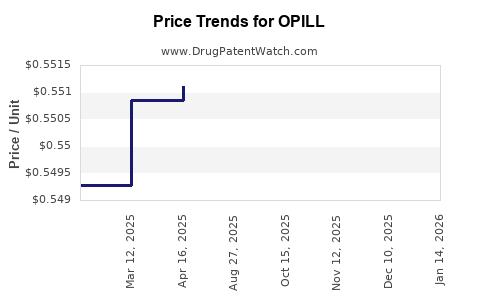
Drug Prices: Drug price information for OPILL
What excipients (inactive ingredients) are in OPILL?OPILL excipients list
DailyMed Link:OPILL at DailyMed
Drug patent expirations by year for OPILL
Drug Prices for OPILL

See drug prices for OPILL

DrugPatentWatch® Estimated Loss of Exclusivity (LOE) Date for OPILL
Generic Entry Date for OPILL*:
Constraining patent/regulatory exclusivity:
RX TO OTC SWITCH OR OTC USE
NDA:
Dosage:
TABLET;ORAL

*The generic entry opportunity date is the latter of the last compound-claiming patent and the last regulatory exclusivity protection. Many factors can influence early or later generic entry. This date is provided as a rough estimate of generic entry potential and should not be used as an independent source.

US Patents and Regulatory Information for OPILL

OPILL is protected by zero US patents and one FDA Regulatory Exclusivity.

Based on analysis by DrugPatentWatch, the earliest date for a generic version of OPILL is ⤷  Get Started Free.

This potential generic entry date is based on RX TO OTC SWITCH OR OTC USE.

Generics may enter earlier, or later, based on new patent filings, patent extensions, patent invalidation, early generic licensing, generic entry preferences, and other factors.

Applicant Tradename Generic Name Dosage NDA Approval Date TE Type RLD RS Patent No. Patent Expiration Product Substance Delist Req. Exclusivity Expiration
Laboratoire Hra OPILL norgestrel TABLET;ORAL 017031-001 Approved Prior to Jan 1, 1982 OTC Yes Yes ⤷  Get Started Free ⤷  Get Started Free ⤷  Get Started Free
>Applicant >Tradename >Generic Name >Dosage >NDA >Approval Date >TE >Type >RLD >RS >Patent No. >Patent Expiration >Product >Substance >Delist Req. >Exclusivity Expiration

Expired US Patents for OPILL

Applicant Tradename Generic Name Dosage NDA Approval Date Patent No. Patent Expiration
Laboratoire Hra OPILL norgestrel TABLET;ORAL 017031-001 Approved Prior to Jan 1, 1982 3,666,858 ⤷  Get Started Free
Laboratoire Hra OPILL norgestrel TABLET;ORAL 017031-001 Approved Prior to Jan 1, 1982 3,850,911 ⤷  Get Started Free
Laboratoire Hra OPILL norgestrel TABLET;ORAL 017031-001 Approved Prior to Jan 1, 1982 3,959,322 ⤷  Get Started Free
>Applicant >Tradename >Generic Name >Dosage >NDA >Approval Date >Patent No. >Patent Expiration

International Patents for OPILL

See the table below for patents covering OPILL around the world.

Country Patent Number Title Estimated Expiration
Brazil 6349023 ⤷  Get Started Free
Belgium 658257 ⤷  Get Started Free
Germany 1793598 13-Alkyl-gona-1,3,5(10),8-tetraene ⤷  Get Started Free
Netherlands 139310 ⤷  Get Started Free
Belgium 645393 ⤷  Get Started Free
Germany 1793574 2-(1'-Tetralylidenaethyl)-2-alkylcyclopentan-1,3-dione ⤷  Get Started Free
>Country >Patent Number >Title >Estimated Expiration

Supplementary Protection Certificates for OPILL

Patent Number Supplementary Protection Certificate SPC Country SPC Expiration SPC Description
1453521 C 2015 029 Romania ⤷  Get Started Free PRODUCT NAME: LEVONORGESTREL SI ETINILESTRADIOL; NATIONAL AUTHORISATION NUMBER: RO 7793/2015/001; DATE OF NATIONAL AUTHORISATION: 20150612; NUMBER OF FIRST AUTHORISATION IN EUROPEAN ECONOMIC AREA (EEA): SK. 17/0017/15-S; DATE OF FIRST AUTHORISATION IN EEA: 20150129
1453521 300814 Netherlands ⤷  Get Started Free PRODUCT NAME: LEVONORGESTREL EN ETHINYLESTRADIOL; NATIONAL REGISTRATION NO/DATE: RVG 117453 20151211; FIRST REGISTRATION: SK 17/0017/15-S 20150211
1453521 122015000093 Germany ⤷  Get Started Free PRODUCT NAME: LEVONORGESTREL UND ETHINYLESTRADIOL; NAT. REGISTRATION NO/DATE: 87675.00.00 20150720; FIRST REGISTRATION: SLOWAKEI 17/0017/15-S 20150129
1453521 132016000025143 Italy ⤷  Get Started Free PRODUCT NAME: LEVONORGESTREL ED ETINILESTRADIOLO(SEASONIQUE); AUTHORISATION NUMBER(S) AND DATE(S): 17/0017/15-S, 20150211;042139016, 20150414
1453521 39/2015 Austria ⤷  Get Started Free PRODUCT NAME: ETHINYLESTRADIOL UND EINE KOMBINATION VON LEVONORGESTREL UND ETHINYLESTRADIOL; NAT. REGISTRATION NO/DATE: 136021 20150224; FIRST REGISTRATION: SK 17/0017/15-S 20150211
1453521 C201630040 Spain ⤷  Get Started Free PRODUCT NAME: ETINILESTRADIOL Y MEZCLA DE LEVONORGESTREL Y ETINILESTRADIOL; NATIONAL AUTHORISATION NUMBER: 80340; DATE OF AUTHORISATION: 20160122; NUMBER OF FIRST AUTHORISATION IN EUROPEAN ECONOMIC AREA (EEA): 17/0017/15-S; DATE OF FIRST AUTHORISATION IN EEA: 20150211
>Patent Number >Supplementary Protection Certificate >SPC Country >SPC Expiration >SPC Description

Market Dynamics and Financial Trajectory for the Pharmaceutical Drug OPILL

Last updated: July 28, 2025


Introduction

OPILL (ulipristal acetate) represents a significant entrant within the emergency contraceptive market, holding distinction as a prescription-only emergency contraceptive launched by rivals such as Zae Labs. As a selective progesterone receptor modulator (SPRM), OPILL offers a unique mechanism of action compared to over-the-counter options like Plan B One-Step, thus positioning itself in a specialized niche. The following analysis explores the core market drivers, competitive landscape, regulatory environment, and financial outlook shaping OPILL’s trajectory.


Market Overview

Global Emergency Contraceptive Landscape

The emergency contraceptive (EC) market is projected to grow at a Compound Annual Growth Rate (CAGR) of approximately 8% over the next five years, driven by rising unintended pregnancies, increasing awareness, and broader access to reproductive health products [1]. North America, especially the U.S., dominates this market, with substantial adoption driven by evolving healthcare policies and consumer awareness initiatives.

OPILL’s Positioning

OPILL distinguishes itself among EC options as a prescription-only drug approved by the FDA (in 2018), designed for use within five days post-intercourse. Its efficacy is comparable to other ECs but offers advantages in safety profile and reduced side effects, making it suitable for women with specific contraindications to hormonal methods.


Market Drivers

Legal and Regulatory Factors

Regulatory policies significantly influence OPILL’s market penetration. The FDA’s approval granted OPILL a critical first-mover advantage in the prescription EC domain. However, the ongoing debate over OTC availability could reshape the market dynamics, potentially expanding the accessible user base but introducing regulatory risks. For instance, in recent years, the U.S. government has advocated for OTC access to ECs like Plan B, which could pressure prescriptive-only drugs like OPILL.

Consumer Awareness and Demographics

Increasing reproductive health literacy and women’s rights movements underpin growth in demand. Younger women, particularly in urban settings, are increasingly seeking prescription options for perceived safety and efficacy. Moreover, insurance coverage for prescription drugs in the U.S. facilitates affordability, further increasing adoption.

Healthcare Provider Dynamics

Physician prescription practices, influenced by perceptions about efficacy and safety, shape the distribution channels. Education campaigns highlighting OPILL’s benefits could foster higher prescribing rates, especially among OB-GYNs and primary care physicians.

Ethical and Societal Trends

Administering emergency contraception within the framework of broader reproductive rights supports market expansion. Legislative restrictions or bans, however, could curtail market growth, as seen in some states with imposed limitations on reproductive health services.


Competitive Landscape

Existing Electro-Contraceptive Options

OPILL competes primarily with OTC pills like Plan B One-Step, which boasts higher consumer accessibility. Regulatory shifts permitting OTC access to OPILL could substantially enlarge its market share.

Emerging Alternatives

There is an imminent pipeline of novel contraceptive methods, including hormonal and non-hormonal options, which may dilute OPILL’s market share in the long term. Additionally, advancements in long-acting reversible contraceptives (LARCs) may influence the overall contraceptive landscape.

Market Penetration Strategies

OPILL’s adoption hinges on direct physician advocacy, strategic partnerships with health providers, and reimbursement strategies with insurers. Digital health platforms and telemedicine services also facilitate prescription access, with their growth promising to boost OPILL’s reach.


Regulatory and Policy Impact on Financial Trajectory

Potential OTC Conversion

The FDA’s stance on OTC availability directly affects OPILL’s revenue potential. A shift towards OTC could precipitate a surge in volume, with analysts estimating up to a 3-4x increase in sales volume within the first two years post-approval. However, OTC status could intensify price competition and reduce margins.

Reimbursement & Insurance Coverage

Insurance coverage remains crucial; approximately 85% of U.S. women have some form of prescription drug coverage, facilitating affordability and fueling demand. Policy changes extending coverage for EC drugs would further accelerate growth.

Pricing Strategies

OPILL’s premium price compared to OTC ECs positions it as a physician-recommended, safety-focused option. Yet, eventual price competition may emerge if the drug moves OTC, compelling strategic adjustments.


Financial Trajectory Projections

Revenue Forecasts

  • Current Revenue (Pre-2023): Limited, primarily through specialty pharmacy channels.
  • Post-OTC Potential: Industry forecasts anticipate revenues could multiply by 300-400% within five years if OTC conversion occurs [2].
  • Key Revenue Factors: Prescription volume growth, insurance reimbursement rates, and potential licensing agreements, especially in international markets such as Europe and Asia.

Profitability Outlook

Given the high R&D and regulatory approval costs, profit margins are initially narrow. Economies of scale arising from increased sales volumes, especially following OTC status, are essential for sustained profitability.

Investment and Market Risks

  • Regulatory delays or denials.
  • Competitive pricing pressures.
  • Changes in societal policy or insurance coverage.
  • Emergence of alternative, more effective contraceptive methods.

Global Expansion and Market Opportunities

While the U.S. remains OPILL’s primary market, expansion into Europe, where regulatory pathways for reproductive health drugs are mature, presents significant upside. The European Medicines Agency’s (EMA) approval process could serve as a pathway, contingent on demonstrating safety and efficacy comparable to existing options.

Emerging markets with expanding healthcare infrastructure and rising reproductive health awareness also represent potential growth avenues, primarily through licensing or joint ventures, subject to local regulatory compliance.


Key Challenges and Considerations

  • Regulatory Uncertainty: Moving from prescription to OTC status remains a pivotal, uncertain factor.
  • Competitive Pressure: OTC availability of similar drugs may restrict pricing power.
  • Societal and Legal Risks: Legislative actions adversely affecting reproductive health access could impede growth.
  • Market Penetration: Physician and consumer acceptance levels.

Key Takeaways

  • OPILL is strategically positioned within a growing emergency contraceptive market, with favorable regulatory backing and unmet demand.
  • Regulatory developments, especially OTC approval, are poised to dramatically accelerate revenue potential.
  • Insurance coverage and demographic trends support expanding adoption, but societal and legal shifts could pose risks.
  • International markets represent significant future growth, contingent on navigating differing regulatory landscapes.
  • Maintaining competitive differentiation through safety, efficacy, and physician advocacy is critical.

FAQs

1. What sets OPILL apart from over-the-counter emergency contraceptives?
OPILL’s prescription-only status ensures medical oversight, offering a safety and efficacy profile trusted by healthcare providers. Its mechanism as an SPRM provides an alternative to hormonal ECs, benefitting women with specific contraindications.

2. How might OTC availability influence OPILL’s market share?
Transitioning OPILL to OTC status could lead to a substantial sales increase, as consumer access removes prescribing barriers. However, this also introduces price competition and erodes premium pricing afforded by prescriptive status.

3. What regulatory hurdles does OPILL face for international expansion?
International markets require local regulatory approval, which involves demonstrating comparable safety and efficacy profiles. Variations in approval timelines and requirements can delay market entry.

4. How does insurance coverage impact OPILL’s growth?
Insurance coverage reduces out-of-pocket costs, making OPILL more accessible. Expanding coverage policies directly correlates with increased prescription rates and revenue.

5. What are the long-term prospects for OPILL amid emerging contraceptive technologies?
While long-acting and non-hormonal options are advancing, OPILL’s unique mechanism and safety profile position it as a valuable part of contraceptive choices. Continuous innovation and strategic positioning will be essential for sustained relevance.


Conclusion

OPILL stands at the nexus of regulatory evolution, societal shifts, and technological advancement within the reproductive health sector. Its future financial trajectory hinges on regulatory decisions, societal acceptance, and market expansion strategies. With proactive adaptation to the changing landscape, OPILL has the potential to significantly benefit from the expanding global demand for reliable emergency contraception.


References

[1] Grand View Research, "Emergency Contraceptive Drugs Market Size, Share & Trends Analysis," 2022.
[2] MarketWatch, "Pharmaceuticals Market Outlook: Emergency Contraceptives," 2023.

More… ↓

⤷  Get Started Free

Make Better Decisions: Try a trial or see plans & pricing

Drugs may be covered by multiple patents or regulatory protections. All trademarks and applicant names are the property of their respective owners or licensors. Although great care is taken in the proper and correct provision of this service, thinkBiotech LLC does not accept any responsibility for possible consequences of errors or omissions in the provided data. The data presented herein is for information purposes only. There is no warranty that the data contained herein is error free. We do not provide individual investment advice. This service is not registered with any financial regulatory agency. The information we publish is educational only and based on our opinions plus our models. By using DrugPatentWatch you acknowledge that we do not provide personalized recommendations or advice. thinkBiotech performs no independent verification of facts as provided by public sources nor are attempts made to provide legal or investing advice. Any reliance on data provided herein is done solely at the discretion of the user. Users of this service are advised to seek professional advice and independent confirmation before considering acting on any of the provided information. thinkBiotech LLC reserves the right to amend, extend or withdraw any part or all of the offered service without notice.