Last updated: June 24, 2026
Olmesartan medoxomil (generic name: olmesartan medoxomil; brand names include Benicar in the US) is a mature angiotensin II receptor blocker (ARB) with a long runway of generic availability in major markets. Market dynamics are dominated by generic erosion, payer step-therapy behavior for hypertension, and ongoing share rotation across ARBs. Financial trajectory is tied to (1) how quickly biosimilar-style risks are irrelevant here and instead generic entrants scale, (2) contract manufacturing and distribution economics, and (3) patent estate timing that has already largely moved into generic competition in the US.
How has olmesartan medoxomil performed commercially since peak ARB growth?
Featured answer: Olmesartan is now in a late-life revenue phase in the US and other core markets where generics have fully launched, with revenues sustained mainly by brand pull-through in certain geographies and ongoing branded-share tactics where authorized generics or brand discounts exist.
US revenue and share: what typically drives trajectory in late-life ARB markets
Commercial performance for mature ARBs follows a consistent pattern:
- Pre-generic phase: brand pricing power with limited competition and guideline positioning for ARB intolerance.
- Post-generic launch: rapid gross-to-net decline from wholesale price erosion and payer preferred-drug lists.
- Sustained decline: share shifts to lower-cost agents in the same class (losartan, valsartan, irbesartan, telmisartan, candesartan).
- Lifecyle maintenance: formulation and combination entries can slow decline, but do not restore monopoly economics once plain olmesartan generics dominate.
Category-level dynamics for ARBs
ARB market pricing is structurally vulnerable because:
- Indication is broad (hypertension, often with cardiovascular risk reduction in select labeling).
- Payers treat ARBs as therapeutically substitutable for formulary purposes.
- Multiple competitors have equivalent guideline standing across efficacy endpoints.
What market drivers most affect olmesartan medoxomil demand and pricing?
Featured answer: In mature hypertension markets, olmesartan demand is driven by formulary positioning and switching costs, while pricing is driven by generic competition intensity and rebate pressure.
1) Payer formularies and step therapy
- Many payers prefer lower-cost ARBs (often losartan or generic valsartan) and use step therapy or “preferred ARB” rules.
- Olmesartan benefits when it remains on plan formularies due to prescriber inertia, tolerability, and medical-necessity pathways.
2) Switching behavior in hypertension
- Hypertension patients are often long-term users. Switching requires clinical risk management and refill cycles.
- That produces a lag: even after generics launch, brand remnants can persist for some time through existing prescriptions, then erode.
3) Safety signal and labeling-driven effects
Olmesartan medoxomil faces category scrutiny because of the historically reported association with sprue-like enteropathy (often discussed in clinical and regulatory literature). Labeling communications affect:
- initiation rates by risk-averse prescribers
- monitoring practices
- payer utilization management
This can reduce incremental demand even when generics are available because risk perception can lower new prescribing and trigger discontinuation in susceptible patients.
4) Combination therapy: where revenue can be protected longer
Brand and company revenue can be supported by fixed-dose combinations (e.g., olmesartan with hydrochlorothiazide or other antihypertensives) because:
- combination products can have differentiated formulations
- payer coverage can remain tied to combination status for a period even after plain-drug generic penetration
Who are the main competitors to olmesartan medoxomil, and how do their strategies change pricing power?
Featured answer: The competitive set is dominated by other ARBs and by low-cost generic substitution. The biggest revenue threat is faster erosion from equivalent ARBs, especially losartan and valsartan generics.
Key competitive mechanisms
- Losartan: typically lowest-cost anchor in formularies, pushing utilization.
- Valsartan: widely available with strong generic competition; can capture conversion from other ARBs via rebates.
- Telmisartan, Irbesartan, Candesartan: compete on dosing preference, plan coverage, and patient tolerability.
- Combination ARB/HCTZ products: compete for the same “second-line” prescription flows.
When does olmesartan medoxomil face the largest revenue downside: generic launch waves or patent expirations?
Featured answer: For olmesartan medoxomil, the dominant downside event was plain-drug generic entry and ongoing erosion after patent exclusivity ended. Post-expiry, revenue becomes a function of how quickly generics capture net revenue share and how well remaining branded/combination business is defended.
US exclusivity and generic entry reality
In practical market terms, olmesartan medoxomil in the US has already moved through the main exclusivity window and into mature generic competition. The ongoing revenue trajectory is therefore shaped less by “when exclusivity ends” and more by:
- authorized generic availability timing
- rebate intensity
- payer switching
- contract and distribution economics
What does the likely financial trajectory look like across geographies?
Featured answer: High-income markets show the steepest decline after generic launches, while emerging markets show delayed erosion based on local regulatory timelines and manufacturing readiness.
US and EU-5 style pattern
- US: steep early loss once generics scaled, followed by continued gross-to-net decline.
- EU: similar erosion pattern, with additional effects from national tendering and reference pricing.
Emerging markets pattern
- Slower generic penetration can extend revenue in the short run.
- Local competition and regulatory approvals determine speed.
- Pricing is often constrained by government procurement and reference pricing.
How do payer rebates and wholesaler contracting shape olmesartan medoxomil’s net sales curve?
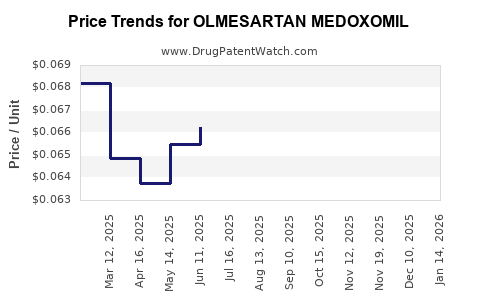
Featured answer: Even when unit volumes stabilize, net sales fall due to rebate escalation, tender pressure, and payer concentration in large accounts.
Mechanics of gross-to-net erosion
- As generics enter, brand manufacturers typically increase rebates to defend share.
- Wholesaler and GPO contracts push price down even when list prices remain stable.
- Conversion to generics reduces average selling price and increases sales volatility.
What formulation and combination opportunities exist for revenue stabilization?
Featured answer: Revenue stabilization tends to come from fixed-dose combinations and alternative dosage strengths that preserve formulary relevance longer than monotherapy.
Combination therapy relevance
- ARB plus diuretic is common in guideline algorithms.
- A combination can stay preferred within formularies even as monotherapy faces substitution.
- The competitive threat is that combination generics eventually launch too, compressing the window further.
Patient adherence and switching
Combination products can improve adherence and reduce pill burden, supporting persistence of demand relative to pure substitution, but they still face generic penetration.
What is the IP and generic entry risk profile for olmesartan medoxomil?
Featured answer: For decision-making in 2026, the IP-driven risk profile for olmesartan medoxomil monotherapy is primarily a legacy consideration. Commercial risk is mostly already realized through generic competition; incremental IP impact comes from combination formulations or specific manufacturing/secondary patents.
Patent estate dynamics in mature ARBs
In ARBs after primary compound patent expiry:
- secondary patents can exist for formulations, salts, processes, polymorphs, and combinations
- litigation can occur, but it rarely reverses class-level substitution outcomes once authorized generics and multiple generic players scale
How strong is the patent estate for olmesartan medoxomil in 2026?
Featured answer: Patent strength is commercially secondary in most major markets because generic entry has largely completed. Any remaining enforceable rights tend to be narrower: specific formulations, combination products, or manufacturing methods.
How that changes the risk model
- For licensing or litigation investment, the relevant question shifts from “is olmesartan patent protected?” to “which specific product forms and markets still have enforceable rights?”
- For generic launch strategy, the risk centers on narrower patents and potential settlement terms rather than broad compound coverage.
What generic entry scenarios are most likely for olmesartan medoxomil’s remaining protected products?
Featured answer: The most likely scenario is ongoing generic penetration of any remaining combination dosage forms and strengths, with launch timing shaped by (1) regulatory filing approvals, (2) remaining IP obstacles, and (3) litigation/settlement outcomes tied to specific products.
Launch timing drivers
- Paragraph IV is relevant only if the product is still tied to Orange Book-listed patents for a specific NDA.
- If Orange Book listing coverage is expired for that product, launch proceeds without IP delay.
- If settlements exist, launch timing can be moved out by contract even if litigation is not ongoing.
What Orange Book status considerations matter for olmesartan medoxomil product planning?
Featured answer: Any remaining Orange Book protections affect product-level launch timelines rather than monotherapy class economics.
Decision points for product-level planning
- Determine which olmesartan medoxomil NDA(s) and combination NDAs still list active patents.
- Map claims to potential generic design-arounds.
- Evaluate risk of delayed launch due to settlement terms.
How does olmesartan medoxomil compare with other ARBs in market maturity and pricing pressure?
Featured answer: Olmesartan is among the more established ARBs and experiences similar class-wide pressure, with pricing dominated by generic substitutes and rebate dynamics.
Comparative commercialization patterns
- All ARBs face similar generic erosion schedules once compound patents expire.
- Differences show up mainly in:
- timing of patent expiry across brands
- combination product portfolios
- formulary preferences in large payer contracts
- local regulatory speed for generics
What litigation and settlement dynamics historically matter for ARB generics, and how does that translate to olmesartan?
Featured answer: In ARBs, the primary commercial impact of litigation is launch-delay risk on still-protected product forms, not long-term brand restoration.
Practical effect on financial trajectory
- Settlement terms tend to monetize the risk of delayed generic entry and can temporarily sustain brand net sales for a subset of products.
- Once multiple generic players enter, price compression resumes regardless of earlier litigation.
What manufacturing and supply-chain economics influence gross margin for olmesartan products?
Featured answer: In generic-heavy markets, margin is driven by cost of goods, scale, and payer rebate intensity, not by therapeutic differentiation.
Key cost/margin levers
- API and intermediate sourcing economics
- captive vs toll manufacturing mix
- tender pricing and contract duration
- distribution channel leverage
Key data table: market dynamics drivers and financial impact (condensed)
| Market driver |
Primary impact on net sales |
Primary impact on margin |
Typical timing |
| Generic entry into monotherapy |
unit share loss, ASP compression |
margin compression via low price competition |
early and rapid after expiry |
| Rebates/contracting pressure |
gross-to-net decline |
further margin compression |
accelerates post-generic |
| Formulary switching rules |
demand volume shift to lowest-cost ARBs |
reduces ability to maintain price |
ongoing |
| Combination product mix |
slows decline for subsets |
moderate margin support until combination generics |
intermediate |
| Labeling risk perception |
reduces new starts |
mixed, depending on supply strategy |
variable, can be persistent |
| Tender/reference pricing |
steep pricing reductions |
margin squeeze |
country-specific and periodic |
Key Takeaways
- Olmesartan medoxomil is a mature ARB where financial trajectory is dominated by generic erosion and payer rebate intensity rather than active exclusivity.
- Market dynamics favor the lowest-cost ARB anchors and preferred formulary positioning, with olmesartan persisting mainly through inertia and combination product relevance.
- The biggest remaining commercial swing factors are product-specific IP coverage (often narrower rights around combinations) and contract-level rebate/tender strategies that determine net sales after generic penetration.
- In 2026 planning, the revenue model is a net-share and net-price problem, not a brand monopoly problem: optimization hinges on mix (combination vs monotherapy), payer access, and cost-to-serve economics.
FAQs
1) Will olmesartan medoxomil face new revenue loss if additional ARB competitors launch?
Revenue pressure will track payer cost-minimization behavior. In late-stage markets, incremental competitor entries typically compress net pricing further through rebate and tender competition.
2) Which product type matters most for keeping olmesartan medoxomil revenues higher: monotherapy or combinations?
Combinations tend to provide longer formulary persistence, but they also eventually face combination-generic penetration. Net impact depends on where IP coverage and formulary preference align.
3) Does olmesartan medoxomil pricing depend more on ASP list prices or rebates and discounts?
Net sales and gross-to-net are usually dominated by rebates, discounts, and payer contracts once generics establish a lower-cost benchmark.
4) How do risk perceptions from labeling issues change prescribing behavior in ARBs like olmesartan?
They can reduce new patient starts and trigger earlier discontinuation in susceptible patients, impacting incremental demand even if generics are widely available.
5) What is the most important timing factor for a generic entry decision for olmesartan products still on the Orange Book?
The relevant factor is whether specific listed patents for a given NDA or combination product are still in force and whether any settlements delay effective launch for that product.