You're using a free limited version of DrugPatentWatch: Upgrade for Complete Access

Last Updated: December 15, 2025

NOURIANZ Drug Patent Profile


✉ Email this page to a colleague

« Back to Dashboard


Which patents cover Nourianz, and what generic alternatives are available?

Nourianz is a drug marketed by Kyowa Kirin and is included in one NDA. There are two patents protecting this drug and one Paragraph IV challenge.

This drug has forty-nine patent family members in seventeen countries.

The generic ingredient in NOURIANZ is istradefylline. There is one drug master file entry for this compound. One supplier is listed for this compound. Additional details are available on the istradefylline profile page.

DrugPatentWatch® Generic Entry Outlook for Nourianz

Nourianz was eligible for patent challenges on August 27, 2023.

By analyzing the patents and regulatory protections it appears that the earliest date for generic entry will be September 5, 2027. This may change due to patent challenges or generic licensing.

There is one Paragraph IV patent challenge for this drug. This may lead to patent invalidation or a license for generic production.

Indicators of Generic Entry

< Available with Subscription >

  Get Started Free

AI Deep Research
Questions you can ask:
  • What is the 5 year forecast for NOURIANZ?
  • What are the global sales for NOURIANZ?
  • What is Average Wholesale Price for NOURIANZ?
Summary for NOURIANZ
International Patents:49
US Patents:2
Applicants:1
NDAs:1
Finished Product Suppliers / Packagers: 1
Raw Ingredient (Bulk) Api Vendors: 92
Clinical Trials: 3
Patent Applications: 1,040
Drug Prices: Drug price information for NOURIANZ
What excipients (inactive ingredients) are in NOURIANZ?NOURIANZ excipients list
DailyMed Link:NOURIANZ at DailyMed
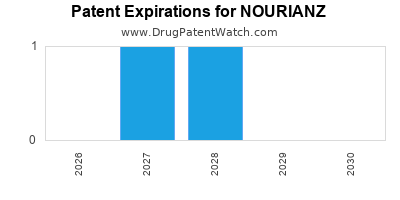
Drug patent expirations by year for NOURIANZ
Drug Prices for NOURIANZ

See drug prices for NOURIANZ

DrugPatentWatch® Estimated Loss of Exclusivity (LOE) Date for NOURIANZ
Generic Entry Date for NOURIANZ*:
Constraining patent/regulatory exclusivity:
NDA:
Dosage:
TABLET;ORAL

*The generic entry opportunity date is the latter of the last compound-claiming patent and the last regulatory exclusivity protection. Many factors can influence early or later generic entry. This date is provided as a rough estimate of generic entry potential and should not be used as an independent source.

Recent Clinical Trials for NOURIANZ

Identify potential brand extensions & 505(b)(2) entrants

SponsorPhase
Georgetown UniversityPhase 4
Kyowa Kirin, Inc.Phase 4
ALS AssociationPhase 1/Phase 2

See all NOURIANZ clinical trials

Paragraph IV (Patent) Challenges for NOURIANZ
Tradename Dosage Ingredient Strength NDA ANDAs Submitted Submissiondate
NOURIANZ Tablets istradefylline 20 mg and 40 mg 022075 1 2025-08-13

US Patents and Regulatory Information for NOURIANZ

NOURIANZ is protected by two US patents.

Based on analysis by DrugPatentWatch, the earliest date for a generic version of NOURIANZ is ⤷  Get Started Free.

This potential generic entry date is based on patent 8,318,201.

Generics may enter earlier, or later, based on new patent filings, patent extensions, patent invalidation, early generic licensing, generic entry preferences, and other factors.

Applicant Tradename Generic Name Dosage NDA Approval Date TE Type RLD RS Patent No. Patent Expiration Product Substance Delist Req. Exclusivity Expiration
Kyowa Kirin NOURIANZ istradefylline TABLET;ORAL 022075-001 Aug 27, 2019 RX Yes No 7,727,993 ⤷  Get Started Free Y ⤷  Get Started Free
Kyowa Kirin NOURIANZ istradefylline TABLET;ORAL 022075-002 Aug 27, 2019 RX Yes Yes 8,318,201 ⤷  Get Started Free Y ⤷  Get Started Free
Kyowa Kirin NOURIANZ istradefylline TABLET;ORAL 022075-001 Aug 27, 2019 RX Yes No 8,318,201 ⤷  Get Started Free Y ⤷  Get Started Free
Kyowa Kirin NOURIANZ istradefylline TABLET;ORAL 022075-002 Aug 27, 2019 RX Yes Yes 7,727,993 ⤷  Get Started Free Y ⤷  Get Started Free
>Applicant >Tradename >Generic Name >Dosage >NDA >Approval Date >TE >Type >RLD >RS >Patent No. >Patent Expiration >Product >Substance >Delist Req. >Exclusivity Expiration

Expired US Patents for NOURIANZ

Applicant Tradename Generic Name Dosage NDA Approval Date Patent No. Patent Expiration
Kyowa Kirin NOURIANZ istradefylline TABLET;ORAL 022075-002 Aug 27, 2019 7,541,363 ⤷  Get Started Free
Kyowa Kirin NOURIANZ istradefylline TABLET;ORAL 022075-001 Aug 27, 2019 7,541,363 ⤷  Get Started Free
Kyowa Kirin NOURIANZ istradefylline TABLET;ORAL 022075-002 Aug 27, 2019 7,727,994 ⤷  Get Started Free
Kyowa Kirin NOURIANZ istradefylline TABLET;ORAL 022075-001 Aug 27, 2019 7,727,994 ⤷  Get Started Free
>Applicant >Tradename >Generic Name >Dosage >NDA >Approval Date >Patent No. >Patent Expiration

EU/EMA Drug Approvals for NOURIANZ

Company Drugname Inn Product Number / Indication Status Generic Biosimilar Orphan Marketing Authorisation Marketing Refusal
Kyowa Kirin Holdings B.V. Nouryant istradefylline EMEA/H/C/005308Istradefylline is indicated in adults as an adjunctive treatment to levodopa based regimens in patients with Parkinson’s disease (PD) experiencing “OFF” time. Refused no no no 2022-01-06
>Company >Drugname >Inn >Product Number / Indication >Status >Generic >Biosimilar >Orphan >Marketing Authorisation >Marketing Refusal

International Patents for NOURIANZ

See the table below for patents covering NOURIANZ around the world.

Country Patent Number Title Estimated Expiration
World Intellectual Property Organization (WIPO) 03063876 ⤷  Get Started Free
Portugal 2260850 ⤷  Get Started Free
Japan WO2005030219 ジアリールビニレン化合物の安定化方法 ⤷  Get Started Free
Japan 4606326 ⤷  Get Started Free
>Country >Patent Number >Title >Estimated Expiration

Market Dynamics and Financial Trajectory for Nourianz (Istradefylline)

Last updated: July 27, 2025

Introduction

Nourianz (istradefylline), a targeted adenosine A2A receptor antagonist, received FDA approval in 2019 as an adjunctive therapy for adults with Parkinson’s disease experiencing "off" episodes. Since then, its commercialization has provided crucial insights into its market performance, competitive landscape, and future financial prospects. This analysis explores the evolving market dynamics and forecasted financial trajectory for Nourianz, considering factors such as therapeutic value, competitive positioning, regulatory developments, and market penetration strategies.

Market Overview and Therapeutic Context

Parkinson’s disease (PD) affects over 10 million individuals globally, with symptomatic treatments primarily comprising dopaminergic agents such as levodopa and dopamine agonists. "Off" episodes—periods of worsening motor symptoms—are a significant clinical challenge, prompting need for adjunct therapies. Currently, the market for PD adjuncts includes drugs like COMT inhibitors, MAO-B inhibitors, and more recently, adenosine receptor antagonists.

Nourianz’s unique mechanism targets the adenosine A2A receptor, modulating basal ganglia circuits to improve motor function without the dopaminergic side effects associated with some therapies. This mechanism positions Nourianz as a complementary option rather than a replacement, impacting its market dynamics in a competitive arena.

Market Dynamics

  1. Regulatory and Reimbursement Landscape

Since its approval, Nourianz’s market uptake has been shaped by regulatory considerations across key geographies. The FDA’s designation as an adjunct therapy for PD “off” episodes provides a clear clinical niche; however, reimbursement policies significantly influence market penetration.

In the U.S., initial reimbursement coverage was limited but has improved following publication of real-world data demonstrating efficacy, as well as negotiations with payers. Elsewhere, in regions like Europe and Asia, regulatory acceptance varies, with some countries’ health authorities requiring additional local clinical data, influencing global adoption trajectories.

  1. Competitive Environment

Nourianz enters a crowded PD adjunct therapy market. Its primary competitors include:

  • Entacapone and Tolcapone: COMT inhibitors that extend levodopa’s half-life.
  • Safinamide: A reversible MAO-B inhibitor.
  • Amantadine: For dyskinesias and "off" episodes.
  • Emerging therapies: Including gene therapies and novel dopamine receptor modulators.

While Nourianz’s novel mechanism offers differentiation, its market success depends on physician acceptance, real-world efficacy, and safety profile compared to existing therapies.

  1. Market Penetration and Adoption

Initial sales post-launch were modest but showed gradual growth, driven by:

  • Physician education: Increasing awareness among neurologists.
  • Patient adherence: Favorable safety profile suits chronic use.
  • Pricing strategies: Competitive pricing relative to existing therapies.

Adoption has been enhanced by inclusion in clinical guidelines, with data from phase IV studies further validating its role.

  1. Pricing and Revenue Generation

Pricing strategies directly impact revenue prospects. Given the chronic nature of PD and long-term treatment needs, Nourianz’s pricing has been set to balance profitability and payer acceptance. Its cost-effectiveness is under assessment, especially as healthcare systems scrutinize high-cost therapeutics.

  1. Pipeline and Future Indications

While currently approved solely for PD "off" episodes, preclinical and early clinical data suggest potential for expanded indications, including other neurodegenerative conditions. Securing approval for additional uses can diversify revenue streams and enhance its market size.

Financial Trajectory: Projections and Trends

  1. Short-term (1-3 years)
  • Sales Growth: Expected to increase as awareness grows and prescriptions rise, with a projected compound annual growth rate (CAGR) of approximately 20-25% during this period.
  • Revenue Estimates: Based on US sales data, revenues could reach $200-300 million within this timeframe if market adoption accelerates, considering current market size estimates.
  1. Mid-term (4-7 years)
  • Market Expansion: Entry into international markets and potential label expansions target additional PD patient subgroups.
  • Market Share: Likely to stabilize at around 10-15% of the PD adjunct therapy segment, contingent upon competition and real-world performance.
  • Revenue Milestones: Projected revenues could surpass $500 million globally, factoring in new indications and increased adoption.
  1. Long-term (8+ years)
  • Market Saturation: Growth slows as the prevalence of PD stabilizes and competitors introduce alternative therapies.
  • Lifecycle Management: Opportunities in combination therapies, biosimilars (if applicable), and digital adherence tools may sustain revenues.
  • Potential for Exit or Partnership: Larger pharmaceutical players may acquire or partner for marketing or strategic expansion, impacting overall financial trajectory.

Factors Influencing Financial Outcomes

  • Clinical Efficacy and Safety: Demonstrated benefits over existing therapies will be pivotal.
  • Regulatory Approvals: Broader indications can significantly boost revenues.
  • Market Competition: Competitive innovations may cap growth unless Nourianz’s advantages are clearly established.
  • Pricing and Reimbursement: Favorable reimbursement policies are critical for widespread adoption.
  • Global Market Penetration: Entry strategies in emerging markets present growth opportunities but require tailored approaches.

Conclusion

Nourianz’s market dynamics are characterized by gradual adoption driven by its unique mechanism, evolving regulatory and reimbursement landscapes, and the competitive nature of PD therapeutics. Its financial trajectory shows promising growth potential, contingent on strategic positioning, clinical validation, and market expansion efforts. As Parkinson’s disease prevalence rises and unmet needs persist, Nourianz’s role as an adjunct therapy is poised to become increasingly significant, promising a steady revenue stream for stakeholders willing to navigate the complexities of neurodegenerative therapeutics.


Key Takeaways

  • Nourianz enters a competitive PD adjunct landscape with a unique mechanism, offering differentiation but facing adoption challenges.
  • The drug’s growth depends heavily on reimbursement policies, physician acceptance, and clinical data validating its efficacy and safety.
  • Short-term revenues are projected to grow steadily, with mid- to long-term potential driven by global expansion and label extensions.
  • Competitive innovations and market saturation pose risks; continuous evidence generation and strategic collaborations are vital.
  • Emerging markets and combination therapies represent opportunities to diversify revenue sources and extend lifecycle value.

FAQs

1. What are the primary competitive advantages of Nourianz compared to existing PD therapies?
Nourianz’s selective adenosine A2A receptor antagonism presents a novel mechanism with a favorable safety profile, offering symptomatic relief in "off" episodes without dopaminergic side effects. This positions it as an adjunct rather than a replacement, potentially enhancing tolerability and combinability.

2. How has reimbursement affected Nourianz’s market penetration?
Reimbursement policies initially limited access, but improved acceptance after demonstrating cost-effectiveness and efficacy in real-world studies has gradually expanded coverage, facilitating increased prescriptions.

3. Are there plans for expanding Nourianz's indications?
Currently focused on PD "off" episodes, future expansion depends on ongoing clinical trials assessing efficacy in related neurodegenerative conditions. Such extensions could significantly impact its market size.

4. How does Nourianz compare price-wise to other PD adjunct therapies?
Pricing strategies aim for competitive positioning, balancing affordability with profitability. Real-world budget impact assessments influence payer acceptance, which in turn affects market penetration.

5. What are the primary risks to Nourianz’s financial growth?
Key risks include competitors releasing more effective or better-tolerated therapies, regulatory hurdles for new indications, pricing disagreements with payers, and limited physician acceptance.


References

  1. U.S. Food and Drug Administration (2019). FDA approves Nourianz for Parkinson’s "off" episodes.
  2. Market data on Parkinson’s disease therapeutics (2022).
  3. Clinical trial repositories and published studies on Nourianz.
  4. Industry reports on neurodegenerative drug market projections.
  5. Regulatory guidelines and reimbursement policies in major markets.

More… ↓

⤷  Get Started Free

Make Better Decisions: Try a trial or see plans & pricing

Drugs may be covered by multiple patents or regulatory protections. All trademarks and applicant names are the property of their respective owners or licensors. Although great care is taken in the proper and correct provision of this service, thinkBiotech LLC does not accept any responsibility for possible consequences of errors or omissions in the provided data. The data presented herein is for information purposes only. There is no warranty that the data contained herein is error free. We do not provide individual investment advice. This service is not registered with any financial regulatory agency. The information we publish is educational only and based on our opinions plus our models. By using DrugPatentWatch you acknowledge that we do not provide personalized recommendations or advice. thinkBiotech performs no independent verification of facts as provided by public sources nor are attempts made to provide legal or investing advice. Any reliance on data provided herein is done solely at the discretion of the user. Users of this service are advised to seek professional advice and independent confirmation before considering acting on any of the provided information. thinkBiotech LLC reserves the right to amend, extend or withdraw any part or all of the offered service without notice.