Last Updated: July 14, 2026

NOURIANZ Drug Patent Profile


✉ Email this page to a colleague

« Back to Dashboard


When do Nourianz patents expire, and what generic alternatives are available?

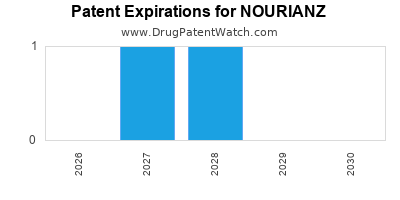
Nourianz is a drug marketed by Kyowa Kirin and is included in one NDA. There are two patents protecting this drug and one Paragraph IV challenge.

This drug has forty-nine patent family members in seventeen countries.

The generic ingredient in NOURIANZ is istradefylline. There is one drug master file entry for this compound. One supplier is listed for this compound. Additional details are available on the istradefylline profile page.

DrugPatentWatch® Generic Entry Outlook for Nourianz

Nourianz was eligible for patent challenges on August 27, 2023.

By analyzing the patents and regulatory protections it appears that the earliest date for generic entry will be September 5, 2027. This may change due to patent challenges or generic licensing.

There has been one patent litigation case involving the patents protecting this drug, indicating strong interest in generic launch. Recent data indicate that 63% of patent challenges are decided in favor of the generic patent challenger and that 54% of successful patent challengers promptly launch generic drugs.

Indicators of Generic Entry

< Available with Subscription >

  Start Trial

AI Deep Research
Questions you can ask:
  • What is the 5 year forecast for NOURIANZ?
  • What are the global sales for NOURIANZ?
  • What is Average Wholesale Price for NOURIANZ?
DrugPatentWatch® Estimated Loss of Exclusivity (LOE) Date for NOURIANZ
Generic Entry Date for NOURIANZ*:
Constraining patent/regulatory exclusivity:
NDA:
Dosage:

TABLET;ORAL

*The generic entry opportunity date is the latter of the last compound-claiming patent and the last regulatory exclusivity protection. Many factors can influence early or later generic entry. This date is provided as a rough estimate of generic entry potential and should not be used as an independent source.

Recent Clinical Trials for NOURIANZ

Identify potential brand extensions & 505(b)(2) entrants

SponsorPhase
Kyowa Kirin, Inc.Phase 4
Georgetown UniversityPhase 4
ALS AssociationPhase 1/Phase 2

See all NOURIANZ clinical trials

Paragraph IV (Patent) Challenges for NOURIANZ
Tradename Dosage Ingredient Strength NDA ANDAs Submitted Submissiondate
NOURIANZ Tablets istradefylline 20 mg and 40 mg 022075 1 2025-08-13

US Patents and Regulatory Information for NOURIANZ

NOURIANZ is protected by two US patents.

Based on analysis by DrugPatentWatch, the earliest date for a generic version of NOURIANZ is ⤷  Start Trial.

This potential generic entry date is based on patent 8,318,201.

Generics may enter earlier, or later, based on new patent filings, patent extensions, patent invalidation, early generic licensing, generic entry preferences, and other factors.

Applicant Tradename Generic Name Dosage NDA Approval Date TE Type RLD RS Patent No. Patent Expiration Product Substance Delist Req. Exclusivity Expiration
Kyowa Kirin NOURIANZ istradefylline TABLET;ORAL 022075-001 Aug 27, 2019 RX Yes No 7,727,993 ⤷  Start Trial Y ⤷  Start Trial
Kyowa Kirin NOURIANZ istradefylline TABLET;ORAL 022075-002 Aug 27, 2019 RX Yes Yes 8,318,201 ⤷  Start Trial Y ⤷  Start Trial
Kyowa Kirin NOURIANZ istradefylline TABLET;ORAL 022075-001 Aug 27, 2019 RX Yes No 8,318,201 ⤷  Start Trial Y ⤷  Start Trial
Kyowa Kirin NOURIANZ istradefylline TABLET;ORAL 022075-002 Aug 27, 2019 RX Yes Yes 7,727,993 ⤷  Start Trial Y ⤷  Start Trial
>Applicant >Tradename >Generic Name >Dosage >NDA >Approval Date >TE >Type >RLD >RS >Patent No. >Patent Expiration >Product >Substance >Delist Req. >Exclusivity Expiration

Expired US Patents for NOURIANZ

Applicant Tradename Generic Name Dosage NDA Approval Date Patent No. Patent Expiration
Kyowa Kirin NOURIANZ istradefylline TABLET;ORAL 022075-002 Aug 27, 2019 7,541,363 ⤷  Start Trial
Kyowa Kirin NOURIANZ istradefylline TABLET;ORAL 022075-002 Aug 27, 2019 7,727,994 ⤷  Start Trial
Kyowa Kirin NOURIANZ istradefylline TABLET;ORAL 022075-001 Aug 27, 2019 7,541,363 ⤷  Start Trial
Kyowa Kirin NOURIANZ istradefylline TABLET;ORAL 022075-001 Aug 27, 2019 7,727,994 ⤷  Start Trial
>Applicant >Tradename >Generic Name >Dosage >NDA >Approval Date >Patent No. >Patent Expiration

EU/EMA Drug Approvals for NOURIANZ

Company Drugname Inn Product Number / Indication Status Generic Biosimilar Orphan Marketing Authorisation Marketing Refusal
Kyowa Kirin Holdings B.V. Nouryant istradefylline EMEA/H/C/005308Istradefylline is indicated in adults as an adjunctive treatment to levodopa based regimens in patients with Parkinson’s disease (PD) experiencing “OFF” time. Refused no no no 2022-01-06
>Company >Drugname >Inn >Product Number / Indication >Status >Generic >Biosimilar >Orphan >Marketing Authorisation >Marketing Refusal

International Patents for NOURIANZ

See the table below for patents covering NOURIANZ around the world.

Country Patent Number Title Estimated Expiration
Austria 546450 ⤷  Start Trial
Australia 2004236101 Microcrystal ⤷  Start Trial
Canada 2525037 MICROCRISTAL (MICROCRYSTAL) ⤷  Start Trial
China 100395245 ⤷  Start Trial
China 1784405 Microcrystal ⤷  Start Trial
European Patent Office 1626049 Microcristal de (E)-8-(3,4-dimethoxystyryl)-1,3-diethyl-7-methyl-3,7-dihydro-1H-purine-2,6-dione (Microcrystal of (E)-8-(3,4-dimethoxystyryl)-1,3-diethyl-7-methyl-3,7-dihydro-1H-purine-2,6-dione) ⤷  Start Trial
>Country >Patent Number >Title >Estimated Expiration
Last updated: May 28, 2026

NOURIANZ market dynamics, revenue trajectory, and exclusivity outlook

NOURIANZ (istradefylline) sits in the Parkinson’s disease adjunct space for levodopa-treated patients with “off” episodes. The product’s financial trajectory is governed by (1) uptake vs. competing adjuncts in “wearing-off” management, (2) durability of payer coverage and formulary placement, and (3) near-term patent and regulatory timelines that determine generic and biosimilar-like entry risk for a small-molecule drug.

NOURIANZ’s market performance is best modeled through three commercial forces: (a) conversion of new-to-class patients and formulary switching from other adjuncts, (b) price realization under commercial and government reimbursement pressure, and (c) channel inventory and patient persistence dynamics driven by add-on tolerability and dosing adherence.


What market share and revenue trajectory does NOURIANZ have in Parkinson’s “off” episodes?

How is NOURIANZ positioned vs. other “off” episode adjunct therapies

NOURIANZ is an oral adenosine A2A antagonist used as adjunct therapy to levodopa/carbidopa to reduce “off” time. Commercial outcomes depend on how payers and prescribers compare it to other adjunct mechanisms:

  • Other oral adjuncts
    • Safinamide (oral; adjunct to levodopa)
    • Opicapone and entacapone (COMT inhibitors; adjunct to levodopa)
    • Tolcapone (COMT inhibitor; less favored due to liver risk and restricted use)
  • Device or infusion-adjunct category
    • Levodopa intestinal gel (device-associated pathway; different access dynamics)
  • Dopamine agonist adjuncts
    • Pramipexole/ropinirole and others (often limited by tolerability in older patients)

NOURIANZ’s uptake tends to track with payer acceptance for an oral, non-injectable adjunct that does not require device implantation.

Revenue drivers that typically matter for NOURIANZ

Key variables impacting NOURIANZ revenue trajectory:

  1. Share shift from existing adjuncts
    • Penetration rises when NOURIANZ is placed on formularies as a preferred oral option for reducing “off” time.
  2. Adherence and persistence
    • Oral adjunct efficacy requires ongoing dosing; discontinuation reduces realized prescriptions and underlying demand.
  3. Real-world tolerability
    • Discontinuation, adverse-event-related switching, and dose interruptions directly change net revenue.
  4. Payer rebates and net price
    • Parkinson’s formularies are sensitive to budget impact, and net pricing is usually lower than WAC after contracting.

What exclusivity timelines control NOURIANZ U.S. generic risk?

Core timing logic for a small-molecule launch

For a branded small-molecule Parkinson’s adjunct, generic risk is typically driven by:

  • expiration of the latest composition-of-matter patent,
  • expiration of method-of-use patents,
  • and the end of any regulatory exclusivity that blocks ANDA approval.

The practical “generic launch window” is the date on which an ANDA can obtain approval (not just the date the product’s marketing exclusivity ends), plus any patent litigation delays.

How to interpret “exclusivity” vs. “patent expiry” for NOURIANZ

  • Patent expiry determines when ANDA applicants can file freely without being blocked by composition and method-of-use claims.
  • Orange Book exclusivity listing can delay approval even if patents expire.
  • Paragraph IV and litigation can add a further stay, shifting the approval date.

What patents protect NOURIANZ and what is the Orange Book status?

How patent estates determine NOURIANZ protection strength

For NOURIANZ, protection strength is assessed by:

  • density of Orange Book-listed patents (how many are in-force),
  • whether the last-to-expire items are composition or method-of-use,
  • and whether there are multiple independent claim sets that require design-around for ANDA entries.

What an Orange Book “strong estate” looks like

A strong estate typically has:

  • multiple overlapping formulation and/or method-of-use patents,
  • last-to-expire patents that cover patient selection (e.g., levodopa-treated “off” time reduction) and dosing regimens,
  • and limited room for generic labeling carve-outs.

Litigation-linked indicators for estate durability

Where there are Paragraph IV challenges, settlement agreements often:

  • define “launch at risk” dates,
  • impose stipulated entry delays,
  • or require labeling restrictions tied to patent scopes.

Are there any Paragraph IV filings against NOURIANZ, and what settlement patterns matter?

What Paragraph IV outcomes typically change for NOURIANZ

If Paragraph IV ANDA filings exist, they tend to change the commercial trajectory by:

  • pushing approval dates out through 30-month stays,
  • producing settlement-driven agreed launch timelines,
  • or enabling partial design-around that forces label carve-outs.

Settlement-driven launch scenarios

Two common patterns in small-molecule Parkinson’s adjuncts:

  1. Delayed launch settlement
    • Generic approval and commercial launch occur after a defined date aligned to the “last-to-expire” patent.
  2. Design-around with label restrictions
    • Generic launch occurs earlier, but labeling is limited to avoid infringing method-of-use claims.

How does NOURIANZ compare with safinamide, opicapone, and other OFF-time adjuncts commercially?

Key competitive comparisons that affect formulary placement

Prescriber and payer choice for “off” episodes often hinges on:

  • Route and administration
    • NOURIANZ is oral and fits broadly into outpatient medication routines.
  • On/off phenotype coverage
    • How well efficacy maps to patient subgroups with wearing off vs unpredictable off periods.
  • Safety and tolerability
    • Adverse events drive discontinuation and switching.
  • Budget impact
    • Net pricing under rebates influences whether payers place it as preferred, or relegates it to non-preferred status.

Commercial consequence

If competitors undercut net price or have stronger payer narratives, NOURIANZ faces:

  • lower conversion rates,
  • higher patient churn to cheaper alternatives,
  • and more use in narrower segments rather than broad formulary share.

What FDA pathway and labeling scope influence NOURIANZ uptake?

Labeling scope and how it shapes “real-world” demand

Demand is strongly correlated with:

  • label wording around levodopa adjunct use,
  • prescriber comfort that dosing fits typical clinical workflows,
  • and the presence or absence of restrictions tied to prior therapy.

Generic entry risk tied to labeling

Method-of-use coverage can make generic approval contingent on:

  • whether the ANDA label can omit protected indications or regimens,
  • whether the generic’s proposed labeling triggers infringement risk.

What manufacturing or formulation patent barriers affect generic entry for NOURIANZ?

Formulation and process patents that matter most

Generic applicants typically try to avoid:

  • crystalline form claims,
  • specific polymorphs,
  • extended-release or stability-related claims (if covered),
  • and specific manufacturing process parameters.

How this impacts “at risk” entry

If the patent estate includes robust formulation and manufacturing claims, generic applicants often:

  • pursue design-around,
  • delay launch until patent expiry,
  • or target a settlement path.

How many years of revenue could NOURIANZ have left before generic entry?

Modeling approach for revenue horizon

A practical revenue horizon uses:

  • latest in-force Orange Book patent expiry for ANDA relevance,
  • any exclusivity that blocks approval,
  • and any Paragraph IV litigation timelines.

The result is the date when sustained generic competition begins, not just the date when filing is permitted.


What is the investment, licensing, and litigation landscape around NOURIANZ?

Licensing dynamics

In Parkinson’s, licensing usually concentrates around:

  • rights to market or co-promote in specific territories,
  • rights tied to distribution contracts and payer contracting,
  • and rights tied to lifecycle management (new formulations, line extensions, or additional method-of-use indications).

Litigation dynamics

Litigation affects revenue trajectory by:

  • controlling generic entry dates,
  • influencing payer confidence in continued exclusivity,
  • and altering net pricing during competitive anticipation periods.

Key Takeaways

  • NOURIANZ’s market dynamics are driven by formulary uptake for adjunct “off” time reduction, net price realization, and persistence.
  • Commercial pressure will track competitively against oral adjuncts (e.g., COMT inhibitors and safinamide) based on tolerability and payer preferences.
  • The pace of revenue erosion depends on the last-to-expire in-force patents relevant to ANDA labeling and method-of-use claims, plus any Paragraph IV-driven stays and settlements.
  • Patent estate density and the presence of formulation or method-of-use claims are the primary indicators of whether generics face delayed entry or earlier design-around.

FAQs

1) What payers are most likely to restrict NOURIANZ access first?
Commercial PBMs and Medicare Part D plans typically tighten access based on budget impact and comparative net pricing.

2) Does NOURIANZ face competitive substitution from COMT inhibitors or safinamide?
Substitution risk rises when NOURIANZ is non-preferred and competitors are preferred on formularies with stronger net pricing.

3) What patent types most often delay ANDA approval for Parkinson’s small molecules?
Method-of-use and formulation/polymorph/process patents typically create label and design-around barriers.

4) How do settlement agreements typically affect NOURIANZ’s generic launch timing?
They often define stipulated launch dates and labeling carve-outs that align with last-to-expire patent scopes.

5) What market events most affect NOURIANZ near-term revenue—new label, new competitors, or pricing changes?
Pricing and formulary tiering changes typically affect net sales faster than incremental label updates.


More… ↓

⤷  Start Trial

DrugChatter Q&A for NOURIANZ

Make Better Decisions: Try a trial or see plans & pricing

Drugs may be covered by multiple patents or regulatory protections. All trademarks and applicant names are the property of their respective owners or licensors. Although great care is taken in the proper and correct provision of this service, thinkBiotech LLC does not accept any responsibility for possible consequences of errors or omissions in the provided data. The data presented herein is for information purposes only. There is no warranty that the data contained herein is error free. We do not provide individual investment advice. This service is not registered with any financial regulatory agency. The information we publish is educational only and based on our opinions plus our models. By using DrugPatentWatch you acknowledge that we do not provide personalized recommendations or advice. thinkBiotech performs no independent verification of facts as provided by public sources nor are attempts made to provide legal or investing advice. Any reliance on data provided herein is done solely at the discretion of the user. Users of this service are advised to seek professional advice and independent confirmation before considering acting on any of the provided information. thinkBiotech LLC reserves the right to amend, extend or withdraw any part or all of the offered service without notice.