Drug Sales Trends for NITRO-DUR
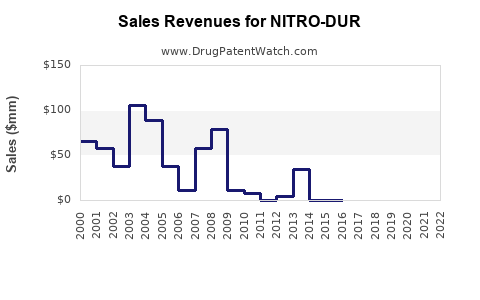
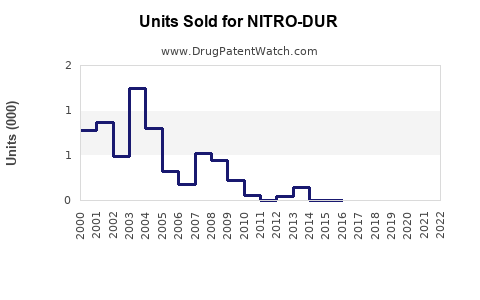
Annual Sales Revenues and Units Sold for NITRO-DUR
| Drug Name | Revenues (USD) | Units | Year |
|---|---|---|---|
| NITRO-DUR | ⤷ Start Trial | ⤷ Start Trial | 2022 |
| NITRO-DUR | ⤷ Start Trial | ⤷ Start Trial | 2021 |
| NITRO-DUR | ⤷ Start Trial | ⤷ Start Trial | 2020 |
| NITRO-DUR | ⤷ Start Trial | ⤷ Start Trial | 2019 |
| NITRO-DUR | ⤷ Start Trial | ⤷ Start Trial | 2018 |
| >Drug Name | >Revenues (USD) | >Units | >Year |
Nitro-Dur Market Analysis, Patent Status, Competitive Landscape, and Sales Projections
Nitro-Dur is a mature transdermal nitroglycerin product for the prevention of angina pectoris. Its commercial value is limited by generic competition, low-cost oral alternatives, an established therapeutic class, and the absence of meaningful remaining market exclusivity. A reasonable U.S. branded-sales estimate is approximately $3 million to $8 million annually, with a base-case decline to $1 million to $3 million by 2030. The broader U.S. transdermal nitroglycerin market is likely to remain commercially viable but small, with generic products accounting for most volume.
What is Nitro-Dur and how is it used?
Nitro-Dur is a transdermal delivery system containing nitroglycerin. The patch provides continuous nitrate exposure for prevention of angina attacks in patients with coronary artery disease. It is not intended to terminate an acute angina episode because transdermal absorption is too slow for rescue treatment. Sublingual nitroglycerin remains the standard rapid-relief product for acute symptoms. [1]
Available strengths have historically included 0.1, 0.2, 0.3, 0.4, 0.6 and 0.8 mg per hour. The patch is generally worn for a limited period each day, followed by a nitrate-free interval to reduce tolerance. The branded product competes with generic nitroglycerin transdermal systems and with non-patch antianginal therapies.
Nitro-Dur product profile
| Attribute | Nitro-Dur |
|---|---|
| Active ingredient | Nitroglycerin |
| Delivery system | Transdermal patch |
| Primary indication | Prevention of angina pectoris |
| Acute symptom treatment | No |
| FDA application | NDA 019872 |
| Therapeutic class | Organic nitrate |
| Product type | Small-molecule drug-device combination |
| Biosimilar exposure | None |
| Primary competitors | Generic nitroglycerin patches, isosorbide mononitrate, isosorbide dinitrate, beta blockers, calcium-channel blockers |
| Commercial maturity | Mature, largely genericized |
How large is the Nitro-Dur market?
The Nitro-Dur market is a niche segment within cardiovascular pharmaceuticals. The relevant market is not total coronary artery disease treatment. It is the much smaller market for chronic nitrate prophylaxis, particularly transdermal nitroglycerin.
A practical market definition includes:
- Branded Nitro-Dur prescriptions.
- Generic nitroglycerin transdermal patches.
- Hospital and outpatient dispensing.
- Mail-order and retail pharmacy sales.
- Limited institutional demand for nitrate patches where oral therapy is unsuitable.
The market has several structural constraints:
- Many patients with stable angina are treated with beta blockers, calcium-channel blockers, ranolazine or long-acting oral nitrates.
- Patch use requires scheduled nitrate-free intervals.
- The product does not replace sublingual nitroglycerin for acute attacks.
- Generic substitution is routine in U.S. retail pharmacy.
- Cardiovascular prescribing has shifted toward revascularization, statins, antiplatelet therapy and disease-modifying treatment rather than chronic nitrate monotherapy.
- The product has limited use in certain patients who cannot tolerate oral therapy or require a transdermal option.
Estimated U.S. market value
Public companies do not generally report Nitro-Dur revenue separately. The estimates below are analyst scenarios based on the product’s mature branded status, generic competition, likely unit economics and the absence of recent exclusivity.
| Segment | Estimated 2025 U.S. annual sales | Estimated 2030 U.S. annual sales | 2025-2030 trend |
|---|---|---|---|
| Nitro-Dur branded product | $3 million-$8 million | $1 million-$3 million | Declining |
| Generic nitroglycerin patches | $15 million-$35 million | $13 million-$32 million | Stable to modest decline |
| Total transdermal nitroglycerin market | $18 million-$43 million | $14 million-$35 million | Low-single-digit decline |
| Global transdermal nitroglycerin market | $40 million-$90 million | $35 million-$80 million | Flat to declining |
These figures represent market-sizing estimates rather than reported manufacturer revenue. The principal commercial conclusion is that Nitro-Dur is unlikely to generate material growth without a new formulation, new indication or reimbursement advantage.
What are the Nitro-Dur sales projections through 2030?
The most likely outcome is continued erosion in branded sales as pharmacies substitute generic patches and prescribers use alternative antianginal drugs.
Base-case sales projection
| Year | Estimated U.S. Nitro-Dur sales | Estimated U.S. generic patch sales | Key assumption |
|---|---|---|---|
| 2025 | $5.0 million | $25 million | Mature brand with limited residual preference |
| 2026 | $4.4 million | $24 million | Continued generic substitution |
| 2027 | $3.8 million | $23 million | Stable patient base, lower brand share |
| 2028 | $3.2 million | $22 million | Price and formulary pressure |
| 2029 | $2.7 million | $21 million | Further brand contraction |
| 2030 | $2.3 million | $20 million | Residual brand demand |
The base case implies a branded-sales compound annual growth rate of approximately negative 16% from 2025 through 2030.
Scenario analysis
| Scenario | 2025 Nitro-Dur sales | 2030 Nitro-Dur sales | Strategic driver |
|---|---|---|---|
| Upside | $8 million | $5 million | Supply disruptions affecting generics, brand continuity, niche prescriber loyalty |
| Base case | $5 million | $2.3 million | Gradual generic substitution |
| Downside | $3 million | Less than $1 million | Brand discontinuation, formulary exclusion or generic price compression |
The downside case is commercially credible because mature transdermal products can lose meaningful revenue after a manufacturer reduces promotion, limits distribution or exits the market. The upside case does not imply significant market expansion. It reflects temporary share capture or supply constraints.
What patents protect Nitro-Dur?
The original Nitro-Dur patent estate is effectively expired and does not provide a meaningful barrier to generic entry. The core technology, transdermal delivery of nitroglycerin for prophylaxis of angina, has been commercially available for decades.
Patent and exclusivity position
| Protection category | Nitro-Dur status |
|---|---|
| Original composition-of-matter patent | Expired |
| Core transdermal delivery protection | Expired or commercially immaterial |
| FDA new-drug exclusivity | Expired |
| Orphan-drug exclusivity | None identified |
| Pediatric exclusivity | None materially relevant |
| Active formulation exclusivity | No meaningful protection expected |
| Biosimilar exclusivity | Not applicable |
| Generic substitution barrier | Low |
The product is identified under FDA NDA 019872. Current commercial competition is governed primarily by manufacturing capability, FDA approval, pharmacy contracting, supply reliability and pricing rather than patent exclusion. [2]
What formulation patents protect nitroglycerin patches?
Historically, transdermal nitroglycerin products have relied on adhesive systems, rate-controlling membranes, backing layers and drug-reservoir designs. Those technologies can be patentable, but the relevant early patents have aged out. A new manufacturer could still obtain patents on a redesigned adhesive, low-irritation system, multilayer patch or manufacturing process. Such patents would protect only the new product architecture and would not restore exclusivity to the legacy Nitro-Dur product.
The strongest remaining intellectual-property opportunities would involve:
- Improved adhesion during sweating or movement.
- Reduced skin irritation.
- More consistent delivery across skin types.
- Longer wear time.
- Reduced nitrate tolerance.
- Lower-cost manufacturing.
- Combination delivery with another cardiovascular agent.
No such improvement is inherent in the legacy Nitro-Dur product.
What is the FDA regulatory status of Nitro-Dur?
Nitro-Dur is an FDA-approved prescription drug delivered through a transdermal system. Its regulatory position is mature. The product does not have the regulatory profile of a new molecular entity, biologic or first-in-class cardiovascular treatment.
FDA labeling emphasizes:
- Prevention rather than acute treatment of angina.
- A daily nitrate-free interval.
- Headache, dizziness and hypotension as important adverse effects.
- Contraindication with phosphodiesterase-5 inhibitors such as sildenafil, tadalafil and vardenafil because of the risk of severe hypotension.
- Potential loss of efficacy with continuous exposure. [1]
Orange Book status
The Orange Book identifies approved drug products and related patent and exclusivity information. Nitro-Dur’s original regulatory exclusivity has expired. Any current Orange Book listing would need to be reviewed by product-specific application and dosage form because FDA listings can change with manufacturer status, supplements and discontinuation records. [2]
The commercial implication is clear: Nitro-Dur does not depend on an active Orange Book patent to maintain its market position. Its residual sales depend on availability, prescriber familiarity and payer treatment.
Which companies are challenging Nitro-Dur?
Generic competition is the principal challenge. The relevant competitors are manufacturers of FDA-approved nitroglycerin transdermal systems rather than companies pursuing high-value Paragraph IV litigation.
Potential generic competitors have included major and specialty generic manufacturers that supply retail pharmacies, wholesalers and institutional channels. Product availability can vary by strength, manufacturer, dosage form and distribution status.
Paragraph IV risk
Paragraph IV risk is low as a current commercial issue because the core Nitro-Dur protection is old. Paragraph IV certifications may have been relevant when generic products first entered the market, but they are unlikely to create a new, durable barrier today.
A new Paragraph IV dispute would matter only if a manufacturer obtained a later-expiring patent on a specific formulation, device configuration or manufacturing method. Such a dispute would not normally block all generic nitroglycerin patches unless the patent claims covered the essential product architecture.
What patent litigation affects Nitro-Dur?
No major current patent litigation is central to the Nitro-Dur investment thesis. The product’s commercial risk is operational and market-based rather than litigation-based.
Key risks include:
- Generic supply interruptions.
- FDA manufacturing observations.
- Product discontinuation.
- Pharmacy benefit manager exclusion.
- Reimbursement reductions.
- Inconsistent availability of individual patch strengths.
- Substitution by oral nitrates or other antianginal agents.
A legacy product may have no active litigation yet still experience commercial decline if the sponsor reduces manufacturing capacity or promotional support.
How strong is the Nitro-Dur patent estate?
The Nitro-Dur patent estate is weak for investment and licensing purposes.
| Patent-estate factor | Assessment |
|---|---|
| Remaining exclusivity | Very low |
| Barrier to generic entry | Very low |
| Composition-of-matter protection | None of practical value |
| Formulation protection | Legacy protection no longer commercially decisive |
| Method-of-use protection | Expired or readily designed around |
| Manufacturing know-how | Moderate operational value, low exclusionary value |
| Regulatory switching cost | Low to moderate |
| Litigation leverage | Low |
| Licensing attractiveness | Low unless tied to a new delivery platform |
Manufacturing know-how may still matter. A transdermal patch requires control of adhesive uniformity, drug loading, release rate, pouch integrity and stability. These factors can create quality and supply advantages, but they do not substitute for patent exclusivity.
What generic entry risks exist for Nitro-Dur?
Generic entry risk is already realized rather than prospective. The central question is the rate of continued branded erosion.
Generic substitution is strongest where:
- Multiple manufacturers supply the same strength.
- The generic has AB-rated or otherwise substitutable status.
- Payers impose low or zero brand reimbursement.
- The prescribing physician does not specify brand-only dispensing.
- The generic product has stable supply.
Brand retention is more likely where:
- A patient has stable control with a particular patch.
- The pharmacy cannot source a generic strength.
- The prescriber prefers a known adhesive or wear profile.
- A payer temporarily favors the branded product because of contracting.
- Generic supply is disrupted.
The projected U.S. branded share is likely to remain below 20% of the transdermal nitroglycerin market and could fall below 10% by 2030.
How does Nitro-Dur compare with competing antianginal drugs?
Nitro-Dur competes against both other nitrates and broader antianginal therapies.
| Product class | Main advantage over Nitro-Dur | Main limitation |
|---|---|---|
| Sublingual nitroglycerin | Rapid relief of acute angina | Short duration; does not provide prophylaxis |
| Isosorbide mononitrate | Oral convenience and low cost | Systemic adverse effects; tolerance risk |
| Isosorbide dinitrate | Established oral nitrate option | More frequent dosing |
| Beta blockers | Disease-established first-line role in many patients | Contraindications and tolerability issues |
| Calcium-channel blockers | Useful when beta blockers are unsuitable | Edema, bradycardia or hypotension depending on agent |
| Ranolazine | Less effect on heart rate and blood pressure | Higher cost and drug-interaction burden |
| Revascularization | Treats underlying coronary obstruction | Procedural risk and patient-selection limits |
Nitro-Dur’s strongest commercial position is as a niche delivery option for patients who need preventive nitrate therapy and cannot use, tolerate or reliably take oral alternatives.
Are there licensing deals involving Nitro-Dur?
No major recent licensing transaction appears central to Nitro-Dur’s value. The product is a mature prescription asset, and any transaction would more likely involve:
- A regional commercialization agreement.
- A mature-products portfolio transfer.
- A manufacturing and supply agreement.
- A product-rights acquisition bundled with other cardiovascular products.
The absence of a major licensing catalyst limits upside. A buyer would likely value Nitro-Dur on current cash flow, manufacturing efficiency and distribution rights rather than on future exclusivity.
What is the likely commercial outlook for Nitro-Dur?
Nitro-Dur has a declining but persistent niche market. The product is unlikely to generate significant organic growth under its current formulation and indication.
The principal value drivers are:
- Reliable supply of all commercially important strengths.
- Low manufacturing cost.
- Pharmacy distribution.
- Retention of patients with brand familiarity.
- Limited generic shortages.
- Stable reimbursement for transdermal nitrate therapy.
The principal value destroyers are:
- Generic price compression.
- Brand discontinuation.
- Reduced prescriber familiarity.
- More aggressive use of oral antianginals.
- Hospital and payer substitution.
- Manufacturing or quality failures.
A strategic buyer could justify ownership if Nitro-Dur is acquired at a low valuation and integrated into an existing cardiovascular portfolio. A standalone acquisition based on growth expectations would be difficult to support.
Key Takeaways
- Nitro-Dur is a mature transdermal nitroglycerin product for prevention of angina.
- Its core patent and regulatory exclusivity have expired.
- Generic competition is the primary commercial threat.
- Estimated U.S. branded sales are approximately $3 million to $8 million in 2025.
- Base-case U.S. branded sales decline to approximately $2.3 million by 2030.
- The total U.S. transdermal nitroglycerin market is estimated at $18 million to $43 million in 2025.
- No biosimilar risk exists because Nitro-Dur is a small-molecule drug, not a biologic.
- Paragraph IV litigation and active patent disputes are not central to the current market outlook.
- Manufacturing reliability and distribution are more important than patent strength.
- The product has limited licensing value unless bundled with other mature cardiovascular assets or paired with a new patch technology.
FAQs
Can Nitro-Dur still command a premium over generic nitroglycerin patches?
Only in limited circumstances. Brand pricing may persist where supply reliability, physician preference or patient familiarity outweighs payer pressure, but routine premium pricing is difficult in a mature genericized market.
Is Nitro-Dur interchangeable with oral isosorbide mononitrate?
No. Both are long-acting nitrate therapies, but they differ in pharmacokinetics, dosing, administration and patient response. A prescriber must determine whether one is clinically appropriate as a substitute for the other.
Does Nitro-Dur have biosimilar competition?
No. Biosimilar rules apply to biologic products. Nitro-Dur contains the small molecule nitroglycerin and faces conventional generic-drug competition.
Could a new Nitro-Dur patch obtain market exclusivity?
A materially redesigned product could qualify for patent protection or regulatory benefits if it met applicable FDA requirements. The legacy Nitro-Dur product itself would not regain exclusivity merely through continued marketing.
What would most improve Nitro-Dur sales?
The strongest commercial opportunities would be a differentiated patch with better adhesion, lower skin irritation, longer wear time or improved delivery consistency, supported by enforceable intellectual-property claims and favorable reimbursement.
References
- U.S. Food and Drug Administration. (n.d.). Nitro-Dur nitroglycerin transdermal system prescribing information. DailyMed.
- U.S. Food and Drug Administration. (n.d.). Drugs@FDA: FDA-approved drugs and Orange Book resources.
- U.S. Food and Drug Administration. (2024). Approved drug products with therapeutic equivalence evaluations.
- National Library of Medicine. (n.d.). Nitroglycerin transdermal system drug labeling. DailyMed.
- American College of Cardiology and American Heart Association. (2023). Guideline resources for the management of chronic coronary disease.
More… ↓
