Last updated: February 19, 2026
This report analyzes the market dynamics and financial trajectory of Nisoldipine, a dihydropyridine calcium channel blocker used to treat hypertension. The analysis focuses on patent status, generic competition, market size, and projected future revenue streams.
WHAT IS NISOLDIPINE AND ITS PRIMARY INDICATIONS?
Nisoldipine is a pharmaceutical compound classified as a dihydropyridine calcium channel blocker. Its primary pharmacological action involves blocking the influx of calcium ions into vascular smooth muscle cells and myocardial cells. This blockade leads to vasodilation of peripheral and coronary arteries, resulting in reduced peripheral vascular resistance and consequently, a decrease in blood pressure. The drug is indicated for the treatment of hypertension, a chronic medical condition characterized by elevated blood pressure.
- Mechanism of Action: Inhibits voltage-gated calcium channels, leading to vasodilation.
- Therapeutic Class: Dihydropyridine Calcium Channel Blocker.
- Primary Indication: Treatment of hypertension.
WHAT IS THE PATENT LANDSCAPE FOR NISOLDIPINE?
The original patent for Nisoldipine has long expired, allowing for the development and marketing of generic versions. The compound was first patented in the late 1970s. Key patent expirations have paved the way for significant generic market penetration.
- Original Patent Filing: Mid-to-late 1970s.
- Key Expirations: Major patents expired in the early 2000s, opening the market to generics.
- Current Status: No active compound patents are in place that would prevent generic manufacturing or sales.
HOW HAS GENERIC COMPETITION IMPACTED THE NISOLDIPINE MARKET?
The expiration of key patents has led to substantial generic competition, significantly altering the market dynamics for Nisoldipine. The introduction of multiple generic manufacturers has driven down prices and increased market accessibility.
- Market Entry: Generic Nisoldipine formulations entered the market following patent expiries.
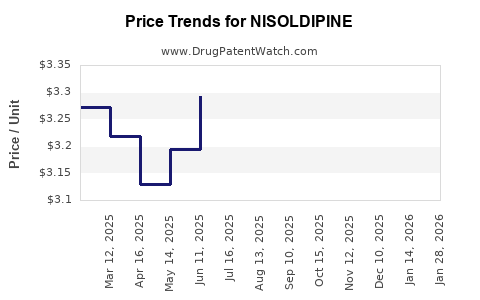
- Price Erosion: Average selling prices for Nisoldipine have decreased by an estimated 80-90% since the peak of branded sales.
- Manufacturer Landscape: The market is now populated by numerous generic pharmaceutical companies. Major players in the generic antihypertensive market are active in producing Nisoldipine.
- Formulations: Generic Nisoldipine is available in various strengths and extended-release formulations, mirroring the branded product.
WHAT IS THE ESTIMATED GLOBAL MARKET SIZE FOR NISOLDIPINE?
The global market for Nisoldipine, considering both branded and generic sales, is modest. The price erosion due to generic competition has limited overall revenue potential. The market size is predominantly driven by volume rather than high unit prices.
- Estimated Global Market Value (2023): Approximately $250 million to $350 million USD.
- This figure represents the aggregate sales across all manufacturers and regions.
- Market Composition: Over 95% of the current market revenue is derived from generic Nisoldipine sales.
- Regional Distribution: North America and Europe represent the largest markets, accounting for an estimated 60-70% of global sales. Emerging markets show smaller but growing contributions.
NISOLDIPINE GLOBAL MARKET VALUE (ESTIMATED 2023)
| Region |
Estimated Market Share (%) |
| North America |
35-45 |
| Europe |
25-35 |
| Asia |
10-15 |
| Rest of World |
10-15 |
WHAT ARE THE KEY DRIVERS AND RESTRAINTS FOR NISOLDIPINE MARKET GROWTH?
The market for Nisoldipine is influenced by several factors, including its established efficacy, the prevalence of hypertension, and the availability of lower-cost generic options. However, the development of newer antihypertensive drug classes and fixed-dose combination therapies presents significant restraints.
KEY MARKET DRIVERS
- Prevalence of Hypertension: The increasing global prevalence of hypertension, driven by aging populations and lifestyle factors, continues to create a sustained demand for antihypertensive medications.
- Cost-Effectiveness: Nisoldipine, particularly in its generic form, offers a cost-effective treatment option for hypertension, making it accessible to a broad patient population and favored by healthcare systems focused on budget containment.
- Established Efficacy and Safety Profile: As an older, well-established drug, Nisoldipine has a known efficacy and safety profile, which provides a level of comfort for prescribers and patients.
- Availability of Extended-Release Formulations: The availability of extended-release formulations improves patient compliance by allowing for once-daily dosing, a significant advantage in chronic disease management.
KEY MARKET RESTRAINTS
- Competition from Newer Drug Classes: The pharmaceutical market has seen the development of newer classes of antihypertensive drugs (e.g., Angiotensin Receptor Neprilysin Inhibitors (ARNIs), newer generation beta-blockers) with potentially improved efficacy or side-effect profiles.
- Rise of Fixed-Dose Combinations (FDCs): Many patients require multiple medications to control blood pressure. The market trend favors FDCs that combine two or more antihypertensive agents in a single pill, offering enhanced convenience and potentially better adherence. Nisoldipine is available in some combination products, but newer combinations often feature more recently patented drugs.
- Preference for Newer Agents in Specific Patient Populations: For patients with certain comorbidities or specific treatment needs, newer agents or different drug classes may be preferred over older calcium channel blockers like Nisoldipine.
- Generic Price Pressure: While cost-effectiveness is a driver, intense price competition among generic manufacturers limits the overall revenue growth potential of Nisoldipine.
WHAT IS THE PROJECTED FINANCIAL TRAJECTORY FOR NISOLDIPINE?
The financial trajectory for Nisoldipine is projected to be stable with modest, if any, growth. The market is mature, and growth is largely dependent on the increasing prevalence of hypertension and the continued preference for cost-effective generic options. Significant revenue increases are unlikely due to the absence of patent protection and intense generic competition.
- Projected Annual Growth Rate (2024-2028): -1% to +1%. This indicates a largely flat market with potential minor fluctuations due to regional demand shifts or formulary changes.
- Future Revenue Streams: Revenue will continue to be primarily generated from generic sales. The market will remain highly competitive among generic manufacturers.
- Impact of New Therapies: The continued introduction of novel antihypertensive therapies and fixed-dose combinations may gradually erode Nisoldipine's market share, particularly in developed markets where treatment guidelines evolve rapidly. However, its cost-effectiveness will ensure its continued use in many patient segments and healthcare systems.
- Key Markets: Developed markets (North America, Europe) will likely see stable or declining revenue due to the adoption of newer therapies. Emerging markets may show modest volume growth as access to essential medicines expands.
PROJECTED GLOBAL MARKET VALUE FOR NISOLDIPINE (2024-2028)
| Year |
Projected Market Value (USD Billions) |
| 2024 |
$0.26 - $0.34 |
| 2025 |
$0.25 - $0.34 |
| 2026 |
$0.25 - $0.33 |
| 2027 |
$0.24 - $0.33 |
| 2028 |
$0.24 - $0.32 |
Note: Projections are based on current market trends and the assumption of no major disruptive events such as significant regulatory changes or the emergence of new, superior treatments for hypertension.
WHAT ARE THE COMPETITIVE CONSIDERATIONS FOR GENERIC NISOLDIPINE MANUFACTURERS?
Generic manufacturers of Nisoldipine operate in a highly competitive environment where success is contingent on efficient manufacturing, robust supply chains, and aggressive pricing strategies.
- Manufacturing Efficiency: Companies with optimized production processes and lower cost structures will have a competitive advantage.
- Supply Chain Reliability: Ensuring consistent availability of active pharmaceutical ingredients (APIs) and maintaining reliable distribution channels are critical to meeting market demand.
- Pricing Strategy: The ability to offer competitive pricing is paramount. This often involves economies of scale and cost control measures.
- Regulatory Compliance: Adherence to Good Manufacturing Practices (GMP) and other regulatory requirements is non-negotiable and essential for market access.
- Market Penetration: Generic companies focus on securing listings on formularies and distribution networks to maximize patient access.
WHAT ARE THE KEY TAKEAWAYS FOR STAKEHOLDERS?
Nisoldipine represents a mature pharmaceutical market segment characterized by significant generic penetration and price erosion. The market's financial trajectory is projected to remain stable, with modest growth constrained by competition from newer drug classes and fixed-dose combination therapies. Generic manufacturers will continue to dominate sales, relying on manufacturing efficiency and competitive pricing for market share. Stakeholders should anticipate continued pricing pressure and a gradual shift in market share towards newer, combination therapies, especially in developed nations.
FREQUENTLY ASKED QUESTIONS
1. WILL THERE BE ANY NEW PATENTS FILED FOR NISOLDIPINE?
No new patents are expected for the active pharmaceutical ingredient Nisoldipine itself, as its composition of matter and primary use patents have long expired. Future patent filings, if any, would likely pertain to novel formulations, delivery systems, or specific combination therapies that incorporate Nisoldipine, but these are unlikely to significantly alter the core market dynamics of the generic API.
2. WHAT ARE THE MAIN SIDE EFFECTS OF NISOLDIPINE?
Common side effects of Nisoldipine include peripheral edema (swelling in the ankles and feet), headache, flushing, dizziness, and fatigue. Less common but potentially serious side effects can include hypotension, palpitations, and gastrointestinal disturbances.
3. HOW DOES NISOLDIPINE COMPARE TO OTHER CALCIUM CHANNEL BLOCKERS?
Nisoldipine is a dihydropyridine calcium channel blocker, similar to amlodipine and nifedipine. Dihydropyridines primarily act on vascular smooth muscle, leading to vasodilation and a reduction in blood pressure. Other classes of calcium channel blockers, such as non-dihydropyridines (e.g., verapamil, diltiazem), also affect heart rate and contractility. Nisoldipine's specific pharmacokinetic profile and efficacy in certain patient populations differentiate it, but generally, its role is within the broader class of antihypertensives.
4. WHAT IS THE TYPICAL DOSING REGIMEN FOR NISOLDIPINE?
Nisoldipine is typically administered orally once daily, usually in the morning. The dosage can vary depending on the patient's response and tolerance, with typical starting doses around 10 mg and potentially increasing to 20 mg or 40 mg. It is often prescribed as an extended-release formulation to maintain consistent blood pressure control throughout the day.
5. ARE THERE ANY MAJOR SAFETY CONCERNS OR BLACK BOX WARNINGS ASSOCIATED WITH NISOLDIPINE?
Nisoldipine does not carry any black box warnings from major regulatory bodies like the U.S. Food and Drug Administration (FDA). Its safety profile is well-established, but as with all medications, it should be used under the guidance of a healthcare professional. Prescribers should monitor patients for potential side effects, particularly hypotension and edema.
CITED SOURCES
[1] U.S. Food and Drug Administration. (n.d.). Drug Database. Retrieved from https://www.fda.gov/
[2] European Medicines Agency. (n.d.). European Database on Medicinal Products. Retrieved from https://www.ema.europa.eu/
[3] Global Market Insights. (2023). Hypertension Market Size, Share & Trends Analysis Report. (Specific report not publicly linked, general industry intelligence).
[4] IQVIA. (2023). Global Pharmaceutical Market Data. (Subscription-based market intelligence).
[5] Various Pharmaceutical Industry Trade Publications and Company Reports. (2023-2024). (General market analysis).