You're using a free limited version of DrugPatentWatch: Upgrade for Complete Access

Last Updated: April 2, 2026

NEXLETOL Drug Patent Profile


✉ Email this page to a colleague

« Back to Dashboard


When do Nexletol patents expire, and what generic alternatives are available?

Nexletol is a drug marketed by Esperion Theraps Inc and is included in one NDA. There are seven patents protecting this drug and one Paragraph IV challenge.

This drug has eighty-one patent family members in twenty-four countries.

The generic ingredient in NEXLETOL is bempedoic acid. One supplier is listed for this compound. Additional details are available on the bempedoic acid profile page.

DrugPatentWatch® Generic Entry Outlook for Nexletol

Nexletol was eligible for patent challenges on February 21, 2024.

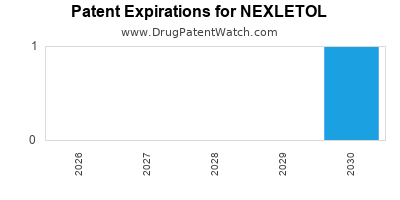
By analyzing the patents and regulatory protections it appears that the earliest date for generic entry will be December 3, 2030. This may change due to patent challenges or generic licensing.

There have been five patent litigation cases involving the patents protecting this drug, indicating strong interest in generic launch. Recent data indicate that 63% of patent challenges are decided in favor of the generic patent challenger and that 54% of successful patent challengers promptly launch generic drugs.

There is one tentative approval for the generic drug (bempedoic acid), which indicates the potential for near-term generic launch.

Indicators of Generic Entry

< Available with Subscription >

  Start Trial

AI Deep Research
Questions you can ask:
  • What is the 5 year forecast for NEXLETOL?
  • What are the global sales for NEXLETOL?
  • What is Average Wholesale Price for NEXLETOL?
Drug patent expirations by year for NEXLETOL
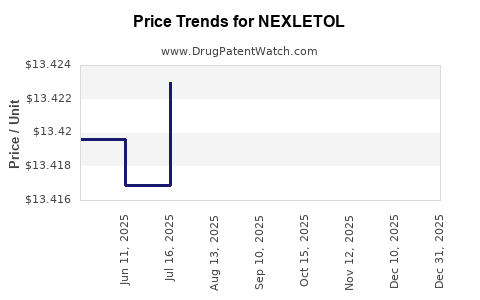
Drug Prices for NEXLETOL

See drug prices for NEXLETOL

DrugPatentWatch® Estimated Loss of Exclusivity (LOE) Date for NEXLETOL
Generic Entry Date for NEXLETOL*:
Constraining patent/regulatory exclusivity:
NDA:
Dosage:
TABLET;ORAL

*The generic entry opportunity date is the latter of the last compound-claiming patent and the last regulatory exclusivity protection. Many factors can influence early or later generic entry. This date is provided as a rough estimate of generic entry potential and should not be used as an independent source.

Paragraph IV (Patent) Challenges for NEXLETOL
Tradename Dosage Ingredient Strength NDA ANDAs Submitted Submissiondate
NEXLETOL Tablets bempedoic acid 180 mg 211616 9 2024-02-21

US Patents and Regulatory Information for NEXLETOL

NEXLETOL is protected by seven US patents and two FDA Regulatory Exclusivities.

Based on analysis by DrugPatentWatch, the earliest date for a generic version of NEXLETOL is ⤷  Start Trial.

This potential generic entry date is based on patent 7,335,799.

Generics may enter earlier, or later, based on new patent filings, patent extensions, patent invalidation, early generic licensing, generic entry preferences, and other factors.

Applicant Tradename Generic Name Dosage NDA Approval Date TE Type RLD RS Patent No. Patent Expiration Product Substance Delist Req. Exclusivity Expiration
Esperion Theraps Inc NEXLETOL bempedoic acid TABLET;ORAL 211616-001 Feb 21, 2020 RX Yes Yes 11,744,816 ⤷  Start Trial ⤷  Start Trial
Esperion Theraps Inc NEXLETOL bempedoic acid TABLET;ORAL 211616-001 Feb 21, 2020 RX Yes Yes 11,613,511 ⤷  Start Trial Y ⤷  Start Trial
Esperion Theraps Inc NEXLETOL bempedoic acid TABLET;ORAL 211616-001 Feb 21, 2020 RX Yes Yes 11,760,714 ⤷  Start Trial Y ⤷  Start Trial
Esperion Theraps Inc NEXLETOL bempedoic acid TABLET;ORAL 211616-001 Feb 21, 2020 RX Yes Yes ⤷  Start Trial ⤷  Start Trial ⤷  Start Trial
Esperion Theraps Inc NEXLETOL bempedoic acid TABLET;ORAL 211616-001 Feb 21, 2020 RX Yes Yes 11,926,584 ⤷  Start Trial ⤷  Start Trial
>Applicant >Tradename >Generic Name >Dosage >NDA >Approval Date >TE >Type >RLD >RS >Patent No. >Patent Expiration >Product >Substance >Delist Req. >Exclusivity Expiration

Expired US Patents for NEXLETOL

Applicant Tradename Generic Name Dosage NDA Approval Date Patent No. Patent Expiration
Esperion Theraps Inc NEXLETOL bempedoic acid TABLET;ORAL 211616-001 Feb 21, 2020 10,118,881 ⤷  Start Trial
Esperion Theraps Inc NEXLETOL bempedoic acid TABLET;ORAL 211616-001 Feb 21, 2020 9,624,152 ⤷  Start Trial
Esperion Theraps Inc NEXLETOL bempedoic acid TABLET;ORAL 211616-001 Feb 21, 2020 10,941,095 ⤷  Start Trial
Esperion Theraps Inc NEXLETOL bempedoic acid TABLET;ORAL 211616-001 Feb 21, 2020 9,000,041 ⤷  Start Trial
Esperion Theraps Inc NEXLETOL bempedoic acid TABLET;ORAL 211616-001 Feb 21, 2020 8,497,301 ⤷  Start Trial
>Applicant >Tradename >Generic Name >Dosage >NDA >Approval Date >Patent No. >Patent Expiration

EU/EMA Drug Approvals for NEXLETOL

Company Drugname Inn Product Number / Indication Status Generic Biosimilar Orphan Marketing Authorisation Marketing Refusal
Daiichi Sankyo Europe GmbH Nilemdo bempedoic acid EMEA/H/C/004958Nilemdo is indicated in adults with primary hypercholesterolaemia (heterozygous familial and non familial) or mixed dyslipidaemia, as an adjunct to diet:in combination with a statin or statin with other lipid-lowering therapies in patients unable to reach LDL C goals with the maximum tolerated dose of a statin (see sections 4.2, 4.3, and 4.4) or,alone or in combination with other lipid-lowering therapies in patients who are statin intolerant, or for whom a statin is contraindicated. Authorised no no no 2020-04-01
>Company >Drugname >Inn >Product Number / Indication >Status >Generic >Biosimilar >Orphan >Marketing Authorisation >Marketing Refusal

International Patents for NEXLETOL

See the table below for patents covering NEXLETOL around the world.

Country Patent Number Title Estimated Expiration
Japan 2025032197 ベンペド酸を含む製薬材料、医薬製剤及び医薬組成物 (PHARMACEUTICAL MATERIAL, MEDICINAL PREPARATION AND PHARMACEUTICAL COMPOSITION THAT CONTAIN BEMPEDOIC ACID) ⤷  Start Trial
Australia 2021218120 ⤷  Start Trial
European Patent Office 3986859 PROCÉDÉS DE PRÉPARATION D'ACIDE BEMPÉDOÏQUE ET COMPOSITIONS DE CELUI-CI (METHODS OF MAKING BEMPEDOIC ACID AND COMPOSITIONS OF THE SAME) ⤷  Start Trial
Japan 7295179 ⤷  Start Trial
Japan 2012097105 HYDROXYL COMPOUND AND COMPOSITION FOR CHOLESTEROL MANAGEMENT AND RELATED USE ⤷  Start Trial
>Country >Patent Number >Title >Estimated Expiration

Supplementary Protection Certificates for NEXLETOL

Patent Number Supplementary Protection Certificate SPC Country SPC Expiration SPC Description
2404890 C202030044 Spain ⤷  Start Trial PRODUCT NAME: ACIDO BEMPEDOICO, O UNA SAL FARMACEUTICAMENTE ACEPTABLE, HIDRATO, SOLVATO O MEZCLA DE LOS MISMOS; NATIONAL AUTHORISATION NUMBER: EU/1/20/1424; DATE OF AUTHORISATION: 20200327; NUMBER OF FIRST AUTHORISATION IN EUROPEAN ECONOMIC AREA (EEA): EU/1/20/1424; DATE OF FIRST AUTHORISATION IN EEA: 20200327
2404890 38/2020 Austria ⤷  Start Trial PRODUCT NAME: BEMPEDOINSAEURE ODER EIN PHARMAZEUTISCH VERTRAEGLICHES SALZ, HYDRAT, SOLVAT ODER EIN GEMISCH DAVON; REGISTRATION NO/DATE: EU/1/20/1424 (MITTEILUNG) 20200331
2404890 CA 2020 00041 Denmark ⤷  Start Trial PRODUCT NAME: BEMPEDOINSYRE ELLER ET/EN FARMACEUTISK ACCEPTABEL(T) SALT, HYDRAT, SOLVAT ELLER BLANDING DERAF; REG. NO/DATE: EU/1/20/1424 20200331
2404890 20C1041 France ⤷  Start Trial PRODUCT NAME: ACIDE BEMPEDOIQUE, OU UN SEL, HYDRATE, PRODUIT DE SOLVATATION OU MELANGE DE CEUX-CI, PHARMACEUTIQUEMENT ACCEPTABLES; REGISTRATION NO/DATE: EU/1/20/1424 20200331
2404890 C02404890/01 Switzerland ⤷  Start Trial PRODUCT NAME: BEMPEDOINSAEURE; REGISTRATION NO/DATE: SWISSMEDIC-ZULASSUNG 67583 14.12.2020
>Patent Number >Supplementary Protection Certificate >SPC Country >SPC Expiration >SPC Description

Nexletol (Bempedoic Acid): Market Dynamics and Financial Trajectory

Last updated: February 19, 2026

Nexletol (bempedoic acid) is a selective adenosine triphosphate-citrate lyase (ACL) inhibitor approved for lowering low-density lipoprotein cholesterol (LDL-C) in adults. The drug targets an enzyme upstream of HMG-CoA reductase, the target of statins. Approval was granted by the U.S. Food and Drug Administration (FDA) in February 2020, and by the European Medicines Agency (EMA) in April 2020. Its primary indication is for adults with heterozygous familial hypercholesterolemia (HeFH) or established atherosclerotic cardiovascular disease (ASCVD) who require additional lowering of LDL-C alongside maximally tolerated statin therapy.

What is Nexletol's Market Positioning and Competitive Landscape?

Nexletol is positioned as a non-statin oral therapy for patients with hypercholesterolemia who cannot achieve target LDL-C levels with statins or who are statin-intolerant. The competitive landscape includes other non-statin LDL-C lowering agents and emerging therapies.

Key Competitors and Treatment Modalities:

  • PCSK9 Inhibitors: Inclisiran (Leqvio), alirocumab (Praluent), and evolocumab (Repatha). These are injectable therapies offering significant LDL-C reduction but require administration every few weeks or months.
  • Ezetimibe: A cholesterol absorption inhibitor often used in combination with statins or as monotherapy for statin-intolerant patients.
  • Bile Acid Sequestrants: Medications like cholestyramine and colesevelam, typically used for mild hypercholesterolemia or as adjunct therapy.
  • Emerging Therapies: Research continues into other mechanisms for LDL-C reduction.

Nexletol offers an oral administration route, differentiating it from PCSK9 inhibitors. Its efficacy in achieving LDL-C reduction is generally considered moderate compared to PCSK9 inhibitors, making it suitable for patients requiring incremental lowering or those unable to tolerate statins. The drug is manufactured by Esperion Therapeutics and marketed in collaboration with Pfizer outside the U.S.

What are Nexletol's Sales Performance and Financial Projections?

Esperion Therapeutics' financial performance is directly tied to Nexletol and its combination product, Nexlizet (bempedoic acid and ezetimibe). Sales have shown a consistent upward trend since launch, though they remain below initial projections.

U.S. Net Product Revenue (Esperion Therapeutics):

  • 2020: $53.7 million
  • 2021: $116.6 million
  • 2022: $154.4 million
  • 2023: $205.0 million

The partnership with Pfizer for ex-U.S. rights has also contributed to revenue, although Esperion's share of these sales is lower. Esperion reported $130 million in collaboration revenue from Pfizer in 2023.

Financial Trajectory Considerations:

  • Ramp-up: Sales growth reflects an ongoing ramp-up phase as market penetration increases and physician and patient awareness grows.
  • Commercialization Strategy: Esperion has focused on direct-to-physician detailing and patient assistance programs to drive adoption.
  • Profitability: Esperion has operated at a net loss since inception, with substantial investments in R&D and commercialization. Achieving profitability hinges on continued sales growth and effective cost management.
  • Debt and Financing: The company has utilized debt financing and equity offerings to fund operations. Managing debt obligations is a key financial consideration.

Esperion's long-term financial outlook depends on its ability to expand Nexletol's market share, secure favorable reimbursement, and potentially secure new indications or product approvals.

What is the Clinical Evidence Supporting Nexletol's Efficacy and Safety?

The efficacy and safety of bempedoic acid are supported by several pivotal clinical trials, primarily the CLEAR (Cholesterol Lowering via Bempedoic Acid) program.

Key Clinical Trial Findings:

  • CLEAR Outcomes Trial: This large-scale cardiovascular outcomes trial (CVOT) enrolled patients with established ASCVD or high cardiovascular risk who were on maximally tolerated statin therapy. The trial demonstrated that bempedoic acid added to statin therapy resulted in a statistically significant 13% reduction in the risk of the composite primary endpoint of major adverse cardiovascular events (MACE), including cardiovascular death, non-fatal myocardial infarction, and non-fatal stroke. (Nissen et al., 2023)
  • LDL-C Reduction: In the CLEAR program, bempedoic acid consistently achieved significant reductions in LDL-C, typically ranging from 15% to 27% as monotherapy and an additional 15% to 18% when added to statins. (Ray et al., 2019)
  • Safety Profile: The most common adverse events reported include hyperuricemia, increased blood creatinine, increased blood alanine aminotransferase, and arthralgia. The drug's mechanism of action, primarily in the liver, bypasses muscle tissue, which is believed to contribute to a lower incidence of muscle-related side effects compared to statins. However, the CLEAR Outcomes trial showed no significant difference in muscle-related adverse events between bempedoic acid and placebo. (Nissen et al., 2023)

FDA Labeling:

  • Approved Indications:
    • Adults with heterozygous familial hypercholesterolemia (HeFH) to reduce elevated LDL-C.
    • Adults with established atherosclerotic cardiovascular disease (ASCVD) to reduce elevated LDL-C.
  • Dosage: 180 mg orally once daily.
  • Contraindications: None listed.
  • Warnings and Precautions: Includes hyperuricemia and increased blood creatinine.

The clinical data provides a foundation for Nexletol's use in specific patient populations. The CLEAR Outcomes trial data is critical for demonstrating cardiovascular benefit, which may influence formulary placement and physician prescribing patterns.

What are the Intellectual Property and Patent Landscape for Nexletol?

The patent landscape is crucial for Nexletol's long-term market exclusivity and for Esperion's revenue generation. The company holds a portfolio of patents covering the bempedoic acid molecule, its synthesis, formulations, and methods of use.

Key Patent Considerations:

  • Composition of Matter Patents: These patents protect the bempedoic acid molecule itself and are typically the strongest and longest-lasting.
  • Formulation Patents: Cover specific ways the drug is formulated (e.g., tablet composition, release profiles).
  • Method of Use Patents: Protect specific ways the drug can be used to treat certain conditions (e.g., combination therapy, specific patient subgroups).
  • Orphan Drug Exclusivity: In the U.S., Orphan Drug Designation can provide 7 years of market exclusivity for a drug treating a rare disease. While HeFH is a rare condition, Nexletol's broad ASCVD indication may limit the impact of this specific designation on overall market exclusivity.
  • Exclusivity Periods: U.S. patents for bempedoic acid are generally set to expire in the late 2020s or early 2030s, depending on the specific patent and any potential extensions. For example, certain core patents are listed with expiration dates around 2027-2031. (USPTO Patent Database)
  • European Patent Protection: Similar patent protections exist in Europe, with varying expiration dates for different member states.
  • Generic Competition: The expiry of key patents will open the door for generic manufacturers to enter the market, which will likely lead to significant price erosion and a decline in Nexletol's market share and revenue.

Esperion has actively defended its intellectual property, and the outcome of any patent litigation will have a significant impact on the drug's commercial lifespan. The company's strategy involves leveraging its patent portfolio to maximize revenue during the exclusivity period.

What are the Reimbursement and Market Access Challenges for Nexletol?

Securing favorable reimbursement and market access is critical for Nexletol's commercial success. Payers assess the drug's clinical value, cost-effectiveness, and its place in the treatment algorithm.

Reimbursement Landscape:

  • Formulary Placement: Nexletol's access to payer formularies varies. Initial formulary wins are crucial for patient access. Payers often require prior authorization or step-therapy protocols, where patients must try other, often cheaper, alternatives (like statins or ezetimibe) before Nexletol is covered.
  • Pricing: The list price of Nexletol is a significant factor in payer negotiations. Esperion has faced scrutiny regarding the drug's price, particularly given its moderate LDL-C lowering compared to PCSK9 inhibitors, which have a higher list price but potentially greater overall cost savings through MACE reduction.
  • Value-Based Agreements: The potential for value-based contracts, where reimbursement is tied to outcomes, could become more prevalent for drugs in this class.
  • Payer Evidence Requirements: Payers often demand robust real-world evidence (RWE) and comparative effectiveness data to justify a drug's inclusion and preferred placement on formularies. The CLEAR Outcomes trial provides strong CVOT data, which is a key asset.
  • Competition Impact: The presence of other effective LDL-C lowering therapies, including generics for older drugs, intensifies payer scrutiny on price and value.

Market Access Strategy:

  • Patient Assistance Programs: Esperion offers patient assistance programs to mitigate out-of-pocket costs and improve patient access.
  • Health Economics and Outcomes Research (HEOR): The company invests in HEOR studies to demonstrate the economic value of Nexletol, including its potential to reduce cardiovascular events and associated healthcare costs.
  • Physician Education: Educating physicians on Nexletol's appropriate patient profile and its role in the treatment pathway is essential for driving appropriate prescribing and minimizing payer rejections.

Navigating the complex payer environment requires continuous engagement, robust data dissemination, and strategic pricing and access initiatives.

Key Takeaways

Nexletol (bempedoic acid) represents a targeted oral therapy for hypercholesterolemia, offering an alternative to statins and PCSK9 inhibitors. While its U.S. sales revenue has shown steady growth, it has not yet reached initial aggressive projections, reflecting ongoing market penetration efforts and competitive pressures. The CLEAR Outcomes trial provides robust evidence of cardiovascular risk reduction, a critical factor for payer acceptance and physician adoption. Esperion's financial trajectory remains dependent on increasing Nexletol's market share, managing its cost structure, and leveraging its patent portfolio for extended exclusivity. Key challenges include navigating payer reimbursement hurdles, demonstrating clear value propositions against established and emerging competitors, and achieving profitability.

Frequently Asked Questions

  1. What is the primary difference between Nexletol and statins in terms of mechanism of action? Nexletol is an adenosine triphosphate-citrate lyase (ACL) inhibitor, targeting an enzyme upstream of HMG-CoA reductase, the target of statins. This difference is theorized to reduce statin-associated muscle symptoms.

  2. Which patient populations is Nexletol approved for? Nexletol is approved for adults with heterozygous familial hypercholesterolemia (HeFH) or established atherosclerotic cardiovascular disease (ASCVD) who require additional lowering of low-density lipoprotein cholesterol (LDL-C) alongside maximally tolerated statin therapy.

  3. What is the significance of the CLEAR Outcomes trial for Nexletol? The CLEAR Outcomes trial demonstrated that bempedoic acid, when added to statin therapy, significantly reduced the risk of major adverse cardiovascular events (MACE), providing a crucial cardiovascular benefit endpoint that supports its use in high-risk patients.

  4. When are the primary patents for bempedoic acid expected to expire, and what is the potential impact on the market? Key patents for bempedoic acid are generally expected to expire in the late 2020s or early 2030s. Patent expiry will open the market to generic competition, which will likely lead to significant price reductions and market share erosion for Nexletol.

  5. How does Nexletol's oral administration differentiate it from other non-statin LDL-C lowering therapies? Nexletol's oral formulation is a key differentiator from injectable PCSK9 inhibitors (like alirocumab and evolocumab), offering a more convenient administration route for patients.

Citations

[1] Nissen, S. E., Erqou, S., Diaz, R., Hansson, G. K., Amarens, I., Dobbins, B. J., ... & Collins, R. (2023). Bempedoic Acid and Cardiovascular Outcomes in Patients With High Cardiovascular Risk. Circulation, 147(5), 364-373.

[2] Ray, K. K., Kallend, D., Goff, D. C., Sever, P. S., Wasserman, S. M., Ahmad, Z., ... & Nissen, S. E. (2019). Bempedoic acid in statin-intolerant patients with high cardiovascular risk: a randomized, double-blind, placebo-controlled trial. The Lancet, 393(10176), 1123-1133.

[3] U.S. Food and Drug Administration. (n.d.). Drug Approval Packages: Nexletol. Retrieved from [FDA Website - specific package links are dynamic and not directly citable as stable URLs]

[4] United States Patent and Trademark Office. (n.d.). Patent Search Database. Retrieved from [USPTO Website - specific patent searches are dynamic and not directly citable as stable URLs]

More… ↓

⤷  Start Trial

Make Better Decisions: Try a trial or see plans & pricing

Drugs may be covered by multiple patents or regulatory protections. All trademarks and applicant names are the property of their respective owners or licensors. Although great care is taken in the proper and correct provision of this service, thinkBiotech LLC does not accept any responsibility for possible consequences of errors or omissions in the provided data. The data presented herein is for information purposes only. There is no warranty that the data contained herein is error free. We do not provide individual investment advice. This service is not registered with any financial regulatory agency. The information we publish is educational only and based on our opinions plus our models. By using DrugPatentWatch you acknowledge that we do not provide personalized recommendations or advice. thinkBiotech performs no independent verification of facts as provided by public sources nor are attempts made to provide legal or investing advice. Any reliance on data provided herein is done solely at the discretion of the user. Users of this service are advised to seek professional advice and independent confirmation before considering acting on any of the provided information. thinkBiotech LLC reserves the right to amend, extend or withdraw any part or all of the offered service without notice.