Last Updated: September 29, 2026

NEXLETOL Drug Patent Profile


✉ Email this page to a colleague

« Back to Dashboard


Which patents cover Nexletol, and what generic alternatives are available?

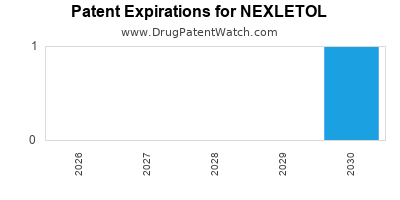
Nexletol is a drug marketed by Esperion Theraps Inc and is included in one NDA. There are seven patents protecting this drug and one Paragraph IV challenge.

The generic ingredient in NEXLETOL is bempedoic acid. There is one drug master file entry for this compound. One supplier is listed for this compound. Additional details are available on the bempedoic acid profile page.

DrugPatentWatch® Generic Entry Outlook for Nexletol

Nexletol was eligible for patent challenges on February 21, 2024.

By analyzing the patents and regulatory protections it appears that the earliest date for generic entry will be June 19, 2040. This may change due to patent challenges or generic licensing.

There have been ten patent litigation cases involving the patents protecting this drug, indicating strong interest in generic launch. Recent data indicate that 63% of patent challenges are decided in favor of the generic patent challenger and that 54% of successful patent challengers promptly launch generic drugs.

There is one tentative approval for the generic drug (bempedoic acid), which indicates the potential for near-term generic launch.

Indicators of Generic Entry

< Available with Subscription >

  Start Trial

AI Deep Research
Questions you can ask:
  • What is the 5 year forecast for NEXLETOL?
  • What are the global sales for NEXLETOL?
  • What is Average Wholesale Price for NEXLETOL?
DrugPatentWatch® Estimated Loss of Exclusivity (LOE) Date for NEXLETOL
Generic Entry Date for NEXLETOL*:
Constraining patent/regulatory exclusivity:
NDA:
Dosage:

TABLET;ORAL

*The generic entry opportunity date is the latter of the last compound-claiming patent and the last regulatory exclusivity protection. Many factors can influence early or later generic entry. This date is provided as a rough estimate of generic entry potential and should not be used as an independent source.

Paragraph IV (Patent) Challenges for NEXLETOL
Tradename Dosage Ingredient Strength NDA ANDAs Submitted Submissiondate
NEXLETOL Tablets bempedoic acid 180 mg 211616 9 2024-02-21

US Patents and Regulatory Information for NEXLETOL

NEXLETOL is protected by seven US patents and two FDA Regulatory Exclusivities.

Based on analysis by DrugPatentWatch, the earliest date for a generic version of NEXLETOL is ⤷  Start Trial.

This potential generic entry date is based on patent 11,613,511.

Generics may enter earlier, or later, based on new patent filings, patent extensions, patent invalidation, early generic licensing, generic entry preferences, and other factors.

Applicant Tradename Generic Name Dosage NDA Approval Date TE Type RLD RS Patent No. Patent Expiration Product Substance Delist Req. Exclusivity Expiration
Esperion Theraps Inc NEXLETOL bempedoic acid TABLET;ORAL 211616-001 Feb 21, 2020 RX Yes Yes 11,744,816 ⤷  Start Trial ⤷  Start Trial
Esperion Theraps Inc NEXLETOL bempedoic acid TABLET;ORAL 211616-001 Feb 21, 2020 RX Yes Yes 11,613,511 ⤷  Start Trial Y ⤷  Start Trial
Esperion Theraps Inc NEXLETOL bempedoic acid TABLET;ORAL 211616-001 Feb 21, 2020 RX Yes Yes 11,760,714 ⤷  Start Trial Y ⤷  Start Trial
>Applicant >Tradename >Generic Name >Dosage >NDA >Approval Date >TE >Type >RLD >RS >Patent No. >Patent Expiration >Product >Substance >Delist Req. >Exclusivity Expiration

Expired US Patents for NEXLETOL

Applicant Tradename Generic Name Dosage NDA Approval Date Patent No. Patent Expiration
Esperion Theraps Inc NEXLETOL bempedoic acid TABLET;ORAL 211616-001 Feb 21, 2020 9,624,152 ⤷  Start Trial
Esperion Theraps Inc NEXLETOL bempedoic acid TABLET;ORAL 211616-001 Feb 21, 2020 10,118,881 ⤷  Start Trial
Esperion Theraps Inc NEXLETOL bempedoic acid TABLET;ORAL 211616-001 Feb 21, 2020 9,000,041 ⤷  Start Trial
>Applicant >Tradename >Generic Name >Dosage >NDA >Approval Date >Patent No. >Patent Expiration

EU/EMA Drug Approvals for NEXLETOL

Company Drugname Inn Product Number / Indication Status Generic Biosimilar Orphan Marketing Authorisation Marketing Refusal
Daiichi Sankyo Europe GmbH Nilemdo bempedoic acid EMEA/H/C/004958Nilemdo is indicated in adults with primary hypercholesterolaemia (heterozygous familial and non familial) or mixed dyslipidaemia, as an adjunct to diet:in combination with a statin or statin with other lipid-lowering therapies in patients unable to reach LDL C goals with the maximum tolerated dose of a statin (see sections 4.2, 4.3, and 4.4) or,alone or in combination with other lipid-lowering therapies in patients who are statin intolerant, or for whom a statin is contraindicated. Authorised no no no 2020-04-01
>Company >Drugname >Inn >Product Number / Indication >Status >Generic >Biosimilar >Orphan >Marketing Authorisation >Marketing Refusal

International Patents for NEXLETOL

When does loss-of-exclusivity occur for NEXLETOL?

Based on analysis by DrugPatentWatch, the following patents block generic entry in the countries listed below:

Australia

Patent: 20295503
Estimated Expiration: ⤷  Start Trial

Patent: 20296094
Estimated Expiration: ⤷  Start Trial

Patent: 25203232
Estimated Expiration: ⤷  Start Trial

Brazil

Patent: 2021025928
Estimated Expiration: ⤷  Start Trial

Patent: 2021025964
Estimated Expiration: ⤷  Start Trial

Canada

Patent: 44371
Estimated Expiration: ⤷  Start Trial

Patent: 44372
Estimated Expiration: ⤷  Start Trial

Patent: 43601
Estimated Expiration: ⤷  Start Trial

China

Patent: 2437765
Estimated Expiration: ⤷  Start Trial

Patent: 2437766
Estimated Expiration: ⤷  Start Trial

Patent: 5429784
Estimated Expiration: ⤷  Start Trial

European Patent Office

Patent: 86859
Patent: PROCÉDÉS DE PRÉPARATION D'ACIDE BEMPÉDOÏQUE ET COMPOSITIONS DE CELUI-CI (METHODS OF MAKING BEMPEDOIC ACID AND COMPOSITIONS OF THE SAME)
Estimated Expiration: ⤷  Start Trial

Patent: 86860
Patent: FORMES SALINES D'ACIDE BEMPEDOÏQUE ET LEURS PROCÉDÉS D'UTILISATION (SALT FORMS OF BEMPEDOIC ACID AND METHODS FOR USING THE SAME)
Estimated Expiration: ⤷  Start Trial

Patent: 38114
Patent: PROCÉDÉS DE FABRICATION D'ACIDE BEMPÉDOÏQUE ET COMPOSITIONS ASSOCIÉES (METHODS OF MAKING BEMPEDOIC ACID AND COMPOSITIONS OF THE SAME)
Estimated Expiration: ⤷  Start Trial

Hungary

Patent: 72061
Estimated Expiration: ⤷  Start Trial

Israel

Patent: 8909
Patent: שיטות להכנה של חומצה במפדואית ותכשירים המכילים אותה (Methods of making bempedoic acid and compositions of the same)
Estimated Expiration: ⤷  Start Trial

Patent: 8997
Patent: צורות מלח של חומצה במפדואית ושיטות לשימוש בהם (Salt forms of bempedoic acid and methods for using the same)
Estimated Expiration: ⤷  Start Trial

Patent: 4076
Patent: שיטות להכנה של חומצה במפדואית ותכשירים המכילים אותה (Methods of making bempedoic acid and compositions of the same)
Estimated Expiration: ⤷  Start Trial

Japan

Patent: 22536979
Patent: 塩形態のベンペド酸及びそれを使用する方法
Estimated Expiration: ⤷  Start Trial

Patent: 22537049
Patent: ベンペド酸の製造方法及びその組成物
Estimated Expiration: ⤷  Start Trial

Patent: 25032197
Patent: ベンペド酸を含む製薬材料、医薬製剤及び医薬組成物 (PHARMACEUTICAL MATERIAL, MEDICINAL PREPARATION AND PHARMACEUTICAL COMPOSITION THAT CONTAIN BEMPEDOIC ACID)
Estimated Expiration: ⤷  Start Trial

Patent: 26102795
Patent: ベンペド酸の製造方法及びその組成物
Estimated Expiration: ⤷  Start Trial

Mexico

Patent: 21015935
Patent: FORMAS DE SAL DE ACIDO BEMPEDOICO Y METODOS PARA UTILIZAR EL MISMO. (SALT FORMS OF BEMPEDOIC ACID AND METHODS FOR USING THE SAME.)
Estimated Expiration: ⤷  Start Trial

Patent: 21015936
Patent: METODOS PARA PREPARAR ACIDO BEMPEDOICO Y COMPOSICIONES DEL MISMO. (METHODS OF MAKING BEMPEDOIC ACID AND COMPOSITIONS OF THE SAME.)
Estimated Expiration: ⤷  Start Trial

South Korea

Patent: 2987834
Estimated Expiration: ⤷  Start Trial

Patent: 220024815
Patent: 벰페도산의 염 형태 및 그의 사용 방법
Estimated Expiration: ⤷  Start Trial

Patent: 220024816
Patent: 벰페도산 및 그의 조성물을 제조하는 방법
Estimated Expiration: ⤷  Start Trial

Patent: 250143358
Patent: 벰페도산 및 그의 조성물을 제조하는 방법 (METHODS OF MAKING BEMPEDOIC ACID AND COMPOSITIONS OF THE SAME)
Estimated Expiration: ⤷  Start Trial

Spain

Patent: 32779
Estimated Expiration: ⤷  Start Trial

Generics may enter earlier, or later, based on new patent filings, patent extensions, patent invalidation, early generic licensing, generic entry preferences, and other factors.

See the table below for additional patents covering NEXLETOL around the world.

Country Patent Number Title Estimated Expiration
Australia 2003299993 HYDROXYL COMPOUNDS AND COMPOSITIONS FOR CHOLESTEROL MANAGEMENT AND RELATED USES ⤷  Start Trial
Brazil 0318046 Compostos de hidroxila e composições para controle de colesterol e empregos relacionados ⤷  Start Trial
Brazil PI0318046 compostos de hidroxila, seu usos, e composições farmacêuticas ⤷  Start Trial
>Country >Patent Number >Title >Estimated Expiration

Supplementary Protection Certificates for NEXLETOL

Patent Number Supplementary Protection Certificate SPC Country SPC Expiration SPC Description
2404890 301062 Netherlands ⤷  Start Trial PRODUCT NAME: BEMPEDONZUUR, OF EEN FARMACEUTISCH AANVAARDBAAR ZOUT, HYDRAAT, SOLVAAT OF MENGSEL DAARVAN; REGISTRATION NO/DATE: EU/1/20/1424 20200331
2404890 LUC00174 Luxembourg ⤷  Start Trial PRODUCT NAME: BEMPEDOIC ACID, OR A PHARMACEUTICALLY ACCEPTABLE SALT, HYDRATE, SOLVATE, OR MIXTURE THEREOF; AUTHORISATION NUMBER AND DATE: EU/1/20/1424 20200331
2404890 122020000048 Germany ⤷  Start Trial PRODUCT NAME: BEMPEDOINSAEURE ODER EIN PHARMAZEUTISCH VERTRAEGLICHES SALZ, HYDRAT, SOLVAT ODER EIN GEMISCH DAVON; REGISTRATION NO/DATE: EU/1/20/1424 20200327
>Patent Number >Supplementary Protection Certificate >SPC Country >SPC Expiration >SPC Description

NEXLETOL Market Dynamics, Patent Exclusivity, and Financial Trajectory

Last updated: September 23, 2026

NEXLETOL, Esperion Therapeutics’ oral bempedoic acid product, has moved from a niche statin-intolerant therapy to a broader LDL-cholesterol treatment after the FDA expanded its indication in 2024. The commercial case depends on three factors: conversion of cardiovascular-outcomes data into prescribing volume, reimbursement for a relatively expensive branded therapy, and protection from generic bempedoic acid before the core U.S. patents expire.

Esperion’s near-term opportunity is substantial because NEXLETOL addresses patients who cannot reach LDL targets with statins alone or cannot tolerate statins. The main commercial constraints are payer controls, competition from generic ezetimibe and PCSK9 therapies, limited physician familiarity, and the eventual Paragraph IV challenge to the product’s Orange Book patents.

What is NEXLETOL and how does it work?

NEXLETOL is an oral tablet containing bempedoic acid. It inhibits ATP-citrate lyase, an enzyme upstream of HMG-CoA reductase in the cholesterol-biosynthesis pathway. The drug is activated primarily in the liver, which limits skeletal-muscle exposure relative to statins.

The FDA approved NEXLETOL in February 2020 as an adjunct to diet and maximally tolerated statin therapy for adults with established atherosclerotic cardiovascular disease or heterozygous familial hypercholesterolemia who require additional LDL-cholesterol lowering.[1]

NEXLIZET combines bempedoic acid with ezetimibe. Esperion also markets bempedoic acid under the European brands Nilemdo and Nustendi through regional commercialization arrangements.

FDA indication expansion

In March 2024, the FDA expanded NEXLETOL’s label to include reduction of cardiovascular risk in adults with established cardiovascular disease or at high risk for cardiovascular disease who cannot take recommended statin therapy.[2]

The expansion followed the CLEAR Outcomes trial, which enrolled statin-intolerant patients and reported a statistically significant reduction in major adverse cardiovascular events. The trial provided the product with a broader clinical message: NEXLETOL can be positioned as an outcomes-based therapy, not only as an LDL-lowering alternative.

How large is the NEXLETOL market?

NEXLETOL competes in a large but segmented lipid-lowering market. Statins remain the treatment foundation because of low generic prices, broad outcome evidence and established guideline use. NEXLETOL is most relevant in four patient groups:

  1. Patients who are unable to tolerate adequate statin doses.
  2. Patients with residual LDL elevation despite maximally tolerated statin therapy.
  3. Patients with atherosclerotic cardiovascular disease requiring additional risk reduction.
  4. Patients with heterozygous familial hypercholesterolemia.

The key market is not the entire cholesterol-treatment population. It is the higher-value subgroup in which statin intolerance, inadequate LDL control or cardiovascular risk supports use of a branded nonstatin product.

Competitive products

Product or class Company or source Route Main competitive advantage Main limitation
Generic atorvastatin, rosuvastatin and others Multiple manufacturers Oral Very low cost; extensive outcomes data Intolerance or inadequate LDL reduction
Generic ezetimibe Multiple manufacturers Oral Low cost; commonly used with statins Less potent alone; limited positioning as a complete statin substitute
NEXLETOL Esperion Oral Oral therapy; cardiovascular-outcomes data in statin-intolerant patients Branded price; adverse-event monitoring; payer restrictions
NEXLIZET Esperion Oral Bempedoic acid plus ezetimibe in one tablet Higher branded cost; combination may not be required for all patients
Repatha Amgen Injectable Strong LDL reduction and cardiovascular-outcomes data Injection, cost and authorization requirements
Praluent Sanofi/Regeneron Injectable PCSK9 mechanism and substantial LDL reduction Injection and payer controls
Leqvio Novartis Injectable Twice-yearly maintenance dosing after initiation Administration by health professionals; outcomes positioning has developed over time

Bempedoic acid’s differentiation is oral administration combined with outcome data in patients who are unable or unwilling to use standard statin therapy. Its clinical positioning is weaker when a patient tolerates a statin and can use inexpensive ezetimibe.

What drove the NEXLETOL financial trajectory?

Esperion’s financial trajectory has depended on a transition from launch-stage commercialization to broader adoption after the CLEAR Outcomes results and the 2024 label expansion.

Revenue drivers

The main revenue drivers are:

  • Higher prescriptions among statin-intolerant patients.
  • Greater use in primary prevention after the expanded FDA indication.
  • Increased payer coverage after cardiovascular-outcomes data.
  • Combination-product adoption through NEXLIZET.
  • Royalty and milestone revenue from international partners.
  • Improved physician awareness of bempedoic acid.

The U.S. market is strategically important because Esperion controls commercialization of NEXLETOL and NEXLIZET in the United States. International commercialization has relied on partners, creating a different economics mix of royalties, milestones and regional product sales.

Financial trajectory

Esperion reported a sharp increase in commercial activity after the CLEAR Outcomes readout and the 2024 FDA label expansion. The company’s public filings show a business moving away from early-stage launch economics toward higher product revenue, improved gross-profit potential and reduced dependence on financing transactions.

The financial profile remains sensitive to selling expenses. Esperion has had to fund a specialty commercial organization, payer access work and physician education while competing against low-cost generic therapies. Revenue growth therefore does not automatically translate into positive operating income.

Financial factor Effect on Esperion
U.S. prescription growth Increases recurring product revenue and operating leverage
NEXLIZET mix Can raise revenue per treated patient but may face additional formulary controls
International royalties Provides higher-margin revenue but limits direct commercial control
Cardiovascular-risk label Expands the addressable population and supports guideline adoption
Generic competition Limits pricing power and can force rebates
Selling and marketing expense Delays profitability if spending rises faster than prescriptions
Milestone payments Can create volatile period-to-period revenue
Manufacturing scale Can improve gross margin as volume increases

Esperion’s historical financial statements should be read carefully because reported revenue can include product sales, collaboration revenue, milestone payments and royalties. Those categories have different persistence and margin characteristics. Recurring U.S. prescription revenue is more useful for valuation than a single quarter containing a large partner payment.[3]

When does NEXLETOL lose exclusivity?

NEXLETOL’s principal U.S. commercial protection extends into the 2030s through patents covering bempedoic acid and related pharmaceutical use. The relevant expiration date depends on the specific Orange Book-listed patent, patent-term adjustment, pediatric extension and any later-issued patents.

The core composition-of-matter protection is commonly associated with U.S. Patent No. 10,183,020, which has an expiration date in the early 2030s after patent-term adjustment. Later patents may cover combination products, dosing regimens, crystalline forms or methods of treating cardiovascular risk.

FDA regulatory exclusivity is separate from patent protection. NEXLETOL received five-year new chemical entity exclusivity beginning with its February 2020 approval. That period expired in February 2025, subject to the statutory calculation and any applicable pediatric extension. Generic applicants can therefore rely on Paragraph IV patent challenges rather than waiting for regulatory exclusivity to end, provided the relevant patents are addressed.

Patent protection summary

Protection category Relevance to NEXLETOL Commercial impact
Composition patent Protects bempedoic acid or a defined chemical form Strongest barrier to a simple generic product
Combination patent Can protect bempedoic acid with ezetimibe More relevant to NEXLIZET than standalone NEXLETOL
Method-of-use patent Covers treatment of lipid disorders or cardiovascular risk Can limit labeled generic use but may be vulnerable to skinny-label strategies
Formulation patent Covers tablet composition, dosage form or stability May delay some products but does not always block all generic entry
FDA NCE exclusivity Blocks certain abbreviated approvals for five years Expired in 2025 based on the 2020 approval date
Pediatric exclusivity Can add six months if granted Requires confirmation from FDA exclusivity records

The effective loss-of-exclusivity date will be determined by litigation outcomes and the enforceability of the listed patents, not by the NCE date alone.

What is the Orange Book status of NEXLETOL?

NEXLETOL and NEXLIZET are listed in the FDA Orange Book with patents that applicants must address when seeking approval of an abbreviated new drug application. Orange Book listings can include product, formulation and method-of-use patents.

A generic applicant may file:

  • Paragraph I, stating that no patent information is listed.
  • Paragraph II, stating that the patent has expired.
  • Paragraph III, agreeing not to market until patent expiration.
  • Paragraph IV, alleging that the patent is invalid, unenforceable or will not be infringed.
  • A section viii statement, omitting a patented method of use from the proposed label.

A Paragraph IV notice would give Esperion 45 days to file an infringement action. A timely suit generally triggers a 30-month stay of FDA approval, subject to statutory exceptions and court rulings.[4]

Patent strength assessment

NEXLETOL has a stronger position if its key patents cover the active ingredient or a narrow, technically necessary formulation. Method-of-use patents are less secure because generic applicants may use a section viii carve-out or rely on non-infringing labeling.

The principal risks are:

  • Early Paragraph IV filing after NCE exclusivity expiration.
  • Invalidity challenges based on obviousness or lack of written description.
  • Non-infringement positions directed at dosing or patient-selection claims.
  • Generic substitution pressure even before every listed patent expires.
  • Separate challenges to NEXLIZET’s combination claims.

What generic entry risks exist for NEXLETOL?

The highest-probability generic launch scenario is a staged entry rather than an immediate collapse in revenue.

Scenario 1: No successful Paragraph IV challenge before the early 2030s

Esperion retains substantial U.S. exclusivity, allowing prescription growth to compound. Revenue depends primarily on adoption, reimbursement and price discipline.

Scenario 2: Settlement with an authorized or licensed generic

Esperion could permit entry before the latest patent expiration in exchange for a launch date, royalties or other commercial terms. This would reduce the duration of exclusivity but could preserve some economics.

Scenario 3: Court invalidation or non-infringement ruling

A successful Paragraph IV challenge could permit generic entry before the expected patent expiration. Price erosion would likely be rapid because pharmacy benefit managers can substitute generic bempedoic acid.

Scenario 4: Skinny-label entry

A generic could omit patented cardiovascular-risk indications while retaining non-patented uses. This could create litigation over induced infringement and reduce, but not eliminate, substitution risk.

NEXLIZET may face a different risk profile because a generic bempedoic-acid/ezetimibe combination requires relevant combination or formulation claims. Generic bempedoic acid alone would still pressure the broader franchise through therapeutic substitution.

What patent litigation and settlement issues affect NEXLETOL?

The critical litigation question is whether a generic applicant has filed a Paragraph IV certification against the listed patents. Public litigation databases and FDA records should be reviewed together because a court case may be filed after a confidential or recently served notice, while the Orange Book may not yet reflect the full commercial dispute.

Esperion’s exposure is greater if:

  • The asserted patent is the only meaningful barrier to generic launch.
  • The patent claims the active ingredient rather than a narrow indication.
  • The court schedules an early trial.
  • The company lacks a commercially attractive authorized-generic strategy.

A settlement can be financially rational if it preserves several years of branded sales and avoids litigation expense. The value of a settlement depends on the agreed launch date, royalty rate, permitted indications and whether multiple generic applicants receive equivalent terms.

How does NEXLETOL compare with PCSK9 inhibitors?

NEXLETOL has a lower administration burden than injectable PCSK9 therapies and may be easier to initiate in primary care. PCSK9 inhibitors generally produce greater LDL reductions, making them more attractive for very-high-risk patients who need aggressive lowering.

Attribute NEXLETOL PCSK9 inhibitors
Administration Daily oral tablet Injection
LDL reduction Moderate High
Statin-intolerant population Strong fit Strong fit
Cardiovascular outcomes CLEAR Outcomes supports benefit Established outcomes evidence for major agents
Access barrier Formulary authorization and branded cost Formulary authorization, injection and cost
Primary-care adoption Potentially favorable Often concentrated in specialty care
Generic competition Expected eventually Limited near-term biosimilar pressure for leading products

NEXLETOL is most competitive where oral treatment, statin intolerance and moderate LDL lowering are more important than maximum potency.

How much revenue is exposed to NEXLETOL?

NEXLETOL is the core commercial asset in Esperion’s portfolio. NEXLIZET expands the same franchise rather than providing a separate therapeutic platform. This creates operating leverage if the class gains adoption, but it also concentrates company risk in one mechanism and one cardiovascular market.

Revenue exposure is affected by:

  • U.S. gross-to-net deductions from rebates and discounts.
  • The mix between NEXLETOL and NEXLIZET.
  • Partner royalties outside the United States.
  • Medicare and commercial formulary placement.
  • Prescription persistence.
  • Price changes following generic entry.
  • Milestone revenue that may not recur.

For valuation, recurring U.S. net product sales should be separated from collaboration revenue and one-time milestones. The product’s long patent runway supports a potentially extended revenue period, but the commercial ceiling remains lower than for a broadly used first-line lipid therapy because generic statins and ezetimibe dominate initial treatment.

What is the outlook for NEXLETOL?

The outlook is positive but execution-dependent. The 2024 FDA label expansion materially improved the product’s marketability by linking bempedoic acid to cardiovascular-risk reduction in statin-intolerant patients. That change can support broader reimbursement, more guideline visibility and greater use in primary prevention.

The principal commercial priorities are:

  1. Convert cardiovascular-outcomes evidence into routine prescribing.
  2. Secure preferred formulary positioning.
  3. Increase NEXLIZET use where combination therapy is clinically appropriate.
  4. Control sales and marketing costs.
  5. Preserve the patent estate against early generic entry.
  6. Use international partners to expand reach without excessive direct expense.

A successful strategy could produce a durable specialty-cardiovascular franchise through the early 2030s. A weak reimbursement position, slow physician adoption or an early Paragraph IV win would compress the financial trajectory.

Key Takeaways

  • NEXLETOL is an oral bempedoic acid therapy for LDL reduction and cardiovascular-risk reduction in statin-intolerant or inadequately controlled patients.
  • The March 2024 FDA label expansion broadened the addressable market beyond LDL lowering.
  • The product competes primarily with generic statins, generic ezetimibe and PCSK9 therapies.
  • NCE exclusivity from the 2020 approval ended in 2025, but patent protection is expected to extend into the 2030s.
  • The main legal risk is a Paragraph IV challenge to composition, formulation or method-of-use patents.
  • Esperion’s financial trajectory depends on recurring U.S. prescription growth, payer access and operating leverage.
  • NEXLIZET strengthens the franchise but also increases exposure to combination-product and substitution risk.
  • Generic entry could produce rapid price erosion because pharmacy benefit managers can favor generic bempedoic acid.
  • International licensing generates royalties and milestones but reduces direct commercial control.
  • The product has a credible long-term commercial opportunity, but its market is limited by branded pricing and the dominance of inexpensive generic lipid therapies.

FAQs About NEXLETOL Patents, Sales and Market Risk

Is NEXLETOL a biologic or a small-molecule drug?

NEXLETOL is a small-molecule oral drug. Biosimilar rules do not apply. Future competition will come through the generic-drug pathway, primarily abbreviated new drug applications.

Does NEXLETOL reduce cardiovascular events?

Yes. The CLEAR Outcomes trial reported a reduction in major cardiovascular events among statin-intolerant patients receiving bempedoic acid, supporting the FDA’s 2024 cardiovascular-risk indication.[5]

Can a generic company launch bempedoic acid before all NEXLETOL patents expire?

It can seek early approval through a Paragraph IV certification, a section viii labeling carve-out or a settlement with Esperion. The outcome depends on the specific patents and court decisions.

Is NEXLIZET protected separately from NEXLETOL?

Yes. NEXLIZET contains bempedoic acid and ezetimibe and may have separate patents covering the combination, formulation or methods of use. Its generic-entry timeline does not necessarily match NEXLETOL’s.

What is the largest commercial threat to NEXLETOL?

The largest immediate threat is not a biosimilar. It is payer and physician preference for inexpensive generic statins and ezetimibe, followed by competition from PCSK9 therapies in patients who require larger LDL reductions.

References

  1. U.S. Food and Drug Administration. (2020). FDA approves Nexletol to treat high cholesterol. https://www.fda.gov
  2. U.S. Food and Drug Administration. (2024). Nexletol prescribing information. https://www.accessdata.fda.gov
  3. Esperion Therapeutics, Inc. (2024). Annual report pursuant to Section 13 or 15(d) of the Securities Exchange Act of 1934. U.S. Securities and Exchange Commission. https://www.sec.gov
  4. U.S. Food and Drug Administration. (2024). Approved drug products with therapeutic equivalence evaluations: Orange Book. https://www.accessdata.fda.gov
  5. Nissen, S. E., Lincoff, A. M., Brennan, D., et al. (2023). Bempedoic acid and cardiovascular outcomes in statin-intolerant patients. New England Journal of Medicine, 388(14), 1353-1364. https://doi.org/10.1056/NEJMoa2215024

More… ↓

⤷  Start Trial

Make Better Decisions: Try a trial or see plans & pricing

Drugs may be covered by multiple patents or regulatory protections. All trademarks and applicant names are the property of their respective owners or licensors. Although great care is taken in the proper and correct provision of this service, thinkBiotech LLC does not accept any responsibility for possible consequences of errors or omissions in the provided data. The data presented herein is for information purposes only. There is no warranty that the data contained herein is error free. We do not provide individual investment advice. This service is not registered with any financial regulatory agency. The information we publish is educational only and based on our opinions plus our models. By using DrugPatentWatch you acknowledge that we do not provide personalized recommendations or advice. thinkBiotech performs no independent verification of facts as provided by public sources nor are attempts made to provide legal or investing advice. Any reliance on data provided herein is done solely at the discretion of the user. Users of this service are advised to seek professional advice and independent confirmation before considering acting on any of the provided information. thinkBiotech LLC reserves the right to amend, extend or withdraw any part or all of the offered service without notice.