Esperion Theraps Inc Company Profile
✉ Email this page to a colleague
What is the competitive landscape for ESPERION THERAPS INC
ESPERION THERAPS INC has two approved drugs.
There are eight US patents protecting ESPERION THERAPS INC drugs.
Summary for Esperion Theraps Inc
| US Patents: | 8 |
| Tradenames: | 2 |
| Ingredients: | 2 |
| NDAs: | 2 |
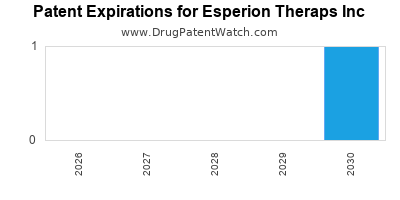
Drugs and US Patents for Esperion Theraps Inc
| Applicant | Tradename | Generic Name | Dosage | NDA | Approval Date | TE | Type | RLD | RS | Patent No. | Patent Expiration | Product | Substance | Delist Req. | Exclusivity Expiration |
|---|---|---|---|---|---|---|---|---|---|---|---|---|---|---|---|
| Esperion Theraps Inc | NEXLIZET | bempedoic acid; ezetimibe | TABLET;ORAL | 211617-001 | Feb 26, 2020 | RX | Yes | Yes | 12,404,227 | ⤷ Start Trial | Y | ⤷ Start Trial | |||
| Esperion Theraps Inc | NEXLETOL | bempedoic acid | TABLET;ORAL | 211616-001 | Feb 21, 2020 | RX | Yes | Yes | 7,335,799 | ⤷ Start Trial | Y | ⤷ Start Trial | |||
| Esperion Theraps Inc | NEXLIZET | bempedoic acid; ezetimibe | TABLET;ORAL | 211617-001 | Feb 26, 2020 | RX | Yes | Yes | 12,398,087 | ⤷ Start Trial | Y | Y | ⤷ Start Trial | ||
| Esperion Theraps Inc | NEXLETOL | bempedoic acid | TABLET;ORAL | 211616-001 | Feb 21, 2020 | RX | Yes | Yes | 11,760,714 | ⤷ Start Trial | Y | ⤷ Start Trial | |||
| Esperion Theraps Inc | NEXLETOL | bempedoic acid | TABLET;ORAL | 211616-001 | Feb 21, 2020 | RX | Yes | Yes | ⤷ Start Trial | ⤷ Start Trial | |||||
| >Applicant | >Tradename | >Generic Name | >Dosage | >NDA | >Approval Date | >TE | >Type | >RLD | >RS | >Patent No. | >Patent Expiration | >Product | >Substance | >Delist Req. | >Exclusivity Expiration |
Expired US Patents for Esperion Theraps Inc
| Applicant | Tradename | Generic Name | Dosage | NDA | Approval Date | Patent No. | Patent Expiration |
|---|---|---|---|---|---|---|---|
| Esperion Theraps Inc | NEXLIZET | bempedoic acid; ezetimibe | TABLET;ORAL | 211617-001 | Feb 26, 2020 | 10,118,881 | ⤷ Start Trial |
| Esperion Theraps Inc | NEXLIZET | bempedoic acid; ezetimibe | TABLET;ORAL | 211617-001 | Feb 26, 2020 | 9,624,152 | ⤷ Start Trial |
| Esperion Theraps Inc | NEXLETOL | bempedoic acid | TABLET;ORAL | 211616-001 | Feb 21, 2020 | 9,624,152 | ⤷ Start Trial |
| Esperion Theraps Inc | NEXLETOL | bempedoic acid | TABLET;ORAL | 211616-001 | Feb 21, 2020 | 10,118,881 | ⤷ Start Trial |
| Esperion Theraps Inc | NEXLIZET | bempedoic acid; ezetimibe | TABLET;ORAL | 211617-001 | Feb 26, 2020 | 8,497,301 | ⤷ Start Trial |
| >Applicant | >Tradename | >Generic Name | >Dosage | >NDA | >Approval Date | >Patent No. | >Patent Expiration |
International Patents for Esperion Theraps Inc Drugs
| Country | Patent Number | Estimated Expiration |
|---|---|---|
| China | 112437766 | ⤷ Start Trial |
| Australia | 2020296094 | ⤷ Start Trial |
| Japan | 6940411 | ⤷ Start Trial |
| South Korea | 102987834 | ⤷ Start Trial |
| Japan | 2018507901 | ⤷ Start Trial |
| >Country | >Patent Number | >Estimated Expiration |
Supplementary Protection Certificates for Esperion Theraps Inc Drugs
| Patent Number | Supplementary Protection Certificate | SPC Country | SPC Expiration | SPC Description |
|---|---|---|---|---|
| 2404890 | C 2020 031 | Romania | ⤷ Start Trial | PRODUCT NAME: ACID BEMPEDOIC, SAU O SARE, HIDRAT, SOLVAT ACCEPTABILE FARMACEUTIC SAU AMESTECUL ACESTORA; NATIONAL AUTHORISATION NUMBER: EU/1/20/1424; DATE OF NATIONAL AUTHORISATION: 20200327; NUMBER OF FIRST AUTHORISATION IN EUROPEAN ECONOMIC AREA (EEA): EU/1/20/1424; DATE OF FIRST AUTHORISATION IN EEA: 20200327 |
| 2404890 | 2020/037 | Ireland | ⤷ Start Trial | PRODUCT NAME: BEMPEDOIC ACID, OR A PHARMACEUTICALLY ACCEPTABLE SALT, HYDRATE, SOLVATE, OR MIXTURE THEREOF; REGISTRATION NO/DATE: EU/1/20/1424 20200331 |
| 2404890 | 2020C/534 | Belgium | ⤷ Start Trial | PRODUCT NAME: ACIDE BEMPEDOIQUE OU UN SEL, HYDRATE, PRODUIT DE SOLVATATION OU MELANGE DE CEUX-CI, PHARMACEUTIQUEMENT ACCEPTABLES; AUTHORISATION NUMBER AND DATE: EU/1/20/1424 20200331 |
| 2404890 | 132020000000112 | Italy | ⤷ Start Trial | PRODUCT NAME: ACIDO BEMPEDOICO, O UN SUO SALE FARMACEUTICAMENTE ACCETTABILE, IDRATO, SOLVATO, O LORO MISCELA(NUSTENDI); AUTHORISATION NUMBER(S) AND DATE(S): EU/1/20/1424, 20200331 |
| 2404890 | 2090035-3 | Sweden | ⤷ Start Trial | PRODUCT NAME: BEMPEDOIC ACID, OR A PHARMACEUTICALLY ACCEPTABLE SALT,HYDRATE,SOLVATE OR MIXTURE THEREOF; REG. NO/DATE: EU/1/20/1424 20200331 |
| >Patent Number | >Supplementary Protection Certificate | >SPC Country | >SPC Expiration | >SPC Description |
Similar Applicant Names
Applicants may be listed under multiple names.
Here is a list of applicants with similar names.
Here is a list of applicants with similar names.
