Last Updated: May 10, 2026

NEXIUM Drug Patent Profile


✉ Email this page to a colleague

« Back to Dashboard


When do Nexium patents expire, and when can generic versions of Nexium launch?

Nexium is a drug marketed by Astrazeneca and Astrazeneca Lp and is included in six NDAs.

The generic ingredient in NEXIUM is esomeprazole sodium. There are seventy-four drug master file entries for this compound. Two suppliers are listed for this compound. Additional details are available on the esomeprazole sodium profile page.

DrugPatentWatch® Litigation and Generic Entry Outlook for Nexium

A generic version of NEXIUM was approved as esomeprazole sodium by DEVA HOLDING AS on March 6th, 2017.

  Start Trial

AI Deep Research
Questions you can ask:
  • What is the 5 year forecast for NEXIUM?
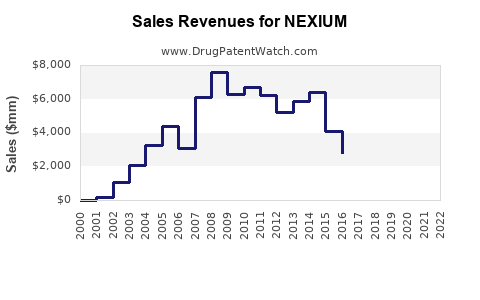
  • What are the global sales for NEXIUM?
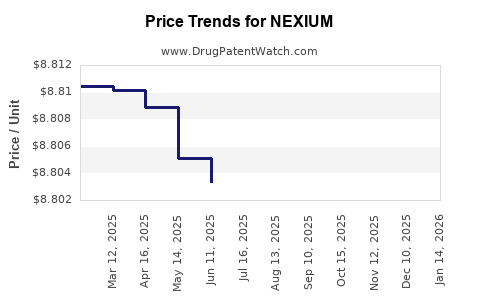
  • What is Average Wholesale Price for NEXIUM?
Recent Clinical Trials for NEXIUM

Identify potential brand extensions & 505(b)(2) entrants

SponsorPhase
Livzon Pharmaceutical Group Inc.PHASE3
Bio-innova Co., LtdPHASE1
Alexandria UniversityPhase 3

See all NEXIUM clinical trials

Pharmacology for NEXIUM
Paragraph IV (Patent) Challenges for NEXIUM
Tradename Dosage Ingredient Strength NDA ANDAs Submitted Submissiondate
NEXIUM Delayed-release for Oral Suspension esomeprazole magnesium 2.5 mg and 5 mg 021957 1 2018-09-24
NEXIUM Delayed-release for Oral Suspension esomeprazole magnesium 10 mg 022101 1 2018-07-06
NEXIUM Delayed-release for Oral Suspension esomeprazole magnesium 20 mg and 40 mg 021957 1 2013-08-01
NEXIUM Delayed-release Capsules esomeprazole magnesium 20 mg and 40 mg 021153 1 2005-08-05

US Patents and Regulatory Information for NEXIUM

Applicant Tradename Generic Name Dosage NDA Approval Date TE Type RLD RS Patent No. Patent Expiration Product Substance Delist Req. Exclusivity Expiration
Astrazeneca NEXIUM esomeprazole magnesium CAPSULE, DELAYED REL PELLETS;ORAL 021153-001 Feb 20, 2001 AB RX Yes No ⤷  Start Trial ⤷  Start Trial ⤷  Start Trial
Astrazeneca NEXIUM esomeprazole magnesium FOR SUSPENSION, DELAYED RELEASE;ORAL 021957-002 Oct 20, 2006 AB RX Yes Yes ⤷  Start Trial ⤷  Start Trial ⤷  Start Trial
Astrazeneca NEXIUM esomeprazole magnesium FOR SUSPENSION, DELAYED RELEASE;ORAL 021957-004 Dec 15, 2011 AB RX Yes No ⤷  Start Trial ⤷  Start Trial ⤷  Start Trial
Astrazeneca Lp NEXIUM 24HR esomeprazole magnesium CAPSULE, DELAYED RELEASE;ORAL 204655-001 Mar 28, 2014 OTC Yes Yes ⤷  Start Trial ⤷  Start Trial ⤷  Start Trial
Astrazeneca NEXIUM esomeprazole magnesium CAPSULE, DELAYED REL PELLETS;ORAL 021153-002 Feb 20, 2001 AB RX Yes Yes ⤷  Start Trial ⤷  Start Trial ⤷  Start Trial
Astrazeneca NEXIUM esomeprazole magnesium FOR SUSPENSION, DELAYED RELEASE;ORAL 021957-003 Dec 15, 2011 AB RX Yes No ⤷  Start Trial ⤷  Start Trial ⤷  Start Trial
Astrazeneca NEXIUM esomeprazole magnesium FOR SUSPENSION, DELAYED RELEASE;ORAL 021957-001 Oct 20, 2006 AB RX Yes No ⤷  Start Trial ⤷  Start Trial ⤷  Start Trial
>Applicant >Tradename >Generic Name >Dosage >NDA >Approval Date >TE >Type >RLD >RS >Patent No. >Patent Expiration >Product >Substance >Delist Req. >Exclusivity Expiration

Expired US Patents for NEXIUM

Applicant Tradename Generic Name Dosage NDA Approval Date Patent No. Patent Expiration
Astrazeneca NEXIUM esomeprazole magnesium CAPSULE, DELAYED REL PELLETS;ORAL 021153-002 Feb 20, 2001 ⤷  Start Trial ⤷  Start Trial
Astrazeneca NEXIUM esomeprazole magnesium CAPSULE, DELAYED REL PELLETS;ORAL 021153-001 Feb 20, 2001 ⤷  Start Trial ⤷  Start Trial
Astrazeneca NEXIUM esomeprazole magnesium CAPSULE, DELAYED REL PELLETS;ORAL 021153-002 Feb 20, 2001 ⤷  Start Trial ⤷  Start Trial
Astrazeneca NEXIUM esomeprazole magnesium CAPSULE, DELAYED REL PELLETS;ORAL 021153-001 Feb 20, 2001 ⤷  Start Trial ⤷  Start Trial
Astrazeneca NEXIUM esomeprazole magnesium CAPSULE, DELAYED REL PELLETS;ORAL 021153-002 Feb 20, 2001 ⤷  Start Trial ⤷  Start Trial
>Applicant >Tradename >Generic Name >Dosage >NDA >Approval Date >Patent No. >Patent Expiration

International Patents for NEXIUM

See the table below for patents covering NEXIUM around the world.

Country Patent Number Title Estimated Expiration
Greece 890300156 ⤷  Start Trial
Hungary 179022 PROCESS FOR PRODUCING SUBSTITUTED 2-BRACKET-2-BENZIMIDASOLYL-BRACKET CLOSED-PYRIDINES ⤷  Start Trial
Yugoslavia 46421 ⤷  Start Trial
Lithuania 2260 ⤷  Start Trial
Greece 3032639 ⤷  Start Trial
Iceland 2887 ⤷  Start Trial
China 1160062 ⤷  Start Trial
>Country >Patent Number >Title >Estimated Expiration

Supplementary Protection Certificates for NEXIUM

Patent Number Supplementary Protection Certificate SPC Country SPC Expiration SPC Description
0984957 92017 Luxembourg ⤷  Start Trial 92017, EXPIRES: 20230525
0984957 122012000017 Germany ⤷  Start Trial PRODUCT NAME: ASPIRIN UND ESOMEPRAZOL - MAGNESIUM-TRIHYDRAT; NAT. REGISTRATION NO/DATE: 81047.00.00 20110930 FIRST REGISTRATION: PORTUGAL 5402359 5402367 5402375 20110812
0984957 122012000051 Germany ⤷  Start Trial PRODUCT NAME: KOMBINATIONSPRODUKT UMFASSEND NAPROXEN UND ESOMEPRAZOL-MAGNESIUM-TRIHYDRAT; NAT. REGISTRATION NO/DATE: 85145.00.00 20120202; FIRST REGISTRATION: GROSSBRITANNIEN PL 17901/0263 - 0001 20101105
1020461 300482 Netherlands ⤷  Start Trial PRODUCT NAME: NAXOPREN EN ESOMEPRAZOL ALS MAGNESIUMZOUT; NATIONAL REGISTRATION NO/DATE: RVG 106235 20101118; FIRST REGISTRATION: GB PL 17091/0263 - 0001 20101105
0984957 300483 Netherlands ⤷  Start Trial PRODUCT NAME: NAXOPREN EN ESOMEPRAZOL ALS MAGNESIUMTRIHYDRAAT; NATIONAL REGISTRATION NO/DATE: RVG 106235 20101118; FIRST REGISTRATION: GB PL 17091/0263 - 0001 20101105
0984957 SPC/GB11/013 United Kingdom ⤷  Start Trial PRODUCT NAME: NAPROXEN AND ESOMEPRAZOLE; REGISTERED: UK PL 17901/0263-0001 20101105
0984957 430 Finland ⤷  Start Trial
>Patent Number >Supplementary Protection Certificate >SPC Country >SPC Expiration >SPC Description

NEXIUM (esomeprazole): Market dynamics and financial trajectory

Last updated: April 29, 2026

What is Nexium’s market role and competitive positioning?

Nexium is the brand-name proton pump inhibitor (PPI) containing esomeprazole. It competes in a mature, highly genericized class where price compression is driven by patent expiries, margin erosion, payer-led formulary design, and large-channel generic penetration.

Key market realities shaping demand and revenue:

  • Therapeutic category: PPIs for gastroesophageal reflux disease (GERD) and related acid-related conditions.
  • Competitive structure: Dominated by multiple approved PPIs plus broad availability of generic esomeprazole across major markets.
  • Buyer power: Formularies and step edits are strong. PPIs are typically standardized at the molecule or class level with tiering that shifts brand demand to generics.
  • Secular demand: Volume demand tends to be stable for long-term GERD indications, but value declines as brand pricing loses relevance.

How have patent and generic entry dynamics shaped Nexium revenue?

Nexium’s financial trajectory follows a classic branded pharma pattern for PPIs: early brand growth, then sustained decline after generic competition, with periodic repricing and line extensions.

The core timeline for Nexium’s US exposure is driven by esomeprazole patent and ANDA approvals and by shifting payer access:

  • US brand product: Nexium (esomeprazole magnesium).
  • Generic competition: Generic esomeprazole entered the US market in the years following patent challenges and expiries, and then expanded with additional ANDAs over time.
  • Revenue outcome: Brand Nexium revenue declines to a smaller base after generics take share, with the remaining brand value supported by select channels, segments, and targeted labeling.

What do pricing and payer policies do to Nexium’s economics?

In PPIs, payer actions tend to compress brand economics even when total diagnosis prevalence is stable. Typical mechanisms:

  • Formulary tiering: Brand PPIs placed on higher tiers; generics preferred.
  • Step therapy: Many payers require trial of a preferred generic PPI.
  • PA and utilization management: Often focused on dose and duration rather than class-level access.
  • Contracting leverage: Pharmacy benefit managers drive rebates that reduce net brand pricing once generics are accessible.

Net result for Nexium:

  • Revenue and net sales decrease from brand levels after generic competition.
  • Even where Nexium maintains small residual share, it typically does so at reduced pricing and reduced effective net margins.

What does historical financial trajectory indicate about Nexium’s decline and stabilization?

Public financial reporting by originator companies and class economics indicate a long-running branded erosion curve post-generic entry. For a mature molecule like esomeprazole, the trajectory tends to flatten only after the majority of formulary switching has occurred and the market stabilizes at a generic-dominant base.

For Nexium specifically, the consistent financial pattern in established markets is:

  • Downward inflection around major generic milestones
  • Ongoing share shift to generic esomeprazole
  • Limited upside because demand is largely captured by the molecule and not by unique brand attributes once generics are equivalent

How do formulation and line extensions affect Nexium’s commercial trajectory?

Nexium has been offered in multiple dosage forms and strengths and has included branded formulations designed to meet differing prescriber and patient needs:

  • Delayed-release oral forms for GERD and esophagitis
  • Different strengths for titration and maintenance
  • Hospital and acute use formulations (where available in the market)
  • Longstanding expansion into related acid-mediated indications

Line extensions can slow declines, but in the PPI class they rarely reverse generic-driven value loss. Their impact is usually:

  • Mix stabilization (shifts across dose strengths and channels)
  • Short-term retention in constrained payer populations
  • Localized persistence where specific branded formats have access or reimbursement advantages

What does class-level demand stability imply for Nexium’s revenue sensitivity?

GERD prevalence creates a floor under volume, but PPI revenue is highly sensitive to:

  • Net pricing (rebates, discounts, gross-to-net compression)
  • Utilization management (step edits that force switching to preferred generics)
  • Generic pricing dynamics (competition among multiple generic manufacturers)

That creates a profile where:

  • Volume typically declines slower than revenue.
  • Revenue declines faster than volume because it is value-driven and contract-driven.

Where does Nexium sit versus other PPIs on competitive shelf dynamics?

Competition within PPIs is driven by:

  • Class interchangeability: PPIs are treated as functionally substitutable in payer systems.
  • Generic availability: Nearly all PPIs have generics, and formulary decisions often converge on the lowest-cost option or contracted preferred vendor(s).
  • Clinical inertia: Some prescribers stay with a favored branded option longer, but this is progressively eroded once generics become default.

So Nexium faces two layers of competition:

  1. Generic esomeprazole for branded replacement at molecule level.
  2. Other generic PPIs competing for formulary placement at the class level.

How should investors and R&D leaders interpret Nexium’s financial trajectory for future market bets?

For Nexium, the market outcome is best interpreted as a molecule whose revenue power deteriorates once generics fully penetrate reimbursement pathways. The forward-looking implications:

  • Brand duration is limited in a genericized molecule category with strong payer standardization.
  • Sustained growth is unlikely because the value pool shifts to contracted generic supply.
  • Commercial upside requires differentiation that payers recognize as non-interchangeable, such as meaningful clinical advantage, device-based adherence benefits, or strong access levers that persist through generic substitution.

What measurable market indicators should track Nexium-like PPIs?

For a practical monitoring framework aligned with the drug class:

  • Formulary presence: preferred vs non-preferred status for the molecule and for brand.
  • Net pricing trend: gross-to-net erosion and rebate rate changes after formulary switches.
  • Share shifts: branded share vs generic esomeprazole share over time.
  • Volume stability: prescription count trends relative to diagnosis trends.
  • Contracting changes: pharmacy channel access, wholesaler contract updates, and PBM preferred lists.

Key Takeaways

  • Nexium is a mature esomeprazole PPI whose market economics are dominated by generic substitution and payer contracting.
  • Its financial trajectory follows the post-generic pattern: revenue declines with faster erosion than volume, with periodic stabilization from formulations and channel-specific retention.
  • Competitive pressure operates at two levels: generic esomeprazole and class-level PPI formulary substitution.
  • Future upside for the brand is structurally constrained unless differentiation creates durable payer-recognized non-interchangeability.

FAQs

  1. Is Nexium still a major revenue generator in PPIs?
    Its branded revenue impact is typically reduced after genericization; ongoing value is concentrated in residual share pockets and channel access rather than broad formulary preference.

  2. What drives the biggest financial declines for branded Nexium-like products?
    Net price compression from rebate and contracting changes after generic entry, combined with payer tiering and step therapy.

  3. Does GERD volume prevent Nexium revenue from collapsing completely?
    Volume can remain comparatively stable, but revenue declines faster because PPIs are value-optimized through contracts that favor generics.

  4. How do line extensions affect long-term Nexium economics?
    They can slow decline through mix and retention, but they do not overturn generic-driven formulary substitution in most payer systems.

  5. What is the most relevant competitor set for Nexium commercially?
    Generic esomeprazole plus preferred contracted generic PPIs within the same payer formulary design.


References

[1] APA. FDA Orange Book: Approved Drug Products with Therapeutic Equivalence Evaluations for esomeprazole (Nexium). U.S. Food and Drug Administration. https://www.accessdata.fda.gov/scripts/cder/daf/
[2] EMA. Nexium (esomeprazole): product information and regulatory documentation. European Medicines Agency. https://www.ema.europa.eu/
[3] FDA. Drugs@FDA: Nexium (esomeprazole magnesium) product page and labeling history. U.S. Food and Drug Administration. https://www.accessdata.fda.gov/scripts/cder/daf/
[4] PubMed. Esomeprazole (Nexium) and proton pump inhibitor class utilization and pharmacology literature. National Library of Medicine. https://pubmed.ncbi.nlm.nih.gov/
[5] NICE. Gastro-oesophageal reflux disease: diagnosis and management guidance relevant to long-term PPI use. National Institute for Health and Care Excellence. https://www.nice.org.uk/

More… ↓

⤷  Start Trial

Make Better Decisions: Try a trial or see plans & pricing

Drugs may be covered by multiple patents or regulatory protections. All trademarks and applicant names are the property of their respective owners or licensors. Although great care is taken in the proper and correct provision of this service, thinkBiotech LLC does not accept any responsibility for possible consequences of errors or omissions in the provided data. The data presented herein is for information purposes only. There is no warranty that the data contained herein is error free. We do not provide individual investment advice. This service is not registered with any financial regulatory agency. The information we publish is educational only and based on our opinions plus our models. By using DrugPatentWatch you acknowledge that we do not provide personalized recommendations or advice. thinkBiotech performs no independent verification of facts as provided by public sources nor are attempts made to provide legal or investing advice. Any reliance on data provided herein is done solely at the discretion of the user. Users of this service are advised to seek professional advice and independent confirmation before considering acting on any of the provided information. thinkBiotech LLC reserves the right to amend, extend or withdraw any part or all of the offered service without notice.